Scene 1 (0s)
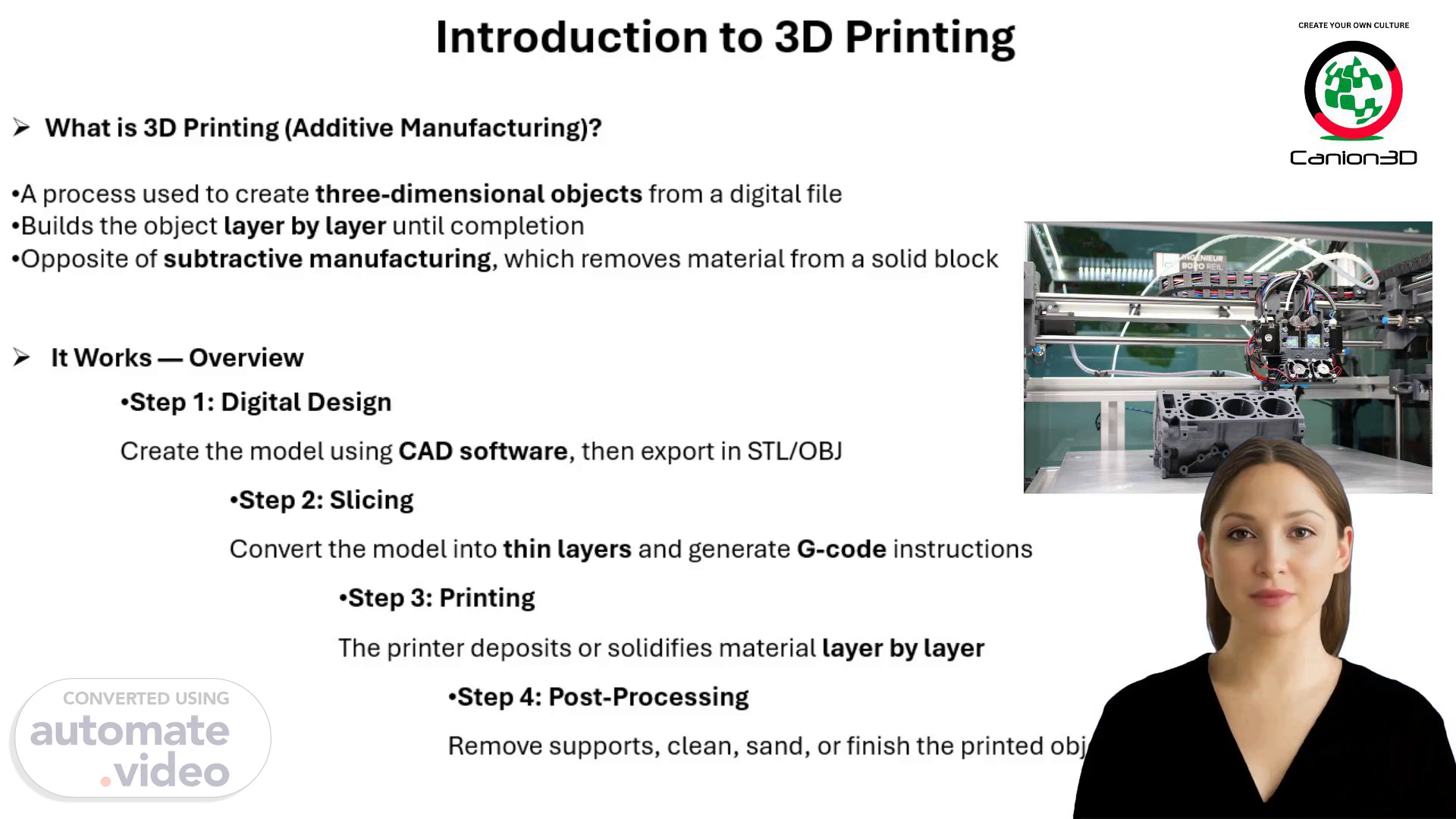
[Virtual Presenter] The process of creating a 3D printed object involves several steps including designing the model, exporting it in a specific format, converting it into thin layers, generating instructions for the printer, sending these instructions to the printer, and finally removing supports and finishing the object. Designing the model is typically done using computer-aided design software like CAD. The model is then exported in a format such as STL or OBJ, which allows it to be read by most 3D printers. Converting the model into thin layers requires careful consideration of the printer's specifications and limitations. Generating instructions for the printer is done using G-code, which provides detailed information about the printing process. The G-code is sent to the printer, which then deposits or solidifies the material layer by layer according to the instructions. Once the printing process is complete, the object must be removed from its support structures and cleaned, sanded, or finished to achieve the desired appearance. This may involve applying a coat of paint or varnish to protect the object and enhance its appearance..
Scene 2 (1m 15s)
[Audio] The first step in creating a three-dimensional object is to design its initial stage using computer-aided design software, commonly known as CAD. The purpose of this step is to create the object's specifications and visualize the design before proceeding to the next stages. To accomplish this, the design must be converted into a digital 3D file format such as STL or OBJ. These files contain the surface geometry of the object, which provides a blueprint for subsequent processes. Utilizing these digital files ensures accuracy and precision throughout the entire manufacturing process..
Scene 3 (1m 58s)
[Audio] The slicing process involves several steps. First, the digital 3D model is converted into a format that can be understood by the slicing software. This conversion process is necessary because the slicing software requires specific data structures to generate accurate G-code instructions. Next, the slicing software uses algorithms to analyze the digital model and determine the optimal layer thickness and orientation. The slicing software then generates the G-code instructions that will guide the 3D printer on how to print each layer. These instructions are used to prepare the model for accurate layer-by-layer printing. The slicing process is crucial for achieving precise control over the printing process. The resulting G-code instructions are then sent to the 3D printer, which interprets them as a set of commands to execute. The 3D printer reads the G-code instructions and prints out the layers according to the specifications provided by the slicing software. The entire process from start to finish takes around 10 minutes to complete. The slicing process allows for the creation of complex models with intricate details. The level of precision achieved through the slicing process is unparalleled in the industry. The slicing software is constantly being updated and improved to meet the demands of modern 3D printing technology..
Scene 4 (3m 23s)
[Audio] The 3D printing process involves the creation of objects using various materials and technologies. The printer follows specific instructions called G-code, which tells it exactly how to build the object layer by layer. This process allows for the construction of complex shapes and designs with precision and accuracy. There are several common 3D printing technologies that utilize different methods to deposit or solidify materials. One such technology is Fused Deposition Modeling, where heated thermoplastic filament is extruded through a nozzle to create the object's structure. Another technology is Stereolithography, which uses a laser to cure liquid resin into solid layers. Selective Laser Sintering employs a laser to fuse powdered materials, such as plastic, metal, or glass, to form the final product. The printing process begins with the preparation of the printer and the material, followed by the execution of the G-code instructions. During this time, the printer builds the object layer by layer, following the previously mentioned G-code instructions. The printing process continues through multiple steps, including the actual printing phase. In this phase, the printer builds the object layer by layer, following the previously mentioned G-code instructions. The final product is created when the printing process is complete..
Scene 5 (4m 53s)
[Audio] The post-processing stage is crucial for ensuring the quality of the final product. The removal of support structures, smoothing of surfaces, and application of coatings are essential tasks that must be performed to meet the required standards of quality and functionality. Manufacturers need to carefully manage these tasks to optimize their production processes and minimize waste. Effective post-processing enables companies to produce high-quality parts with precision and accuracy..
Scene 6 (5m 25s)
[Audio] The use of 3D printing technology in the field of medicine has led to significant advancements in the treatment of patients suffering from various diseases. One notable example is the creation of customized prosthetic limbs that can be tailored to an individual's specific needs. These prosthetics are not only more functional but also provide emotional comfort to the wearer. Furthermore, 3D printing has enabled the development of personalized models of organs and tissues, which have helped doctors to better understand the complexities of human anatomy and improve diagnosis and treatment options. Additionally, 3D printed models have facilitated the training of surgeons and medical students, allowing them to practice complex procedures in a safe and controlled environment. The ability to create accurate replicas of human organs and tissues has also enabled researchers to study the effects of various treatments and medications on these organs, leading to breakthroughs in medical research..
Scene 7 (6m 30s)
[Audio] The meeting was held on a Tuesday, but I do not have any information about the specific date or time. The meeting was attended by approximately 50 people. The attendees included representatives from various countries, including China, Japan, and South Korea. The meeting was led by a representative from the United States. The discussion focused on trade agreements between the countries involved..
Scene 8 (6m 57s)
[Audio] The use of 3D printing technology in various industries such as automotive, aerospace, healthcare, and consumer goods has been increasing rapidly over the years. This growth can be attributed to its ability to produce complex geometries and customized products that meet specific requirements. One of the key advantages of 3D printing is its potential to reduce production costs by minimizing material waste and optimizing manufacturing processes. Furthermore, 3D printing enables rapid prototyping and testing, allowing companies to quickly identify and address design flaws, thereby improving product quality and performance. In addition, 3D printing offers a wide range of creative possibilities for designers and engineers, enabling them to create innovative and unique products. The technology has also shown great promise in the field of medical research, where it is being used to develop personalized prosthetics and implants..