Scene 1 (0s)
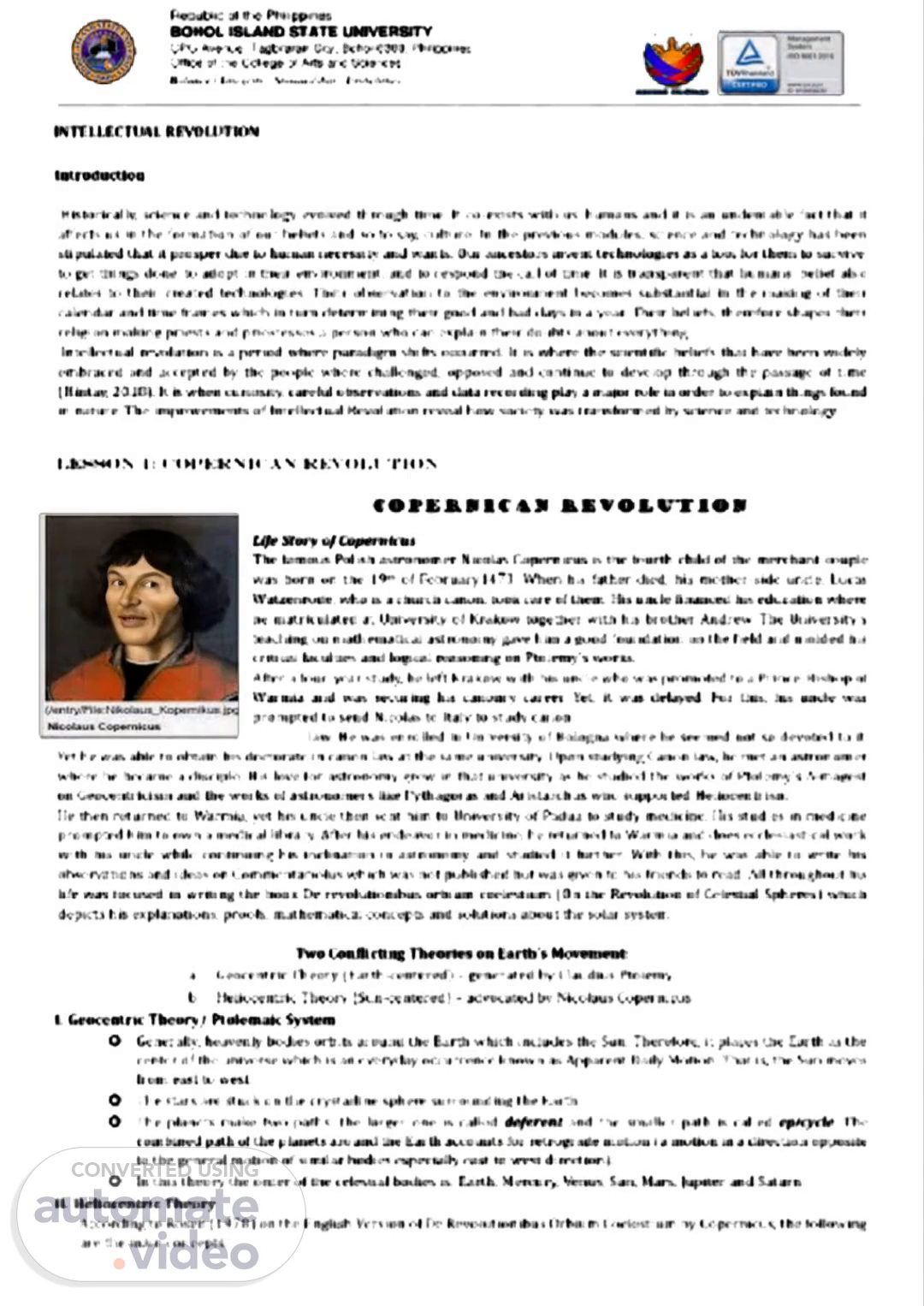
Republic of the Philippines BOHOL ISLAND STATE UNIVERSITY CPG Avenue, Tagbilaran City, Bohol 6300, Philippines Office of the College of Arts and Sciences Balance I Integrity I Stewardship I Uprightness _______________________________________________________________________________________________ INTELLECTUAL REVOLUTION Introduction Historically, science and technology evolved through time. It co-exists with us, humans and it is an undeniable fact that it affects us in the formation of our beliefs and so to say, culture. In the previous modules, science and technology has been stipulated that it prosper due to human necessity and wants. Our ancestors invent technologies as a tool for them to survive, to get things done, to adopt in their environment, and to respond the call of time. It is transparent that humans’ belief also relates to their created technologies. Their observation to the environment becomes substantial in the making of their calendar and time frames which in turn determining their good and bad days in a year. Their beliefs, therefore shapes their religion making priests and priestesses a person who can explain their doubts about everything. Intellectual revolution is a period where paradigm shifts occurred. It is where the scientific beliefs that have been widely embraced and accepted by the people where challenged, opposed and continue to develop through the passage of time (Hintay, 2018). It is when curiosity, careful observations and data recording play a major role in order to explain things found in nature. The improvements of Intellectual Revolution reveal how society was transformed by science and technology. Lesson 1: Copernican Revolution COPERNICAN REVOLUTION Life Story of Copernicus The famous Polish astronomer Nicolas Copernicus is the fourth child of the merchant couple was born on the 19th of February1473. When his father died, his mother-side uncle, Lucas Watzenrode, who is a church canon, took care of them. His uncle financed his education where he matriculated at University of Krakow together with his brother Andrew. The University’s teaching on mathematical astronomy gave him a good foundation on the field and molded his critical faculties and logical reasoning on Ptolemy’s works. After a four-year study, he left Krakow with his uncle who was promoted to a Prince-Bishop of Warmia and was securing his canonry career. Yet, it was delayed. For this, his uncle was prompted to send Nicolas to Italy to study canon law. He was enrolled in University of Bologna where he seemed not so devoted to it. Yet he was able to obtain his doctorate in canon law at the same university. Upon studying Canon law, he met an astronomer where he became a disciple. His love for astronomy grew in that university as he studied the works of Ptolemy’s Almagest on Geocentricism and the works of astronomers like Pythagoras and Aristarchus who supported Heliocentrism. He then returned to Warmia, yet his uncle then sent him to University of Padua to study medicine. His studies in medicine prompted him to own a medical library. After his endeavor in medicine, he returned to Warmia and does ecclesiastical work with his uncle while continuing his inclination in astronomy and studied it further. With this, he was able to write his observations and ideas on Commentariolus which was not published but was given to his friends to read. All throughout his life was focused in writing the book De revolutionibus orbium coelestium (On the Revolution of Celestial Spheres) which depicts his explanations, proofs, mathematical concepts and solutions about the solar system. Two Conflicting Theories on Earth’s Movement: a. Geocentric Theory (Earth-centered) – generated by Claudius Ptolemy b. Heliocentric Theory (Sun-centered) – advocated by Nicolaus Copernicus I. Geocentric Theory/ Ptolemaic System Generally, heavenly bodies orbits around the Earth which includes the Sun. Therefore, it places the Earth as the center of the universe which is an everyday occurrence known as Apparent Daily Motion. That is, the Sun moves from east to west. The stars are stuck on the crystalline sphere surrounding the Earth. The planets make two paths: the larger one is called deferent and the smaller path is called epicycle. The combined path of the planets around the Earth accounts for retrograde motion (a motion in a direction opposite to the general motion of similar bodies especially east to west direction). In this theory the order of the celestial bodies is: Earth, Mercury, Venus, Sun, Mars, Jupiter and Saturn. II. Heliocentric Theory According to Rosen (1978) on the English Version of De Revolutionibus Orbium Coelestium by Copernicus, the following are the main concepts:.
Scene 2 (28s)
[Audio] The concept of the Intellectual Revolution has challenged and changed our scientific beliefs, paving the way for new discoveries and advancements. Today, we will delve into the life of astronomer Nicolas Copernicus, who revolutionized our understanding of the universe. As we explore the revolutionary ideas of Copernicus, let us keep in mind the following key points: Firstly, Copernicus proposed that the center of the universe is not Earth, but rather near the sun. This belief challenged the long-held belief that Earth was the center of the universe. Secondly, the universe was believed to be spherical, with no increase or decrease in size. This challenged the notion of a stagnant and unchanging universe. Thirdly, Copernicus believed that not only is the Earth spherical, but it also rotates on its axis. This explains the phenomenon of stars in the north always remaining in the sky, while stars in the south set. Furthermore, the Earth is perfectly round and its position is maintained by the center of gravity. This is the force that keeps the land and water in place. Moving on, Copernicus observed that the heavenly bodies, including the sun, moon, and five planets, move in circular motion or multiple circles. The apparent irregularities in their motion are a result of the distance from which we observe them. Another important point to note is that the Earth is not the center of the universe. While it may seem stationary when observed from Earth, it is actually rotating with respect to other celestial bodies. Moreover, the time taken for a body to complete its orbit depends on its distance from the object it is orbiting. For example, the moon takes one month to revolve around Earth, while Saturn takes 30 years to revolve around the sun. This also explains the Earth's daily rotation, giving us the cycle of day and night. Finally, Copernicus believed that the distance between Earth and the stars is more quantifiable than the distance between Earth and the sun. This shows that the Earth is just a small part of the vast expanse of the universe. In summary, the revolutionary ideas of Nicolas Copernicus have greatly influenced our understanding of the universe..
Scene 3 (2m 36s)
[Audio] Charles R. Darwin, a naturalist and biologist, is known for his theory of evolution and the process of natural selection. Born in Shrewsbury, England, he joined a five-year survey travel around the world on HMS Beagle as a naturalist in 1831. During this trip, he observed that species differ in size and characteristics, noting these findings as the basis for his theory. In 1859, he published "On the Origin of Species," which revolutionized philosophy in biology, other sciences, and religious thought systems..
Scene 4 (3m 41s)
[Audio] Freud's theories on psychoanalysis greatly transformed the understanding of oneself and human behavior. His concepts of the unconscious mind, repression, and personality structure have significantly impacted modern psychology and remain influential today. The notions of id, ego, and superego developed by Freud have become essential in comprehending human actions and motivations. Furthermore, his work has also influenced various other fields, including literature, art, and philosophy..
Scene 5 (4m 46s)
[Audio] Anxiety is an emotional state that occurs when the id, or our primal desires, overrides the ego, leading to a weakened sense of self and a state of fear known as anxiety. To cope with this anxiety, our minds have developed defense mechanisms, which are techniques used to protect ourselves from unpleasant feelings. The ultimate goal of these defense mechanisms is to make things better and reduce any unwanted emotions. Various dynamic processes make up our defense mechanism, including denial, fantasy, compensation, projection, displacement, sublimation, reaction formation, regression, repression, and suppression. These processes work together to protect us from anxiety and unpleasant feelings..