Scene 1 (0s)
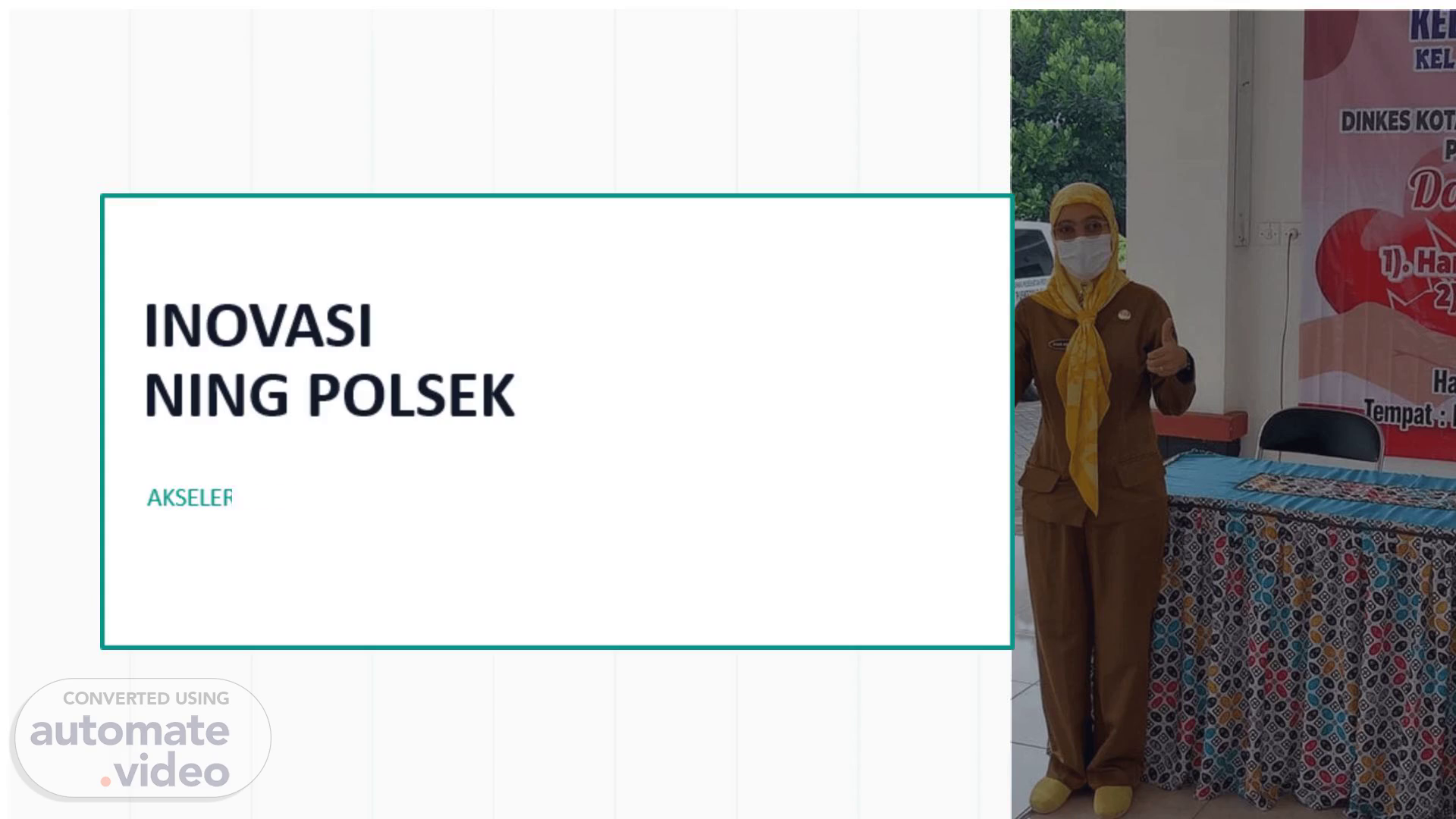
DINKES KOTA 1). Han Hat. INOVASI NING POLSEK. AKSELERASI ELIMINASI TBC MELALUI KOLABORASI LINTAS SEKTOR.
Scene 2 (39s)
[Audio] Improving Participation & Treatment Success Main Objectives Expected Outcomes Strengthening tuberculosis control through synergy of cross sector and integrated programs in the working area of Puskesmas Kandangsapi. Increasing participation of volunteers and cross sector collaboration Expansion of screening coverage for suspected TB cases Increase in cure rate Decrease in TB-related deaths Breaking the chain of transmission in the community Improved quality of life for TB patients Continuing from the introduction, this polsek innovation has a clear main objective. We aim to strengthen TB control through cross sector synergy and integration of programs. We hope that this innovation will increase the participation of volunteers and other sectors. It will also expand TB screening coverage in the community. Ultimately, we want to see an increase in cure and treatment success rates, as well as a decrease in mortality. All of this is to break the chain of TB transmission in the community. Let's further examine the working mechanism of this polsek..
Scene 3 (2m 23s)
[Audio] Ning Polsek Operational Mechanism Proposal Submission: T-B-C officers submit their innovation to the Head of the Health Center. Data Collection: Gathering data from sitb and conducting contact tracing with community cadres. Socialization: Distributing leaflets and screening forms to various programs and sectors. Active Screening: Conducting screenings at integrated health posts, schools, religious boarding schools, and government institutions. Mobilization: Collaborating with military and police officers for referrals of symptomatic patients. So, how does Ning Polsek work in the field? Our workflow is highly structured, starting from data collection to direct interventions. We don't just wait for patients to come to us, but we actively go out and seek them with full support from law enforcement and local community leaders. The process begins with proposal submission, followed by data collection from sitb and contact tracing. We then conduct socialization and distribute screening forms to various sectors. Active screening is then carried out at integrated health posts, boarding schools, schools, and government institutions. We also collaborate with military and police officers to refer symptomatic individuals. This is a comprehensive approach. Now, let's take a look at the advantages of this innovation..
Scene 4 (3m 54s)
[Audio] The Excellence of Innovation at the Police Sub District Strategic Focus across Sectors Discovery of cases in non traditional locations such as schools, Islamic boarding schools, and government institutions (OPD/KODIM). Digital Screening Innovation Implementation of self screening barcodes which facilitate access for the community without having to go through initial physical procedures. Integration of Primary Health Care Services Screening is conducted simultaneously with routine activities such as Prolanis, K-I-A--, and Health Service Clusters. Holistic Approach Combining physical screening methods with mass health education to raise awareness. Real Action in the Education Sector So, what makes this police sub district stand out? One of the main differences is the use of technology and a broad cross sector reach. We focus on discovering cases in non traditional locations such as schools and workplaces. We also implement self screening through barcodes or QR codes, which greatly simplifies access for the community. This screening is also integrated with other routine activities at the primary health care center. This is a holistic approach that combines physical screening with massive health education. All of this is to ensure that nothing is missed. So, what impact does this have on the trend of T-B-C cases?.
Scene 5 (5m 28s)
[Audio] Tuberculosis Case Trends 2023-2-0-2-5 Screening Growth The significant increase from 553 in 2023 to 864 in 2025 indicates an expansion of innovation reach. Effectiveness of Discoveries The increase in screening directly correlates with the rise in active cases discovered and treated. From the data, we can see that since the implementation of this innovation in 2023, the screening numbers have significantly increased. We have observed a significant growth from 553 in 2023 to 864 in 2025. This proves the effectiveness of our expanded screening reach. The increase in screening has a positive correlation with the discovery of active cases that are treated according to standards. This positive trend serves as a strong foundation towards achieving the national T-B-C elimination target by 2030. This is an outstanding achievement. Let us take a closer look at our accomplishments at the beginning of 2026..
Scene 6 (6m 40s)
[Audio] First Quarter Achievement of 2026: Exceeding Target >2000% Screening Achievement Massive Screening: 7901 people screened out of the target of 344. High Accuracy: 247 suspected T-B-C cases were identified (Target: 132). Focus on Children with T-B-C: 4 cases of children were successfully identified and treated. Conclusion: Active collaboration among cadres has proven to be effective in finding hidden cases. After seeing positive trends in previous years, we are now witnessing an extraordinary increase in the First Quarter of 2026. Our screening achievement has exceeded the initial target by over 2000 percent. This is not just a number, but real evidence of hard work and active collaboration in the field. We have successfully identified 247 suspected T-B-C cases, far above the target of 132, demonstrating the accuracy and effectiveness of the program. What is more important, we have also identified and treated four cases of T-B-C in children, reaffirming the criticality of massive screening for vulnerable populations. This achievement shows that we have not only reached the target, but have also exceeded it with significant impact. And this impact is not only limited to numbers, but also extends to broader social aspects..
Scene 7 (8m 25s)
[Audio] Social Impact & Community Empowerment Sectoral Synergy Community Awareness Quality Assurance Succeeded in mobilizing active participation from various institutions to take responsibility for the elimination of T-B-C-. Increasing public understanding of the importance of early detection to create a healthy and productive environment. Providing a sense of security through consistent and standardized services. Realizing a Generation of Excellent, Independent, And T-B-C-Free Successors From the remarkable achievements mentioned earlier, we now turn to the equally important social impact. The police station has successfully mobilized various non health sector institutions to care about T-B-C-. This is not just about treatment, but also about building awareness and collective responsibility in society. We have seen an increase in public understanding of the importance of early detection, which ultimately creates a healthier environment. And with consistent services, we provide a sense of security and prepare a generation of healthy and T-B-C-free successors. This social impact then resonates with the bigger vision, which is our contribution to the President's Asta Cita..
Scene 8 (10m 5s)
[Audio] Contributions to the President's Five Principles Productivity & Welfare of Human Resources Reducing the Financial Burden of the State Accelerating the Elimination of TB 2030 Massive screening and close contact tracing ensure that no cases are missed, breaking the chain of transmission within families. Early detection through Free Health Checks (F-H-C--) prevents loss of work and income, maintaining the economic productivity of the community. Quick interventions in the early stages reduce long term curative costs and significantly decrease the burden on national healthcare facilities. Direct innovations at the polyclinic level contribute directly to the pillar of health reform in the President's Five Principles. With early detection, we maintain the productivity of human resources, prevent loss of work and income for the community. Early interventions are also much more efficient, reducing the financial burden on the state for long term treatment. And most importantly, this massive screening accelerates our efforts towards the national elimination of TB by 2030. This is a concrete step towards strengthening the nation's health resilience. However, the sustainability of this program requires a well thought out strategy..
Scene 9 (11m 38s)
[Audio] Sustainability Innovation Strategy Legal Aspect Budget Support Officially registered in the Mayor of Pasuruan Decision Number 100.3.3.3/281/423.011/2025 as a recognized local innovation institutionally. Financial sustainability is ensured through the 2026 Annual Budget Allocation in the Sub Activity of Tuberculosis Suspected Patient Health Service Management. Social Synergy Managerial Strategy Regular commitment gathering through Monthly and Tri Monthly Mini Workshops with cross program and cross sector participation. Development of consistent regional networks and integration into standard operational procedures (S-O-P) for service in U-P-T Kandangsapi Community Health Centers. We have seen how this innovation aligns with the national vision. Now, let's discuss how the probational police can ensure its long term sustainability. This innovation is not only supported morally, but also legally and financially. The Mayor of Pasuruan's decision officially recognizes the probational police as a local innovation, providing a strong legal foundation. And most importantly, the budget support from the 2026 Annual Budget Allocation guarantees the continuous operation and development of this program. This is not just a temporary project, but a strong institutional commitment. With this solid foundation, we are ready to move forward with the implementation in the field..
Scene 10 (13m 27s)
[Audio] Implementation of activities by the Polsek Field Ckg Program Pondok & School Integration with Free Health Checks (C-K-G--) for school children to ensure free growth and development from T-B-C-. Routine screenings at Pondok Pesantren Al Muttaqin in Bugullor Village for early detection in crowded environments. Collaboration with Authorities Village Services Implementation of screenings at kodim 0819 Kota Pasuruan and Polsek Bugul Kidul as a form of synergy between security and health. Active screenings in Pekuncen Village in cooperation with P-M-I to reach the grassroots level. After understanding our sustainability strategy, let's see how the Polsek takes direct action in the field. We are not just planning, but also implementing with a broad and inclusive reach. Our routine screenings are conducted at pesantren and schools, reaching vulnerable and crowded populations. We also closely collaborate with security authorities such as Polsek and Kodim, demonstrating tangible cross sector synergy. And of course, working with the village and P-M-I ensures that we reach people at the grassroots level. This is all evidence of our commitment. Now, let's sum up and look at our future plans..
Scene 11 (14m 54s)
[Audio] Conclusions & Future Plans Summary of Achievements Strategic Roadmap The police sector has proven that cross sector collaboration is the key to discovering cases of T-B-C. Full Digitalization: Integration of real time application based screening reporting system. Empowering Cadres: Strengthening the role of cadres as the front line in early detection at the neighborhood level. Massive screening improvements are directly correlated to the success of patient treatment. Private Sector Partnership: Expanding collaboration with industries and companies in the working area. Institutional and legal support ensures the long term sustainability of innovation. Achieving T-B-C Free Kandangsapi Health Center by 2030 In conclusion, the police sector has proven that cross sector collaboration is the key to discovering cases of T-B-C. Massive screening improvements are directly correlated to the success of patient treatment, and institutional support ensures the sustainability of this innovation. Moving forward, we will fully digitalize the screening reporting system, strengthen the role of cadres as the front line, and expand partnerships with the private sector. Our vision is clear: to achieve a T-B-C free Kandangsapi Health Center by 2030. This is an ambitious goal, but with the collaborative spirit of the police sector, we are confident we can achieve it..