Scene 1 (0s)
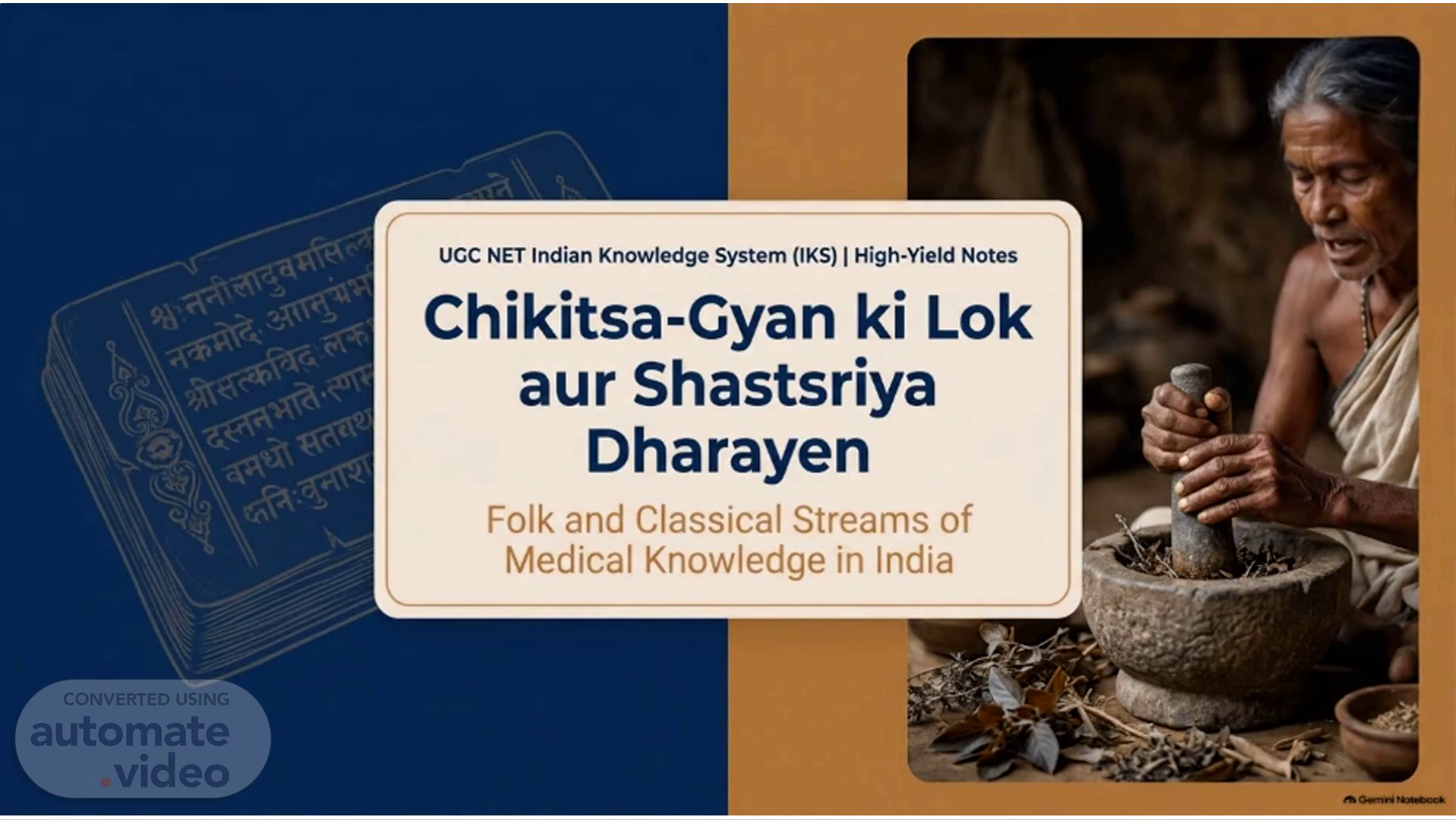
UCC NET Indian Knowledge System (IKS) I High-Yield Notes Chikitsa-Gyan ki Lok aur Shastsriya Dharayen Folk and Classical Streams of Medical Knowledge in India.
Scene 2 (2m 38s)
[Audio] The Indian Knowledge System (IKS) encompasses various forms of traditional knowledge including medicine, agriculture, architecture, and spirituality. The IKS has evolved over time, influenced by cultural exchange and migration. The two main streams of knowledge are the Great Tradition and the Little Tradition. The Great Tradition consists of classical branches of medical knowledge such as Ayurveda, Siddha, and Unani. These are based on written texts and have been passed down through the traditional university system. The Little Tradition focuses on oral, community-based, and local ecological knowledge. This includes practices and remedies passed down through generations based on their experiences and observations. Both streams are interconnected and contribute to the richness of the IKS. The IKS is characterized by its holistic approach to health and wellness, emphasizing the importance of balance and harmony between physical, mental, and spiritual aspects. The IKS has been recognized as a valuable resource for promoting public health and well-being. Its unique characteristics make it an attractive option for those seeking alternative approaches to healthcare. The IKS continues to evolve, incorporating new ideas and perspectives while maintaining its core principles. The integration of Western medicine with traditional knowledge has led to the development of hybrid systems. Hybrid systems combine elements from both Western and traditional knowledge to provide comprehensive care. The IKS has been studied extensively in recent years, and research has highlighted its potential benefits for improving health outcomes. The IKS offers a range of benefits, including improved health outcomes, enhanced well-being, and increased resilience. The IKS has been successfully implemented in various settings, including rural communities and urban centers. The IKS has the potential to address global health challenges, such as infectious diseases and chronic conditions. The IKS provides a framework for understanding the complex relationships between human health and the environment. The IKS has been recognized as a key component of sustainable development. The IKS has the potential to promote cross-cultural understanding and cooperation. The IKS offers a unique perspective on health and wellness, one that emphasizes the interconnectedness of physical, mental, and spiritual aspects. The IKS has been studied extensively, and research has highlighted its potential benefits for improving health outcomes. The IKS has the potential to address global health challenges, such as infectious diseases and chronic conditions. The IKS provides a framework for understanding the complex relationships between human health and the environment. The IKS has been recognized as a key component of sustainable development..
Scene 3 (5m 54s)
[Audio] The two main streams of medical knowledge in India are Shastriya Chikitsa and Lok Chikitsa. These two streams are compared and analyzed to understand their differences and similarities. The first parameter considered is the source of knowledge. Shastriya Chikitsa is derived from written texts such as Charak and Sushrut, while Lok Chikitsa is passed down through oral traditions like songs and stories. This difference in source of knowledge affects the underlying principles that govern each stream. Shastriya Chikitsa follows the Tridosha and Panchamahabhuta principles, while Lok Chikitsa relies on trial and error methods based on personal experiences. The second parameter is the training aspect. Shastriya Chikitsa is taught in traditional institutions like Gurukuls and BAMS, whereas Lok Chikitsa is learned within families and communities through observation and experience. The way medicine is used is also a differentiator between these streams. Shastriya Chikitsa mainly uses standardized formulations, while Lok Chikitsa utilizes fresh herbs and local remedies like kadhas and lepas. Accessibility is another key area where these streams diverge. Shastriya Chikitsa is more prevalent in urban areas and is typically expensive, whereas Lok Chikitsa is commonly practiced in rural areas and is generally more affordable. In conclusion, the comparison between Shastriya and Lok Chikitsa reveals the diversity in the Indian medical knowledge system. Each stream has its unique strengths and weaknesses, making them both essential for overall healthcare in the country..
Scene 4 (7m 41s)
[Audio] The importance of ethnobotany in India cannot be overstated. Ethnobotany in India is a big and rich tradition that is connected to many indigenous communities and their medicinal plants. This tradition helps us understand the plant diversity of India and identify the medicinal plants among them. It provides valuable information about the richness of India's plant diversity and the identification of medicinal plants among them..
Scene 5 (8m 8s)
[Audio] The Irula tribe from Tamil Nadu and Kerala has been known for their expertise in venom extraction, with a significant contribution to the modern anti-venom industry. Their traditional practice of extracting venom from certain snakes, such as the saw-scaled viper, has been passed down through generations. The Irula people have also developed unique techniques for cold-resistant treatments, using plants like kutki and brahma kamal. In addition, they have a strong tradition of herbal medicine, combining spiritual practices with natural remedies. The Bhil tribe, on the other hand, relies heavily on plant-based remedies, using specific plants to treat skin conditions and other ailments. The Gond people have developed unique methods for treating fever, using natural substances found in the forest. Finally, the Santhal tribe has a rich tradition of combining spiritual practices with herbal remedies, using the 'ojha' method to treat various health issues. These indigenous tribes have preserved their traditional medical practices, passing them down through generations, and continue to contribute to modern healthcare..
Scene 6 (9m 21s)
[Audio] The kitchen pharmacy refers to the traditional remedies used in everyday life, often passed down through generations. These remedies include Khansi-Jukam, where a mixture of herbs such as Arkad-Tulsi-Shahad is used to treat various ailments. Ghav/Sujan also plays a significant role, with ingredients like Haldi-lep and Aloe Vera being used to soothe and heal. In terms of digestion, Ajwain, Heeng, Jeera, and Saunf are commonly used spices. For joint pain, Sarson/Til tel malish and Ajwain-potli senk are popular treatments. Interestingly, there has been scientific validation for some of these traditional remedies, such as Haldi-lep, which contains Curcumin, a compound with anti-inflammatory properties. This highlights the importance of recognizing and valuing our traditional knowledge systems..
Scene 7 (10m 22s)
[Audio] The Bone-Setter uses Sparsh-aadharit nidan to diagnose fractures. This technique involves palpatory diagnosis using touch. The Bone-Setter relies on manual examination of the patient's hands to diagnose fractures. The Bone-Setter applies herbal remedies such as turmeric and neem to treat fractures. The Bone-Setter uses manual reduction and splints made from bamboo or wood to treat fractures. The Bone-Setter passes down their skills to younger generations..
Scene 8 (10m 52s)
[Audio] The traditional birth attendants are trained to provide care to pregnant women and new mothers through various methods including herbal remedies, massage, and spiritual practices. These methods have been used for centuries and are deeply rooted in local cultures. The training programs for traditional birth attendants focus on providing skills such as midwifery, obstetrics, and newborn care. The training includes both theoretical and practical aspects, covering topics like fetal development, labor management, and postpartum care. The training also covers the use of herbal remedies, massage techniques, and spiritual practices to promote health and well-being..
Scene 9 (11m 36s)
[Audio] The traditional practice of Poison Healer, also known as Vish-Vaidya, has been an integral part of India's medical landscape for centuries. These skilled practitioners have developed a unique three-tier treatment system to address various health issues. The first tier, physical, involves applying pressure on specific bite sites to prevent further venom entry. The second tier, herbal, utilizes locally-sourced plants to create antidotes and treatments. The third tier, psychological, employs mantras and assurances to calm patients' fears and reduce their heart rate. This balanced approach highlights the importance of both conventional and alternative medicine in modern healthcare. By recognizing the contributions of Vish-Vaidyas, we can better understand the rich cultural heritage of India's traditional medical practices..
Scene 10 (12m 31s)
[Audio] The institutions mentioned in this slide are crucial for preserving traditional knowledge and preventing biopiracy. The Traditional Knowledge Digital Library (TKDL) was established in 2001. It aims to digitize local and classical knowledge to prevent unauthorized use. On the other hand, the Forest Research Laboratory and Hospital Trust (FRLHT) was founded in 1993. It has been instrumental in documenting and standardizing traditional health practices and medicinal knowledge. These efforts have helped safeguard India's rich cultural heritage and promote sustainable development. By supporting these initiatives, we can ensure the continued preservation of our collective knowledge and promote equitable access to its benefits..
Scene 11 (13m 22s)
[Audio] The traditional folk medicine practices in India have been facing numerous challenges. Lok Chikitsa, which refers to traditional folk medicine, has been declining rapidly due to globalization and urbanization. Many people are turning away from traditional medicine because of its perceived limitations. The decline of traditional medical knowledge is attributed to a lack of scientific validation. The erosion of knowledge, known as Gyan ka Ksharan, is a significant threat to traditional folk medicine. The loss of traditional medical knowledge is not limited to the knowledge itself but also affects the livelihoods of practitioners and communities. The rights of indigenous communities over their forests are being compromised, limiting access to medicinal plants. Individual patents on community knowledge are problematic, as they can restrict access to traditional medicines. The challenges faced by traditional folk medicine are complex and multifaceted..
Scene 12 (14m 23s)
[Audio] The traditional medical practices in India encompass both Great and Little traditions. The Great tradition includes Ayurveda, Siddha, and Unani, which have been documented in written texts and recognized by universities worldwide. In contrast, the Little tradition consists of folk and community-based knowledge, passed down through generations, often rooted in local ecology and ethnobotany. This dichotomy highlights the complexity of indigenous knowledge systems, where traditional practices coexist with modern scientific validation. The UGC NET exam recognizes this diversity, offering points for understanding both streams of medical knowledge. For instance, the Irula tribe's specialty in snake venom extraction and the use of curcumin in medicine demonstrate the richness of tribal knowledge. Furthermore, the TKDL classification system acknowledges the importance of traditional knowledge resources. The UNESCO term for folk knowledge emphasizes its intangible nature, making it essential to preserve and promote these cultural heritage sites. By recognizing the value of both Great and Little traditions, we can work towards a more inclusive and holistic approach to healthcare..