Scene 1 (0s)
2025: NSO eæezr-alütarazrz, OOPE, 3åz a-nza (AB-PMJAY) (NSO) 2025 GS Paper 2: GS Paper 3: 1110 tqotebookLM.
Scene 2 (52s)
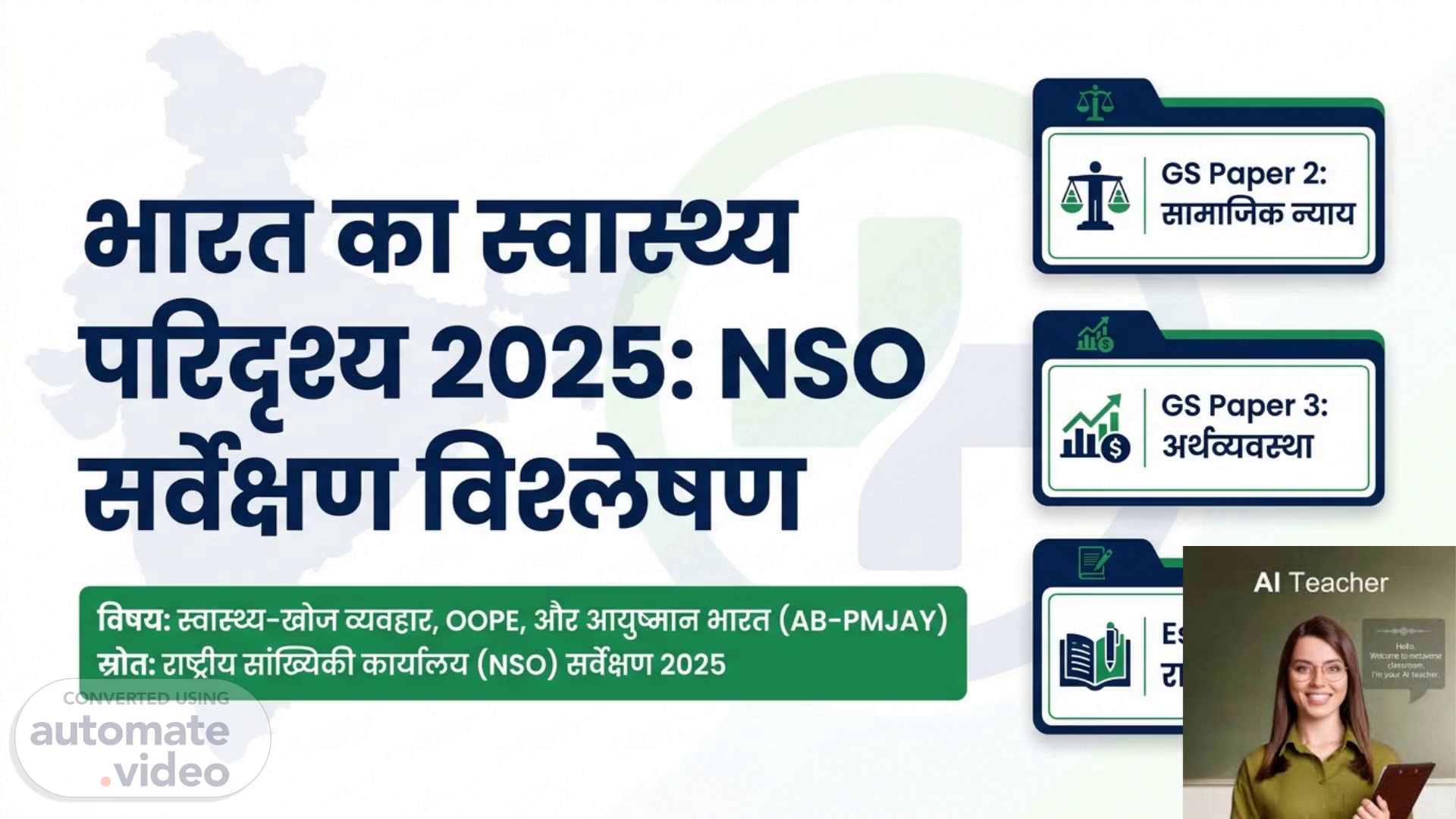
[Audio] We will discuss the National Statistical Office (NSO) and its plans for the year 2025, specifically focusing on improving access and lowering medical costs through the Ayushman Bharat Pradhan Mantri Jan Arogya Yojana (AB-PMJAY). The NSO has recently gained attention for its ambitious plans to improve the healthcare sector in our country. Its objectives include enhancing infrastructure, expanding medical facilities, and increasing access to healthcare services in rural and underprivileged areas. In addition, the NSO aims to reduce the rising costs of medical treatment through effective measures. This includes implementing the AB-PMJAY, a national health insurance scheme that aims to provide financial protection for over 10 crore families in India, covering up to Rs. 5 lakh per family per year for secondary and tertiary care hospitalization. For those preparing for the UPSC exams, it is essential to have a thorough understanding of the NSO and its plans for 2025, as this topic falls under GS Paper 2 and 3. In summary, the NSO's focus for 2025 is on improving access and reducing medical costs through the AB-PMJAY scheme. We hope this has provided an overview of what to expect from the NSO in the coming years. Now, let's move on to the next slide for further details..
Scene 3 (2m 32s)
[Audio] Today in class, we will be discussing the National Statistical Office's (NSO) projections for the year 2025. Our focus will be on the key highlights of this report, specifically in regard to the health and development sector. In slide number three, the NSO's predicted numbers for institutional deliveries in 2025 shows an estimated 95.6% of deliveries taking place in institutional settings, a significant increase from the current rate of 80.6%. Another highlight is the projected out-of-pocket expenditure (OOPE) in the health sector, which is predicted to decrease to 11% in 2025 from the current rate of 12.2%. This indicates improved access to healthcare and increased financial protection for individuals. The report also suggests a significant increase in outpatient department (OPD) visits, with a projected number of 3 visits per person per year in 2025. This shows a positive trend towards better utilization of healthcare services. Furthermore, the report predicts that 45.5% of the population will have health insurance coverage and 31.8% will have access to the government's flagship health insurance scheme, Ayushman Bharat-Pradhan Mantri Jan Arogya Yojana (AB-PMJAY) by 2025. Lastly, the estimated percentage of population covered under the Public Private Partnership (PPP) model is projected to be 1% in 2025. These projections by the NSO highlight the progress we are making towards a healthier and more developed society. Awareness of these statistics is important for students in higher education as we can use them to contribute towards the betterment of our country. Let's now move on to the next slide..
Scene 4 (4m 35s)
[Audio] The proportion of population reporting ailments (PPRA) is an indicator of the health status of a population. It provides valuable information on the prevalence of diseases and overall health of a community. The out-of-pocket expenditure (OOPE) is the healthcare expenses that individuals pay out of their own pockets. It includes both direct and indirect costs, such as medical consultations, medicines, and transportation to healthcare facilities. Direct OOPE is the money paid directly for healthcare services, while indirect OOPE includes the opportunity cost of time spent seeking healthcare and the loss of income due to illness. Both of these types of OOPE can have a significant impact on the financial well-being of individuals and households. PPRA can help us identify the areas that require attention and address them effectively. Moreover, OOPE affects the health-seeking behavior of individuals and their ability to seek timely and appropriate care. Understanding the concept of PPRA is essential for identifying the health issues in a population and addressing them accordingly. The out-of-pocket expenditure has a significant impact on the accessibility of healthcare services. It can lead to delayed diagnosis and treatment if individuals cannot afford the necessary treatments. Therefore, it is crucial to consider the impact of OOPE when formulating policies related to healthcare..
Scene 5 (6m 15s)
[Audio] The National Statistical Office (NSO) plays a vital role in the healthcare sector. The NSO provides accurate and timely data related to health expenditure, treatment outcomes, and other important healthcare indicators. This data helps the government in making informed decisions and policy changes to ensure financial protection for all citizens. The NSO supports the government in identifying gaps and challenges in the health sector. By collecting and analyzing data, the NSO enables the government to make necessary interventions and improvements to ensure that every citizen has access to affordable and quality healthcare. The NSO's data helps mitigate catastrophic health expenditures. Individuals and families often face catastrophic health expenditures due to medical emergencies or chronic illnesses, which can push them into poverty. However, with the accurate data provided by the NSO, the government can develop effective strategies to reduce the burden of healthcare expenses. The NSO's data contributes to a behavioral shift in society. By understanding the healthcare patterns and preferences of individuals, the government can develop targeted campaigns and programs to promote healthier lifestyles and prevent illnesses. According to the NSO, in rural areas of India, 31.8% of households face catastrophic health expenditures, while in urban areas, it is 45.5%. However, with the help of the NSO's data and the Ayushman Bharat-Pradhan Mantri Jan Arogya Yojana (AB-PMJAY), the government aims to reduce these numbers to 10% and 0% respectively by 2025. In conclusion, the NSO's role and significance in the Ayushman Bharat-Pradhan Mantri Jan Arogya Yojana (AB-PMJAY) cannot be overstated. Through its data and analysis, the NSO ensures financial protection for all citizens and contributes to a healthier and more prosperous society..
Scene 6 (8m 27s)
[Audio] The National Statistical Office (NSO) has developed a comprehensive healthcare strategy which includes the National Health Stack and Ayushman Bharat-Pradhan Mantri Jan Arogya Yojana (AB-PMJAY). However, the key element of this strategy is the development of healthcare infrastructure. A strong healthcare infrastructure is essential for providing quality healthcare services to the population. The establishment of Public Healthcare Centres (PHCs), Community Health Centres (CHCs), and Health and Wellness Centres (HWCs) is critical to achieving this goal. HWCs, in particular, will bring healthcare services closer to the people, especially in rural and remote areas, where access to quality healthcare is limited. Reducing the financial burden on the general public is another important aspect of the strategy. The implementation of AB-PMJAY has already reduced the financial burden on many patients, but there is still much work to be done. Developing more healthcare infrastructure will help to further reduce the financial burden on the common people when they come to accessing quality healthcare. Restoring public trust in the healthcare system is also a priority. The lack of trust in public healthcare facilities has been a major challenge, and the NSO is committed to addressing it through increased transparency and accountability. In conclusion, the NSO's healthcare infrastructure plan is a vital step towards achieving its goal of a healthy and resilient nation. With the support and cooperation of all stakeholders, the NSO is confident that it can achieve its target of 35% utilization of healthcare infrastructure by 2025 and provide accessible and quality healthcare to all..
Scene 7 (10m 25s)
[Audio] The shift in disease burden from infectious to non-communicable diseases is expected to continue in 2025. The decrease in infectious diseases is attributed to advancements in medical technology and improved healthcare systems. However, this does not mean that the risk of infectious diseases has decreased significantly. Non-communicable diseases, including heart disease, diabetes, and cancer, pose a greater threat to public health than infectious diseases. The main reasons for this shift include an aging population, changes in lifestyle and diet, and environmental factors. These factors contribute to an increased risk of chronic conditions such as heart disease, diabetes, and cancer. Furthermore, the global economy's growing influence on people's lives means that more people are exposed to unhealthy behaviors and lifestyles. As a result, the burden of non-communicable diseases is likely to increase in the coming years. To mitigate this, effective strategies must be implemented to promote healthy habits and lifestyles. This includes education, awareness campaigns, and community-based initiatives. Additionally, governments should prioritize funding for research into new treatments and technologies..
Scene 8 (11m 47s)
[Audio] The National Statistical Office (NSO) has set its sights on several key areas for the year 2025. These include human capital, GDP growth, poverty alleviation, and the empowerment of citizens. The NSO aims to improve the health and well-being of citizens through various measures and initiatives. A healthy population leads to a more productive and prosperous society. The NSO envisions a demographic dividend with a growing and youthful population. This demographic dividend is expected to drive the country towards progress and success. The NSO also aims to empower citizens by providing access to education, skills training, and opportunities. The NSO sets a goal to achieve a 95.6% literacy rate by 2025. This will have a positive impact on the economy and society. The NSO also seeks to reduce the maternal mortality rate, ensuring better maternal health for women in the country. The NSO's vision for 2025 focuses on these key areas..
Scene 9 (12m 56s)
[Audio] It is important to consider the impact of the National Statistical Office (NSO) as we look towards the year 2025. The NSO is responsible for collecting, analyzing, and disseminating statistical information for the development of the nation. Today, we will discuss its role in E-governance, digital economy, and social welfare. Slide nine will focus on the NSO's role in E-governance. In today's digital age, the government requires efficient and transparent processes, which the NSO supports by providing accurate and reliable data. Through its surveys and data collection methods, the NSO ensures the government has timely and relevant information. Slide ten will highlight the NSO's contribution to the development of the digital economy. As technology and globalization continue to drive growth, the NSO's data on internet usage, e-commerce, and digital platforms are crucial for informed decision-making. On slide eleven, we will discuss the NSO's role in social welfare. By collecting data on poverty, health, education, and employment, the NSO supports the government's welfare programs. It helps identify areas for improvement and measures the impact of government initiatives. The final slide shows that the NSO is a key player in shaping the future of the nation. With its vast pool of data and analytical capabilities, the NSO is a valuable resource for policymakers and researchers. It contributes to achieving the UN's sustainable development goals and promoting inclusive growth. In conclusion, the NSO will continue to play a crucial role in shaping the future of the nation. As we approach 2025, let us recognize the significance of data and continue to support the NSO in its mission to provide accurate and reliable information for the progress of the nation..
Scene 10 (14m 58s)
[Audio] The 2025 vision for India's National Statistical Organization aims to transform it into a world-class organization capable of meeting the challenges of a rapidly evolving world. This vision has three core pillars: eGovernance, Openness, and Efficiency. These pillars are essential for driving progress and maintaining the NSO's position as a leader in data collection and analysis. Slide number 10 outlines the key components of the 2025 vision, including GS Paper 2 which focuses on governance and public policy, and GS Paper 3 which focuses on leveraging technology and innovation for more efficient and accurate data collection and analysis. The clock symbol on the slide serves as a reminder of the limited time to achieve the 2025 vision, emphasizing the need for diligence and efficiency. The question mark symbol represents the uncertainties and challenges that may arise, but with a strong foundation and clear roadmap, the NSO is confident in overcoming these obstacles. The figure 24 and the letters SON symbolize the 24 Sustainable Development Goals set by the United Nations, showcasing the NSO's commitment to both national and global progress. In conclusion, while the 2025 vision for the NSO is bold and ambitious, with the right strategies and collaboration, it is achievable, making the NSO a shining example of excellence in the field of statistics..
Scene 11 (16m 38s)
[Audio] Here is the rewritten text: The first question is, what does NSO stand for? Is it A) National Security Office, B) National Statistics Office, or C) National Science Organization? The correct answer is B) National Statistics Office. NSO plays a crucial role in providing accurate and reliable statistical data for policy-making and development planning. Moving on to the second question, which papers of the GS series will cover the topic of NSO 2025? Is it A) GS Paper 1 and 2, B) GS Paper 2 and 3, or C) GS Paper 3 and 4? The correct answer is B) GS Paper 2 and 3. These papers will cover the important aspects of NSO 2025 and its impact on various sectors. Lastly, let's test your knowledge on the current status of NSO 2025. According to recent data, what is the percentage difference between the number of beneficiaries under the NSO scheme and the PMJAY scheme? Is it A) 55.5%, B) 45.5%, or C) 31.8%? The correct answer is B) 45.5%. This means that NSO is reaching out to almost half of the beneficiaries who are under the PMJAY scheme. You can find the solution box on this slide which contains the correct answer for these questions. I hope this exercise has helped you to better understand NSO 2025 and its significance. That brings us to the end of slide 11..
Scene 12 (18m 27s)
[Audio] As we conclude our presentation on the topic of "2025: NSO, OOPE, 3åz a-nza (AB-PMJAY)", it is important to focus on Mains Answer Writing Practice. This includes two Question Cards, one for a 10 Marker with 150 words and the other for a 15 Marker with 250 words. The components of (OOPE) and (NCDs) are crucial in (NSO) 2025 and should not be neglected in your answers. Additionally, we must highlight the significance of (AB-PMJAY) and (UHC) in relation to (3öTV). These topics are interconnected and should be addressed in your answers. (Mains Pro-Tip: Introduction) Properly addressing NSO 2025 OOPE can lead to higher marks, with a notable increase of 45.5%. It is essential to take note of these key points in order to effectively answer questions in your Mains exam. Remember, (NotebookLM) can serve as a useful tool in organizing your thoughts and presenting your answers clearly and concisely. Thank you for your attention during this presentation. We hope you have gained valuable insights on the topic of "2025: NSO, OOPE, 3åz a-nza (AB-PMJAY)". Good luck on your Mains exam and continue striving for success. Remember to always stay updated and regularly practice your answer writing skills. Thank you again, and have a wonderful day..