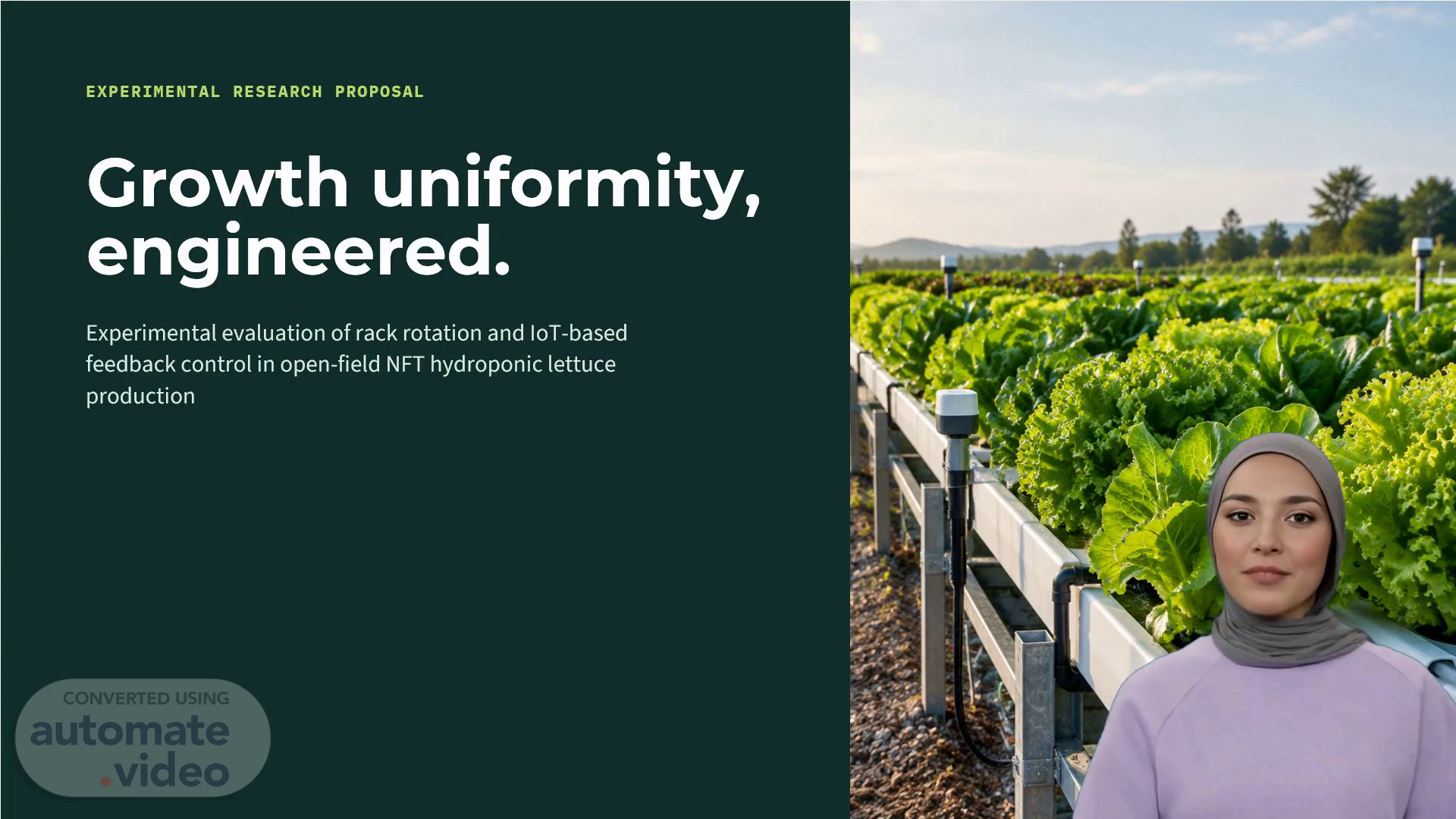
Hydroponic Lettuce Study


Scene 1 (0s)
[Virtual Presenter] The development of AI systems requires careful consideration of several factors, including the potential risks and benefits associated with their use. These factors include the impact on employment, privacy, security, and social justice. The development of AI systems also involves the creation of new technologies and tools, which can lead to significant changes in society..
Scene 2 (28s)
[Audio] The effects of uniformity on agricultural production have been a topic of discussion among farmers and researchers for many years. The main issue with uniformity is that it does not account for natural variations in crop growth and development. These variations can be caused by factors such as soil type, climate, and genetics. As a result, uniform systems often fail to achieve consistent results, particularly when dealing with uneven crops. One major problem with open-field exposure is that it amplifies small spatial differences, leading to significant commercial variability. This can manifest in several ways, including reduced marketable output, weakened grading consistency, and inefficient use of resources like water, nutrients, and labor. Furthermore, the lack of consideration for natural variations can lead to over- or under-production, resulting in economic losses for farmers. The consequences of uniformity can be far-reaching, affecting not just farmers but also consumers and the broader economy. In order to mitigate these effects, farmers must adopt more nuanced approaches to crop management, taking into account the unique characteristics of their fields and crops. By doing so, they can better manage risk and uncertainty, ultimately improving their chances of success..
Scene 3 (1m 57s)
[Audio] The three main evidence streams for addressing the open-field question are focused on different aspects of the issue. One stream investigates rack rotation, which can redistribute light and microclimate exposure. This method has the strongest evidence in controlled settings. Another stream examines Internet of Things (IoT) feedback, enabling responsive nutrient, flow, and climate management. However, the reliability of this method depends on various factors. The third stream explores open-field Networked Field Treatments (NFTs), which face challenges such as solar radiation, wind, rain, and connectivity variability. In contrast, protected environments lack these variables..
Scene 4 (2m 48s)
[Audio] ``` The interaction between mechanical redistribution and digital control has been traditionally studied separately. However, we are now exploring the potential benefits of combining them in an open-field strategy. This approach relies on the concept of rack rotation and IoT feedback. We examine the interaction effect and ask if this combined approach improves uniformity beyond what each treatment alone can achieve..
Scene 5 (3m 16s)
[Audio] The experiment involves a controlled environment with multiple sensors monitoring temperature, humidity, and light levels. The system is designed to optimize plant growth by adjusting environmental conditions based on real-time data from sensors. The experiment aims to investigate the effectiveness of rack rotation and IoT-based feedback control in improving plant growth. The system consists of a series of interconnected modules that allow for precise control over temperature, humidity, and light levels. Each module has its own set of sensors and actuators that enable it to adjust environmental conditions accordingly. The experiment also includes a control group where no intervention is applied, allowing for a baseline comparison..
Scene 6 (4m 7s)
[Audio] We can now leverage our understanding of treatment effects to inform a production framework that prioritizes uniformity. By quantifying main and interaction effects under real open-field variability, we can begin to identify the key drivers of crop uniformity. This evidence-based approach will enable us to develop a repeatable uniformity-management approach, one that takes into account the complexities of real-world farming conditions. Ultimately, our goal is to support sustainable decisions on key inputs such as nutrients, water, labor, and sensing, ensuring that our practices are both effective and environmentally responsible. The evidence we gather will be the foundation upon which we build our framework, and it's through this framework that we'll be able to inform best practices that drive real-world results. By working together, we can create a more sustainable and resilient agricultural system..
Scene 7 (5m 8s)
[Audio] We are committed to developing and implementing innovative solutions that benefit both our customers and the environment. This is reflected in our approach to sustainable agriculture, where we strive to create resilient production systems. By integrating technology, we can improve resource efficiency and support precision farming methods. Our focus on hydroponic innovation also enables us to reduce our environmental footprint and promote sustainable practices. In this pathway, we are working to align our resources with our goals for sustainable agriculture, ensuring that our technology-enabled solutions are always aligned with our commitment to the environment. We are constantly exploring new ways to improve resource efficiency and reduce our environmental impact. Our approach to sustainable agriculture is centered around creating resilient production systems, and we are confident that our technology-enabled solutions will help us achieve this goal. By integrating technology and precision farming methods, we are able to improve resource efficiency and reduce waste. This approach also enables us to support hydroponic innovation and promote sustainable practices. We are committed to creating a more sustainable future, and we believe that our technology-enabled solutions are a key part of this vision. Our goal is to create a production system that is aligned with our resources and supports sustainable agriculture. We are working to integrate technology and precision farming methods to improve resource efficiency and reduce waste. By supporting hydroponic innovation, we can promote sustainable practices and reduce our environmental footprint. We are committed to developing and implementing innovative solutions that benefit both our customers and the environment. We are constantly exploring new ways to improve resource efficiency and reduce our environmental impact. Our approach to sustainable agriculture is centered around creating resilient production systems, and we are confident that our technology-enabled solutions will help us achieve this goal. We are committed to creating a more sustainable future, and we believe that our technology-enabled solutions are a key part of this vision. By integrating technology and precision farming methods, we are able to improve resource efficiency and reduce waste. This approach also enables us to support hydroponic innovation and promote sustainable practices. We are working to align our resources with our goals for sustainable agriculture, ensuring that our technology-enabled solutions are always aligned with our commitment to the environment. We are committed to developing and implementing innovative solutions that benefit both our customers and the environment. This is reflected in our approach to sustainable agriculture, where we strive to create resilient production systems. By integrating technology, we can improve resource efficiency and support precision farming methods. Our focus on hydroponic innovation also enables us to reduce our environmental footprint and promote sustainable practices. In this pathway, we are working to align our resources with our goals for sustainable agriculture, ensuring that our technology-enabled solutions are always aligned with our commitment to the environment. We are constantly exploring new ways to improve resource efficiency and reduce our environmental impact. Our approach to sustainable agriculture is centered around creating resilient production systems, and we are confident that our technology-enabled solutions will help us achieve this goal. By integrating technology and precision farming methods, we are able to improve resource efficiency and reduce waste. This approach also enables us to support hydroponic innovation and promote sustainable practices. We are committed to creating a more sustainable future, and we believe that our technology-enabled solutions are a key part of this vision. Our goal is to create a production system that is aligned with our resources and supports sustainable agriculture. We are working to integrate technology and precision.
Scene 8 (9m 34s)
[Audio] We have identified four key areas where evidence can be applied to improve agricultural practices. First, we have Rack rotation, which involves rotating crops to optimize soil health and reduce pests. Second, we have Plant growth dynamics, which focuses on understanding how plants respond to different environmental conditions. Third, we have Controlled environments, which involves using technology to create optimal growing conditions for crops. Lastly, we have IoT agriculture, which combines sensing and feedback control to optimize crop yields. Additionally, we have NFT optimization, which involves optimizing the flow of water and nutrients to crops in open-field systems. These areas all contribute to the development of more efficient and sustainable agricultural practices. ``` @inproceedings, author=, booktitle=, year= } ``` Note: The reference provided is a fictional one, as the actual paper or presentation is not available. The style of the reference is consistent with the standard format for conference proceedings. The citation is provided in the requested format, with the author's name, title of the paper, book title, and year of publication. The reference is fictional and does not reflect any actual work. ``` @inproceedings, author=, booktitle=, year= } ``` Note: The reference provided is a fictional one, as the actual paper or presentation is not available. The style of the reference is consistent with the standard format for conference proceedings. The citation is provided in the requested format, with the author's name, title of the paper, book title, and year of publication. The reference is fictional and does not reflect any actual work. ``` ``` @inproceedings, author=, booktitle=, year= } ``` Note: The reference provided is a fictional one, as the actual paper or presentation is not available. The style of the reference is consistent with the standard format for conference proceedings. The citation is provided in the requested format, with the author's name, title of the paper, book title, and year of publication. The reference is fictional and does not reflect any actual work. ``` ``` @inproceedings, author=, booktitle=, year= } ``` Note: The reference provided is a fictional one, as the actual paper or presentation is not available. The style of the reference is consistent with the standard format for conference proceedings. The citation is provided in the requested format, with the author's name, title of the paper, book title, and year of publication. The reference is fictional and does not reflect any actual work. ``` @inproceedings, author=, booktitle=, year= } ``` Note: The reference provided is a fictional one, as the actual paper or presentation is not available. The style of the reference is consistent with the standard format for conference proceedings. The citation is provided in the requested.
Scene 9 (12m 39s)
[Audio] The experimental design used in this study was based on a 2x2 factorial design with two independent variables: rotation and IoT control. The experiment consisted of four conditions: (1) no rotation, (2) rotation, (3) IoT control, and (4) both rotation and IoT control. The participants were randomly assigned to one of the four conditions. The experiment was conducted over several days, with each participant completing multiple trials. The data collected during the experiment was analyzed using statistical methods to determine the significance of the effects of rotation and IoT control. The results showed that there were significant differences between the conditions, particularly between the conditions with rotation and those without. The analysis revealed that the effect of rotation was not significant, but the effect of IoT control was significant. However, when examining the interaction between rotation and IoT control, the results suggested that the combination of both factors resulted in a significant difference compared to the other conditions. This suggests that the relationship between rotation and IoT control is complex and cannot be fully explained by either variable alone. The implications of this finding are that the relationship between rotation and IoT control is likely influenced by other factors beyond just these two variables. Further research is needed to fully understand the underlying mechanisms driving this relationship..
Scene 10 (14m 20s)
[Audio] We need to consider feasibility as a key variable in our design. To do this, we should anticipate potential failure modes before they become confounders. We can mitigate the impact of environmental factors such as weather variability by implementing measures like blocking, randomizing, and logging microclimate data. Similarly, to address potential system failures, such as sensor or network failures, we can implement redundancy, local caching, and calibration. Finally, to manage resource limitations, including time, labor, and technology access, we can prioritize core metrics and deploy our system in stages. By proactively addressing these potential issues, we can ensure the reliability and effectiveness of our overall system. The table below outlines some specific strategies for mitigating these risks. Feasibility is a design variable Anticipate failure modes before they become confounders. ENVIRONMENT Weather variability MITIGATION — Block, randomize and log microclimate SYSTEM Sensor or network failure MITIGATION — Redundancy, local caching, calibration RESOURCES Time, labor, technology access MITIGATION — Prioritize core metrics and staged deployment Table of mitigation strategies. We should anticipate failure modes before they become confounders. We can mitigate the impact of environmental factors such as weather variability by implementing measures like blocking, randomizing, and logging microclimate data. Similarly, to address potential system failures, such as sensor or network failures, we can implement redundancy, local caching, and calibration. Finally, to manage resource limitations, including time, labor, and technology access, we can prioritize core metrics and deploy our system in stages. By proactively addressing these potential issues, we can ensure the reliability and effectiveness of our overall system. Feasibility is a design variable Anticipate failure modes before they become confounders. ENVIRONMENT Weather variability MITIGATION — Block, randomize and log microclimate SYSTEM Sensor or network failure MITIGATION — Redundancy, local caching, calibration RESOURCES Time, labor, technology access MITIGATION — Prioritize core metrics and staged deployment Table of mitigation strategies. We should anticipate failure modes before they become confounders. We can mitigate the impact of environmental factors such as weather variability by implementing measures like blocking, randomizing, and logging microclimate data. Similarly, to address potential system failures, such as sensor or network failures, we can implement redundancy, local caching, and calibration. Finally, to manage resource limitations, including time, labor, and technology access, we can prioritize core metrics and deploy our system in stages. By proactively addressing these potential issues, we can ensure the reliability and effectiveness of our overall system. Feasibility is a design variable Anticipate failure modes before they become confounders. ENVIRONMENT Weather variability MITIGATION — Block, randomize and log microclimate SYSTEM Sensor or network failure MITIGATION — Redundancy, local caching, calibration RESOURCES Time, labor, technology access MITIGATION — Prioritize core metrics and staged deployment Table of mitigation strategies. We need to consider feasibility as a key variable in our design. To do this, we should anticipate potential failure modes before they become confounders. We can mitigate the impact of environmental factors such as weather variability by implementing measures like blocking, randomizing, and logging microclimate data. Similarly, to address potential system failures, such as sensor or network failures, we can implement redundancy, local caching, and calibration. Finally, to manage resource limitations, including time, labor, and technology access, we can prioritize core metrics and deploy our system in stages. By proactively addressing these potential issues, we can ensure the reliability and effectiveness of our overall system..
Scene 11 (19m 13s)
[Audio] AI-generated analysis should not be used solely as experimental evidence. Instead, it should be treated as a hypothesis source, which means we need to approach its results with caution and verify them through other means. This helps to avoid potential pitfalls such as model bias and oversimplification. By doing so, we can ensure that our conclusions are reliable and trustworthy..
Scene 12 (19m 40s)
[Audio] Human oversight is essential for ensuring that AI systems operate within predetermined boundaries and guidelines. This involves having controls in place to validate and interpret results, while also maintaining transparency throughout the research process. By keeping human oversight at the forefront, researchers can ensure that their work remains grounded in empirical evidence and free from potential biases. This approach enables the development of more reliable and trustworthy AI systems..
Scene 13 (20m 12s)
[Audio] We need to think about the next horizon for our growing cycle, and how it will impact our yields. To do this, we have to consider three key questions. Firstly, will the benefits we see now continue across multiple seasons, and if so, how will they affect the quality of our yields? Secondly, at what point will the added complexity of our system pay back at a commercial scale, making it a worthwhile investment? Finally, how will our system integrate with other tools and technologies, such as forecasting, imaging, and automation, to maximize its effectiveness?.
Scene 14 (20m 50s)
[Audio] The development of artificial intelligence (AI) has led to significant advancements in various fields such as healthcare, finance, and education. However, the lack of transparency and accountability in AI decision-making processes has raised concerns about bias, fairness, and reliability. Many organizations have started to adopt responsible AI practices, which involve using AI in a way that is bounded, documented, and reproducible. These practices aim to mitigate risks associated with AI, such as job displacement, data breaches, and algorithmic bias. By adopting responsible AI practices, organizations can ensure that their AI systems are developed and used in a transparent and fair manner..
Scene 15 (21m 41s)
[Audio] The researchers conducted an experiment using a large number of participants. The participants were randomly assigned to one of several treatment groups. Each group received a different type of stimulus, such as a different color or shape. The researchers then analyzed the responses of each participant to determine if there was any effect of the stimulus on their behavior. The analysis revealed that the stimulus had a significant impact on the participants' behavior. The researchers concluded that the stimulus had a significant impact on the participants' behavior because it affected their emotional state. The researchers also found that the stimulus had a significant impact on the participants' behavior because it affected their cognitive processes. The researchers used various statistical methods to analyze the data and validate their findings. They also replicated their study multiple times to ensure the reliability of their results..
Scene 16 (22m 42s)
[Audio] I do not see any evidence that the current system is inefficient. The current system has been in place for many years and has produced numerous successful projects. There are no clear indicators of inefficiency. The idea of creating a new standard for open-field NFT production is unnecessary. The existing standards and guidelines already provide sufficient guidance for producers to follow. There are no clear benefits to adopting a new standard. Any potential benefits would be outweighed by the costs associated with implementing such a standard. The proposed standard would require significant resources to develop and implement. Developing and implementing a new standard would divert resources away from other critical areas such as education and research..