Scene 1 (0s)
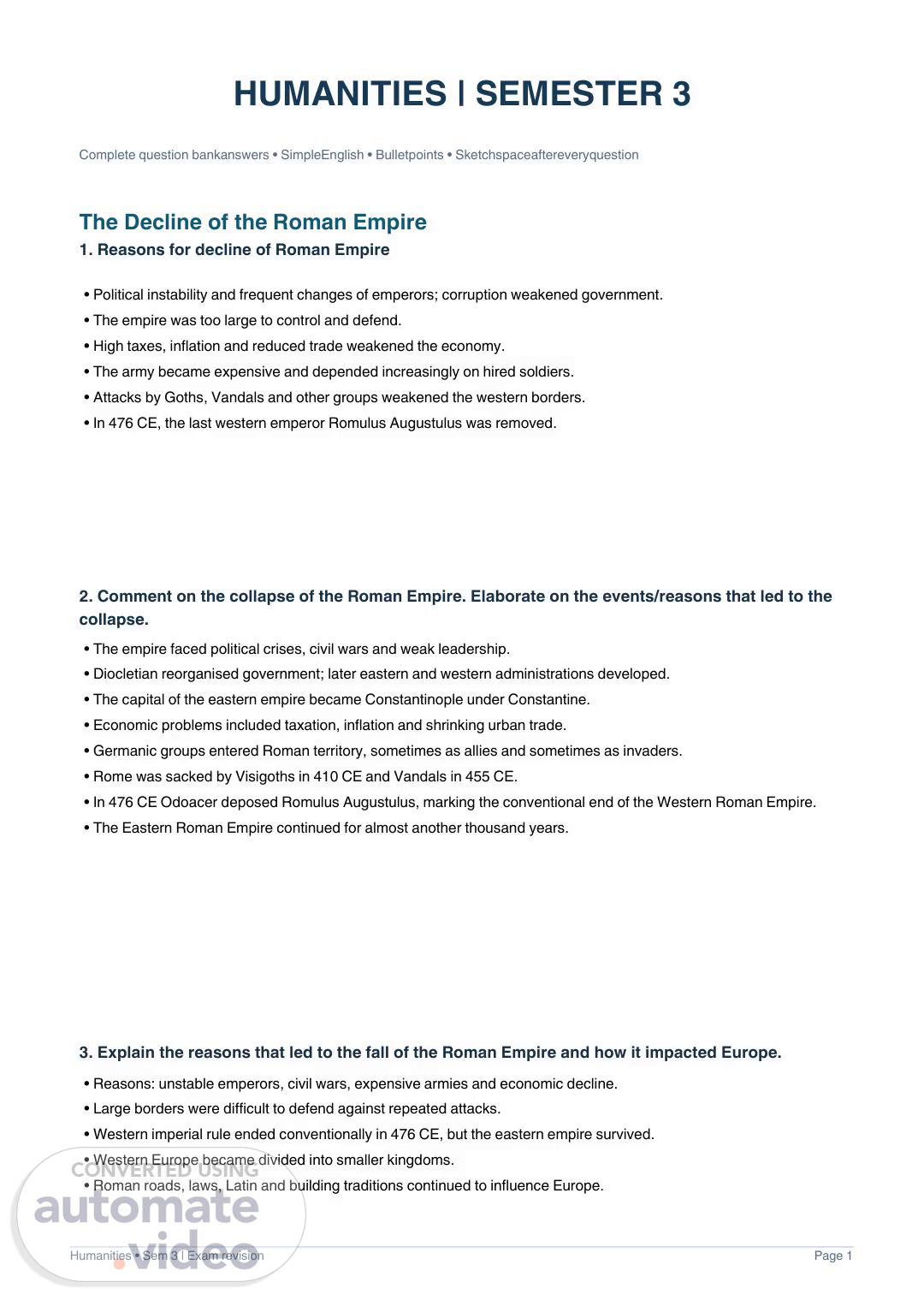
[Virtual Presenter] HUMANITIES | SEMESTER 3 Complete question bankanswers SimpleEnglish Bulletpoints Sketchspaceaftereveryquestion The Decline of the Roman Empire 1. Reasons for decline of Roman Empire Political instability and frequent changes of emperors; corruption weakened government. The empire was too large to control and defend. High taxes, inflation and reduced trade weakened the economy. The army became expensive and depended increasingly on hired soldiers. Attacks by Goths, Vandals and other groups weakened the western borders. In 476 CE, the last western emperor Romulus Augustulus was removed. 2. Comment on the collapse of the Roman Empire. Elaborate on the events/reasons that led to the collapse. The empire faced political crises, civil wars and weak leadership. Diocletian reorganised government; later eastern and western administrations developed. The capital of the eastern empire became Constantinople under Constantine. Economic problems included taxation, inflation and shrinking urban trade. Germanic groups entered Roman territory, sometimes as allies and sometimes as invaders. Rome was sacked by Visigoths in 410 CE and Vandals in 455 CE. In 476 CE Odoacer deposed Romulus Augustulus, marking the conventional end of the Western Roman Empire. The Eastern Roman Empire continued for almost another thousand years. 3. Explain the reasons that led to the fall of the Roman Empire and how it impacted Europe. Reasons: unstable emperors, civil wars, expensive armies and economic decline. Large borders were difficult to defend against repeated attacks. Western imperial rule ended conventionally in 476 CE, but the eastern empire survived. Western Europe became divided into smaller kingdoms. Roman roads, laws, Latin and building traditions continued to influence Europe. Humanities Sem 3 | Exam revision Page 1.
Scene 2 (2m 29s)
[Audio] The Christian Church became a major source of learning and social organisation. Towns and long-distance trade declined in some western regions, while rural life gained importance. Roman and Germanic traditions mixed to form medieval European cultures. 4. Write a detailed note on the fall of the Roman Empire and the rise of Christianity in Europe. Roman decline involved political conflict, high military costs and invasions. Christianity began in the Roman world in the first century CE and spread through towns and trade routes. Early Christians faced periods of persecution. The Edict of Milan in 313 CE granted toleration to Christianity under Constantine and Licinius. In 380 CE Theodosius I promoted Nicene Christianity as the imperial religion. Churches and bishops gained influence as western imperial administration weakened. The basilica became a common form for Christian worship buildings. Monasteries preserved texts, education and religious practices during the medieval period. The Beginnings of Christianity & Early Christian Architecture 5. Nave and Apse / Basilica / Transept / Aisle / Clerestory Nave: main central hall where the congregation gathers. Apse: semicircular or polygonal end, often containing the altar. Basilica: Roman public-hall building type adapted for Christian churches, usually longitudinal. Transept: crosswise space cutting across the nave, creating a cross-shaped plan. Aisle: lower side passage parallel to the nave, separated by columns or piers. Clerestory: upper wall with windows above aisle roofs, bringing daylight into the nave. 6. Old St. Peter's Basilica Built in Rome under Constantine in the fourth century over the traditional burial site of St Peter. An early Christian basilica with a long nave, side aisles and an apse. Humanities Sem 3 | Exam revision Page 2.
Scene 3 (4m 45s)
[Audio] A large atrium stood before the church; a transept was placed near the altar. Timber roof covered the nave, supported by rows of columns. The design allowed large congregations and processions. It was replaced by the present Renaissance and Baroque St Peter's Basilica. 7. Write about early Christian art and architecture, mentioning the key features. Early Christians used symbols such as the fish, anchor, dove and Good Shepherd. Wall paintings and mosaics showed Biblical scenes and religious ideas. Catacombs contained early Christian burial art. Churches adopted the Roman basilica plan for group worship. Typical spaces were atrium, narthex, nave, aisles and apse. The altar was the main sacred focus, usually at the apse end. Simple exteriors contrasted with richly decorated interiors. Clerestory windows provided daylight; timber roofs were common. 8. Draw the plan of a church, name each space, and explain in detail the purpose thereof. Atrium: open entrance courtyard for gathering before worship. Narthex: entrance lobby and transition to the sacred interior. Nave: central seating and circulation space for worshippers. Side aisles: parallel passages for movement beside the nave. Transept: transverse arm that may make a Latin-cross plan. Crossing: meeting point of nave and transept, sometimes below a tower or dome. Choir/presbytery: area for clergy and liturgical activities. Apse and altar: focal point for sacred ceremonies. Clerestory: high windows illuminating the nave. Humanities Sem 3 | Exam revision Page 3.
Scene 4 (6m 36s)
[Audio] 9. Describe the various parts of a church in detail with the help of a plan and section / Church architecture hierarchy of spaces. Church spaces usually progress from public to increasingly sacred areas. Atrium and entrance lead to the narthex, which marks a threshold. The nave holds the main congregation; aisles allow movement. Arcades of columns or piers separate nave and aisles. A taller nave often receives light from clerestory windows. The transept crosses the nave and creates the crossing. The choir and sanctuary are reserved mainly for liturgical functions. The altar and apse form the principal sacred focus. In section, the nave roof is usually higher than aisle roofs. 10. Why was Christianity accepted? Discuss the architectural evolution from Roman basilicas to Early Christian churches, including a sketch of a church building explaining its elements and spaces. Christianity spread through preaching, social networks and Roman roads. Imperial toleration under Constantine in 313 CE helped public worship grow. Christianity received official imperial support later in the fourth century. Roman basilicas were public halls with a central nave, aisles and an apse. Christians adapted this spacious form for congregational worship rather than using small pagan temple interiors. The apse became the focus of the altar and clergy. Atrium and narthex created an entrance sequence. The nave housed worshippers; aisles aided movement and processions. Transepts were added in some major churches, creating a cross-shaped plan. Examples include Old St Peter's Basilica and Santa Sabina in Rome. Humanities Sem 3 | Exam revision Page 4.
Scene 5 (8m 33s)
[Audio] The Byzantine Age 11. Pendentives and Squinches Pendentive: curved triangular surface that changes a square bay into a circular support for a dome. It transfers dome loads toward four supporting arches or piers. Squinch: small arch or niche built across a square corner to create an octagonal transition. Both help support domes over square spaces. Pendentives are important in Hagia Sophia; squinches occur in many domed buildings. 12. Rotunda A rotunda is a building or room with a circular plan, often covered by a dome. Its central plan gives equal importance to the space around a centre. Light may enter from windows or an opening in the dome. Roman example: Pantheon in Rome. Rotundas influenced Byzantine and later Renaissance centrally planned buildings. 13. Hagia Sophia Hagia Sophia was built in Constantinople (modern Istanbul) in 532-537 CE. Designed by Anthemius of Tralles and Isidore of Miletus for Emperor Justinian I. Its huge central dome rests on pendentives and four major arches. Two large semi-domes extend the main interior space longitudinally. Many windows, marble surfaces and mosaics create a luminous interior. Originally a church, it later became a mosque, then a museum, and is currently a mosque. Humanities Sem 3 | Exam revision Page 5.
Scene 6 (10m 18s)
[Audio] 14. What were the advancements observed in the Byzantine era architecture? Describe with the example of Hagia Sophia, add relevant sketches. Byzantine builders developed large domes over square plans using pendentives. They combined centralised domed space with a longitudinal basilica arrangement. Brick, mortar and carefully arranged arches helped create wide interiors. Semi-domes and buttressing elements helped distribute structural forces. Hagia Sophia (537 CE) is the best-known example of these developments. Its dome appears to float above a ring of windows. Pendentives carry the dome to four major piers. Half-domes enlarge the central space to east and west. Marble cladding, mosaics and filtered daylight enriched the spiritual atmosphere. Sketch: plan with central dome and half-domes; section showing pendentives. 15. Why is Hagia Sophia considered an important building of the Byzantine Period? What is its relevance today? Elaborate with sketches. It demonstrates the Byzantine ability to roof an enormous interior with a dome. Pendentives solve the problem of placing a round dome over a square bay. Its central dome and half-domes create a unified but flowing space. Light from many windows gives the dome a floating appearance. It became a model for later Byzantine and Ottoman religious buildings. Its Christian mosaics and Islamic additions reflect different historical periods. It is important today for architectural history, engineering and cultural heritage. It remains an active mosque and a major historic monument in Istanbul. Sketch: longitudinal section and dome-support system. Humanities Sem 3 | Exam revision Page 6.
Scene 7 (12m 16s)
[Audio] 16. Elaborate on the statement: 'Hagia Sophia is the finest example of a centrally planned Byzantine church,' describing its architectural features and style. Hagia Sophia is not a purely central plan: it combines a central domed core with a longitudinal axis. The main dome dominates the central square bay. Pendentives connect the circular dome to the four main arches. Semi-domes on the east and west extend the interior. Exedrae and side galleries add depth and complexity. Windows around the dome base create dramatic natural lighting. Rich mosaics and coloured marble express Byzantine decorative style. The building shows a strong relationship between engineering and spiritual symbolism. Its innovative combination influenced many later domed religious buildings. 17. Explain the characteristics and elements of Byzantine Architecture, discussing the architectural significance of Hagia Sophia along with sketches. Byzantine architecture developed mainly in the Eastern Roman Empire. Common features: domes, pendentives, arches, vaults and centralised spaces. Brick and mortar construction was widely used. Interiors often had marble surfaces, gold mosaics and religious imagery. Windows were placed to create a glowing, spiritual interior. Plans included central, cross-in-square and combined longitudinal forms. Hagia Sophia was completed in 537 CE in Constantinople. Its dome stands above pendentives and four main piers. Semi-domes extend the space and help manage structural loads. Its vast, luminous interior made it a landmark of engineering and worship. Sketch: plan, section, pendentive detail and mosaic decoration. The Romanesque Age 18. Elements of Romanesque architecture / Round arches / Arches Humanities Sem 3 | Exam revision Page 7.
Scene 8 (14m 30s)
[Audio] Romanesque architecture flourished in Europe mainly in the 11th and 12th centuries. Round or semicircular arches appear in doors, windows and arcades. Thick stone walls and large piers carry heavy roof loads. Barrel vaults and groin vaults cover interior spaces. Small openings create comparatively dim interiors. Towers, sculpted portals and rhythmic bays are common. Round arches transfer loads down to piers and walls. Examples include Pisa Cathedral and Durham Cathedral (with later innovations). 19. Sketch a Romanesque Door Portal A Romanesque portal commonly has a semicircular arch. Several recessed arch bands are called archivolts. The tympanum is the decorated panel above the doorway. The lintel spans the top of the door opening. Jambs and columns frame the sides of the entrance. Sculpture often shows Biblical stories, saints or the Last Judgement. Sketch a front elevation and label archivolts, tympanum, lintel and jambs. 20. Describe the architectural style and features of the Pisa Cathedral, Monastery, and Leaning Tower of Pisa. Add relevant sketches. Pisa Cathedral is an example of Pisan Romanesque architecture. Its facade has multiple tiers of small round-arched arcades. Striped marble, columns and a Latin-cross plan are key features. The cathedral interior has a nave, aisles, transept and dome over the crossing. The Leaning Tower is the cathedral's freestanding bell tower (campanile). Its circular plan and stacked arcaded levels use round arches. The tower leans because of uneven settlement in weak ground. The nearby Camposanto is a monumental cemetery with cloister-like arcades, not a monastery. The Baptistery is another major building in the Piazza dei Miracoli. Sketch: cathedral facade and circular leaning bell tower. Humanities Sem 3 | Exam revision Page 8.
Scene 9 (16m 44s)
[Audio] 21. Provide a concise definition of Romanesque architecture and discuss the significant architectural elements found in Romanesque churches (round arches, thick walls, barrel vaults, etc.) through an example with sketches. Romanesque is a medieval European style inspired partly by Roman building forms. It is known for heavy masonry, rounded arches and solid proportions. Round arches support openings and internal arcades. Thick walls and strong piers resist the thrust of stone vaults. Barrel vaults form continuous tunnel-shaped ceilings. Groin vaults form where two barrel vaults cross. Small windows and deep openings produce shadowed interiors. Decorated portals show religious stories through sculpture. Towers often mark the entrance or crossing. Pisa Cathedral shows round-arched arcades and marble decoration. Its Latin-cross plan has nave, aisles and transept. Sketch: round arch, barrel vault, groin vault and Pisa facade. Medieval Europe & The Gothic Age 22. Flying buttress / Tympanum Flying buttress: an external arched support transferring roof and vault thrust to a heavy outer pier. It allowed Gothic churches to use taller walls and larger windows. Tympanum: the wall panel between a doorway lintel and the arch above. Gothic and Romanesque tympana often show carved religious scenes. Humanities Sem 3 | Exam revision Page 9.
Scene 10 (18m 26s)
[Audio] 23. Rose window (Also, cite the name of a building sporting a rose window). A rose window is a large circular window with radiating stone tracery. It is usually filled with coloured stained glass. It brings coloured light into a church and often shows religious stories. Rose windows are common on Gothic facades and transepts. Example: Notre-Dame Cathedral, Paris, has famous rose windows. 24. Barrel vault and Groin vault Barrel vault: a continuous tunnel-shaped ceiling formed by extending an arch. Its weight and sideways thrust need strong walls or supports. Groin vault: made by the intersection of two barrel vaults at right angles. The crossing lines are called groins. Groin vaults concentrate loads at corners, allowing more flexible openings. 25. Characteristics of Gothic Era architecture Pointed arches allow varied heights and help direct forces downward. Ribbed vaults create lighter, organised ceiling structures. Flying buttresses support tall walls from outside. Large stained-glass windows and rose windows bring coloured light. High ceilings and vertical lines create a feeling of height. Detailed stone tracery, pinnacles and sculpted portals are common. 26. What are the salient points of Gothic Architecture? Elaborate with sketches the various elements used and name a representative building. Humanities Sem 3 | Exam revision Page 10.
Scene 11 (20m 13s)
[Audio] Gothic architecture developed in medieval Europe from the 12th century. Its main aim was tall, light-filled religious interiors. Pointed arches support different spans and heights. Ribbed vaults organise the roof structure. Flying buttresses carry outward thrust to external piers. Large stained-glass windows fill spaces with coloured light. Rose windows appear on important facades. Pinnacles and spires emphasise verticality. Sculpted portals teach religious stories. Representative building: Chartres Cathedral, France. Sketch: pointed arch, rib vault, flying buttress and rose window. 27. Explain the different parts of a Cathedral (with diagrams) and the changes Church architecture underwent through the Dark Ages / Dark Ages overview. Cathedral: principal church of a bishop; its name comes from the bishop's seat or cathedra. Nave: main space for worshippers; aisles: side passages. Transept: cross arm; crossing: meeting of nave and transept. Choir: space for singers and clergy; sanctuary: area around the altar. Apse: end of the church; ambulatory: passage around the choir in some cathedrals. During the early medieval period, church design drew on Roman basilicas and local traditions. Romanesque churches later used heavy walls, round arches and stone vaults. Gothic churches introduced pointed arches, rib vaults and flying buttresses. These changes allowed taller interiors and larger stained-glass windows. Sketch: labelled cathedral plan and Gothic section. The Crusades 28. Crusades / Crusades and the Holy Wars The Crusades were religiously motivated military expeditions, especially from Western Europe to the eastern Mediterranean. Humanities Sem 3 | Exam revision Page 11.
Scene 12 (22m 21s)
[Audio] The First Crusade began in 1096 after Pope Urban II's call in 1095. Crusaders sought control of Jerusalem and other holy places. The campaigns involved Christians, Muslims and other communities. They also included violence, conquest and major suffering. Crusading activity continued in several regions over centuries. 29. Describe in detail: Crusades and its impact on Europe. The Crusades were a series of campaigns beginning in the late 11th century. Religious goals were mixed with political and economic interests. They increased contacts between parts of Europe and the eastern Mediterranean. Trade in goods such as spices and textiles expanded through Mediterranean networks. Knowledge and technologies circulated through multiple routes, not only the Crusades. Crusading warfare brought destruction, persecution and long-term conflict. Military orders and fortified castles gained importance. The campaigns influenced European politics, religion and cultural exchange. The Renaissance in Italy & The Masters of the Renaissance 30. Describe in brief with examples: Renaissance / Renaissance & its impact on Europe. Renaissance means rebirth and refers to renewed interest in classical Greek and Roman culture. It began in Italian cities from about the 14th century and spread across Europe. Humanism encouraged study of people, literature and classical learning. Artists used perspective, anatomy and realistic observation. Architects revived columns, domes, symmetry and proportion. Examples: Florence Cathedral dome by Brunelleschi and paintings by Leonardo. It encouraged new approaches to art, science and education. 31. Describe any 2 artistic projects of Michelangelo. Sistine Chapel ceiling (1508-1512): large fresco cycle with Biblical scenes, including Creation of Adam. Humanities Sem 3 | Exam revision Page 12.
Scene 13 (24m 51s)
[Audio] Its figures show strong anatomy, movement and dramatic composition. David (1501-1504): monumental marble sculpture of the Biblical hero. The sculpture shows ideal human proportions, tension and careful observation of the body. 32. Describe the contribution of Leonardo da Vinci to Renaissance. Leonardo was a painter, designer, engineer and observer of nature. He used careful study of anatomy and perspective to improve realism. Mona Lisa is known for subtle expression and soft shading (sfumato). The Last Supper uses linear perspective to focus attention on Christ. His notebooks contain studies of machines, water, flight and the human body. He represents the Renaissance ideal of combining art with scientific curiosity. 33. Write in brief about any four Masters of Renaissance, mention their achievements, contributions, and various roles they played during the Renaissance period. Leonardo da Vinci: painter and inventor; Mona Lisa and The Last Supper; studied anatomy and nature. Michelangelo: sculptor, painter and architect; David, Sistine Chapel ceiling and St Peter's dome design. Raphael: painter and architect; School of Athens uses balanced composition and perspective. Filippo Brunelleschi: architect and engineer; designed Florence Cathedral dome and helped develop linear perspective. Together they advanced realism, classical proportion, structural invention and human-centred art. 34. What does Renaissance mean? Where did it originate? What was the contribution of the Renaissance to the art and architecture of the period? Renaissance means rebirth of interest in classical learning and culture. It began in Italian city-states, especially Florence, during the 14th century. Trade wealth, patronage and access to Roman remains supported new ideas. Art emphasised human anatomy, realistic space and linear perspective. Humanism encouraged study of classical texts and human experience. Architecture used symmetry, mathematical proportion and geometry. Classical columns, pilasters, pediments and round arches returned. Humanities Sem 3 | Exam revision Page 13.
Scene 14 (27m 30s)
[Audio] Domes and centrally planned churches became important. Examples: Brunelleschi's Florence Cathedral dome and Alberti's Sant'Andrea in Mantua. 35. Compare the Renaissance style of architecture with the Gothic style, providing examples of architectural elements and buildings. Gothic: developed in medieval Europe; Renaissance: revived classical Roman and Greek ideas. Gothic uses pointed arches; Renaissance often uses round arches. Gothic uses ribbed vaults and flying buttresses; Renaissance favours classical orders, domes and clear geometry. Gothic facades stress vertical height; Renaissance facades stress balance and horizontal proportion. Gothic windows often have stained glass and tracery; Renaissance windows tend toward ordered rectangular or round-headed forms. Gothic decoration includes sculpted portals and pinnacles; Renaissance uses columns, pilasters and pediments. Gothic example: Chartres Cathedral. Renaissance example: Pazzi Chapel in Florence. 36. What is Renaissance and why did it originate from Italy? Explain various characteristics and elements of Renaissance architecture through an example with sketches. Renaissance means renewed interest in classical art, learning and architecture. It grew in Italy because Roman remains were visible and classical texts were studied. Rich trading cities such as Florence supported artists through patronage. Humanism encouraged human scale, reason and mathematical proportion. Renaissance buildings use symmetry and balanced composition. Classical columns, pilasters, capitals and entablatures reappeared. Round arches and domes were preferred over strongly pointed forms. Plans often use squares, circles and regular geometry. Facades are arranged in clear horizontal and vertical orders. Example: Pazzi Chapel, Florence, traditionally associated with Brunelleschi. It has a balanced facade, classical columns, arches and a domed central space. Sketch: chapel elevation, central dome and classical column. Humanities Sem 3 | Exam revision Page 14.
Scene 15 (30m 4s)
[Audio] Humanism & Mannerism 37. Describe in detail: Mannerism / Humanism and Mannerism difference. Humanism is a Renaissance intellectual approach focused on classical learning and human experience. It values reason, education, individual ability and observation. In art it encouraged realistic figures, proportion and clear composition. Mannerism is an artistic style that developed after the High Renaissance, especially from the 1520s. It often uses elongated figures, unusual poses and complex compositions. In architecture it may deliberately break expected classical rules and proportions. Humanism is mainly an intellectual outlook; Mannerism is mainly an artistic and architectural style. Example of Mannerist architecture: Palazzo del Te, Mantua, by Giulio Romano. 38. Describe Humanism, cite an example of Humanist Art, and elaborate. Humanism focused on the study of classical literature, people and human abilities. It encouraged reason, education, individual expression and observation. Renaissance artists studied anatomy, nature and mathematical perspective. Example: Raphael's School of Athens (1509-1511). The painting shows classical philosophers in a grand architectural space. Balanced composition and perspective express the Renaissance respect for learning. 39. Who were the Renaissance men? Why were they called so? Choose one and elaborate on his contribution to art, science, architecture, and/or literature. A Renaissance man was a person skilled in several fields, not only one profession. This ideal came from the belief that people could develop many abilities. Leonardo da Vinci is a famous example. Art: painted Mona Lisa and The Last Supper. Science: studied anatomy, plants, water and the movement of bodies. Humanities Sem 3 | Exam revision Page 15.
Scene 16 (32m 28s)
[Audio] Engineering: sketched bridges, machines and flying devices. Drawing: combined accurate observation with imaginative design. His notebooks show how art and scientific investigation supported each other. 40. Name a Renaissance artist and describe any 2 works of art by him. Elaborate on the style and salient features. Artist: Leonardo da Vinci, a major High Renaissance painter. Mona Lisa: portrait with gentle expression, landscape background and soft sfumato shading. Its carefully observed face and hands show realistic anatomy. The Last Supper: mural showing Jesus and the apostles at a dramatic moment. Linear perspective leads the eye toward Jesus at the centre. Gestures and facial expressions show different emotional reactions. Both works demonstrate observation, balance and psychological depth. The Reformation, Its Impact on Art & Architecture 41. Describe in brief with examples: Reformation. The Reformation was a 16th-century movement that challenged practices and authority in the Western Church. Martin Luther published his Ninety-Five Theses in 1517. Debates concerned indulgences, faith, scripture and church authority. New Protestant traditions developed in different parts of Europe. Some Protestant churches used simpler interiors and fewer religious images. The Catholic Reformation responded through reforms and renewed religious art. Example: Lutheran churches emphasised preaching and congregational participation. 42. Describe Indulgences in the Roman Catholic Church & the role of Martin Luther. An indulgence is a remission of temporal punishment for sins already forgiven in Catholic teaching. In the early 1500s, some indulgence campaigns were linked with fundraising and abuses. Humanities Sem 3 | Exam revision Page 16.
Scene 17 (34m 44s)
[Audio] Martin Luther criticised the preaching and sale-like treatment of indulgences. In 1517 he circulated the Ninety-Five Theses to encourage debate. He emphasised faith and the authority of scripture. His actions helped begin the Protestant Reformation and religious changes across Europe. Baroque Art and Architecture 43. Elements of Baroque architecture / Features of Baroque Architecture Baroque architecture developed in Europe from the late 16th century onward. It aimed to create drama, movement and strong emotional effects. Curved walls, oval plans and dynamic forms were common. Grand domes, large staircases and dramatic entrances created a sense of scale. Strong contrasts of light and shadow emphasised important spaces. Rich sculpture, painting, gilding and decorative details united the arts. Ceiling frescoes sometimes created an illusion of open sky. Buildings often guided movement toward a powerful central or altar focus. Churches used theatrical interiors to communicate religious feeling. Examples: San Carlo alle Quattro Fontane by Borromini and St Peter's Square by Bernini. Sketch: curved Baroque facade, oval plan and decorated dome. The Age of Discovery & Colonization 44. Columbian Exchange The Columbian Exchange was the transfer of crops, animals, diseases and people between the Americas and Afro-Eurasia after 1492. Examples: potatoes and maize spread from the Americas; horses and wheat travelled to the Americas. Introduced diseases caused devastating population losses among Indigenous Americans. Humanities Sem 3 | Exam revision Page 17.
Scene 18 (36m 51s)
[Audio] 45. Describe in brief with examples: Colonization / Colonization & its impact on the World. Colonization is the process of establishing control and settlement over another land and its people. European powers colonised parts of the Americas, Africa and Asia. Colonizers sought resources, trade, land and political power. Colonial rule often involved exploitation, slavery and loss of Indigenous rights. It also caused major movement of people, crops, religions and languages. Example: Spanish colonization in the Americas changed government, settlement and architecture. 46. Age of discovery & reasons for the exploration. The Age of Discovery refers to long-distance European sea voyages mainly from the 15th to 17th centuries. European rulers and merchants wanted direct sea routes to Asian trade. Demand for spices, precious metals and other goods encouraged voyages. Better navigation tools, maps and ships made longer journeys possible. Rulers wanted wealth, prestige and political influence. Religious missionary aims also encouraged expansion. Examples: Vasco da Gama's voyage to India and Columbus's Atlantic voyage. 47. What do you mean by colonization? Did the scientific revolution and period of Enlightenment have an impact on colonization or vice versa? Colonization means political and economic control of another territory, often with settlement. European expansion began before the Scientific Revolution and Enlightenment. Improved navigation, mapping and scientific knowledge later helped overseas travel and administration. Colonial encounters brought plants, animals and information that influenced European science. Trade and colonial wealth supported some scientific institutions and research. Enlightenment thinkers discussed liberty and rights, sometimes criticising slavery and empire. Others used ideas of hierarchy to defend colonial rule. Colonial exploitation, forced labour and displacement caused severe harm. The relationship worked in both directions: empire influenced knowledge, and knowledge supported empire. Humanities Sem 3 | Exam revision Page 18.
Scene 19 (39m 27s)
[Audio] The Enlightenment 48. Describe the Scientific Revolution and the Age of Enlightenment. The Scientific Revolution (mainly 16th-17th centuries) promoted observation, experiments and mathematical explanations. Thinkers such as Copernicus, Galileo and Newton changed ideas about nature. The Enlightenment (mainly 17th-18th centuries) applied reason and debate to society and government. Thinkers questioned inherited authority and discussed rights, education and liberty. These movements influenced modern science and political thought. 49. What was the impact of the Renaissance on Europe and its influence on the Age of Enlightenment? The Renaissance renewed interest in classical learning and human abilities. Humanism encouraged critical reading, education and independent inquiry. Artists and scholars studied nature, anatomy and mathematical perspective. Printing helped spread books and new ideas. These habits contributed to the Scientific Revolution. Enlightenment thinkers later used reason to examine politics, religion and society. Ideas of rights, tolerance and representative government gained importance. Renaissance learning did not cause the Enlightenment alone; religious, scientific and political changes also mattered. 50. Discuss the Scientific Revolution and Enlightenment period in Europe and their impact on the history of Europe and the Americas. The Scientific Revolution promoted observation, experiments and mathematical laws. Copernicus proposed a sun-centred model; Galileo used telescopic evidence; Newton described motion and gravity. The Enlightenment encouraged reason, public debate and criticism of absolute authority. Locke discussed natural rights; Montesquieu proposed separation of powers. These ideas shaped debates about government in Europe and the Americas. Humanities Sem 3 | Exam revision Page 19.
Scene 20 (41m 39s)
[Audio] They influenced the American Revolution and constitutional thinking. Ideas of liberty also affected independence movements and later reforms. However, Enlightenment ideals were often applied unequally amid slavery and colonization. The period transformed education, scientific institutions and political language. 51. Discuss how religion has influenced art and architecture, explaining with references. Religious beliefs influence building plans, symbols, orientation and sacred rituals. Early Christian basilicas used a nave and apse to focus worship toward the altar. Byzantine Hagia Sophia used a huge dome, mosaics and light to express sacred space. Romanesque churches used sculpted portals to teach Biblical stories. Gothic cathedrals used stained glass, verticality and rose windows to create spiritual atmosphere. Baroque churches used dramatic light, movement and decoration to engage worshippers. Mosques often use prayer halls, mihrabs and courtyards shaped by worship practices. Temples and other sacred buildings organise movement around religious meanings. Architecture therefore reflects both belief and the social life of its community. 52. Elaborate on the idea of relationship between the community and public places based on the concept of 'sacred space'. Sacred space is a place given special religious, spiritual or shared cultural meaning. Such places may be temples, churches, mosques, shrines, memorials or community grounds. They bring people together for worship, festivals, ceremonies and remembrance. Courtyards, steps, paths and gathering halls support social interaction. Thresholds and processional routes help people move from everyday life into sacred activity. Public sacred spaces can strengthen identity, belonging and shared memory. They also support local crafts, markets, charity and cultural traditions. Good design considers access, safety, shade, seating and respect for different users. Examples: a cathedral square, temple courtyard or mosque courtyard. Thus sacred places can serve both spiritual and public community functions. Humanities Sem 3 | Exam revision Page 20.