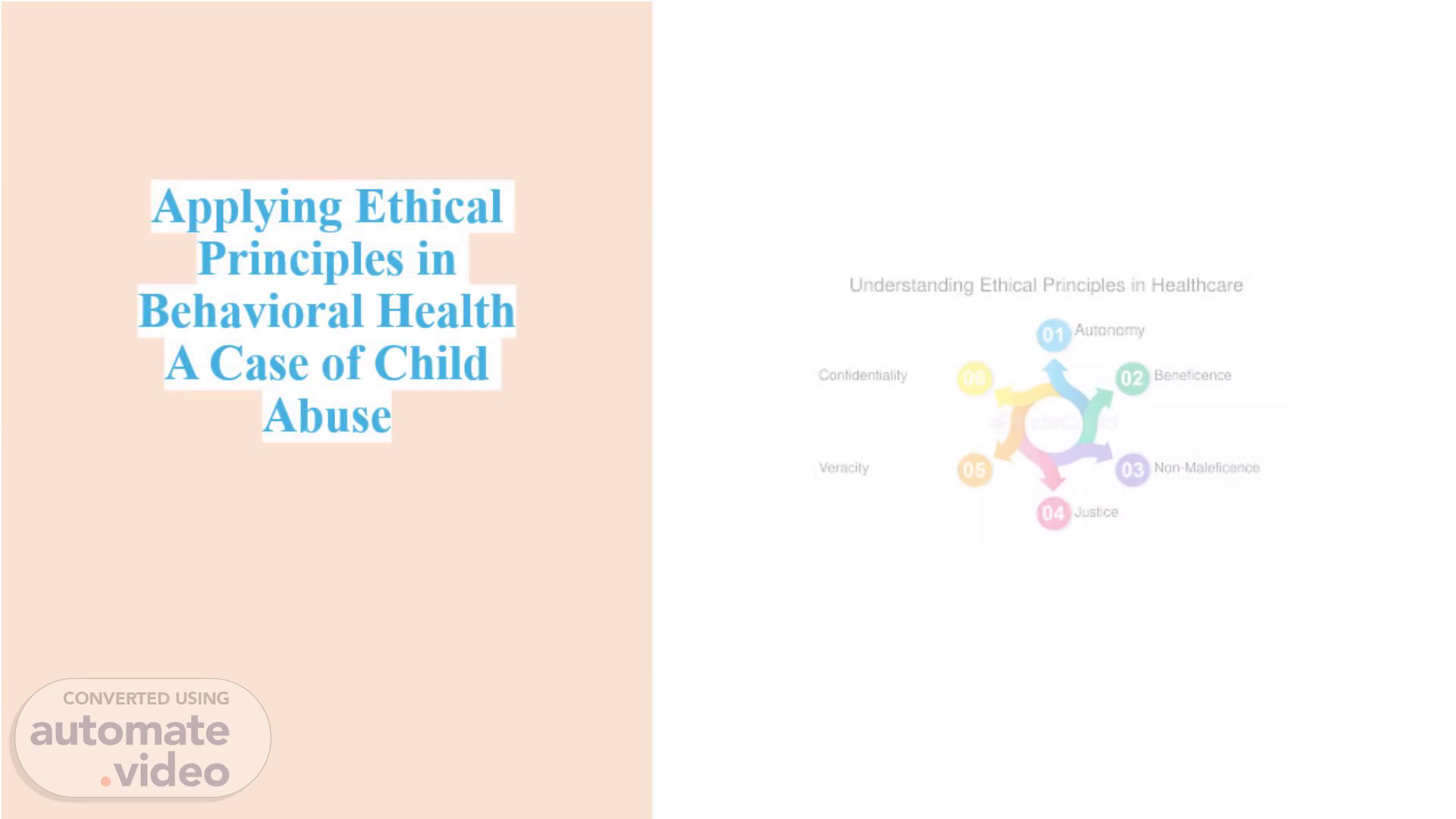
Applying Ethical Principles in Behavioral Health A Case of Child Abuse
Scene 1 (0s)
[Audio] Applying Ethical Principles in Behavioral Health: A case of child abuse.
Scene 2 (12s)
[Audio] In this opening section, I want to introduce the focus of our time together: applying ethical principles in behavioral health through the lens of a real case involving child abuse. My goal isn't just to review the ethical principles themselves, but to show how they guide us when we're faced with complex, emotionally charged situations. Ethical reasoning is essential in behavioral health because the decisions we make directly affect the safety, dignity, and well‑being of vulnerable individuals. The case I'll be walking you through involves a mother who, under significant stress, engaged in an abusive incident toward her son. While she is generally caring, her circumstances created a moment where both ethical and safety concerns had to be addressed. This case gives us a meaningful opportunity to explore how ethical principles function in real‑world practice, not just in theory. Throughout this presentation, I'll be focusing on six core ethical principles: autonomy, fidelity, beneficence, nonmaleficence, justice, and honesty. These principles form the foundation of ethical practice and help us navigate situations where there may not be an easy or obvious answer. Understanding them is essential for responsible, compassionate decision‑making. I'll show how each principle applies directly to the case—how they shape decisions like mandated reporting, communication with the client, and planning for safety. I'll also highlight the ethical risks and sensitive areas that come up, including issues of trust, transparency, and emotional complexity. Finally, I'll weave in a Christian worldview to show how compassion, restoration, and accountability can support ethical care. By the end of this presentation, my hope is that you'll see how ethical reasoning protects both the client and the child while promoting long‑term healing and stability..
Scene 3 (2m 10s)
[Audio] In this section, I want to give you an overview of the case we'll be using throughout the presentation. The client is a single mother experiencing overwhelming stressors that significantly affect her emotional stability and parenting capacity. Understanding this context is essential, because ethical decision‑making requires us to consider not only the abusive incident itself but also the circumstances that contributed to it. One of her major stressors is financial hardship. She receives no financial support from her ex‑husband, which creates chronic strain and uncertainty. We know from research that economic stress is a major risk factor for family conflict, and in this case, it plays a substantial role in her emotional overwhelm. On top of that, she lacks emotional and social support. Without a strong support network, she has fewer outlets for stress and fewer resources to help her cope. The abusive incident occurred during a moment of distress. Although she is generally caring, this incident raises immediate safety concerns and triggers mandated reporting requirements. This is where the complexity comes in: she is not a chronically abusive parent, but she did engage in harmful behavior that must be addressed. Ethical practice requires us to avoid overly punitive assumptions while still prioritizing child safety. There are also legal and ethical concerns at play. Mandated reporting laws require immediate action, and ethical principles must guide how we communicate this to the client. Balancing empathy with legal duty is essential. Ultimately, our goal is to protect the child while supporting the mother's growth. Ethical practice seeks both safety and restoration, recognizing that families can heal when given appropriate support..
Scene 4 (4m 3s)
[Audio] Autonomy Here, I begin applying the principle of autonomy to the case. Autonomy is all about respecting the client's right to make informed decisions about her own life and treatment. Even in situations where I'm required to make a mandated report, her voice still matters. Respecting autonomy helps build trust and reduces feelings of powerlessness. One of the ways I support autonomy is by involving the client in planning. That means developing safety plans, treatment goals, and next steps collaboratively rather than imposing them. Collaboration helps the client feel included and respected, even during difficult conversations. Transparency is another key part of autonomy. When mandated reporting is necessary, I explain the process clearly and honestly. This prevents feelings of betrayal and aligns with the principle of honesty. It also helps the client understand that reporting is a legal requirement, not a personal judgment. I also try to offer choices whenever possible—whether that's counseling options, parenting classes, or support groups. Providing options gives the client a sense of control and increases engagement. Empowerment is especially important after a crisis because it helps the client regain confidence and stability. Maintaining dignity is essential as well. Even when addressing abuse, I avoid shaming or demeaning language. Shame can hinder progress and damage the therapeutic relationship. Encouraging participation in decision‑making strengthens the therapeutic alliance and supports long‑term change. Autonomy doesn't mean ignoring safety concerns; it means respecting the client's humanity while addressing those concerns responsibly..
Scene 5 (5m 50s)
[Audio] Fidelity In this section, I focus on the principle of fidelity, which involves maintaining trust, loyalty, and commitment within ethical boundaries. Fidelity becomes especially important in mandated reporting situations because trust can be easily damaged. When a client shares something sensitive and then learns it must be reported, she may feel betrayed or abandoned. My role is to maintain trust through transparency, consistency, and compassion. One way I uphold fidelity is by being reliable and consistent. Predictable communication reassures the client during stressful times and strengthens rapport. When clients know what to expect, they feel safer and more supported. I also avoid making false promises. I never guarantee outcomes I can't control, such as child custody decisions. Honesty protects the relationship and prevents misunderstandings. Professional boundaries are another major part of fidelity. Boundaries prevent emotional entanglement and ensure that my decisions remain objective. They protect both the client and me. Clear communication is essential, especially during mandated reporting. When clients understand the process, they're less likely to feel blindsided or confused. Even when reporting is required, I continue offering emotional support. This demonstrates loyalty within ethical limits and helps the client remain engaged in services. Ultimately, fidelity means supporting the client while fulfilling my legal and ethical duties. It's about showing that I remain committed to her well‑being, even when difficult actions must be taken..
Scene 6 (7m 41s)
[Audio] Beneficence (Part 1) Here, I introduce the principle of beneficence, which focuses on promoting well‑being for both the mother and the child. Beneficence requires me to act in the best interest of those I serve and to support emotional, physical, and social well‑being. In this case, beneficence means addressing the factors that contributed to the abusive incident while also ensuring the child's safety. One way I promote well‑being is by connecting the client to resources. Referrals to financial assistance, counseling, and parenting programs can significantly reduce stress. Access to resources improves long‑term outcomes and supports stability. Reducing stressors is another key aspect of beneficence. Addressing financial strain, emotional overwhelm, and lack of support can help prevent future incidents. Stress reduction is a major protective factor and improves parenting capacity. I also encourage positive coping strategies. Teaching healthier ways to manage stress—such as mindfulness, emotional regulation, or problem‑solving—reduces the likelihood of harmful reactions. Coping skills are foundational in behavioral health and contribute to long‑term resilience. Supporting family stability is another goal of beneficence. When it's safe, strengthening the family unit benefits both mother and child. Ethical practice avoids unnecessary disruption and focuses on healing. Providing education—such as parenting skills, communication strategies, and emotional regulation—empowers the client and reduces the risk of future harm. Strengthening protective factors like social support, coping skills, and financial stability helps build resilience and reduces risk over time. Beneficence is ultimately about supporting growth, safety, and long‑term stability for the entire family. Slide 6 – Beneficence (Part 2) Continuing with beneficence, I want to show how this principle applies directly to the client's situation. Beneficence calls me to actively promote the well‑being of both the mother and the child. It's not just about preventing harm; it's about helping them move toward greater emotional, physical, and social stability. Connecting the client to resources is one of the most practical ways I do this. Referrals to financial assistance programs, counseling services, and parenting support can significantly reduce the stressors that contributed to the abusive incident. When I help her access these supports, I'm not only addressing the immediate crisis—I'm strengthening her long‑term resilience. Reducing stressors is another essential part of beneficence. Financial strain, emotional overwhelm, and social isolation all increase the risk of harmful behavior. By helping her address these issues, I'm supporting her ability to parent safely and effectively. I also focus on teaching positive coping strategies. When I help her learn healthier ways to manage stress—whether through mindfulness, emotional regulation, or structured problem‑solving—I'm giving her tools that reduce the likelihood of future incidents. These skills are foundational in behavioral health and contribute to long‑term emotional stability. Supporting family stability is another important goal. When it's safe, keeping families together and helping them heal benefits everyone involved. Ethical practice avoids unnecessary disruption and focuses on restoration. Finally, I work to strengthen protective factors like social support, coping skills, and financial stability. These are the elements that reduce risk and promote resilience over time. Beneficence, at its core, is about supporting growth, safety, and long‑term well‑being for the entire family..
Scene 7 (11m 51s)
[Audio] Nonmaleficence Here, I turn to the principle of nonmaleficence—"do no harm." This principle becomes especially important in cases involving child abuse because the potential for harm is immediate and serious. My responsibility is to take protective action right away to ensure the child's safety. Mandated reporting is a central part of nonmaleficence. Reporting isn't optional; it's a legal and ethical requirement designed to protect the child from further harm. When I make a report, I'm acting in alignment with this principle. But how I communicate about it matters just as much as the action itself. Transparency is essential. I explain to the client why reporting is required and what the process will look like. When clients understand that reporting is a legal duty rather than a personal judgment, they're less likely to feel blindsided or betrayed. Ensuring child safety remains the highest priority. Every decision I make must reflect that priority. Safety planning becomes a crucial part of the intervention—developing strategies to prevent future incidents, connecting the family to support services, and coordinating with child protective agencies. At the same time, I continue offering emotional support. Even while fulfilling my legal duties, I can still provide empathy and reassurance. This helps reduce shame and fear and keeps the client engaged in services. I also avoid judgment. Judgment can damage the therapeutic relationship and hinder progress. A nonjudgmental stance aligns with trauma‑informed care and supports healing. Ultimately, nonmaleficence requires me to balance empathy with duty. I can care deeply about the mother's struggles, but that care can never override the need to protect the child. Ethical practice means navigating that balance with clarity and consistency..
Scene 8 (13m 50s)
[Audio] Justice In this section, I focus on the principle of justice and how it applies to this case. Justice requires fairness, equity, and impartiality in every decision I make. It means treating both the mother and the child fairly, without punitive attitudes, while still prioritizing safety. Justice also requires me to consider the systemic factors that contributed to the situation. Poverty, lack of support, and chronic stress all play a role in the mother's behavior. When I acknowledge these systemic issues, I avoid unfairly blaming her for circumstances that are, in many ways, beyond her control. This perspective helps me remain compassionate and balanced. Advocacy is another key part of justice. I advocate for resources—financial assistance, mental health services, parenting support—so the client has access to the help she needs. Advocacy promotes equity and reduces barriers to care. I also have to be aware of my own biases. Biases related to socioeconomic status, parenting style, or cultural background can influence decisions in subtle ways. Through self‑reflection, I work to identify and correct these biases so that my decisions remain fair and ethical. Ensuring equal access to services is another expression of justice. The client deserves the same quality of care as anyone else, regardless of her income or background. Justice ensures that decisions are based on ethical standards rather than personal judgments. Ultimately, justice protects vulnerable individuals. Both the child and the mother are vulnerable in different ways, and justice ensures that neither is overlooked. Fair, balanced outcomes support long‑term stability and strengthen trust in the system..
Scene 9 (15m 45s)
[Audio] Honesty Here, I focus on the principle of honesty, which requires full transparency and truthful communication. Honesty is essential for maintaining trust, especially in situations involving mandated reporting. Transparency prevents misunderstandings and supports ethical fidelity. One of the first things I do is explain my legal duties. The client needs to understand my role as a mandated reporter. When she knows that reporting is a legal requirement—not a personal choice—it helps reduce feelings of betrayal. This clarity supports trust and reduces confusion. I also work to clarify expectations. Clients often feel anxious when they don't know what will happen next. By explaining the steps that will follow—the reporting process, potential outcomes, and available supports—I help reduce fear and uncertainty. Avoiding misinformation is critical. Providing accurate information protects the client from unnecessary worry and ensures that decisions are based on facts. Misinformation can cause harm and damage the therapeutic relationship. Honesty also builds trust, even in difficult situations. When I communicate openly and consistently, clients are more likely to stay engaged in services. Engagement improves outcomes and supports long‑term stability. I encourage open communication. Clients should feel comfortable asking questions or expressing concerns. This openness supports autonomy and strengthens the therapeutic alliance. Ultimately, honesty supports informed decision‑making. When clients have accurate information, they can make choices that empower them and support their recovery. Honesty isn't just an ethical requirement—it's a foundation for effective behavioral health practice..
Scene 10 (17m 36s)
[Audio] Integrating All Six Principles In this section, I explain how all six ethical principles—autonomy, fidelity, beneficence, nonmaleficence, justice, and honesty—work together in this case. Ethical practice requires balancing these principles rather than relying on just one. Integrating all six ensures well‑rounded, responsible decision‑making. Autonomy means including the client in planning and decision‑making. Even when I must report, her voice still matters. Respecting autonomy strengthens engagement and preserves dignity. Fidelity is about maintaining trust through consistent and honest communication. Even during mandated reporting, I show the client that I remain committed to her well‑being within ethical boundaries. Beneficence is expressed through supportive services that promote growth and stability. Connecting the client to resources and strengthening protective factors helps both her and her child. Nonmaleficence is addressed through mandated reporting and safety planning. Reporting is necessary to prevent harm, and safety remains the top priority. Justice ensures fairness and equity. I consider systemic barriers and work to provide equal access to resources. Justice helps me avoid punitive or biased decisions. Honesty is demonstrated through transparency about the process. Clear communication prevents confusion and supports trust. When I integrate all six principles, I'm able to support long‑term stability for both the mother and the child. Ethical practice requires balancing compassion, accountability, and safety in every decision I make..
Scene 11 (19m 21s)
[Audio] Sensitive Ethical Principles Here, I highlight the ethical principles that are most sensitive in this case and explain why they require such careful attention. The first principle that becomes especially delicate is nonmaleficence. Because child safety is at the center of this situation, any misjudgment or delay could result in further harm. That reality makes nonmaleficence the guiding force behind every decision I make. Honesty is another principle that becomes sensitive. Even when I communicate transparently about mandated reporting, the client may still feel betrayed or exposed. My responsibility is to maintain honesty in a way that is compassionate and clear, so I don't unintentionally damage the therapeutic relationship. Fidelity is also at risk. When a report is made, clients often fear abandonment or assume that I'm no longer on their side. I work hard to demonstrate consistency and support, even within the boundaries of my legal obligations. Autonomy becomes sensitive as well because mandated reporting limits the client's control. Even though I must act legally, I still want to preserve her dignity and involve her in planning whenever possible. Respecting her voice helps maintain a sense of agency during a very vulnerable moment. Justice is another principle that requires heightened awareness. Systemic barriers—poverty, limited support, chronic stress—shape the client's circumstances. I have to be mindful of my own biases to avoid unfair or punitive interpretations of her behavior. Finally, the emotional complexity of the case increases ethical risk. Strong feelings—whether sympathy, frustration, or protectiveness—can cloud judgment. That's why self‑reflection, consultation, and supervision are essential. Without careful attention, multiple ethical principles could be compromised at once. Ethical vigilance helps ensure that my decisions remain grounded, balanced, and aligned with professional standards..
Scene 12 (21m 26s)
[Audio] Managing Personal Reactions Here, I focus on how I manage my own emotional reactions and personal conflicts when working with challenging cases like this one. The first step is simply recognizing my emotional responses. It's natural to feel sympathy for the mother or distress about the child's experience. By acknowledging these emotions, I prevent them from influencing my decisions in ways that could compromise fairness or objectivity. Supervision plays a crucial role here. I rely on supervision as a space to process my reactions, gain perspective, and ensure that I'm staying grounded in ethical practice. Supervision provides accountability and helps me maintain clarity when emotions run high. Reflecting on my own biases is another essential part of ethical practice. Biases related to socioeconomic status, parenting style, or even my own personal history can subtly shape my interpretations. Through self‑reflection, I work to identify and correct these biases so that my decisions remain fair and balanced. Maintaining boundaries is also critical. Boundaries protect both the client and me. They prevent emotional entanglement and help me remain objective, especially in situations that are emotionally charged or morally complex. I also rely on ethical decision‑making models. These models give me a structured way to think through difficult situations and ensure that I'm considering all relevant factors. They help me slow down, evaluate options, and make decisions that align with professional standards. Above all, I prioritize safety. Safety must always come first—for both the child and the client. This aligns with nonmaleficence and guides every step of the process. Staying grounded in professional ethical codes ensures consistency, fairness, and integrity. These codes serve as my compass, especially when emotions or personal conflicts could otherwise cloud judgment..
Scene 13 (23m 33s)
[Audio] "In this slide, I want to walk you through the ethical actions I took in this case and explain how each one aligns with the six ethical principles. The first major action I took was reporting the abuse. This aligns with nonmaleficence and justice because it protects the child and fulfills both legal and ethical obligations. Reporting is not optional—it is required to ensure safety, and it reflects my responsibility to prevent further harm. Next, I focused on providing emotional support to the client. This action aligns with beneficence. Even though I had to make a report, I wanted her to know that I was still committed to her well‑being. Offering emotional support helps her cope with the consequences of the report and maintains rapport during a very vulnerable moment. I also connected her to resources. Referrals to financial assistance, counseling, and parenting programs help reduce stress and risk. This supports beneficence by promoting well‑being and justice by addressing systemic barriers that contribute to the situation. Transparency was another key action. I explained the reporting process clearly and honestly. This aligns with honesty and fidelity. Clear communication prevents misunderstandings and helps preserve trust, even when the client may feel afraid or overwhelmed. I also encouraged her participation in planning. Involving her in decisions supports autonomy and helps her feel included rather than powerless. Participation increases engagement and supports long‑term change. Advocating for fairness was another important step. I worked to ensure she received the support she needed and wasn't unfairly penalized due to circumstances beyond her control. This aligns with justice and reinforces the importance of equitable treatment. Ultimately, all of these actions support long‑term stability for both the mother and the child. Ethical practice isn't just about responding to the immediate crisis—it's about promoting healing, growth, and safety moving forward.".
Scene 14 (25m 44s)
[Audio] "In this slide, I want to explore how a Christian worldview can inform ethical decision‑making in this case. A Christian worldview emphasizes compassion and grace, and those values shape how I approach the client. Compassion helps me understand her struggles, and grace allows me to respond with empathy while still promoting accountability. Accountability and protection are also central themes in Christian ethics. Protecting the vulnerable—including the child—is a moral responsibility. Reporting the abuse aligns with this value. Accountability isn't about punishment; it's about creating opportunities for growth, healing, and restoration. Human dignity is another key principle. A Christian worldview teaches that every person has inherent worth. This perspective helps me preserve the client's dignity, even when addressing harmful behavior. It prevents me from responding in ways that are shaming or dehumanizing. Restoration and healing are also deeply rooted in Christian thought. My goal isn't just to correct behavior—it's to help the client rebuild, heal, and move toward healthier patterns. Restoration benefits the entire family and aligns with the broader goals of behavioral health. Supporting the vulnerable is another important aspect. In this case, both the mother and the child are vulnerable in different ways. Christian ethics call me to support both individuals, which aligns closely with the principle of justice. Balancing justice and mercy is essential. Justice protects the child, while mercy supports the mother. A balanced approach ensures that both safety and compassion are upheld. Finally, for clients who value spirituality, encouraging spiritual growth can be a powerful source of resilience. Faith can provide meaning, strength, and motivation for change. This supports long‑term healing and stability.".
Scene 15 (27m 48s)
[Audio] "In this slide, I want to explain why safeguarding ethical principles is absolutely essential in cases involving child abuse. The first and most important reason is child safety. Nonmaleficence—'do no harm'—requires me to take immediate and appropriate action to prevent further harm. If I hesitate or fail to act, the child could remain at risk, and that is something I cannot allow. Safety forms the foundation of every ethical decision I make. At the same time, I recognize how important it is to maintain trust with the client. Mandated reporting can easily strain or even damage that trust, which is why honesty and fidelity become so critical. By communicating openly, explaining my role clearly, and remaining consistent in my support, I help the client understand that I am not abandoning her. I am fulfilling a legal and ethical responsibility while still walking alongside her in the healing process. Safeguarding ethical principles also matters because these situations are emotionally charged. It's easy for personal feelings—sympathy, frustration, fear—to influence judgment. By grounding myself in ethical principles, I ensure that my decisions remain fair, balanced, and focused on the well‑being of everyone involved. Ethical principles also help me navigate systemic issues. Poverty, lack of support, and chronic stress all shape the client's circumstances. Justice requires me to consider these factors and advocate for resources that promote equity rather than punishment. Ultimately, safeguarding ethical principles protects both the child and the mother. It ensures that my actions are consistent, compassionate, and accountable. When I uphold these principles, I create a pathway not only for immediate safety but also for long‑term healing and stability.".
Scene 16 (29m 47s)
[Audio] "As we come to the final slide, I want to bring everything together and reflect on the broader significance of ethical practice in behavioral health. Cases involving child abuse are some of the most challenging situations we face. They require us to balance compassion with accountability, empathy with legal duty, and support with firm boundaries. One of the most important things I hope you take away is that ethical principles are not concepts—they are practical tools that guide real decisions. Autonomy reminds me to respect the client's voice. Fidelity pushes me to maintain trust. Beneficence encourages me to promote well‑being. Nonmaleficence ensures I prevent harm. Justice calls me to fairness and advocacy. Honesty keeps communication clear and grounded. Another key point is that ethical practice is relational. How I communicate, how I show up emotionally, and how I support the client all influence the outcome. Even when I must take difficult actions, I can do so with compassion and respect. I also want to emphasize the importance of hope. Even in situations involving harm, families can heal. With the right support, accountability, and resources, clients can grow, change, and rebuild healthier patterns. Ethical practice creates the conditions for that healing to happen. Finally, I want to acknowledge the emotional weight of this work. It requires courage, humility, and a commitment to ongoing self‑reflection. But when we ground ourselves in ethical principles, we protect those who are vulnerable and support meaningful, long‑term change. Thank you for engaging with this material. My hope is that you leave with a deeper understanding of how ethical reasoning guides our work and how it can transform even the most difficult situations into opportunities for healing and restoration.".
Scene 17 (31m 52s)
References. American Psychological Association. (2017). Ethical principles of psychologists and code of conduct. APA. Fisher, C. B. (2021). Decoding the ethics code: A practical guide for psychologists (5th ed.). SAGE. Martinez‑Martin, N., Insel, T. R., & Cho, M. K. (2021). Ethical issues in using emotion‑recognition technologies in mental health. AMA Journal of Ethics, 23(2), 156–162. Shelly, J. A., & Miller, A. B. (2006). Called to care: A Christian worldview for nursing. IVP Academic. Reamer, F. G. (2018). Ethical standards in social work: A review of the NASW code of ethics (3rd ed.). NASW Press. Corey, G., Corey, M. S., & Callanan, P. (2019). Issues and ethics in the helping professions (10th ed.). Cengage Learning. National Association of Social Workers. (2021). NASW code of ethics. NASW Press..