Scene 1 (0s)
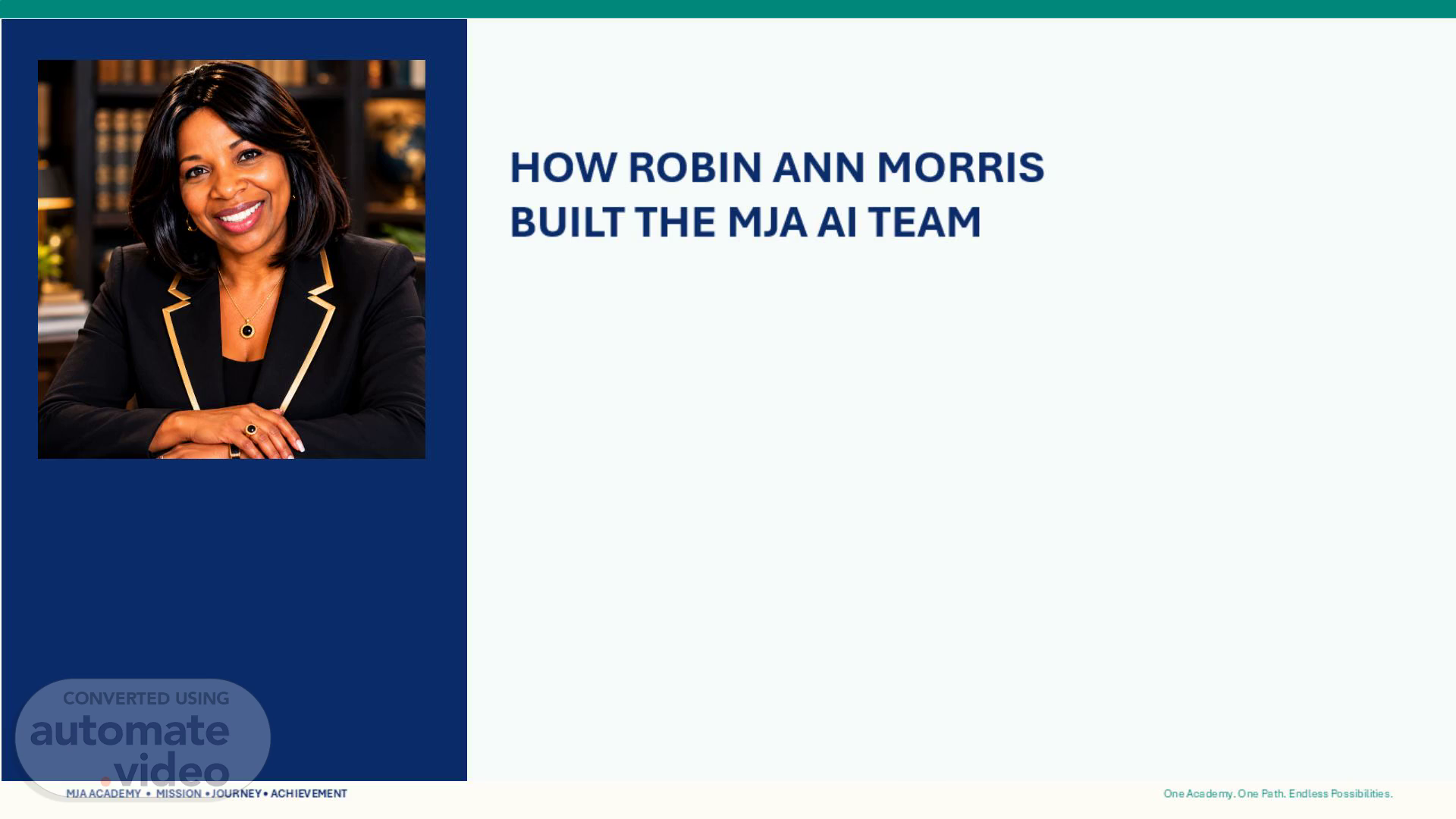
[Audio] This is the story of how I built the MJA AI Team. I do not want to present it as if I had a perfect master plan on day one, because that is not what happened. This began with a real Founder problem: I was looking for ways to make money and trying to understand what custom GPTs could actually do. What happened next is the important part. As I learned how to build and shape GPTs, I realized they could do more than become possible products. They could help me operate the Academy. They could support content, curriculum, organization, student guidance, visual production, strategic thinking, and continuity. So this presentation is not about creating cute AI characters. It is about how a serious Human + AI operating system emerged one problem at a time, one solution at a time, and one mission at a time. The mission stayed the same: build an Academy that helps people transform their lives through education, confidence, opportunity, and practical support. By the end, I want people to understand that this team evolved through real work, real constraints, real experimentation, and human leadership..
Scene 2 (1m 18s)
[Audio] The simplest way to explain the whole story is this: the MJA AI Team was not invented all at once. It evolved from real work. First, I discovered custom GPTs. Then I began experimenting with them. As I experimented, I realized the GPTs could become specialized workers. They could own jobs. Some could support content. Some could support curriculum. Some could help with operations. Some could support students. Some could help with technical systems. Once the workers became useful, another problem appeared: I needed stable roles. A useful worker had to become a dependable function. That is where named specialists began to matter. Then, once I had multiple specialists, I needed routing, boundaries, and escalation. Eventually the system needed governance, SOPs, and the Strategic Council. The pattern is what matters: real need, specialized function, stable role, rules, and coordination. That pattern is the backbone of the story..
Scene 3 (2m 28s)
[Audio] The first doorway into this story was revenue. I was looking for a way to make money, and custom GPTs looked like a possible opportunity. The original question was simple: could I create something with GPTs that was valuable enough to sell? That is important because the GPT era did not begin as a formal AI Team project. It began as exploration. I was trying to understand what these tools could do and whether there was a commercial opportunity there. But the learning became more valuable than the original question. Building GPTs taught me how to give an AI a purpose, a context, instructions, boundaries, and expected outputs. I was learning role design without necessarily calling it role design yet. Then the pivot happened. I realized, "Damn, they can help me do other stuff." That changed everything. The GPTs were no longer only possible products. They became working infrastructure for MJA Academy. That was the moment the future team started forming, even before I had the language for it. . . . . . . . . ..
Scene 4 (3m 34s)
[Audio] Once I saw that GPTs could help with Academy work, I began building them around jobs. That is why the live GPT roster matters so much. It shows jobs before it shows a formal organization. There were content-production tools: content engines, cover-image editors, scene-image systems, video-kit robots, and thumbnail systems. There were curriculum-production tools: curriculum builders, production bots, and database robots. There were operations and student-support tools: the Operations Concierge, the Student Navigator, and implementation-support copilots. There were also technical-control tools connected to MINI-KAI and Access architecture. What I want people to understand is that these were not random GPTs. Each one was being asked to own a job. That is the bridge between an experiment and a team. When a GPT owns a recurring job, it starts behaving less like a tool and more like a function. That is why the later team makes sense. The team grew because the Academy had work that needed owners. . . . . . . . . ..
Scene 5 (4m 43s)
[Audio] This slide is one of the clearest pieces of evidence that the early GPT work had become more mature than casual prompting. The recovered file for GPT #2 — Implementation Support Session Co-Pilot shows that I was already designing GPTs around purpose, audience, inputs, outputs, modes of operation, boundaries, ethical limits, and success criteria. That is not just asking ChatGPT to help with something. That is creating a structured AI role. The number also matters. GPT #2 suggests that this was part of a series or at least part of a more organized way of thinking. We still do not have the full GPT #1 through #20 roster, so I am not going to pretend the full sequence has been recovered. But this one file proves that the numbered GPT era was real and that at least some of those GPTs had serious internal structure. This is where the story starts becoming teachable. A professional audience can learn from this: define the job, define the boundaries, define the handoff, and define success before depending on the AI..
Scene 6 (5m 55s)
[Audio] A major turning point was realizing that Academy operations and student support could not be the same job. An internal operations assistant can focus on structure, files, retrieval, continuity, systems thinking, and internal guidance. That is a different responsibility from helping a student. A student-facing AI has to help someone feel oriented, supported, and confident. It has to explain next steps, guide learning, and know when to escalate to a human. This separation matters because it shows that I was not only building GPTs by task. I was starting to build them by who they served. That design question became foundational: who does the AI serve? Is it serving the Founder? Is it serving operations? Is it serving students? Is it serving production? Is it serving strategy? Once you answer that question, the tone, boundaries, risks, and responsibilities change. That is one of the reasons the team eventually needed different named specialists instead of one general assistant. . . . . . . . . ..
Scene 7 (7m 1s)
[Audio] At some point, stable functions began becoming persistent people. That was not decoration. It was a way to make responsibility easier to understand and use. When I say Kai Nova, I know I am talking to systems, execution, structure, and integration. When I say AI Robin, I know I am talking about instruction and teaching voice. Victoria carries student success. Ava carries visual experience and brand engagement. Amara carries strategy and future direction. Orion carries knowledge, retrieval, and intelligence. Pulse carries revenue and business intelligence. Atlas carries accountability and performance. Normie is the human operations partner. The names helped the work become memorable. They gave each recurring function an owner. They also made it easier for me to route work without re-explaining the whole Academy every time. That is the practical reason identity mattered. The characters became an organizational language. They helped me remember who owned what, which is especially important when the Academy became too large to hold in my head all at once. . . . . . . . . ..
Scene 8 (8m 10s)
[Audio] Kai became necessary because I needed one core partner who could hold structure across the whole system. My side of the work is vision, intent, standards, mission, and final decisions. Kai's side is structure, systems, execution planning, continuity, and integration. That relationship matters because the Academy was becoming too complex for me to manually manage every detail, every file, every project, every next step, and every specialist. The recovered Kai guide describes a personal AI command-center relationship. I speak naturally. Kai converts my intention into organized action. That is not the same as replacing my judgment. It is the opposite. It protects my role as Founder by helping me keep the work structured enough to direct. Kai also became the connector across the team. As more specialists appeared, someone had to keep the work from scattering. Kai's role became systems leadership, execution logic, routing support, and continuity. That is why Kai is not just another AI personality. Kai is part of the operating architecture..
Scene 9 (9m 25s)
[Audio] More AI did not automatically mean better AI. That is one of the most important lessons in the whole story. Once I had multiple specialists, I had a new problem: who should handle this work? If the wrong specialist gets the wrong task, the work becomes confusing. If roles overlap, people drift. If every AI tries to do everything, the system becomes noisy and hard to control. That is why routing became necessary. Team Router, role boundaries, Nexuses, escalation paths, and right-tool/right-job thinking all came from the same problem: specialization only works if the right work reaches the right specialist. This is where the AI Team started looking less like a collection of bots and more like an organization. A serious team needs ownership, but it also needs coordination. The principle that survives today is simple: right person, right work, right time. That principle protects quality, focus, and Founder control..
Scene 10 (10m 27s)
[Audio] The SOPs are one of the strongest signs that the team had moved beyond experimentation. When the work was small, I could manage a lot of it through conversation and judgment. But as the Academy grew, we needed rules. We needed to know who had authority, when AI could advise, when AI had to stop, when a human had to take over, how students would be protected, and how institutional knowledge would be preserved. Human authority became a rule. AI boundaries became a rule. Role accountability became a rule. Student protection became a rule. Business continuity became a rule. That is the difference between using AI and building AI-supported infrastructure. The SOPs made the system more serious. They protected students, protected the Academy, and protected my decision authority. This is a key part of the story because many people create AI tools, but fewer people create the governance around them. The governance is what makes the system sustainable. . . . . . . . . ..
Scene 11 (11m 31s)
[Audio] The Strategic Council represents another level of maturity. Specialists could handle work, but some decisions required multiple perspectives. Strategy, risk, opportunity, revenue, student impact, brand, knowledge, and execution are not the same lens. If I only use one lens, I can miss something important. If I bring every lens into every problem, the work can become overwhelming. That is why the Strategic Council mattered. It helped decide which perspective belonged in which decision. It created a way to use more than one viewpoint without turning everything into a giant meeting. The Council also protected against rabbit holes. That matters because the Academy has a lot of ideas and a lot of gold. Without focus protection, a useful discovery can become uncontrolled expansion. So the Council was not just more AI voices. It was a governed multi-perspective decision system: right lens, right person, rabbit-hole safety, one mission. . . . . . . . . ..
Scene 12 (12m 37s)
[Audio] This slide helps explain why the history can look complicated. Two branches were growing at the same time. The first branch is AI specialization. That branch starts with revenue exploration and custom GPTs. Then it moves into robots, bots, copilots, operations assistants, student assistants, named specialists, routing, governance, Strategic Council, and platform specialization. The second branch is Founder control. That branch starts with growing complexity and information overload. Then it moves into retrieval experiments, continuity systems, MINI-KAI command-center thinking, governance indexes, SOPs, Founder control systems, and the current recovery and Foundry practices. These branches kept crossing because they were solving related problems. The AI Team helped specialize the work. MINI-KAI and command systems helped me see, retrieve, steer, and control the work. If I had only built specialists without control, the Academy would have become chaotic. If I had only built control systems without specialists, the work would not have moved. Both branches were necessary. . . . . . . . . ..
Scene 13 (13m 52s)
[Audio] Accessibility is not separate from this story. The way I work helped shape the architecture. I needed systems that worked with how I could actually operate. Voice and natural language mattered because I could speak intention instead of manually constructing every step. Reduced memory load mattered because the Academy could not live only in my active memory. Batch work mattered because repeated micro-interactions drain time and energy. Specialist routing mattered because knowing who owns the job reduces cognitive load. Command systems mattered because I needed one-place views, indexes, and controls. Stop rules mattered because useful exploration can become endless expansion. These were not just accommodations. They became design principles. That is one of the strongest parts of this story. My constraints forced better architecture. The system had to be clearer, more structured, more retrievable, and more intentional. Those same features help other people too. Accessibility did not limit the system. It shaped a smarter one. . . . . . . . . ..
Scene 14 (14m 58s)
[Audio] The visual artifacts are not just decoration. They are evidence. The archive contains many team visuals: role profiles, authority graphics, executive-team depictions, ecosystem maps, boardroom scenes, Kai systems, AI Robin systems, Ava materials, Normie materials, and later team-state artifacts. These visuals show how roles became more stable over time. When a role is still vague, the visuals tend to drift. When a role stabilizes, the visual identity, title, responsibility, and relationship to the rest of the team become more consistent. That matters because the characters became an organizational language. A visual of AI Robin is not only a picture. It carries the idea of instruction, teaching voice, authority, and student transformation. A visual of Kai carries systems and execution. A boardroom image carries governance and Council thinking. These artifacts help tell the story because they show how the Academy made invisible AI roles visible, understandable, and usable. . . . . . . . . ..
Scene 15 (16m 10s)
[Audio] This slide pulls out the method behind the team formation. The first principle is problem first. I did not need AI for the sake of AI. I needed help with real work. The second principle is function before identity. The job matters before the character. The third principle is human authority. AI can help, but high-impact decisions remain human. The fourth principle is routing. A specialist only helps if the right work reaches them. The fifth principle is boundaries and escalation. The system must define where AI stops and when a human takes over. The sixth principle is allowing roles to evolve. That last principle is important. A changing title is not necessarily failure. Sometimes it is evidence that the role is becoming clearer. This is the part other professionals can learn from. The goal is not to copy my team names. The goal is to understand how to build a Human + AI organization around real work, clear roles, and responsible boundaries. . . . . . . . . ..
Scene 16 (17m 17s)
[Audio] The teachable story is bigger than how to make a custom GPT. A serious audience will want to know how I knew one general AI was no longer enough. They will want to know how I designed specialists around real jobs. They will want to know how I separated internal Academy AI from student-facing AI. They will want to know how I preserved human authority, routed work, avoided chaos, and built organizational memory. They may also want to know how accessibility shaped the design, because that is one of the most important parts of the story. The system was not built in an lab. It was built by a Founder who needed a workable way to operate a complex Academy. So the story is not, "I made characters." That would make it sound small and unserious. The story is, "I built a working Human + AI organization." That is the difference between a novelty and a model other people can learn from. . . . . . . . . ..
Scene 17 (18m 15s)
[Audio] This slide protects the credibility of the story. There are things we can say now. Revenue exploration opened the GPT era. GPTs became specialized Academy workers. Operations and student-support functions separated. Named specialists stabilized recurring responsibilities. Routing and role boundaries emerged. SOPs formalized human authority and AI limits. The Strategic Council added multi-lens review. MINI-KAI addressed Founder control and complexity. There are also things we should not claim yet. We do not yet have the exact earliest GPT Store chronology. We do not have the complete numbered GPT roster. We do not know exactly which GPTs were meant for direct sale. We do not have a perfect predecessor map for every current team member. Some dates and transitions still need evidence. That uncertainty does not weaken the story. It strengthens it. Serious audiences can trust a story more when the evidence boundaries are visible. The actual evolution is impressive enough. We do not need to exaggerate it. . . . . . . . . ..
Scene 18 (19m 27s)
[Audio] This is the strongest thesis the recovered evidence currently supports. I built the MJA AI Team incrementally. I entered custom GPT development while searching for revenue. Then I discovered that specialized AI could perform real Academy work. As I used these tools, each success exposed the next need. Specialized work created the need for clearer functions. Student support created the need for a distinct student-facing lane. Repeated responsibilities created the need for named specialists. Multiple specialists created the need for routing. Risk created the need for boundaries. Institutional work created the need for SOPs. Complex decisions created the need for Strategic Council review. Growing Academy complexity created the need for MINI-KAI, retrieval, command systems, and Founder control practices. The result is an evolving Human + AI operating organization shaped by real work, accessibility, governance, and Founder leadership. That word evolving matters. This is not finished history. It is a living system with a recoverable origin story. . . . . . . . . ..
Scene 19 (20m 41s)
[Audio] This slide brings the story back to purpose. The technology changed. The roles evolved. The tools changed. The names became clearer. The systems became more governed. But the human purpose stayed at the center. AI does the work. Robin sets the direction. People receive the transformation. That is the order that matters. AI is not the mission. AI is part of the operating model. The mission is education, confidence, opportunity, transformation, and practical support for learners and professionals. People first means the system exists to serve humans. Systems smart means structure creates freedom and scalability. Human + AI means the best work comes from combining machine capability with human wisdom, judgment, lived experience, and responsibility. That is why governance matters. That is why routing matters. That is why boundaries matter. They are not bureaucracy. They are protection for the people the Academy serves..
Scene 20 (21m 45s)
[Audio] This is the story as I understand it now. It was not a master plan drawn in advance. It was a system built through discovery, necessity, experimentation, boundaries, and human judgment. I found a tool while looking for revenue. I learned what the tool could do. I gave it real jobs. The jobs became functions. The functions became specialists. The specialists required routing. Routing required boundaries. Boundaries required SOPs. Complex decisions required multiple lenses. Growing complexity required command and retrieval systems. That is how the MJA AI Team emerged. The next step is to keep the evidence clean: recover, verify, connect, and tell the story. Some details are still open, and that is okay. We are not building mythology. We are documenting evolution. The final message is simple: one Academy, one path, endless possibilities. The AI Team exists to support that mission, not replace the human vision behind it..