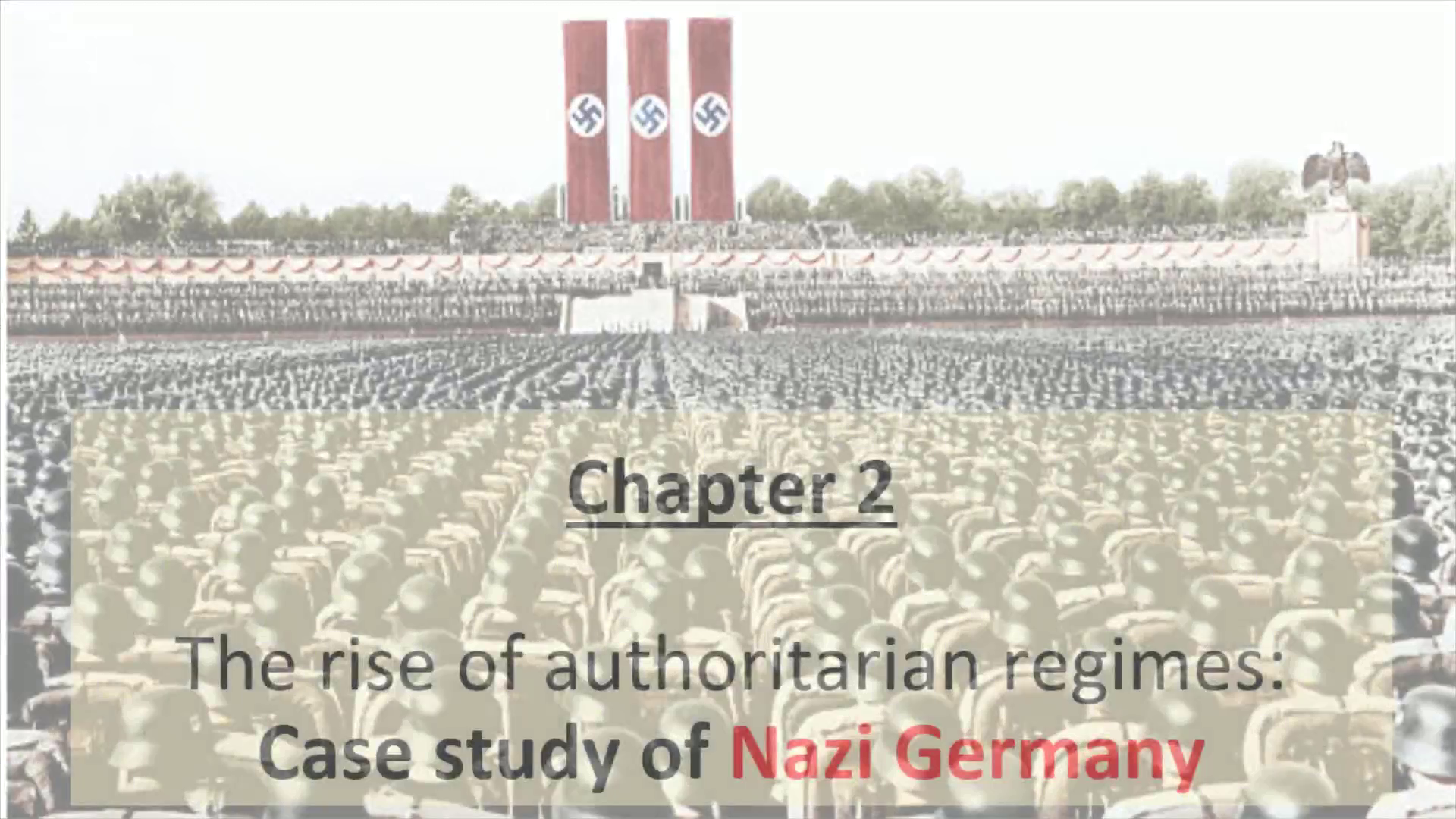
Chapter 2 The rise of authoritarian regimes: Case study of Nazi Germany


Scene 1 (0s)
[Audio] Today we will take a look at the first part of chapter 2: Why did the Nazis rise to power?.
Scene 2 (13s)
[Audio] There will be a total of 4 lessons, covering the 3 main reasons why the Nazis rose to power in a democratic country. A weak Weimar government, The Great depression, and the appeal of the Nazi party. Before we start the lesson, think about why we are learning this part. Can we draw parallels between their rise and the world today? What lessons can we use from this to apply to real life?.
Scene 3 (42s)
[Audio] lesson 1, The weakness of the Weimar Government. By the end of this video, you will learn how the poor political and economic actions led to German people losing faith the the new democratic government..
Scene 4 (58s)
[Audio] The Weimar Republic refers to Germany after the Kaiser abdicated in 1918. The Weimar government refers to the democratic government that took over the fallen monarchy. They republic and government are named after the town of Weimar where the new republic was born. Look at the slides to find out the main difference between a monarchy and a republic. What other modern day republics can you think of? Hint hint, we're living in one right now..
Scene 5 (1m 30s)
[Audio] Here are more differences between a republic and a monarchy..
Scene 6 (1m 48s)
[Audio] This new government only lasted from 1918 to 1933. To the Germans, the new government Did not match the prestige of the Monarchy. Being used to authoritarian rule, they were not confident in the new government's ability to solve the country's economic and political instability. Furthermore New government also seen as November Criminals for betraying Germany and signing the treaty of versailles on Nov 1918.
Scene 7 (2m 18s)
[Audio] Because of the German people's unfavorable view of the government, the main political challenge faced by the new government was the Lack support from people, politicians and soldiers. As their unpopularity grew, extremism grew. The new government remained weak and struggled to hold on to power and authority in the country.
Scene 8 (2m 40s)
[Audio] Extremism was born from both the left wing and right wing. This refers to the people's political leanings. Take a look at the poster. What is your own leaning? This extremism led to 2 events, the Spartacus uprising of 1919 and Kapp Putsch in 1920. These events destabilized the new republic and made it more difficult for the government to be seen as an authority figure as well as recover from world war 1.
Scene 9 (3m 26s)
[Audio] The Spartacist Rising of 1919 came from communist sympathisers. They believed that the working class must form the government..
Scene 10 (3m 52s)
[Audio] The Kapp Putsch was led by Right Wing extremists who attempted to overthrow government due to unhappiness from the Treaty of Versailles. Some also wanted the Kaiser (German King/Emperor) to return back to power..
Scene 11 (4m 17s)
[Audio] So what does this have to do with Nazis? They only came into power nearly 14 years after the creation of the Weimar republic. Think about it. An entire generation of Germans who grew up in an unstable country and lost their faith the new government. This laid the groundwork for many people who, many years later, started to admire a seemingly strong and authoritative party like the nazis.
Scene 12 (4m 46s)
[Audio] The Weimar government also made a huge blunder by causing hyperinflation.
Scene 13 (5m 5s)
[Audio] Inflation occurs naturally. For example, a chicken rice that cost 20 cents 30 to 40 years ago will cost 3 dollars now. However, hyperinflation occurs when prices of goods spiral out of control, too high and too fast. One of the reason this happens is when a country prints money, severely dropping the value of the money..
Scene 14 (5m 31s)
[Audio] Context! In 1919, Germany was close to bankruptcy because of the enormous expense of the war. This was Worsened by reparation from allies.
Scene 15 (5m 44s)
[Audio] What caused the government to print a lot of money? In January 1923, French and Belgium troops occupied the Ruhr because the Germans claimed they were unable to make the full reparations payment. German workers responded by going on a strike. This paralyzed the German industry in the Ruhr.
Scene 16 (6m 8s)
[Audio] The German government printed more money to pay striking Ruhr Workers and to pay off its reparation debts. However, by increasing the number of notes (money) meant that the currency had less value. It became so worthless that people were using the money to burn and keep warm..
Scene 17 (6m 29s)
[Audio] Check out this photo. What can we infer?.
Scene 18 (6m 41s)
[Audio] Lets say it took you 5 years to save 10,000 dollars. Wow. A lot! Time to holiday in Japan! However, during a hyperinflation, your 10,000 dollars might suddenly be worth 10 cents in a single night. Would you be mad? Of course! This event caused many people's savings to be wiped out, especially the middle class and wealthier families..
Scene 19 (7m 13s)
[Audio] Lesson 2: Origins of Nazi party. How did the Nazi party change to be more appealing after Munich Putsch?.
Scene 20 (7m 27s)
[Audio] Hitler joined the right-wing party in 1919 after he agreed with many of the anti-Weimar sentiments and became leader by 1921. He Helped developed Nazi's nationalistic 25 point program which focused on making Germany great again. By 1923, there were 50, 000 members, many of them ex soldiers. What does that tell you about the appeal of the Nazis and Hitler? In 1923, Hitler believed that he had enough manpower to to violently rebel against Weimar government and take over the government during 'The Munich Putsch'.
Scene 21 (8m 6s)
[Audio] Read the comic above to see why the rebellion failed.
Scene 22 (8m 47s)
[Audio] In Hitler's trial, it became a showcase for him. Like a weird tik tok influencer. He made long speeches criticizing the Weimar Republic and setting out his ideas. The newspapers Reported extensively on his speeches and Hitler became a national celebrity. In prison, he wrote 'Mein Kampf', a book that is today banned in many countries including Singapore. I think you can guess why. Anyway, Millions of Germans back then red it, and Hitler's ideas became very well-known..
Scene 23 (9m 24s)
[Audio] Why was this significant to the rise of Nazis? The failed rebellion Convinced Hitler that he could only seize power through the democratic process. After his release, he Reorganized his party to achieve power through democratic process and winning votes, which we will look at later on. By the way, this is also how emperor Palpateen rose to power in star wars. Ha ha ha.
Scene 24 (9m 53s)
[Audio] Lesson 3, the great depression. Was the Great Depression the "spark" that led to the rise in support for extremist parties like the Nazi party?.
Scene 25 (10m 7s)
[Audio] Both hyperinflation and the great depression were economic crisis. However, while the Weimar government caused hyperinflation, the Great depression was started elsewhere. However, it was a significant event due to how poorly the German government handled it.
Scene 26 (10m 27s)
[Audio] Take a look at the graph above. Do you notice anything about the support?.
Scene 27 (10m 43s)
[Audio] https://www.youtube.com/watch?v=rXkSCZdq0Sg.
Scene 28 (10m 56s)
[Audio] The great depression was not great. It was terrible. It was a Severe global economic depression that started in USA and spread worldwide. This led to USA recalling loans and investments in Germany. Without the loans and investment, Businesses went bankrupt, factories closed, millions lost jobs. By 1932, 6 million people, one-third of the population, were unemployed. This led to a severe Social Crisis. Poverty, homelessness and starvation became common..
Scene 29 (11m 37s)
[Audio] Unfortunately, the Weimar government effectively failed as they were too divided to make a decision to solve the crisis in Germany. This also started the President's Rule by Decree, where he decided who became Chancellor and pass new laws under Article 48 without Reichstag's approval. Take a minute to think about what would happen if someone as powerful as the president had unchecked power? Article 48 will be significant in part 2, when Hitler take absolute control of the government.
Scene 30 (12m 9s)
[Audio] The unpopularity of the government was worsened by the Chancellor. During the Great Depression, Chancellor Bruning CUT spending on social welfare and government wages. This was seen as so harsh that many members of Reichstag refused to support. This led to President Hindenburg using Article 48 to pass these harsh laws which also devastated millions of ordinary Germans That's how this Chancellor got the name The Hunger Chancellor from Germans. What if Singapore's government did the same thing during the covid crisis? Instead of the financial help they have given to many Singaporeans, they decide, NOPE. No welfare. What do you think will happen?.
Scene 31 (12m 58s)
[Audio] Because of the incompetence of the government, Germans lost faith in their ability to solve the crisis, and led to the rise in support for extreme parties like the German communist party and Nazi party. People thought that they might have solutions to economic problems and seemed more stable However, the rise in popularity of communists frightened many germans, especially middle class and wealthy Germans and business owners. Can you remember what communists believe in? Would you give up your wealth. Yeah, nah. This group of Germans turned to Nazis to take control of the situation and defeat communism.
Scene 32 (13m 41s)
Inference 1 Inference 2 The unemployment rate steadily rose from 1928 to 1933. More people voted for the Nazi Party when unemployment rate rose..
Scene 33 (13m 58s)
[Audio] Lesson 4, the appeal of the new and improved nazi party.
Scene 34 (14m 14s)
Reasons for rise of Hitler Weaknesses of the Weimar Republic Economic Challenges - Hitler’s charisma and oratorical skills - The SA and SS - Success of Nazi political campaigns (use of propaganda) Political: Weak and unpopular Weimar Government Economic: Hyperinflation - The Great Depression Appeal of Hitler and the Nazi Party.
Scene 35 (14m 33s)
[Audio] Look at Hitler's speech to german women. How did Hitler win over many German women's votes with his speeches?.
Scene 36 (15m 17s)
[Audio] Hitler was a remarkable and charismatic speaker, and to many Germans, he seemed to understand their plight and suffering. He used his speeches to win over people by promising them things they wanted to hear. Order, unity, strength, glory. He also targeted peoples anger towards the Jews and communists for Germany's problems. Like many influencers today, he took advantage of the modern technology of that time to gain as much followers as possible..
Scene 37 (15m 56s)
[Audio] He used the SA to win over Germany's support, but showing how the Nazis can bring order to the country, something which many Germans wanted to see. For example, the SA broke up communist meetings and strike, impressing businesses and anti-communists..
Scene 38 (16m 14s)
[Audio] The SS were Hitler's personal bodyguard, used to Stamp out Hitler's rivals inside and outside the party.
Scene 39 (16m 28s)
[Audio] The SA and SS Gave the impression of discipline and order. This gave the impression to Germans that the Nazi provided social order back to their communities that the Weimar government could not give.
Scene 40 (16m 42s)
[Audio] The Nazis also heavily relied on propaganda to gain support. Joseph Goebbels was in charge of Nazi propaganda. The propaganda Deliberately appealed to people's emotions rather than intellect. This is done by portraying Nazis as strong united party behind one leader, They also Exploited the Great Depression by Blamed the economic problems on the Weimar politicians, Communists and Jews.
Scene 41 (17m 10s)
[Audio] The Nazis also Leveraged on people's fears of Communism. Many Germans were afraid that the Communist would take over Germany and take away their their personal property and wealth. Land-Owning Farmers feared that the Communists take over their lands and assets. Businessmen feared Their businesses might be taken over by a Communist government.
Scene 42 (17m 35s)
[Audio] These fears prompted the people and the business community to support the Nazi Party, which was one of strongest parties at that time, to stop communism, as the people had lost confidence in the Weimar Republic's ability to forestall a Communists take-over. Support included providing financial support to nazis for their campaign.
Scene 43 (18m 1s)
[Audio] Nazi ideology also appealed to many Germans. The Nazi proposed the abolition of TOV , which heavily weakened Germany. Abolishing it allows Germany to restore their pride and build up the economy. Nazi also promised to establish a strong government – Germany suffered years of having a democratic yet weak Weimar government who couldn't take effective actions to solve Germany's problems. A strong government will be better equip to pass laws that benefit the people..
Scene 44 (18m 34s)
[Audio] People were impoverished and needed more than ever to have a strong leader that will bring them out of poverty. Hitler's ideas gave people hope for jobs and restoration of previous glory. Germans gave support to the Nazi Party and Hitler..
Scene 45 (18m 53s)
[Audio] In Jan 1933, Chancellor Von Papen and President Hindenburg invited Hitler to be the next Chancellor. They wanted to use Hitler's popularity and party to provide support to their own Conservative policies and keep communists under control.
Scene 46 (19m 10s)
[Audio] In the 1st year: Hitler ruled in a coalition government. However, when the time was right and he had won enough support, Hitler acted to take complete control over the government. That is all for the rise of Hitler and Nazi party. Which reason do you thin is the most important reason why the Nazis rose to power?.