Scene 1 (0s)
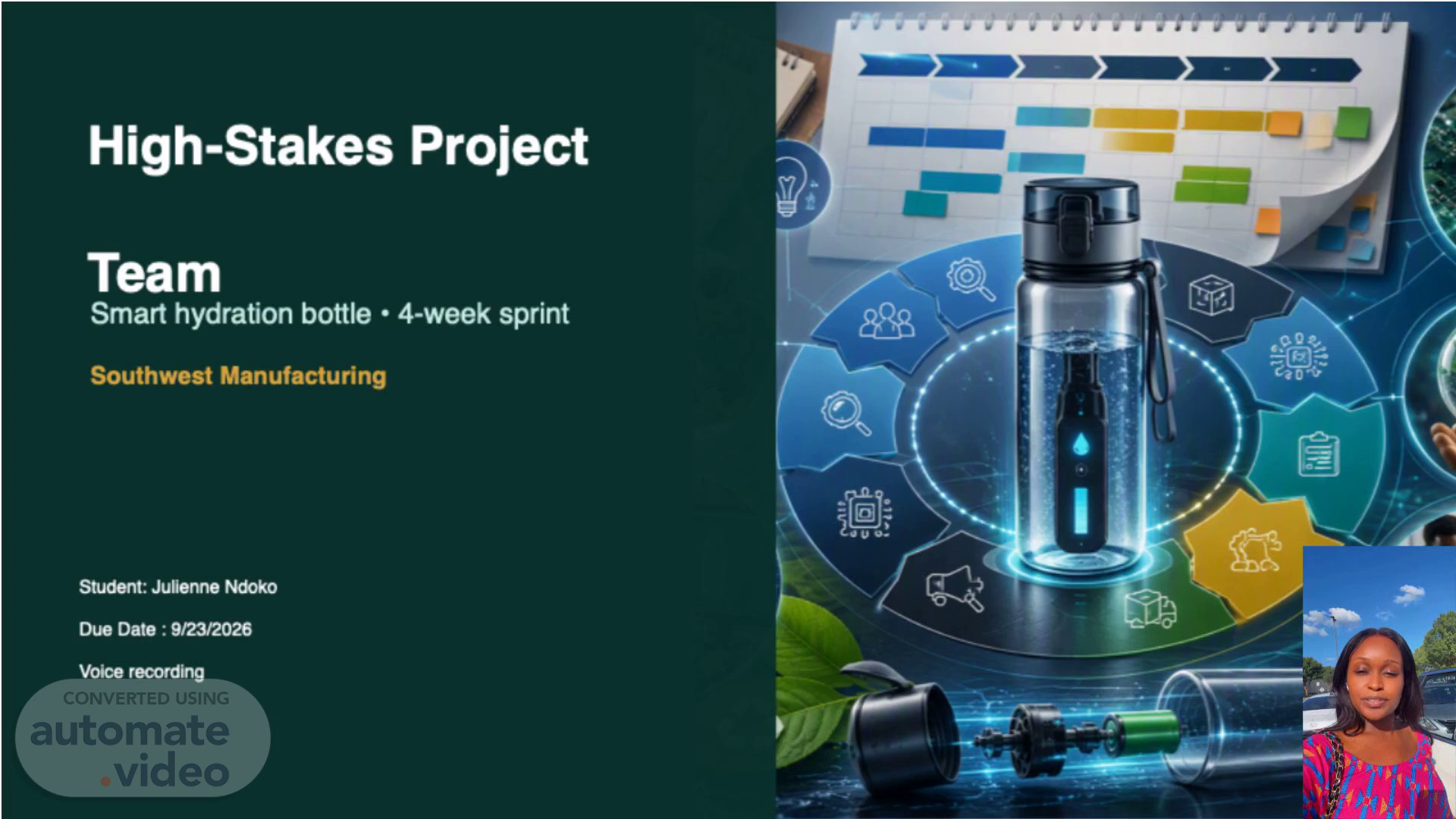
Hello everyone. My name is Julienne Ndoko, and today I’ll be presenting my approach to building and managing a high stakes project team at Southwest Manufacturing. Our challenge is to develop a smart hydration bottle within just four weeks. Under normal circumstances, a project like this would have considerably more time, but this compressed timeline creates a perfect example of why effective teamwork, communication, accountability, and leadership are so important. Throughout this presentation, I’ll explain how I would structure the team, manage our differences, maintain accountability, and keep everyone focused on one common goal..
Scene 2 (40s)
[Audio] Let’s first look at what makes this project so high stakes. Southwest Manufacturing would normally have about twelve weeks to complete this project, but our team has only four. Our goal is to develop a reusable smart bottle that also tracks hydration. Because the schedule has been dramatically compressed, activities that would normally happen one after another now have to overlap. At the same time, we have a limited budget, and the finished product will be presented at a global conference where there will be media exposure and potential investor interest. This means failure could affect much more than the product itself. It could potentially affect the company's reputation and future business opportunities. So, the objective isn't simply to work faster. We have to move quickly without sacrificing safety, quality, or responsible decision making..
Scene 3 (1m 34s)
[Audio] To accomplish that goal, I would build a cross functional team with six complementary roles. The Product Lead would be responsible for overall integration and keeping everyone aligned with the project's objectives. The Design Engineer would focus primarily on usability, while the IoT Engineer would manage the bottle's sensor technology and connection to the application. The Manufacturing Lead would make sure that what we design can actually be produced efficiently. Our Sustainability Lead would evaluate materials and their environmental impact, while the Quality and Launch Lead would focus on testing and product readiness. What is important here is that no single person has all the expertise required to make the project successful. Their skills are different, but they are complementary. The real strength of this team comes from bringing those different areas of expertise together..
Scene 4 (2m 33s)
[Audio] Having talented people doesn't automatically create an effective team. The team still has to develop. I would use the familiar team development process of forming, storming, norming, performing, and eventually adjourning. During forming, I would make sure everyone clearly understands the mission, the timeline, and their responsibilities. During storming, disagreements are likely to emerge because team members have competing priorities. For example, engineering may want more time for development while manufacturing may be concerned about whether the design can actually be produced within our schedule. Instead of avoiding those disagreements, I would encourage the team to discuss them constructively. As we move into norming, we establish routines for communication and decision making. Then, during performing, people have enough trust and clarity to make decisions within their areas of expertise. Finally, during adjourning, we don't simply walk away from the project. We document what worked, what didn't, and what we learned, so those lessons can benefit future projects..
Scene 5 (3m 44s)
[Audio] Another important challenge is managing individual differences. Some team members may enjoy exploring many possibilities, while others prefer to reach a decision quickly and move forward. Some people communicate very directly. Others may need time to reflect before responding. Motivation can also vary. One person may be excited by innovation, while another may be primarily motivated by quality, customer service, or technical excellence. Even the way people approach evidence can differ. One person may prefer rapid experimentation, while another may want more data before making a decision. None of these approaches is automatically right or wrong. My responsibility as a leader is not to make everyone think the same way. It is to create an environment where those differences contribute to better decisions instead of creating unnecessary conflict..
Scene 6 (4m 37s)
[Audio] Generational diversity can add another dimension to those differences. Team members may have different amounts of experience, different perspectives, and different approaches to technology and communication. I would distinguish between two forms of conflict. Cognitive conflict challenges the idea. That can actually be productive because people are questioning assumptions and looking for a better solution. Affective conflict, on the other hand, becomes personal. That's where disagreement can begin damaging relationships and team performance. My goal would therefore be to encourage healthy debate without allowing disagreement to become personal. I would also use shared leadership. The person with the strongest expertise in a particular area should have meaningful influence over decisions in that area. Used properly, diversity becomes an advantage because different perspectives can help the team catch problems that one person working alone might miss..
Scene 7 (5m 35s)
[Audio] Because this is such a compressed project, I would establish our team norms before the pressure increases. First, everyone needs to understand the shared goal and our minimum viable product. Important tasks would have both an owner and a backup. That helps prevent one person's absence or workload from becoming a bottleneck. Decision rights would also be based on risk and expertise. Most importantly, I would set an expectation for direct but respectful communication. One principle I would emphasize is: challenge the idea, but protect the person. Team members should feel comfortable saying, “I disagree with this approach,” without attacking the individual proposing it. Finally, daily stand ups and regular risk reviews would give us frequent opportunities to identify problems before they become crises..
Scene 8 (6m 29s)
[Audio] Two core values would guide this team: accountability and collaboration. Accountability means owning our commitments. If I know my task is falling behind, accountability doesn't mean waiting until the deadline and then explaining what happened. It means identifying the risk early enough for the team to respond. But accountability alone isn't enough. We also need collaboration. Team members must be willing to share expertise, ask for help, and support one another when unexpected problems occur. I would especially encourage people to ask for help early, because in a four week project, losing several days before raising an issue could put the entire schedule at risk. Humility is important here as well. Asking for help isn't weakness. Sometimes it is the most responsible thing a team member can do..
Scene 9 (7m 20s)
[Audio] To manage our extremely limited schedule, I would organize the project into a four week stage gate sprint. Week one focuses on freezing the major requirements. We need sufficient clarity so that the team isn't constantly redesigning the product. Week two focuses on developing an integrated prototype. Instead of individual functions working separately, this is where the pieces start coming together. Week three concentrates on testing and supply readiness. We need to understand whether the product works and whether we can realistically build it. Then, week four focuses on launch preparation and rehearsal. These gates serve an important purpose. They create clear points where we stop, evaluate our progress, and determine whether the project is ready to move forward. In a high pressure environment, moving quickly is important, but moving quickly in the wrong direction is still a problem..
Scene 10 (8m 20s)
[Audio] My next strategy is shared leadership based on expertise. I don't believe the formal project leader should make every technical decision. When the issue involves sensors or application integration, the IoT Engineer should lead that discussion. When we're evaluating whether a design can be produced successfully, our Manufacturing Lead should have a strong voice. Sustainability would lead questions related to materials and environmental claims, while Quality would have authority over verification requirements. The Product Lead would then maintain integration across all of those areas. This approach distributes leadership without eliminating accountability. The person closest to the technical issue helps lead the decision, while the overall team remains aligned around the same project objective..
Scene 11 (9m 10s)
[Audio] Communication is especially important when time is limited, but more communication does not necessarily mean better communication. What we need is the right information, going to the right people, at the right time. I would use a short daily stand up focused primarily on blockers rather than lengthy status reports. Decisions would be documented in a real time decision log so team members don't have to repeatedly debate issues that have already been resolved. Twice each week, we would conduct a focused risk review. After major milestones, we would conduct short debriefs to capture lessons while they are still fresh. However, anything involving safety or quality would be escalated immediately rather than waiting for the next scheduled meeting. This communication structure reduces unnecessary noise while allowing critical information to move quickly..
Scene 12 (10m 10s)
[Audio] Success cannot be measured only by whether we deliver the bottle on time. I would use a balanced scorecard that looks at both product performance and team health. For delivery, we would monitor whether our stage gates are being completed on schedule. For quality, we would watch defect trends and results from testing. Cost measurements would help us understand budget performance and supply issues. But I would also pay attention to the team itself, including workload and whether people feel comfortable speaking up about risks. Finally, we would monitor whether lessons and corrective actions are actually being closed. That's important because a project can technically meet its deadline while leaving behind quality problems, exhausted employees, or unresolved risks. True success means delivering the product while maintaining the health and effectiveness of the team that delivered it..
Scene 13 (11m 5s)
[Audio] In conclusion, the biggest strength of this team is not that everyone is similar. It is that everyone brings something different to the table. Our complementary expertise gives us the ability to address design, technology, manufacturing, sustainability, and quality at the same time. But diversity alone will not make the project successful. We also need clear roles and norms, constructive rather than personal conflict, accountability, collaboration, and shared leadership. Finally, our stage gates and learning loops help us balance speed with careful decision making. Ultimately, building a high performing team does not mean eliminating differences. It means creating the structure, trust, and shared purpose that allow those differences to work toward one common goal..
Scene 14 (11m 59s)
[Audio] These are the references that supported the concepts and research used throughout my presentation. They include our course material, research on generational diversity and team innovation, the Bible, and the artificial intelligence tools used to support development of the presentation. The complete citations are provided here for reference..
Scene 15 (12m 31s)
[Audio] Finally, I want to acknowledge how artificial intelligence was used in preparing this presentation. A-I tools supported organization, drafting, speaker notes, visual ideas, and aspects of the presentation design. However, I reviewed and selected the (A I ) generated material based on its relevance to the assignment and course requirements. These tools were used as supporting resources and did not replace my own judgment, analysis, or responsibility for the final presentation. Thank you for listening to my presentation..