Scene 1 (0s)
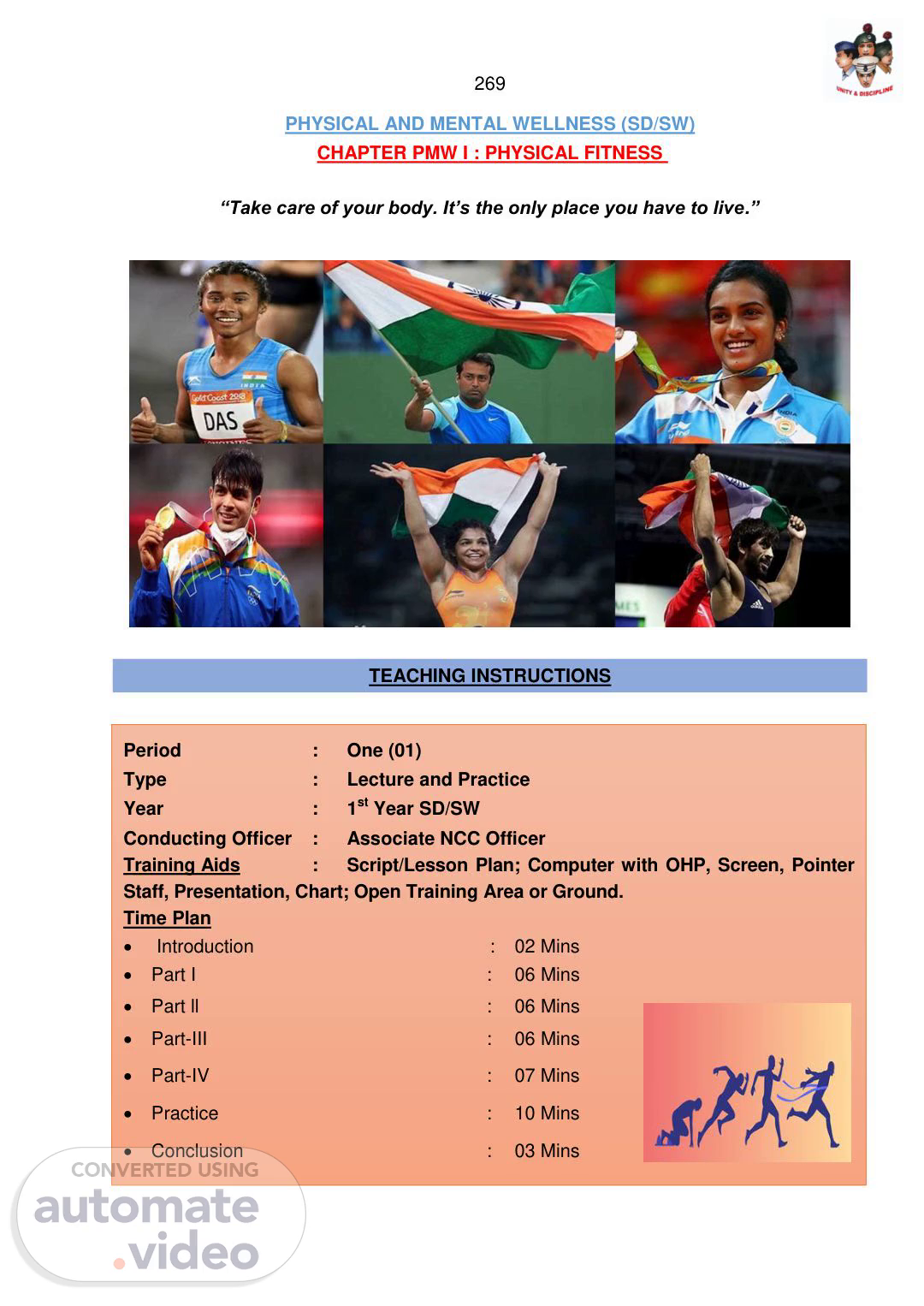
269 PHYSICAL AND MENTAL WELLNESS (SD/SW) CHAPTER PMW I : PHYSICAL FITNESS “Take care of your body. It’s the only place you have to live.” TEACHING INSTRUCTIONS Period : One (01) Type : Lecture and Practice Year : 1st Year SD/SW Conducting Officer : Associate NCC Officer Training Aids : Script/Lesson Plan; Computer with OHP, Screen, Pointer Staff, Presentation, Chart; Open Training Area or Ground. Time Plan Introduction : 02 Mins Part I : 06 Mins Part ll : 06 Mins Part-III : 06 Mins Part-IV : 07 Mins Practice : 10 Mins Conclusion : 03 Mins.
Scene 2 (29s)
270 1. Physical fitness is not just about being healthy, but it is also essential for mental well-being, academic performance and future success. 2. Physical fitness enhances cognitive abilities, self-perception, and coping skills. It can improve concentration, focus, and self-esteem. Engaging in sports and exercise cultivates teamwork and leadership. Furthermore, it can reduce anxiety and promote self-reliance to navigate modern social pressures. 3. Regular physical activity is an excellent way to maintain physical health and enhance mental well-being. Studies demonstrate that exercise prompts the release of endorphins, the body's natural feel-good chemicals, in the brain. Even a brief, brisk 10-minute walk can boost mental alertness, energy levels, and mood. This chapter examines the importance of a regular daily routine, physical training, and recreational activities in supporting effective daily living. INTRODUCTION PART I : SIGNIFICANCE OF PHYSICAL FITNESS Develop good habits Imbibe healthy daily routine Involve in outdoor activities Follow a healthy and nutritious diet Develop habit to do regular physical training LEARNING OBJECTIVES The lecture will be conducted in the following parts:- (a) Part I : Significance of Physical Fitness (b) Part II : Importance of Outdoor Activities (c) Part III : Staying Fit (d) Part IV : Steps to Physical Fitness PREVIEW Life Transforming Morning Habits Wake up early Do Exercise Sit in Silence and meditate Plan your Day Practise Positive Self-Talk Have Dedicated Off-Screen time INTERESTING FACTS.
Scene 3 (1m 27s)
271 4. Physical Fitness. Physical fitness refers to an individual's ability to perform day-to- day tasks without fatigue. It is a measure of the body's efficiency and effectiveness in work and leisure pursuits. To maintain fitness and well-being, one must engage in physical activities and adopt measures to stay physically fit. 5. Habit. Habits are regular routines and behaviors that people engage in, consciously or unconsciously. Positive habits help maintain motivation and make tasks easier when motivation is low. Established habits become part of daily life, requiring little effort. For instance, brushing teeth before bed is a habit that requires no extra motivation, as it has been practiced for years and is now seamless in nightly routine. 6. There are numerous ways to classify habits, such as mental, physical, or emotional; motor, intellectual, or character-building. The more beneficial, constructive, and progressive habits individuals cultivate in their life, the greater the boost to their physical, mental, and emotional well-being. 7. Healthy Daily Routine. A person's daily routine comprises actions and practices that structure their day. These routines can impact efficiency or cause struggle. Individuals may adopt energizing, time-saving routines or more draining, inefficient ones. The daily routine of a cadet includes morning activities, academic pursuits, evening and bedtime components. A suggested daily healthy routine can be as under :- (a) Morning Activities (0600-0800 hrs). Wake up, exercise, get ready, have a nutritious breakfast and plan the day’s activities by setting goals, prioritizing tasks and creating a to-do list. (b) Institution Time (0800-1400 hrs). Attend classes with active participation, maintain proper hydration and enjoy a balanced meal for lunch comprising of a mix of carbs, proteins and vegetables. (c) Post Lunch Routine (1400-1700 hrs). Focus on fulfilling academic responsibilities such that an effective planning can be done for preparation of examination, take nutritious snacks and include periodic breaks in your study routine, allowing for 10–15 minute intervals of physical movement, stretching, or mindful practices to rejuvenate. (d) Evening Activities (1700-2100 hrs). Undertake outdoor physical activities, eat nutritious dinner, unwind through engaging hobbies, literature, or music..
Scene 4 (2m 32s)
272 (e) Bedtime Routine (2100-2200 hrs). Have a screen-free time for at least an hour before bedtime, reflect on the day by introspection, brush your teeth, change into comfortable clothes, and aim for 8-10 hours of sleep to help recharge your body and mind, as is suggested for an age group of around 13 to 16 years. 8. Consistent physical activity and exercise are fundamental strategies for enhancing physical fitness, leading to a variety of benefits that go beyond the musculoskeletal system. 9. Physical Education. Physical education aims to nurture the comprehensive development of an individual. Its ultimate goal is to cultivate physical, mental, and emotional well-being in all people, while also providing them with opportunities to foster the personal and social attributes that enable them to coexist harmoniously with others and become responsible citizens. 10. Significance of Outdoor Activities (Physical Training and Games). Physical fitness is essential for the physical and mental development of cadets. It boosts the immune system by increasing blood flow and adaptability to exertion. Physical training and games have a positive impact on physical health and mental well-being. The impacts are as under:- (a) Physical Health Benefits. Exercise triggers the release of endorphins, improving mood and reducing stress and anxiety. Regular physical activity enhances self-esteem and can alleviate depression symptoms. (b) Academic Performance Benefits. Physical activity increases blood flow to the brain, boosting concentration, memory, and problem-solving skills, leading to improved academic performance. (c) Development of Valuable Life Skills. Sports and physical training teach teamwork, communication, leadership, perseverance, and goal-setting—skills essential for success in life. (d) Social Benefit. Engaging in physical activities helps individuals form friendships, develop social skills, and learn to respect diversity while working toward shared goals. PART II: IMPORTANCE OF OUTDOOR ACTIVITIES For a Healthy and Balanced Life:- Stay Organized. Use a planner, calendar, or app to keep track of your schedule and tasks. Prioritize Personal Well-Being. Make time for positive activities that bring you joy and help you relax. Seek Help When Needed. Don't hesitate to ask teachers, parents, or friends for help when you're struggling with academics or personal issues. TIPS.
Scene 5 (3m 37s)
273 Types of Outdoor Activities 11. Physical Training(PT) and Games. PT and Games are crucial for physical well-being, promoting teamwork, coordination. Individual sports offer a chance to exert physically; develop strength, skill, stamina and endurance. Team Games like football, kho-kho, Kabaddi, basketball etc help one develop a sense of camaraderie, shared purpose and healthy competitive spirit, facilitating social connection alongside physical exertion. Games channelise our energies in right direction, fostering health, social and personal growth. It is rightly said that ‘A healthy mind resides in a healthy body’. 12. Hobbies and Adventure Activities. Trekking, Rafting, Rock-climbing, Cycling, Gardening, Nature-photography, star-gazing etc are some of the hobbies cadets can undertake. 13. Outdoor activities give us a break from the classroom, allowing us to explore our creativity more deeply. Classroom learning alone can limit the ability to think critically. When we experience new surroundings, we gain fresh perspectives on our world, which sparks our curiosity and inspires our creativity to address challenging questions. 14. Benefits. Various benefits of physical training and games are as under:- (a) Improved Physical Health. Regular outdoor activity enhances fitness and well-being. (b) Mental Health Benefits. Outdoor activities reduce stress, anxiety and depression. (c) Social Skills Development. Team sports and group activities foster communication, teamwork and leadership. (d) Environmental Awareness. Outdoor activities promote appreciation and understanding of nature. Breathe deeply and naturally while stretching. Don't bounce or force your muscles beyond a comfortable stretch. Hold each stretch for 15-30 seconds to allow for maximum relaxation of the muscles. Stretch regularly to maintain flexibility and range of motion. Listen to your body and stop stretching if you experience any pain or discomfort. TIPS.
Scene 6 (4m 42s)
274 (e) Building Confidence. Overcoming outdoor challenges and achieving goals boosts self-esteem. 15. Physical fitness is like carefully tuning an engine. It allows us to reach our full potential, enabling us to look, feel, and perform our best in daily tasks, with energy left for leisure and emergencies. Fitness involves the heart, lungs, and muscles, and also impacts mental and emotional well-being. The need of the hour is that cadets need to maintain both health and skill related fitness for their best performance in any task. Basic Components of Fitness 16. Cardio-Respiratory Capability. It is the ability to deliver oxygen and nutrients to tissues, and to remove wastes, over sustained periods of time. Methods for measuring this component include long runs and swims. 17. Muscular Strength. It is the ability of a muscle to exert force for a brief period of time. Upper-body strength can be measured by weight-lifting exercises. PART III : HOW TO STAY FIT.
Scene 7 (5m 24s)
275 18. Muscular Endurance. It is the ability of a muscle, or a group of muscles, to sustain repeated contractions or continue applying force against a fixed object. Tests like push-ups measure endurance of arm and shoulder muscles. 19. Flexibility. It is the ability to move joints and use muscles through their full range of motion. The sit-and-reach test is often used to measure flexibility of the lower back and upper legs. Cooling Down Exercises 20. Body Composition. It refers to the makeup of the body in terms of lean mass (muscle, bone, vital tissues, and organs) and fat mass. An optimal ratio of fat to lean mass indicates fitness, and exercise can help reduce body fat while maintaining or increasing muscle mass. Assessment of Personal Fitness Levels 21. When beginning a fitness program, it is important to assess your current level of physical fitness. Individuals can have varying starting points, often classified as different "beginner" levels. As the saying goes, "Rome wasn't built in a day," and the same principle applies to physical fitness. 22. Professional athletes and sportspeople have dedicated years to training and developing their capabilities. The key is to start slowly and build up gradually, as pushing too hard too soon can lead to burnout and diminish enjoyment of the exercises. Evaluation of your fitness levels, can either be done by Parameters-Based Assessments or Activity- Based Assessments. 23. Parameters-Based Assessments (PBAs). Readings of essential parameters can help determine soundness of physical fitness, some of which are as under:- (a) Heart Rate. Measure your resting heart rate by palpating your pulse using your fingertips, either at the carotid artery in the neck (below the windpipe) or the radial artery at the wrist (below thumb-base). If 50-80, then it is considered.
Scene 8 (6m 30s)
276 to be ranging from very fit to normal and if found greater than 100, then it is below average. (b) Body Fat. Fitness does not solely depend on weight. People can have diverse body types yet still be healthy and physically fit. The recommended body fat range is typically 10-15% for men and 15-20% for women. (c) BMI (Body Mass Index). One is underweight if the BMI is less than 18.5 and overweight when BMI is greater than 25. The method of calculating BMI is:- (i) Multiply your weight by 10,000. Example: 60 x 10,000 = 600,000 (ii) Square your height in cms(multiply it by itself). Example: 155 x 155 = 24,025 (iii) Divide the result from step 1 by the result from step 2. Example: 600,000 ÷ 24,025 = 24.97 (BMI = 25, rounded off) (d) Basal Metabolic Rate. It is the minimum number of calories needed to sustain your body weight based on typical body composition (required for basic activities like breathing, digestion & blood circulation). In order to determine BMR, multiply your body weight in kgs with 24. This can then be multiplied with the activity level number which is 1.45, 1.60,1.70 & 1.88 for sedentary, light, medium and heavy activity. (e) Vmax or VO2 Test. It is a measure of the maximum amount of oxygen your body can use during intense exercise, and it is a key indicator of cardiovascular fitness. It reflects your aerobic capacity, which is the ability of your heart, lungs, and muscles to work together efficiently during endurance activities like running, cycling, and swimming. For a healthy adult, the ideal VMax (or VO2max) can vary based on factors such as age, gender, fitness level, and activity type. However, general ranges are:- (i) For Men (Age 20-30). 40-50 mL/kg/min (elite athletes may exceed 60 mL/kg/min) (ii) For Women(Age 20-30). 35-45 mL/kg/min (elite athletes may exceed 55 mL/kg/min) (iii) As people age, VO2max tends to naturally decrease. But maintaining a higher VO2max (with regular aerobic exercise) is linked to better cardiovascular health and overall fitness. 24. Activity-Based Assessments(ABAs). Ability to undertake physical activities/tests with ease can also be a fair yardstick to evaluate fitness levels. Some of the basic tests are as follows:-.
Scene 9 (7m 35s)
277 (a) Muscular Strength. Evaluating muscular strength can be most easily accomplished through the push-up assessment. However, individuals with lower back injuries should refrain from performing this test. For NCC cadets, it is desired that the senior division cadets complete 18-20 and senior wing cadets complete 8-10 push-ups. (b) Flexibility. For this test, use a measuring tape or 36-inch ruler. Warm up your lower back and hamstrings. Sit with legs straight, feet 10 inches apart, and no shoes. Place the tape with the 15 inch mark at your heels. Cross your hands, reach forward, and hold while the measurement is taken. Do three trials and record the highest result. Score below 13 for boys and 10 for girls in 20’s is considered to be minimum desired value. (c) Abdominal Strength. The assessment process includes a physical fitness evaluation involving sit-ups. The minimum desired number of sit-ups is 32 for senior division cadets and 25 for senior wing cadets. Nutrition 25. Nutrition Basics. Food serves as the primary energy source for the human body. There are six basic nutrients that are necessary to help support your health, even in small amounts. These are protein, carbohydrates, fats, vitamins, minerals and water. The energy content of food is quantified in calories. 26. Essential Nutrients. Essential nutrients are compounds the body requires trusted source to perform basic functions and grow. The six essential nutrients can be broken down into following categories:- (a) Macronutrients. These are nutrients which the body requires in substantial quantities to fuel its activities and maintain its structure. It includes carbohydrates, proteins and fats. Carbohydrates are the primary source of energy. (b) Micronutrients. These include vitamins and minerals that strengthen the immune system, and metabolism (c) Water is neither a macronutrient nor a micronutrient in the traditional sense. However, it is often categorized alongside macronutrients because the body requires it in large amounts for survival. 27. Weight Management. A caloric deficit/gain is a key factor in weight management, meaning the correlation between energy (calories) consumed and expended. So, for weight management following aspects bear importance:- (a) For weight loss, Calories consumed need to be less than Calories expended, creating a caloric-deficit, essential for weight loss..
Scene 10 (8m 40s)
278 (b) For weight gain, Calories consumed need to be more than Calories expended, achieving a caloric surplus. (c) For maintaining body weight, Calories consumed and expended need to be approximately the same. 28. Changing habits by modification of one’s lifestyle is hard. Many people want to eat better, exercise more, or lose weight, but find it difficult for various reasons. There are five stages to making these lifestyle changes:- (a) Pre-contemplation. The individual is unaware of the problem and doesn't want to change, ignoring warnings. Education and highlighting future consequences may help. (b) Contemplation. The person recognizes the problem and considers change but isn't ready yet. Support from others can an encourage action. (c) Preparation. The individual is ready to change within a month, setting goals and taking small steps, with peer support being important. (d) Action. The person actively works on their goals, but setbacks are common. Continued effort for six months leads to progress. (e) Maintenance. After six months, the individual focuses on maintaining the change, especially in stressful situations, by following specific guidelines. (f) Termination/Adoption. The person has sustained the change for over five years, with no likelihood of relapse for negative behaviors, though relapse is still possible for positive ones. (g) Relapse. A relapse is a return to old behaviors, often during action or maintenance stages. Recovery involves assessing progress, identifying weaknesses, and creating a plan for the future. 29. Aim & Principles of PT. The primary aim of physical training is to empower youth physically and mentally by imparting appropriate skills and knowledge, thereby enabling them to engage in a lifetime of healthy physical activities. Three main principles of PT are: - (a) Balanced Development. To give equal exercise to every part of the body. (b) Progressive Improvement. Aim for a steady improvement rather than gains (c) Maintain Continuity. To do PT consistently so that it develops into a habit. PART IV : STEPS TO PHYSICAL FITNESS.
Scene 11 (9m 45s)
279 30. Essentials of PT. The five golden essentials of PT are:- (a) A good environment. (b) Hard work. (c) Sound sleep. (d) Recreation. (e) Patience and satisfaction. 31. An ideal PT program includes all activities from warming up to cooling down. . It’s a good idea to go for a run to build up stamina and endurance, followed by strengthening and stretching exercises. When it comes to doing exercises, remember to do the lateral(sideways) ones before the dorsal(forward and back) ones, to avoid putting of sudden pressure on the core and risk injury. Suggested structure of a 45-minute PT session is as follows:- (a) Warming Up. 03 Mins of slow jogging to warm up the muscles. (b) Running. 10 Mins of running, ending in a sprint for endurance and speed. (c) Strength/Endurance Training.15 Mins of Push-ups, Pull-ups, Skipping, jumping, sprints, sit-ups, rope climbing or competitive games, for gaining strength and power. (d) Stretching. 10 Mins of free stretching exercises to maintain flexibility and mobility. (e) Cooling Down. 07 Mins of Cooling down exercises to restore the metabolism to pre-exercise state. You need to burn off 3,500 calories more than you take in, to lose just one pound! Regular physical activity can increase the size of the ‘hippocampus’, the part of your brain responsible for memory and learning. So, exercising not only improves physical fitness but also cognitive function. DID YOU KNOW?.
Scene 12 (10m 43s)
280 32. Freehand Exercises. These exercises boost flexibility, strength, and stamina without the need for any specialized equipment. They activate various muscle groups, improve coordination, and support joint flexibility. They can be performed anywhere and offer an easy & convenient way to maintain overall fitness. Some of the basic ones are: - (a) Push-ups. Strengthens the chest, shoulders, and arms. (b) Squats. Targets the legs (c) Sit-ups. Strengthens the core (d) Lunges. Focuses on legs and glutes. (e) Planks. Engages the core, shoulders, and back muscles. (f) Mountain Climbers. A full-body exercise that enhances cardio too. (g) Jumping Jacks. Improves cardiovascular health. 33. While both freehand and equipment exercises are good for fitness, their impact on the body is different. Freehand exercises aid development and improve overall physical fitness, while equipment exercises work better for developing specific muscle mass. Some salient points of both are as under:- Free Hand Exercises Equipment/Gym Exercises Are better for improving overall movement patterns, enhancing joint mobility, and building strength using just your body. These exercises can include push-ups, squats, lunges, planks, vertical rope etc. Do not entail expenditure on equipment. These engage the core and multiple muscle groups, improving coordination, stability, and endurance. Since exercise is against body’s own weight, movements are more natural and less stressful on joints compared to lifting heavy weights. This is ideal for beginners or people with joint issues. Baseline level of fitness, strength, form and body-shape is maintained even during periods of reduced training Less chances and severity of injury/muscle damage. Are more focused on increasing mass and hypertrophy (muscle growth) by adding external resistance, targeting specific muscle groups Using equipment like dumbbells, barbells, kettlebells or machines. Normally entail considerable expenditure. These are good for increasing resistance & strength beyond body-weight. Muscle adaptations from equipment-heavy training are more specific, dependent on higher-intensity loading, and prone to faster loss during inactivity Form, mass and shape is gained quicker but is also lost more rapidly as compared to body- weight training in periods of reduced training More chances and severity of injury/muscle damage.
Scene 13 (11m 49s)
281 34. Activities as Per Age, Health, Location and Weather. (a) Age-appropriate Adjustments. Junior cadets should focus on engaging, simple exercises that build basic strength and coordination, like bodyweight squats and jumping jacks. Senior cadets, however, should increase intensity, incorporating strength training like weightlifting and resistance exercises. (b) Health Adjustments. Fitness routines should be adapted to accommodate cadets with injuries or chronic conditions by offering low-impact alternatives, such as swimming, cycling etc (c) Weather and Location Adjustments. Areas with extreme climates or high-altitude locations, demand separate considerations and allowances in performance. For places experiencing heavy rainfall, indoor sessions in covered spaces can ensure training continues safely. 35. Following are the desired minimum physical standards for SD/SW cadets (18-25 yrs) on completion of their three years training:- Boys Girls Weight (BMI) 18.5-21 18.5-22 Walking (30 mins) 4-5 km/hr 3-4 km/hr 1.6 km Running 8-11 mins 10-13 mins 2.4 km Running 12-14 mins 14-16 mins Sit-ups 32 25 Push-ups 18-20 8-10 Plank Hold 60-90 sec 45-60 sec Yoga Proficiency in at least 10 Asanas Swimming 50 metres (Any style/stroke) Note: These desired standards are only meant to serve as a reference guide for cadets to achieve minimum levels of physical fitness. Cadets will NOT be assessed or tested on the same. 36. In addition to above physical standards, to ensure overall physical and mental wellness, following steps can be taken on routinely:- (a) Regular Exercise. Engage in at least an hour of physical activity daily to improve strength, endurance and cardiovascular health. (b) Balanced Diet. Eat a balanced diet rich in fruits, vegetables, lean proteins, and whole grains while limiting processed foods. (c) Oral Health. Brush and floss daily, visit the dentist regularly, and avoid excessive sugar to maintain strong teeth and gums. (d) Adequate Sleep. Ensure 8-10 hrs of quality sleep each night for proper body and brain function..
Scene 14 (12m 54s)
282 (e) Yoga and Meditation. Practice yoga for flexibility, and relaxation, and meditate to reduce stress and enhance focus. (f) Hydration. Drink enough water (at least 8 glasses) throughout the day to maintain energy levels. (g) Stress Management. Engage in hobbies and mindfulness techniques to reduce anxiety and mental fatigue. (h) Limit Screen Time. Reduce excessive phone and computer use to prevent eye-strain, stress and sleep disturbance. 37. This lesson equips cadets with practical knowledge and techniques to adopt a healthy lifestyle, including structured routines, physical training and balanced nutrition. Adopting and implementing these practices can lead to long-term health benefits and personal growth. 38. Practising a healthy lifestyle enhances an individual's quality of life by boosting physical fitness. It improves heart and lung function, increases oxygen supply to body tissues, enhances muscle tone, promotes good posture and a balanced figure, fosters a positive body image, speeds up recovery from illness or injury, and reduces the risk of cardiovascular disease. A healthy daily routine combines adequate sleep, regular physical activity and nutritious meals. Physical training improves physical and mental health, discipline and endurance. Outdoor activities promote holistic development and reduce stress. Following a structured exercise routine with proper techniques prevents injuries and maximizes benefits. A balanced diet is essential for fuelling physical activities and supporting recovery. Regular PT empowers the youth physically and mentally with proper skills and knowledge to enjoy a lifetime of healthy activities physically. A O to divide the cadets into groups of 10-15 and take them outdoors for carrying out Warm up, Strengthening and ooling down exercises as given in the chapter. ACTIVITY CONCLUSION SUMMARY.
Scene 15 (13m 58s)
283 Multiple Choice Questions Q1. Which of the following is a key component of a balanced diet? (a) Only processed foods (b) Rich in fruits, vegetables, lean proteins, and whole grains (c) Only sugary snacks (d) High-fat foods Q2. Bedtime Routine should be devoid of:- (a) Sleep. (b) Relaxation. (c) Screen Time. (d) All of the above. Q3. Physical training and games are essential for:- (a) Physical growth. (b) Mental growth. (c) Both physical and mental growth of the cadets. (d) None of the above. Q4. Being part of the Physical Training and Games/ sports team or group activities lets cadets make:- (a) Money. (b) Friends and imbibe social skills. (c) Good Communication Skills. (d) None of the above. Q5. What is the primary component of physical fitness that involves the ability of the body to transport oxygen and nutrients? (a) Muscular strength. (b) Cardiovascular endurance. (c) Flexibility. (d) Body composition. Q6. Which of the following exercises is an example of aerobic exercise? (a) Weightlifting. (b) Sprinting. (c) Jumping jacks. (d) Yoga. Q7. What do you call it when an individual is unaware of the problem and doesn't want to change, ignoring warnings? (a) Contemplation (b) Pre-contemplation (c) Action (d) Preparation ASSESSMENT EXERCISE.
Scene 16 (14m 45s)
284 Q8. Proper warm-up and cool-down exercises to prevent:- (a) Headache. (b) Digestion. (c) Injuries. (d) None of the above. Q9. What is the term for the ability to move quickly and easily? (a) Agility. (b) Speed. (c) Power. (d) Endurance. Q10. Macronutrients consist of:- (a) Carbohydrates. (b) Proteins. (c) Fats. (d) All of the above. Q11. Cadets must limit consumption of which food item? (a) Sugary Drinks. (b) Fast food and processed snacks. (c) Saturated and trans fats. (d) All of the above. Q12. Essentials of PT involves:- (a) A good environment. (b) Lethargy. (c) More sleep. (d) Watch movie. Q13. Which of the following is True in respect of PT? (a) More people can participate. (b) Only select, persons can participate. (c) Every part of the body gets exercise. (d) (a) and (c) above. Q14. Strength training includes activities to:- (a) Improve strength. (b) Improve Sleep. (c) Improve Appetite. (d) None of the above. Q15. The purpose of Cooling down exercises is to:- (a) Restore metabolic rate to pre-exercise levels. (b) Remove stress. (c) Not sweat anymore..
Scene 17 (15m 29s)
285 (d) None of the above. Short Answer Questions Q1. What is Healthy Daily Routine? Q2. What are Habits? Q3. What are Macronutrients? Q4. What is the aim of PT? Q5. What is muscle endurance? Give two exercises which help in measuring muscle endurance. Long Answer Questions Q1. Discuss the significance of physical fitness. Q2. Briefly describe the importance of outdoor activities. Q3. Explain in detail how does a person stay fit. Q4. Briefly discuss the term PT. Q5. Explain the Parameters Based Assessment (PBA) method of fitness assessment..