Scene 1 (0s)
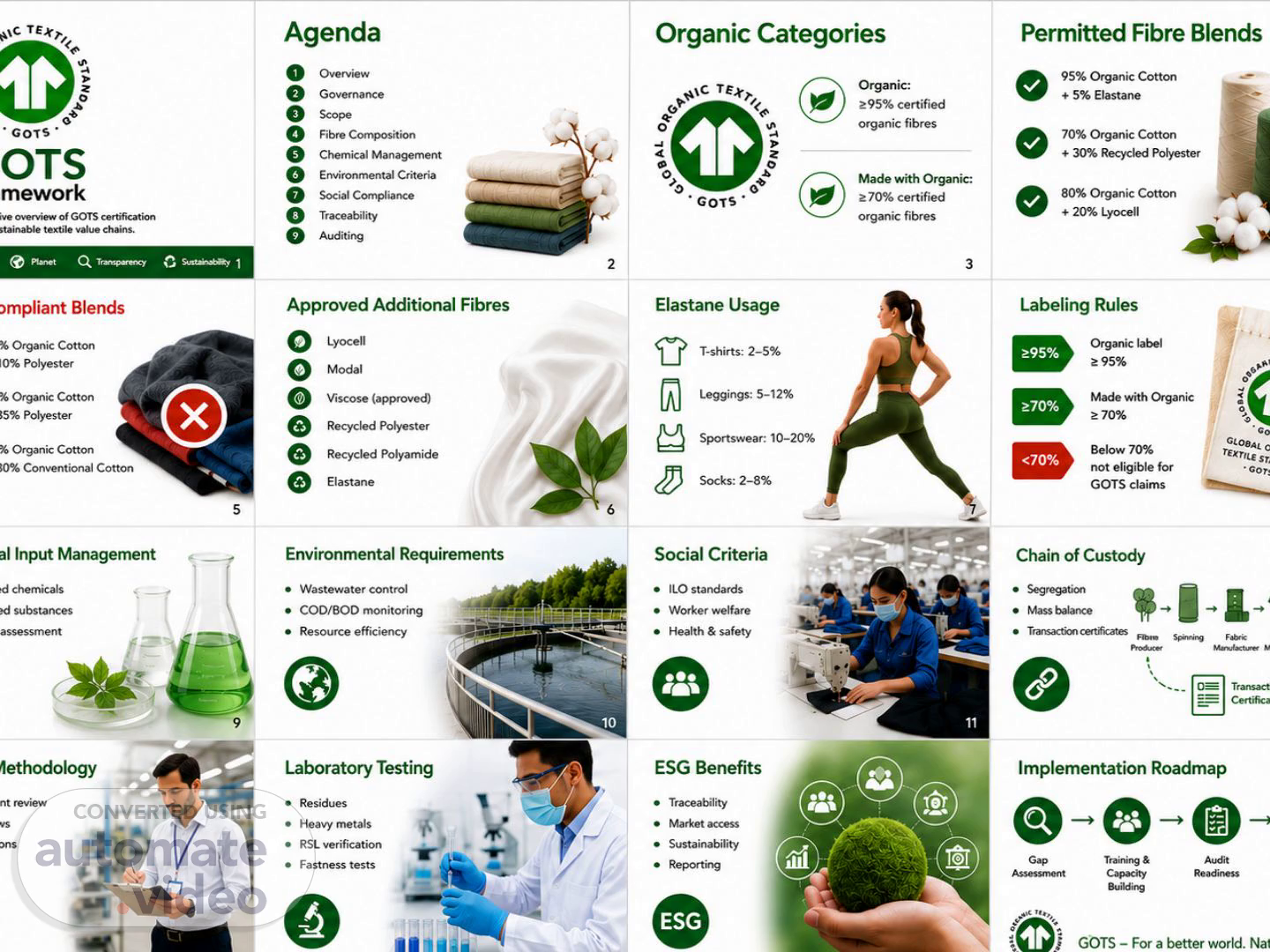
Agenda Organic Categories Permitted Fibre Blends 0 0 • GOTS • GOTS Framework Executi•ve overview of GOTS and Non-Compliant Blends Organic Cotton + Polyester + 35% Polyester + 30% Conventional Cotton 5 Chemical Input Management • Approved • Restricted substances • Toxicity assessment 9 Audit Methodology Interviews Inspections CAPA 3 O o o o O O O O o Governance Fibre Composition Management Environmental Criteria Social Traceability Auditing Approved Additional Fibres O o Viscose (approved) Recycled Polyarnide Environmental Requirements • Wastewater control • COD/BOD monitoring • Resource efficiency Laboratory Testing Residues Heavy metals RSL verification Fastness tests 2 6 10 GOTS • Elastane Usage T-shirts: 2—5% Leggings: 5— Sportswear: Socks: 2-8% Social Criteria • ILO standards • Worker welfare • Health & safety ESG Benefits • Traceability • access • SustainabNity • Reportü•'g ESG 295% certified Organic fibres Made with Organic: 270% certified Organic fibres 3 11 + 5% Elastane Cotton + 30% Recycled Polyester Organic Cotton + Lyocell Labeling Rules label 295% 95% Made with Organic 270% Below not eligible for GOTS claims Chain of Custody Gors {x*srORGAN1c • Gors . 4 8 Implementation Roadmap Training & Transaction _ — Certificate 12 Certification & GOTS — For a better world. Naturally. 16.
Scene 2 (28s)
GOTS. Executive overview of GOTS certification and sustainable textile value chains. GOTS certification provides a globally recognized framework for managing sustainable textile value chains by integrating organic fiber requirements, responsible chemical management, environmental stewardship, social compliance, and end-to-end supply chain traceability..
Scene 3 (43s)
Agenda. Governance Scope Fiber Composition Chemical Management Environmental Criteria Social Compliance Traceability Auditing GOTS is the world's leading standard for processing and manufacturing textiles made from certified organic fibers while ensuring environmental and social compliance throughout the supply chain..
Scene 4 (57s)
Describes how GOTS is administered and controlled. It includes: Standard ownership Revision procedures Approved certification bodies Accreditation mechanisms Compliance oversight Governance ensures that the certification remains: Credible Transparent Globally harmonized.
Scene 5 (1m 12s)
Defines which processes and facilities can be certified. GOTS covers: Upstream activities Ginning Spinning Knitting Weaving Wet processing Dyeing Printing Finishing Manufacturing Cutting Sewing Packaging Downstream Trading Distribution Export Excluded activities Retail stores generally do not require certification..
Scene 6 (1m 27s)
Specifies minimum organic content requirements. Organic Label ≥ 95% certified organic fibres Maximum 5% approved additional fibres Examples ✔ 95% Organic Cotton + 5% Elastane ✔ 97% Organic Cotton + 3% Lyocell Made with Organic Materials ≥ 70% certified organic fibres Maximum 30% approved fibres Examples ✔ 70% Organic Cotton + 30% Recycled Polyester ✔ 80% Organic Cotton + 20% Modal Non-compliant blends ✖ 70% Organic Cotton + 30% Conventional Cotton ✖ 60% Organic Cotton + 40% Polyester.
Scene 7 (1m 46s)
Controls chemicals used in textile processing. Objectives: Reduce environmental impacts Protect workers Ensure consumer safety Requirements include: Restricted substances APEOs Formaldehyde Heavy metals Chlorinated compounds Toxic solvents Approved inputs: Dyes Auxiliaries Enzymes Softeners Detergents Only approved chemicals can be used..
Scene 8 (2m 2s)
Focuses on reducing environmental impacts. Requirements include: Wastewater treatment Mandatory effluent treatment systems Monitoring ( Daily & Recorded Data ) COD BOD pH TSS Temperature Resource efficiency Water reduction Energy conservation Waste minimization Pollution prevention.
Scene 9 (2m 15s)
Ensures ethical working conditions. Based largely on: International Labor Organization conventions. Requirements include: Labor standards No child labor No forced labor No discrimination Fair wages Reasonable working hours Freedom of association Occupational safety PPE availability Emergency preparedness Worker training Safe machinery.
Scene 10 (2m 30s)
Ensures organic fibers remain identifiable throughout production. Mechanisms include: Chain of Custody Tracking materials through every stage. Material balance Input quantities must match output quantities. Segregation Organic materials kept separate from conventional materials. Documentation Purchase records Production records Inventory logs Shipping records Transaction Certificates.
Scene 11 (2m 46s)
Confirms compliance with GOTS requirements. Conducted by approved certification bodies. Audit activities include: Documentation review Purchasing records Chemical inventories Wastewater reports Employee records Site inspection Factory walkthroughs Storage verification Production verification Interviews Management interviews Worker interviews Corrective actions Identification of non-conformities Implementation of CAPA plans Follow-up verification ( Yearly ).
Scene 12 (3m 3s)
Organic Categories. Organic: ≥95% certified organic fibers Made with Organic: ≥70% certified organic fibers.
Scene 13 (3m 23s)
Examples. Composition Status 100% Organic Cotton ✔ Organic 97% Organic Cotton + 3% Elastane ✔ Organic 95% Organic Cotton + 5% Lyocell ✔ Organic 94% Organic Cotton + 6% Elastane ✖ Not Organic.
Scene 14 (3m 34s)
2. Made with Organic (≥70% Certified Organic Fibres) This category allows a greater proportion of non-organic but approved fibers. Requirement At least 70% of fibers must be certified organic. Up to 30% may be approved additional fibers..
Scene 15 (3m 53s)
Permitted Fiber Blends. 95% Organic Cotton + 5% Elastane ✔ 70% Organic Cotton + 30% Recycled Polyester ✔ 80% Organic Cotton + 20% Lyocel ✔ Examples of GOTS-Compliant Fibre Blends ✔ 95% Organic Cotton + 5% Elastane Maintains the Organic GOTS label because at least 95% of the fibres are certified organic. Elastane provides stretch and flexibility. ✔ 70% Organic Cotton + 30% Recycled Polyester Qualifies as Made with Organic Materials under GOTS. Recycled polyester improves durability and moisture management. ✔ 80% Organic Cotton + 20% Lyocell Complies with GOTS requirements and combines organic cotton comfort with Lyocell's softness, strength, and moisture absorption properties..
Scene 16 (4m 18s)
Non-Compliant Blends. 90% Organic Cotton + 10% Polyester ✖ 65% Organic Cotton + 35% Polyester ✖ 70% Organic Cotton + 30% Conventional Cotton ✖ Examples of Non-Compliant Fibre Blends ✖ 90% Organic Cotton + 10% Polyester Does not qualify for the Organic category because organic fibre content is below the required 95%. ✖ 65% Organic Cotton + 35% Polyester Does not meet the minimum 70% organic fibre requirement for the Made with Organic Materials category. ✖ 70% Organic Cotton + 30% Conventional Cotton Not permitted under GOTS because conventional cotton is prohibited; only certified organic and approved additional fibres may be used..
Scene 17 (4m 42s)
Approved Additional Fibres. These fibres are permitted by GOTS to enhance product performance while maintaining organic integrity. Lyocell – Improves softness, strength, and moisture absorption. Modal – Provides a smooth feel, drape, and comfort. Viscose (approved) – Allowed only when sourced and processed according to GOTS requirements. Recycled Polyester – Increases durability and reduces environmental impact. Recycled Polyamide – Adds strength, elasticity, and abrasion resistance. Elastane – Provides stretch and flexibility for fitted and activewear products..
Scene 18 (5m 5s)
Labeling Rules. Labeling Rules (Short Explanation) Organic label (≥95%) – Products containing at least 95% certified organic fibres can be labeled as "Organic" under GOTS. Made with Organic (≥70%) – Products containing 70–94% certified organic fibres can be labeled as "Made with Organic Materials." Below 70% – Products with less than 70% certified organic fibres are not eligible to carry any GOTS claim or logo..
Scene 19 (5m 24s)
Chemical Input Management. Explanation Chemical Input Management ensures that only approved and safe chemicals are used in textile processing. Approved Inputs – Chemicals such as dyes, auxiliaries, and detergents must be evaluated and approved by GOTS. Restricted Substances – Harmful chemicals like toxic solvents, heavy metals, and hazardous dyes are prohibited. Toxicological Assessment – Chemicals are assessed for their impact on human health and the environment before they can be used..
Scene 20 (5m 45s)
Environmental Requirements. Explanation Environmental requirements ensure that textile production minimizes its impact on the environment. Wastewater Treatment – Factories must treat wastewater before releasing it into the environment. COD/BOD Monitoring – Water quality is monitored by measuring pollution levels using Chemical Oxygen Demand (COD) and Biological Oxygen Demand (BOD). Resource Efficiency – Encourages efficient use of water, energy, and raw materials to reduce waste and environmental impact..
Scene 21 (6m 5s)
Social Criteria. Short Explanation Social criteria ensure fair and safe working conditions in textile manufacturing. ILO Conventions – Compliance with international labour standards established by the International Labour Organization. Worker Welfare – Protection of workers' rights, fair wages, and prohibition of child or forced labour. Health and Safety – Safe workplaces, proper training, and measures to prevent accidents and occupational hazards..
Scene 22 (6m 24s)
Chain of Custody. Short Explanation Chain of Custody ensures that organic materials are tracked and verified throughout the supply chain. Segregation – Organic fibres must be kept separate from conventional materials. Mass Balance – The quantity of organic input must match the certified output produced. Transaction Certificates – Documents used to verify and trace certified materials between suppliers and buyers..
Scene 23 (6m 42s)
Audit Methodology. Short Explanation Audit methodology is the process used to verify compliance with GOTS requirements. Document Review – Checking records, certificates, and production documents. Interviews – Discussing practices with management and workers. Inspections – Examining facilities, processes, and operations on-site. CAPA (Corrective and Preventive Actions) – Implementing measures to address non-conformities and prevent future issues..
Scene 24 (7m 0s)
Laboratory Testing. Short Explanation Laboratory testing ensures that textile products comply with GOTS quality and safety requirements. Residues – Tests for unwanted chemical residues remaining in the product. Heavy Metals – Checks for harmful metals such as lead, cadmium, and chromium. RSL Verification – Confirms compliance with the Restricted Substances List (RSL) by ensuring prohibited chemicals are absent. Fastness Tests – Evaluates the fabric's resistance to washing, rubbing, light, and perspiration to maintain color durability and quality..
Scene 25 (7m 22s)
ESG Benefits. Short Explanation GOTS certification supports a company's Environmental, Social, and Governance (ESG) goals. Traceability – Ensures transparency by tracking materials throughout the supply chain. Market Access – Helps companies enter premium and sustainability-focused global markets. Sustainability Reporting – Provides verified data to support ESG disclosures and corporate sustainability reports..
Scene 26 (7m 39s)
Implementation Roadmap. Short Explanation The implementation roadmap outlines the steps required to achieve GOTS certification. Gap Assessment – Evaluate current practices against GOTS requirements and identify areas for improvement. Training – Educate employees on GOTS standards, procedures, and compliance requirements. Audit Readiness – Prepare documents, records, and processes for certification audits. Certification – Undergo assessment by an approved certification body to obtain GOTS certification..