Scene 1 (0s)
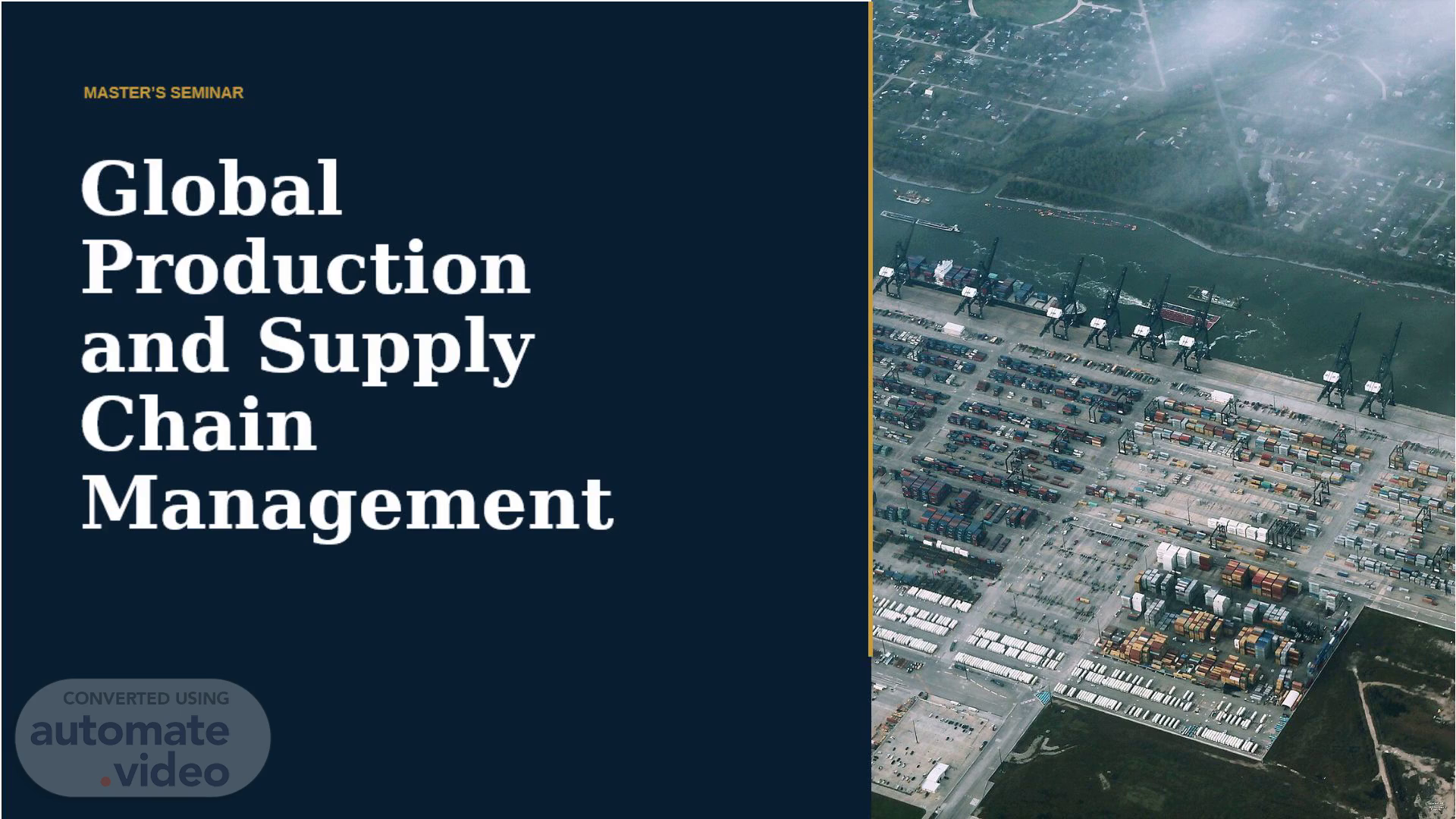
gnu. MASTER’S SEMINAR. Global Production and Supply Chain Management.
Scene 2 (11s)
Presentation Objectives. ORIENTATION / 02. The learning outcomes move from conceptual foundations to managerial implementation..
Scene 3 (51s)
From Factory Efficiency to Network Orchestration.
Scene 4 (1m 23s)
Foundations Before the 21st Century. EVOLUTION / 04.
Scene 5 (1m 59s)
The 21st-Century Transformation. EVOLUTION / 05. Globalization created reach; digitalization created visibility; disruption made resilience strategic..
Scene 6 (2m 35s)
Academic Definitions: What SCM Actually Means. FOUNDATIONS / 06.
Scene 7 (3m 14s)
The Supply Chain as a System of Flows. FOUNDATIONS / 07.
Scene 8 (3m 44s)
Production, Operations, Logistics, and SCM. FOUNDATIONS / 08.
Scene 9 (4m 26s)
Global Production Strategy and Network Design. STRATEGY / 09.
Scene 10 (5m 1s)
Facility Location and Capacity Decisions. STRATEGY / 10.
Scene 11 (5m 38s)
Make, Buy, Outsource, or Partner?. STRATEGY / 11.
Scene 12 (6m 15s)
Global Sourcing and the Kraljic Portfolio. SOURCING / 12.
Scene 13 (6m 47s)
Supplier Management and Collaboration. SOURCING / 13.
Scene 14 (7m 26s)
Global Logistics and Total Landed Cost. EXECUTION / 14.
Scene 15 (8m 2s)
Inventory as a Strategic Decoupling Mechanism. EXECUTION / 15.
Scene 16 (8m 40s)
S&OP / Integrated Business Planning. EXECUTION / 16.
Scene 17 (9m 11s)
Lean Production and the Toyota Production System.
Scene 18 (9m 39s)
Lean, Agile, Resilient—and Viable. OPERATING MODELS / 18.
Scene 19 (10m 14s)
Global Supply Chain Risk Landscape. RISK / 19. Risk = likelihood × impact × exposure duration; systemic risks propagate through dependencies and shared infrastructure..
Scene 20 (10m 54s)
Resilience: Anticipate, Absorb, Recover, Adapt. RISK / 20.
Scene 21 (11m 32s)
Digital Transformation of the Supply Chain. DIGITAL / 21.
Scene 22 (12m 8s)
Sustainable and Circular Supply Chains. SUSTAINABILITY / 22.
Scene 23 (12m 37s)
Implementation Barriers—and How to Overcome Them.
Scene 24 (13m 18s)
Performance System and Implementation Roadmap. IMPLEMENTATION / 24.
Scene 25 (14m 1s)
Executive Summary. CONCLUSION / 25. Global production and SCM create advantage by coordinating the whole network—not by minimizing one local cost..