Scene 1 (0s)
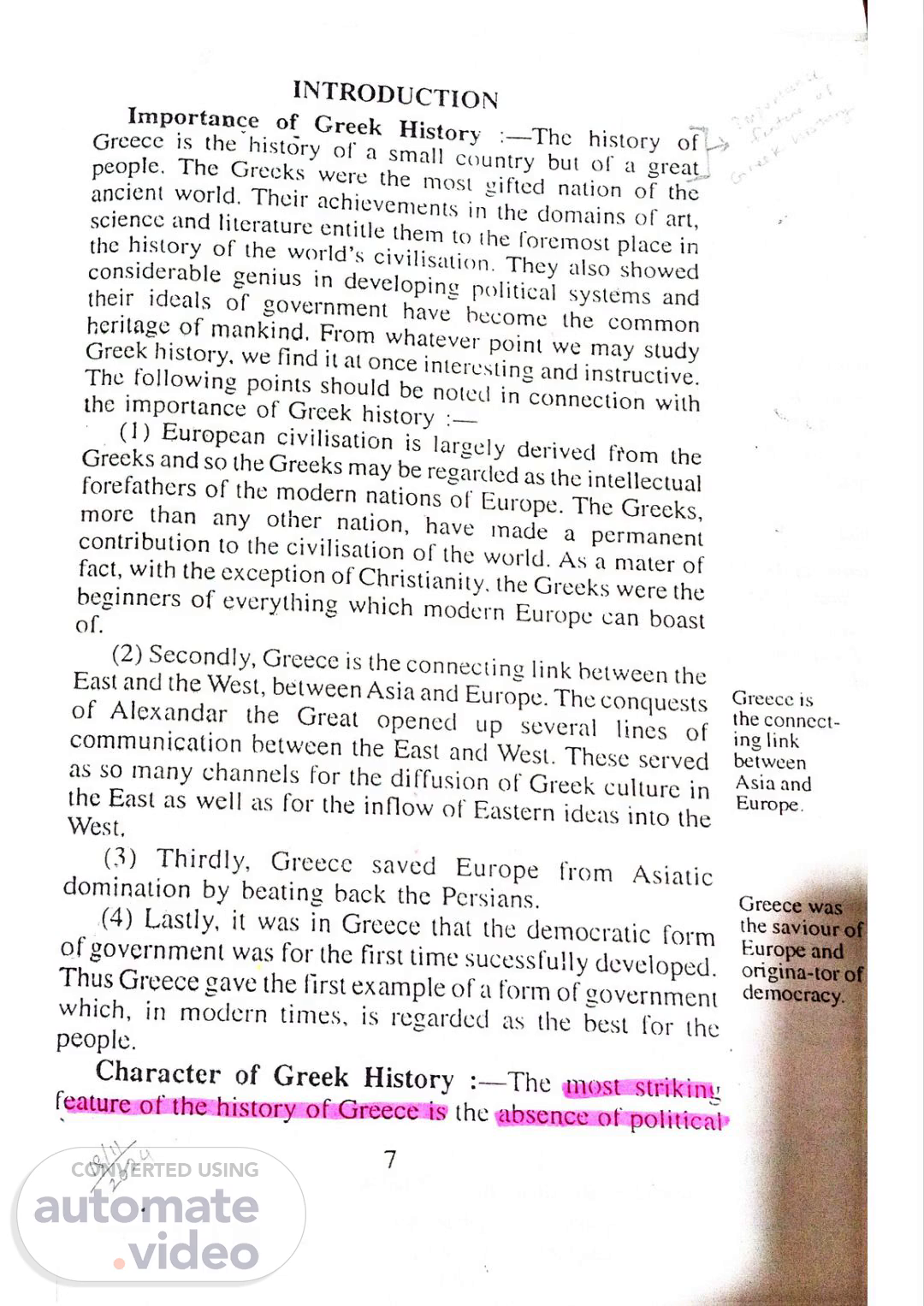
INTRODUCTION Importan€e of Creek History I—The history of Greece is the hist6ry of a small country but of a grea!— people. The Greeks were the most gifted nation of the ancient world. Their achievements in the domains of art, science and literature entitle them to the foremost place in the history of the world's civilisation. They also showed considerable genius in developing political systems and their ideals of government have become the common heritage Of mankind. From whatever point we may study Greek history. we find it at once interesting and instructive. The following points should be noted in connection with thc importance of Greek history (l) European civilisation is largely derived from the Greeks and so lhe Greeks may be regarded as the intellectual forefathers of the modern nations of Europe. The Greeks, more than any other nation, have made a permanent contribution to the civilisation of the world. As a mater of fact, with the exception of Christianity. the Greeks were the beginners of everything which modern Europe can boast of. (2) Secondly, Greece is lhe connecting link between the East and the West, between Asia and Europe. The conquests of Alexandar the Great opened up several lines of communication between the East and West. These served as so many channels for the diffusion ot' Greek culture in the East as well as ror the inflow of Eastern ideas into the West. Greece IS the connect- ing link between Asia and Europe (3) Thirdly, Greece saved Europe from Asiatic Greece domination by beating back the Persians. the saviour of (4) Lastly, it was in Greece that the democratic form Europe and of government was for lhe first time sucessfully developed. origina-torof democracy. Thus Greece gave the lirst example of a form of government which, in modern times, is regarded as the best for the people. Character of Greek History :—The eature.o;f4thehistoryofaGreeceås the 7.
Scene 2 (1m 5s)
8 A STUDY OF GREEK HISTORY It is the history of several Sinall city-states indepen-dcnt Of one another entntula unioWAlmo.st every city in Greece lorined a self-contained whole with its own laws ancl forni of government. In other words, each city formed a state by itself and the history of Greece is the history of these separate city-states taken together. There was no central authority to bring the several citie.s under one com mon control so that each city remained politically separate from its neighbours. This political is the chief characteristic of Greek history. Thus Che history ot• Greece is quite unlike the history 01' other countries, [email protected] historyof,a single country or 010 single people but of many city-states, a Jurronded 00 each independent of one another. ee stdeg Ot inlet *Physical features of Greece and their influence on the character and political destinies or the people. (a) its three sides being washed by the Mediterranean sea. Hence its has an extensive coast_ acraw Ofline. This is further increased by the Gulf of Corinth, which separates (he southern from the northern Greece. The •u fiat goer m Tea/ Into thecoast-line is irregular, being indented by bays and inlets / which often run up into the heart of' the country. Thus, he moun- ains cut up he country to small istncts and IS gave rise city-states d preven- national •ece was home Of almost every clistrict is easily accessible from the water. No place is more than forty miles from the sea. This ready access to ihe sea made the Greeks a maritime and colonising people ancl fo te•e in them a bold and adventuroås spirit. (b) Greece is cut up by mountains,into small districts. These mountains, serving as naturaibarriers, made internal communication extremely difficult. Hence each city grew up in solitary independence, forming state by itself and the history of Greece is a history of small independent city-states. Secondly, these mountains by an exclusive isolating one state from another, (f spirit and thus prevented the accomp IS ment of national unity. TIÆ history of Greece is largely a story of rivalries the different states. (c) Small statesQtre always conduclive to lhe growth&i' individuabfreedom. Thus it was that Greece with its small city-states became and independence ercdom. rira-lrtes.— 'ltqattoo 10 Hhtcb people , Compete Hith each 0th ..
Scene 3 (2m 10s)
we-reem, part Of areece, eartrn part har targe 00, Of good harbours INTRODUCT 9 and its people developed a strong political lite at a very ealdv stagel The Aegean Sea is sprinkled with nu:nerous islands for;ning a sort of island budb between Greece and Asia Minor. This the East and the West. The result was that Greece influenced, as well as was influenced by the ancient civilisation of Asia. (e) The eastern sea-board Greece is provided with a greater number of good harbours than the western. Hence the first connmereial intercourse 01 the Greeks was with the islands of the Aegean and the coast of Asia Minor. As the countries 01' Asia possessed a very old civilisation, the Greeks of the eastern side by coining in contact with them became civilised much earlier than their neighbours on the (Not weather) Old' perhaps rn a western coast. (f) The climate andethisppromoted the(vigou aild energy—o Vt epeop eviler-counlryujnot very.fertilwnnd this compelled the people to work hard. Povertyof th—SWalso promoted Inaritime activity, specially t e growing populati , C Inee adventurous spirits were attracted to the richer lands) beyond the seas. Thus we see that geopraphical features made themselves pronninently felt in Greece. For almost all the leading characteristics of Greek of political union and of a sense of national unity. the growlh or city- states. the maritime activity of the people, etc.—were thc outco:ne of the physical, f'eature.s of the country. Physical divisions of Greece Y—Greece proper or European Greece is naturally divided into Northern, Central and Southern. (l) ort ern reece contains two important provinces, viz.. Thessal and pirus. (2) Central Greece coinprised nine separate states. These were Acarnania, Aetolia, Doris, Eastern Locris, Western Locris. Phocis, Bcotia, Attica, and Megaris. ()f The islands of the Aegean 1 promotgd in- te rco m m u - nication with Asia The number of good harbours are mostly on the easterh coast. fhæt moper Effects of the climate and the nature of the soil Summary..
Scene 4 (3m 15s)
In history Greece includes a wider area than in geopraphy. The Pelasgians. The Aegean people. A STUDY OF GREEK HISTORY 10 these the most important was Attica of wnich the capital was Athens. (3) Southern Greece is connected with the Central by the Ishums of Corinth. It was also known as Peloponnesus. It was divided into seven principal states. viz., Corinth, Achaia, Elis, Arcadia, Messenia, Argolis and Laconia. Of these the most important was Laconia for il contained the city of Sparta. N.B.—In geography Greece is the eastern one of the three peninsulas which make the southern Europe. But in histon• it comprises a much wider area. It included all the' places occupied by the Greeks, such as (he islands ot' the Aegean Sea, the west coast of Asia Minor, a considerable portion of the south of Italy and some portion 01' the northern coast of Africa. Primitive inhabitants of Greece :—The pre-historical inhabitants of Greece, that is, those who lived in Greece before the coming of the Greeks. are described as Pelasgi. According to Dr. Slilith these Pelasgians were not e•eks. Some of se arate race but a people allied to the ree sett ers and some of them foreign them are earlier races. Prof. Bury holds that they were a non-Aryan people. Besides these Pelasgians who lived mostly in Thessaly and Attica, there was the Aegeaw-race, Their important •etllements were at Mycenæ•and Tiryns in Athe .Peloponnesus, in Crete and at Troyuin Asia Minor, This Aegean, race wasm non-Aryan people possessirvan advanced civilisation. Coming of the Greeks to tradition the raditional Greeks were descended from a COmmon ancestoranamed account the Hellen, So the Greeks3:alled 'themselves Hellenes; i.e.. origin of the reeks. he Greeks elonged to he Aryan tock descendants of Hellen and named their land Hellas'. The has been given to them by thetRomans. name, But from the evidence of language it is clear that the Greeks were a branch or the Aryan stock who •came from the East and spread over Europe. Hence they were a people akin to the Teutons, Celts, Latins and Indo-Aryans. They.
Scene 5 (4m 20s)
INTRODUCTION probably came from Asia Minor in different waves of Illicration and conquerd the Aegean world. The non-Aryan Aegean population was not exterminated but graduallv Nature of absorbed by the Greek conquerors. Prof. Bury is of opinion Greek that the Greeks wereomixeuu•age, and partly conquest. Wherever the Qrgeßsettleg, their, language prevailed,oygy the natiygJanguage the land cbcgausejt was much more vigorous.„.anu, — and able •EO control other people The Aegean civilisation and its historical importance :—The Aegean Sea may be regarded as a lake almost completely encircled by the surrounding lands. It is thickly sprinkled with r.umerous island. so that the sea, utu par e an . with its islands and lhe flfnge of shores around il, formed a region by itself which we may call the Aegean world. TIW egeam.worldAong before*theoadvenEuoEtlwGreeky• • .knowmasr,the.Aegcan, civilisation/ a fore 19 • D Duntrg or reglOO The Aegeans were the predecessoÅs of the greeks in the north-eastern Mediterranean. They beronged to a great and gifted white race possessing a high order of civilisation. They had trading connection with many lands. The principal 01' their civilisation were Crete, Troy. and Tiryns.pCrete took the lead in this civilisation. About the year B.C) we lind that the Cretans had passed the stone age and were using articles of bronze. B C) the Cretans had become a highly civilised people with thr•væa: industries in uæv and The royal were not rortified. pa ace • at €npßY. the fffiC&Vre1ttaalnOsfoCvtti'gns were Numerous written documents have been discovered, which show that the Cretans were acquainted with the ar! of writing. Their writing malerial.s were Sinall tables of' cla and the letters of the al habet were of upright linear character. During the same period (i.e., between 3()()() to 2()00 B.C.) there nourished the great city 01' Troy on the north- The Aegean world was the centre of an old civilisation long bef01c• the coming cfthe Greeks. Who were thc Aegean people ? Crete was the earliest centre of Aegean civilisation. Civilisation of Troy..
Scene 6 (5m 25s)
'M v cencvan cnhlisatlon I-Irstoncal A STUDY OF GREEK HISTORY west corner ot Asia Minor. The city was built of sun-baked bricks and stood on the ruins of an older city built or Its inhabitants belonged to the stone and copper aoe. bronze was still a rarity with thenl. This great brick city was by fire about 2000 B.C. and Troy was sevelal tinnes on the same site. The civilisation as it was developed in Crete and Trov is known as the earl v Aegean civilisation. By about lhe year B.C. the seat of the Aegean civilisation was translen•ed to Mycenæ in the Pelopennesus. Hence the period from to 1200 B.C. is known as the Mvcencran Age as during this perlod Mycenæ was the wealthiest and strongest Of all the cities in the A gean world. The chief features of this Mycenæan or IClter Aegean civilisation were as follows. The stone age had passed away and the civilisation or the period belonged to the age of bronze and copper. IrÖn was a rare thing and was used only Ilor ornaments. The castles and palaces of the kings of Mycena and Tiryns were walled round by structure of massive stones laicl in regular layers but rudely dressed. This fashion of building has been called Cvclopean. Another feature of the building was that' the dwelling houses of the women were kept separate from those of the men. The walls of the palaces were richly clecorated Besides these castles and palaces, the burying places of the kings of Mycenæ were their most striking memorials. Their tombs were cut into rock in which were deposited the weapons of men and the ornaments of women. The treasures discovered in the royal tombs clearly show that the kings of Mycenæ were very rich. Thus Homer's 'golden Mycenæ" is hmply justified. description, Thus the remains at Mycenae, Tiryns afid Cnossus, all taken together, point to a wider-spread Aegean civilisation. unponance of The historical importancé of the Aegean civilisation lies in I lie Aegean the [act that the later Greek civilisation was but its •l\'lltsarion continuation and supreme develoßrhent. The Greeks conquerecl the Aegean world and assimilated the civilisation.
Scene 7 (6m 30s)
the Aey;can people. [he G reek conques&f thc Aegean world hotne of Ihe Greeks was somewhere in the north .vest of the Balkan peninsula. Thence they spreacl over the \ egean world ancl gradually occupied what is now called ireece. "I'he GI eek conquest was a 10102', slow process .xtencii11L' over centuries. The ori"inal inhabitants. viz . . the I elasgi and lhe non-Aryan Aegean people, were not •xternunated but were gradually I-lellcni.sccl. The Check ; aru_'uaue was adopted by lhe native races while lhe •onquerors learnt much the conquered Ihe old \egean people po.ssessed a civilisation much more advanced than that of the conquering Greeks. Branches of the Grcck people :-—There were four •hiel divisions 01' the Greek people, viz: the no.ut(/lå. Achteans and 12—iaLLE. Of these the Acheeams ere lhe first- 10 sail across •the Aegean and to occupy ["hessaly. They were the most prominent people in I-!omer's i ime but in the historical period lhey sank into comparative insignificance. It was the Ionians playecl r he most important part in the history of Greece. GENERAL REVIEW A. Summary of physical features and theiv influence : Greece is a peninsula wilh a long coastline broken by the arms of the sea. Its interior is split up ipto small divisions by mountains. There are numerous islapds -Nong the coast specially on the eastern side. Each of tl es(. hysical Ceatures had great influence in shaping the chatt •te, the people and their political destiny. (l ) Thus. ryad) lccess to lhe sea made lhe Greeks a maritime people witl zenius lor commerce and colonisation. (2) The mount liny ut up lhe country int() small districts and thus favourecl,thc •rowlh of city-states. They also make intercommunicacior 2• • ery difficult and thus promoted an exclusive spirit. This -'ave rise to conflicts between lhe states and thus prevented Char 01 the conquest . Four ches of the [lellenic racc Chic( of people I (our -i t lb CS . oonanS ; Ionla.ne.€ a . Ach%an9 4. Ae€ono.as.
Scene 8 (7m 35s)
STUI or: GREEK HISTORY natlonal unity. (R) The islands 01' the Aegean Sea served as Incans ot conununicauon between Greece and A.sia Minor Inore ancient civilisation. Hence Eastern • i'. hich had a Greece which laced A.sia becalne civilisecl earlier than the west Side. (4) The clilnate of Greece is bracing and so the people u:ere energetic. Its soil was not very fertile and so (he people had to work hard and became very hardy. B. Summary of the A gean civilisation — The Aet'ean,s were a race or white people, who long before the coining of (he Greeks, inhabited lhe islands or the Aegean sea and the lands bordering it. They were a race 01' traders rnany lands and possessed a intercourse with civiiisauon Inore advancecl than that of the Greeks who eventually supplanted thern. We have corne to know a great these gilled people from the remains of their 01 civilisation discovered in Crete, Troy, Mycenæ and Tiryns. Thus we learn that Crete was a great seapower and that the Cretan Inerchants were the carriers of the Aegean world. The art oj writine was also known in Crete. The treasures discox ered Ironl the royal tombs of Mycenae, clearly show that Mycen:e was a rich powerful state. It was a well- [ot-tilled city encircled by massive stone walls. The Mycena•an civilisation belonged to the age of bronze. Iron a rare thing. The earlier Aegean civilisation refers was still 10 the period when Crete and Troy were the prominent centres. It extended roughly from 3000 to 1500 B.C. The Mycenæan civilisation was of comparatively late growth. If extended roughly from 2000 to 1000 B.C..