Scene 1 (0s)
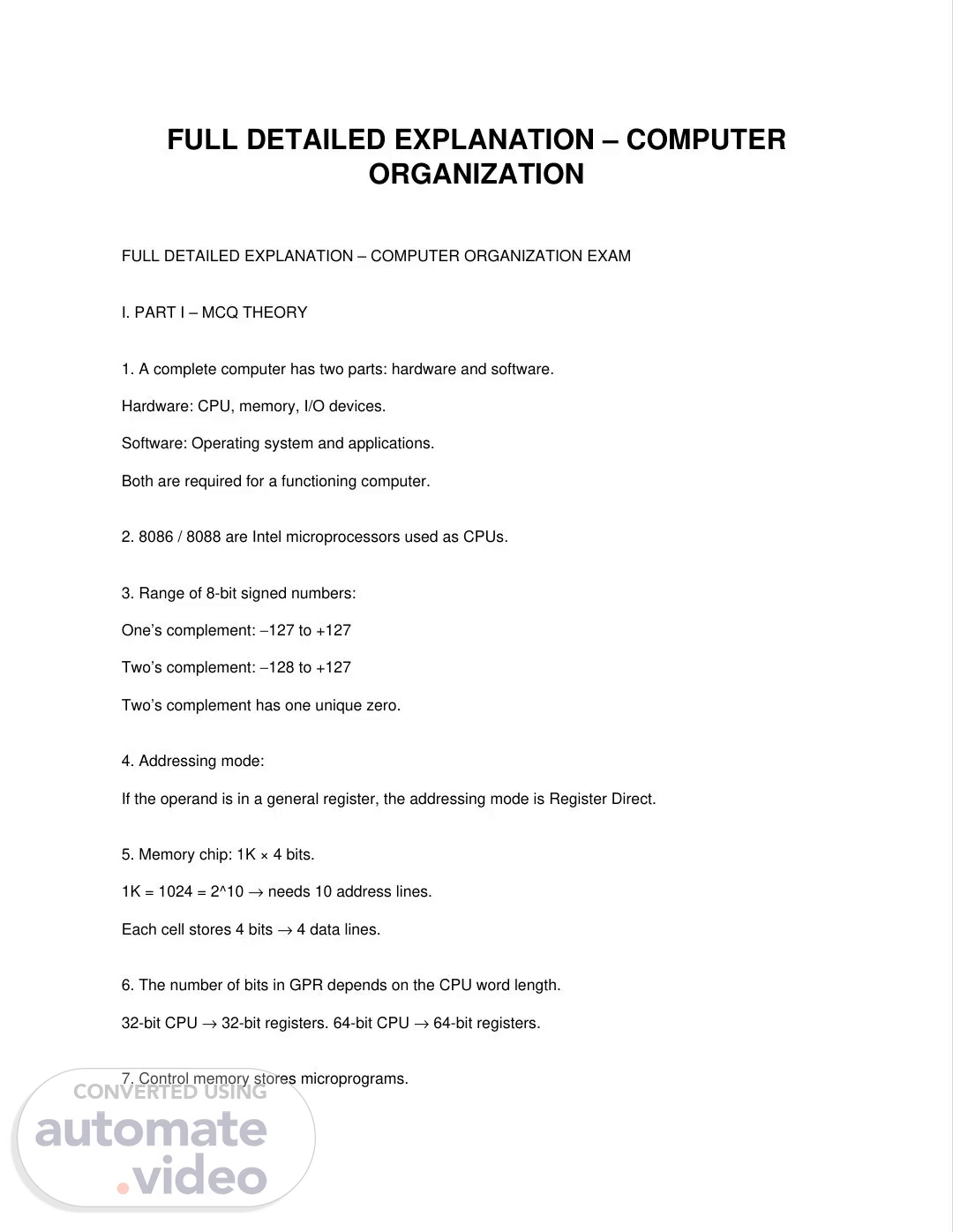
FULL DETAILED EXPLANATION – COMPUTER ORGANIZATION FULL DETAILED EXPLANATION – COMPUTER ORGANIZATION EXAM I. PART I – MCQ THEORY 1. A complete computer has two parts: hardware and software. Hardware: CPU, memory, I/O devices. Software: Operating system and applications. Both are required for a functioning computer. 2. 8086 / 8088 are Intel microprocessors used as CPUs. 3. Range of 8-bit signed numbers: One’s complement: −127 to +127 Two’s complement: −128 to +127 Two’s complement has one unique zero. 4. Addressing mode: If the operand is in a general register, the addressing mode is Register Direct. 5. Memory chip: 1K × 4 bits. 1K = 1024 = 2^10 → needs 10 address lines. Each cell stores 4 bits → 4 data lines. 6. The number of bits in GPR depends on the CPU word length. 32-bit CPU → 32-bit registers. 64-bit CPU → 64-bit registers. 7. Control memory stores microprograms..
Scene 2 (18s)
[Audio] The CPU executes instructions from the operating system and applications. The memory stores data and programs. Input/output devices allow users to interact with the computer. The operating system manages computer resources and provides a platform for running applications. Applications perform specific tasks, such as calculations or data storage. Addressing modes are used to access data stored in memory. Register direct, indirect, and indexed addressing are examples of addressing modes. Memory chips store data and programs. Static RAM and dynamic RAM are types of memory chips. Control memories store microprograms that control the flow of data within the computer. Microprograms are small programs that contain instructions for performing specific tasks. They can be stored in ROM. The cache solves the speed mismatch between the CPU and RAM. The computer organization exam assesses students' understanding of how computers work, their components, and how they interact with each other. The exam evaluates students' knowledge of computer hardware and software components, their interactions, and how they work together to process information..
Scene 3 (56s)
[Audio] The computer's hardware and software components interact with each other to process information. The CPU executes instructions, while memory stores data and programs. Input/output devices allow users to interact with the other devices. Operating systems manage computer resources and provide a platform for running applications. Applications perform specific tasks, such as calculations or data storage. The CPU uses addressing modes to access data stored in memory. There are different types of addressing modes, including register direct, indirect, and indexed addressing. Memory chips come in various sizes, such as 1K, 16K, and 64K, and have different types, like static RAM and dynamic RAM. Control memories store microprograms that control the flow of data within the computer. Microprograms are small programs that contain instructions for performing specific tasks. The formula for determining the number of chips needed is total memory divided by chip size. In this case, we need 8 chips to build an 8K×8 memory, requiring 2 chips per group and 4 groups in total. The address range starts from E0000H and goes up to E0FFFH, with each group having a size of 2048 bytes. The CPU selects 3 bits from the higher address bits to decode the chip groups. This allows us to efficiently organize and manage the memory within the computer..
Scene 4 (1m 40s)
[Audio] The microprogrammed controller stores microinstructions in Read Only Memory (ROM). Each machine instruction has its own microprogram. This allows for efficient execution of instructions. The immediate values for ADDI and XORI operations are stored in IR(0)out. The immediate offsets for BEQ operations are stored in IR(A)out. The EQUAL signal compares the ALU outputs and determines if the registers match for BEQ operations. The SUB operation involves modifying the decoder to compare FUNC with 0x22 (R-type) and generating the SUB output. The microprogram entry for SUB is connected to S4, S3, and S0. The control memory is updated by adding the SUB control bit and increasing the width to 32 bits. The SUB microinstructions involve routing the results to registers rs and rt, and performing the subtraction operation with ALU_OP set to SUB.".
Scene 5 (2m 11s)
[Audio] The computer organization exam covers various topics related to computers, including hardware and software components, addressing modes, memory chips, and control memories. The exam assesses students' understanding of how computers work, their components, and how they interact with each other. The main components of a computer include the central processing unit (CPU), memory, input/output devices, operating systems, and applications. The CPU executes instructions, while memory stores data and programs. Input/output devices allow users to interact with the computer. Operating systems manage computer resources and provide a platform for running applications. Applications perform specific tasks, such as calculations or data storage. The exam also covers topics like addressing modes, which determine how the CPU accesses data stored in memory. There are different types of addressing modes, including register direct, indirect, and indexed addressing. Additionally, the exam covers memory chips, including their size, type, and functionality. Memory chips come in various sizes, such as 1K, 16K, and 64K, and have different types, like static RAM and dynamic RAM. Control memories store microprograms that control the flow of data within the computer. Microprograms are small programs that contain instructions for performing specific tasks. Overall, the computer organization exam tests students' knowledge of computer hardware and software components, their interactions, and how they work together to process information. Zout → Rin(rd)..
Scene 6 (3m 3s)
[Audio] The computer organization exam covers various topics related to computers, including hardware and software components, addressing modes, memory chips, and control memories. The exam assesses students' understanding of how computers work, their components, and how they interact with each other. The main components of a computer include the central processing unit (CPU), memory, input/output devices, operating systems, and applications. The CPU executes instructions, while memory stores data and programs. Input/output devices allow users to interact with the computer. Operating systems manage computer resources and provide a platform for running applications. Applications perform specific tasks, such as calculations or data storage. The exam also covers topics like addressing modes, which determine how the CPU accesses data stored in memory. There are different types of addressing modes, including register direct, indirect, and indexed addressing. Additionally, the exam covers memory chips, including their size, type, and functionality. Memory chips come in various sizes, such as 1K, 16K, and 64K, and have different types, like static RAM and dynamic RAM. Control memories store microprograms that control the flow of data within the computer. Microprograms are small programs that contain instructions for performing specific tasks. Overall, the computer organization exam tests students' knowledge of computer hardware and software components, their interactions, and how they work together to process information..