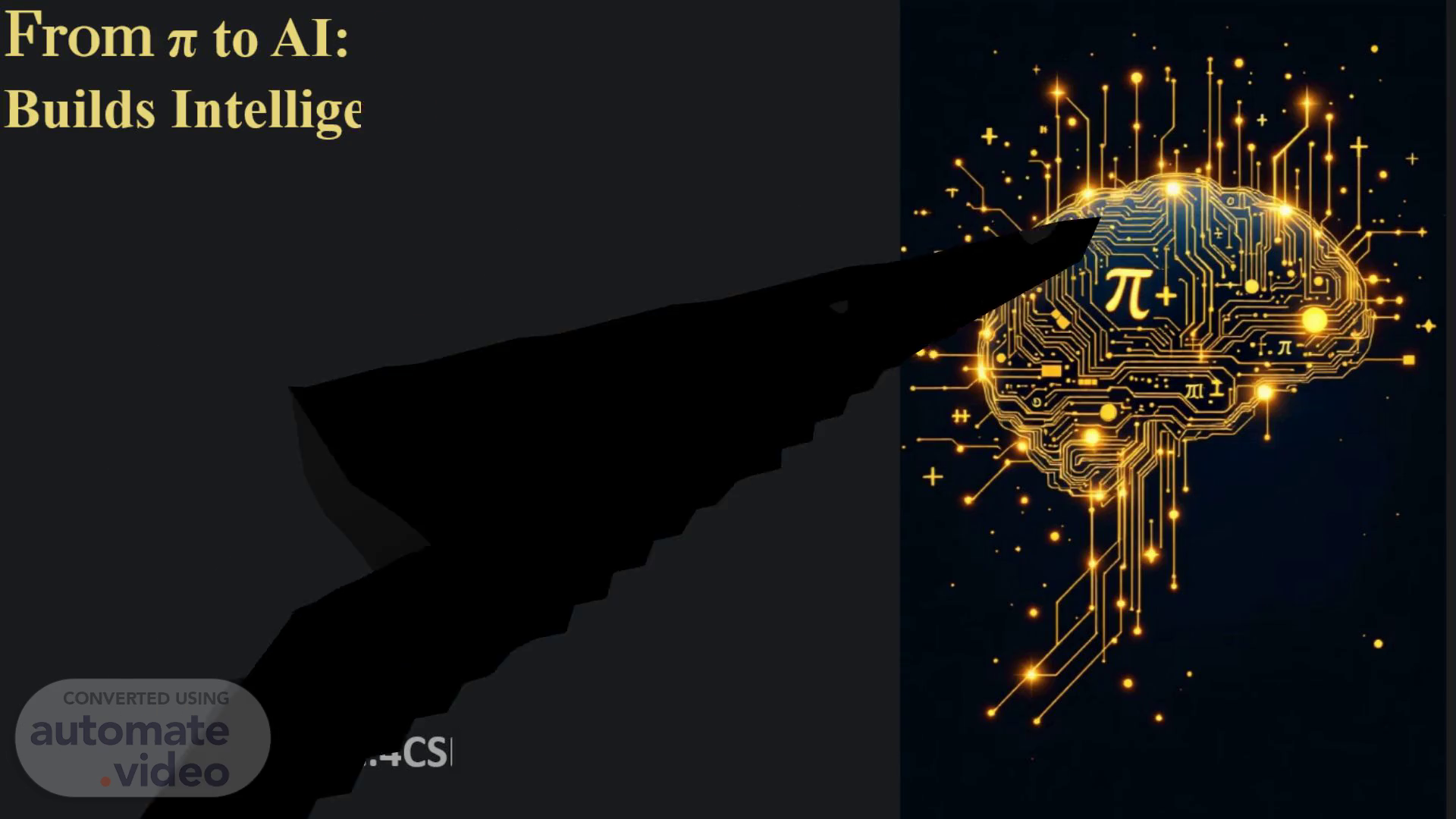
From-p-to-AI-How-Mathematics-Builds-Intelligence (2) (1)
Scene 1 (0s)
Prepared by Pushkar Anand [20241CSI0027] Vivek Baruah [20241CSI0011] Mohammed Huzaifa[20241CSI0003].
Scene 2 (10s)
[Audio] The Universal language of modeling Ancient mathematicians didn't just invent it for fun , they needed a way to model the physical world, like the circumference of a wheel or the shape of a building.. Mathematics as a Model of Reality Solving Real World Problems π was developed to measure circles ,wheels, and buildings — helping humans understand the physical world. Equations allow us to predict motion, like how a ball moves or planets orbit. From Physical Models to Intelligence If math can model nature, it can also model human thinking — which is how A-I begins..
Scene 3 (47s)
[Audio] Probability and Prediction π appears in the Bell Curve formula, which helps A-I estimate chances and make predictions Improving Images Some image processing techniques use π-based formulas to reduce noise and make visuals clearer. Sound and Waves π is connected to waves and cycles, which helps A-I process and understand audio signals..
Scene 4 (1m 30s)
[Audio] Linear Algebra –The Shape of Data Real World → Numbers Computers cannot understand images or objects directly. Everything — pictures, text, sound — must first be converted into numbers. Organizing and Processing Data Linear algebra helps the computer organize these numbers and perform calculations on them, making it possible for A-I to recognize patterns. Images Become Matrices A picture is broken into tiny pixels, and each pixel has a numerical value. These values are arranged in a grid called a matrix..
Scene 5 (2m 8s)
[Audio] Calculus – The Engine of Learning Learning from Mistakes After processing data, A-I calculates how wrong its prediction is — this error guides the learning process. Small Steps, Continuous Improvement By adjusting its values step by step, the A-I gradually reaches lower error and better performance. Finding the Downhill Direction Using gradient descent, calculus measures the “slope” of the error and shows which direction reduces it.
Scene 6 (2m 40s)
[Audio] Probability & Statistics – Embracing the unknown Thinking in Chances, Not Certainties A-I does not give one fixed answer — it calculates the likelihood of different outcomes. Predicting the Most Likely Outcome When generating text or making decisions, A-I chooses what is most probable based on learned patterns. Finding Patterns in Uncertain Data Using statistics, A-I filters messy real world information and focuses on meaningful trends..
Scene 7 (3m 11s)
[Audio] Neural Networks – Putting It All Together Combining Mathematical Foundations Neural networks bring together linear algebra, calculus, and probability into one system. Layers That Process Data Raw data passes through multiple layers, where numbers are adjusted and refined step by step. From Data to Intelligent Output After many mathematical transformations, the system can recognize images, translate languages, or make complex decisions..
Scene 8 (3m 44s)
[Audio] Conclusion : The future is Calculated Mathematics builds intelligence: from π in ancient geometry to matrices, derivatives, and probability that power A-I . A-I Is Mathematics in Action What feels like intelligence is built from equations, patterns, and logic. Understanding Math Removes the Mystery When we understand the formulas, A-I stops being magic — and becomes understandable. The Next Breakthrough Is Mathematical The future of A-I will depend not only on faster machines, but deeper mathematical ideas..