Scene 1 (0s)
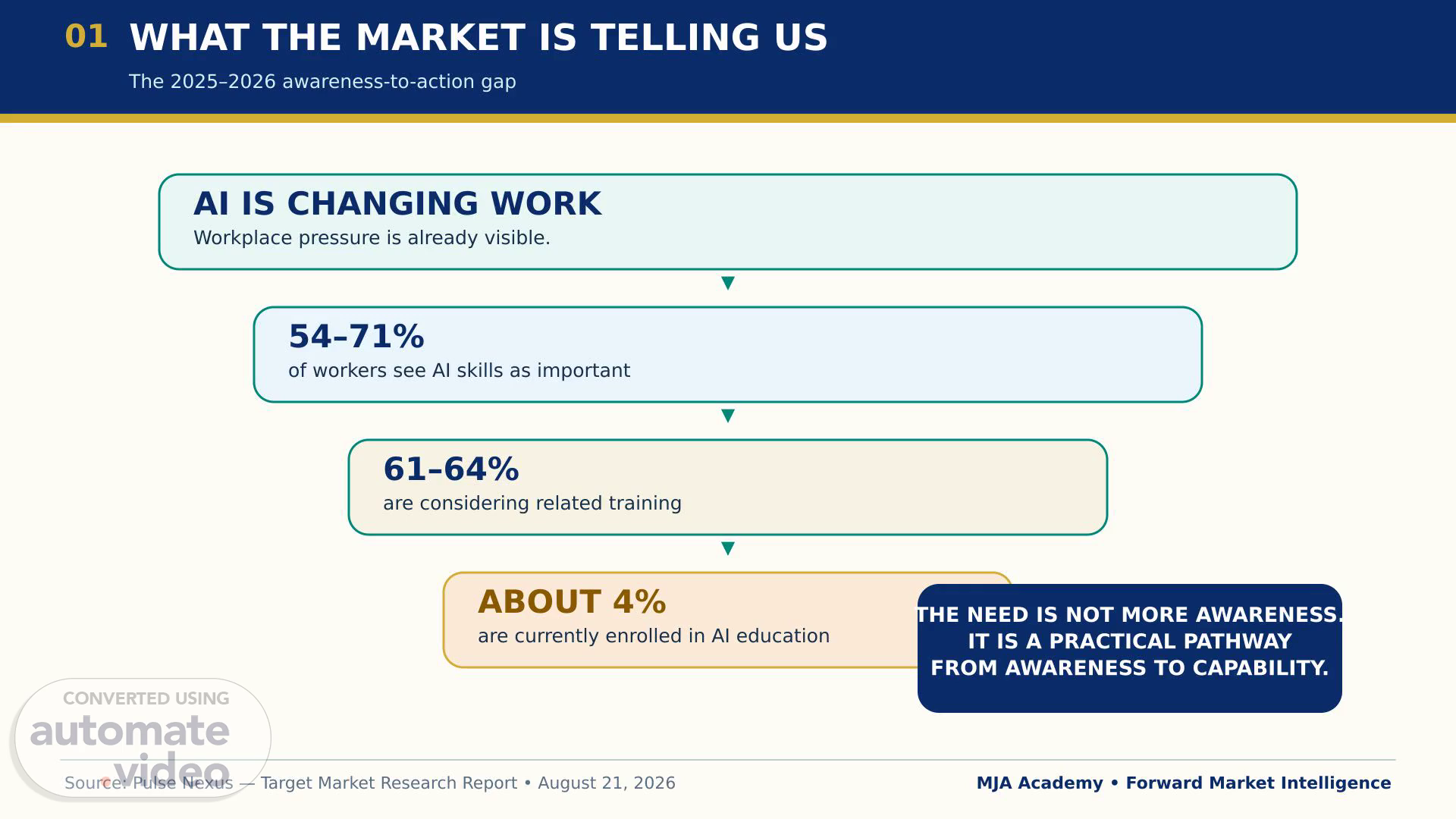
[Audio] This opening slide establishes the central market signal found in the completed Pulse Nexus research. Please take a moment to follow the sequence from the top of the slide downward. AI is already changing work. That does not mean every worker understands every tool or knows exactly how AI will affect a particular job. It means the pressure to understand AI-related skills is now visible across the workforce. The first major statistic shows that approximately 54 to 71 percent of workers recognize AI-related skills as important to remaining competitive. The range reflects the different findings summarized in the research. We should preserve it as a range rather than pretending it represents one single survey population. The next statistic shows that approximately 61 to 64 percent are considering, or are likely to pursue, related training. This tells us that interest is not merely theoretical. A substantial group of adults understands that learning may be necessary. Now pause on the final statistic: only about 4 percent are currently enrolled in AI-related education. This is the awareness-to-action gap. Many workers recognize the pressure. Many say they expect to train. Very few are actually participating now. The strategic meaning is important. The market does not primarily need another explanation that artificial intelligence exists. People need a practical pathway that helps them move from awareness and concern into confidence, judgment, and usable capability. That finding becomes the foundation for the rest of this presentation. We will next examine who has the strongest need, what prevents adults from acting, what outcomes they want, and what an education provider would need to deliver..
Scene 2 (1m 55s)
[Audio] This slide ranks the adult populations with the strongest evidence-supported need. The ranking is based on the completed Pulse Nexus report. It is not built around MJA Academy's former target-market assumptions or its existing products. The first segment is working professionals and mid-career adults. Their need centers on practical AI upskilling for current roles, increased productivity, stronger professional capability, advancement, and career security. These adults may not want an entirely new career. Many want to remain valuable and capable as their current work changes. The second segment includes career changers, workforce reentrants, and workers whose roles are exposed to disruption. Their needs include updated skills, stronger employability, confidence, and a credible transition pathway. The third segment includes freelancers, independent workers, solopreneurs, and virtual assistants. The research supports opportunities for AI-enhanced capability, higher-value work, productivity, and economic flexibility. Virtual assistance is relevant here, but the evidence does not support making VA training the definition of the entire future Academy. The fourth segment includes adults reached through workforce-connected systems. These learners may enter education through employers, workforce organizations, community colleges, vocational programs, libraries, Chambers, or community partnerships. The fifth segment includes entrepreneurs and small-business owners who need practical AI adoption for productivity, operations, decision-making, customer value, and growth. Women, including mid-career women, remain important across these populations. However, the research does not support restricting the future market to women ages 35 to 55. At the same time, the Academy should not try to serve every adult. The forward target architecture must remain evidence-based and sufficiently focused..
Scene 3 (3m 59s)
[Audio] This slide shifts the discussion from who needs education to why more adults are not successfully entering or completing it. The barriers should not be framed as personal failures. They reveal the conditions under which adults are being asked to learn. Those conditions must influence the design of future education. Time is a major barrier. Adults are learning around employment, appointments, family responsibilities, children, businesses, and unpredictable interruptions. Cost matters as well, especially when the return on investment is uncertain. Confidence is another major issue. Some adults have limited technology confidence or worry that everyone else already understands AI. A lack of employer-provided training can leave them responsible for solving a workplace transition alone. Fear appears in several forms: fear of becoming obsolete, embarrassment about skill gaps, and anxiety about whether they can keep up. Information overload can make the problem worse. Adults may encounter a constant stream of tools, terminology, predictions, and conflicting advice without a clear starting point. Practical relevance is essential. Training that does not connect clearly to work, income, business, or advancement is easier to postpone. Rigid schedules also exclude adults whose lives do not fit a traditional classroom pattern. Accessibility and educational history must be treated as design requirements. Disability, prior negative educational experiences, and difficulty navigating technology can affect entry, persistence, and completion. The strategic implication appears at the bottom of the slide: the barriers tell us how education must be designed. Future learning should reduce unnecessary friction, provide clear navigation, build confidence, respect adult circumstances, and demonstrate why each activity matters..
Scene 4 (5m 59s)
[Audio] This slide organizes the market around desired outcomes rather than course titles. That distinction matters because adults do not usually begin by asking for an internal curriculum structure. They begin with a change they want in their lives. Career security means remaining employable and competitive as work changes. Advancement means becoming capable of earning a promotion, moving into a better job, or taking on stronger responsibilities. Income includes higher earnings and additional income opportunities. Career transition means developing the confidence, capability, and credibility to move toward work with stronger prospects. Flexibility may mean remote work, independent work, freelance work, virtual assistance, or greater control over when and how work is performed. Business performance includes using Human plus AI capability to improve productivity, operations, customer value, decision-making, and growth. AI capability is not simply knowing which button to press. The deeper outcome is practical confidence: thinking clearly, prompting and communicating effectively, verifying results, applying human judgment, protecting sensitive information, and transferring capability as tools change. Credibility includes credentials, completion evidence, projects, demonstrations, and work products that allow a learner to show what they can do. Economic mobility brings these outcome families together. It represents greater independence, opportunity, and the ability to respond to changing economic conditions. The central message is that the market is buying meaningful change, not curriculum titles. This does not mean curriculum is unimportant. It means curriculum should be designed backward from the transformation the learner needs, then tested against evidence of capability and measurable progress..
Scene 5 (8m 2s)
[Audio] This slide translates the market evidence into requirements for education. These are not proposed MJA courses. They describe what training must feel like and accomplish if working adults are expected to enter, persist, and complete it. Training must be practical. Learners need real-world application, not information alone. It must also be job-relevant, with a visible connection to work, income, business, advancement, or career transition. Accessibility must be built into the experience. Adults differ in ability, technology confidence, educational history, and personal circumstances. Clear navigation, readable materials, understandable instructions, and multiple ways to engage are not extras. Flexibility is essential because adult responsibilities do not disappear when a course begins. Learners need an experience they can leave and return to without losing their place or having to remember twenty disconnected instructions. Training should be manageable, but manageable must not mean shallow. Shorter learning can reduce overload, while sufficient practice is still required to build real capability. The experience should be guided. Adults benefit from examples, practice, feedback, support, and clear next steps. They should always be able to answer four questions: Where am I? What am I doing? Why does it matter? What do I do next? Training should be outcome-oriented. The learner should understand the capability being developed and how progress will be demonstrated. Finally, the experience should be credible. Where appropriate, completion evidence, credentials, projects, or demonstrations should communicate achievement. The sentence at the bottom protects the boundary of this assignment. This slide defines market requirements for education. It does not approve a specific MJA curriculum or product..
Scene 6 (10m 5s)
[Audio] This slide shows where the research identifies opportunity for an education provider. The opportunity exists at the intersection of five pressures. First, the nature of work is changing. Second, workers face increasing pressure to understand and use AI-related skills. Third, there is a substantial adult training gap. Fourth, adults need career security, income, mobility, and business performance. Fifth, demand is strongest for learning that is practical and job-relevant. Together, these conditions create a market opportunity. However, the two lower sections of the slide must remain distinct. The left side identifies who needs education. This includes working adults, career changers and reentrants, independent workers, virtual assistants, solopreneurs, entrepreneurs, and small-business owners. The right side identifies organizations or ecosystems that may enable access. Employers and workforce organizations may refer participants, sponsor training, provide funding, or integrate education into workforce development. Community colleges and vocational programs may become delivery or pathway partners. Libraries, Chambers, and community organizations may provide trusted access points. Small-business ecosystems may connect entrepreneurs and employers with relevant training. The person who needs education is not always the same person or organization that pays for it, refers the learner, sponsors participation, or helps deliver access. That distinction affects positioning, partnership strategy, enrollment design, and the evidence an education provider must communicate. This slide identifies opportunity areas; it does not decide which opportunity MJA Academy will pursue. That choice requires a focused target learner architecture, defined outcomes, educational requirements, validation, and Founder approval..
Scene 7 (12m 10s)
[Audio] This final slide explains what should happen next. It is a decision architecture, not a curriculum recommendation. The sequence begins with Pulse market research. External evidence gets the first word. The team then identifies the strongest market needs and defines a sufficiently focused future target learner architecture. Next, the Academy defines the outcomes those learners need. Those outcomes should describe meaningful change in career, income, flexible work, business performance, capability, or economic mobility. Once the outcomes are clear, the educational requirements can be defined. This includes the durable Human plus AI capabilities, professional capabilities, learning experience, accessibility requirements, practice, evidence of learning, and success measures needed to produce the intended transformation. AI Robin leads the educational architecture and capability progression. Victoria Hale evaluates the learner journey, usability, accessibility, confidence, persistence, support, and completion requirements. Kai Nova synthesizes the system architecture and implementation structure. Other team members contribute within their governed roles, but the Founder retains final authority. The dark-blue gate is crucial: only after Founder approval should existing MJA assets be compared against the approved future. At that later stage, existing work may be classified as use, adapt, combine, rebuild, retire, or true gap. This prevents the future Academy from being designed merely to protect what was already built. Existing work may still prove valuable, but it must earn its place by serving the approved learner, outcome, and capability architecture. The governing principle for the entire presentation is simple: research gets the first word, the learner's desired transformation guides the design, durable Human plus AI capability provides the foundation, and Founder Robin Ann Morris gets the final word..