Scene 1 (0s)
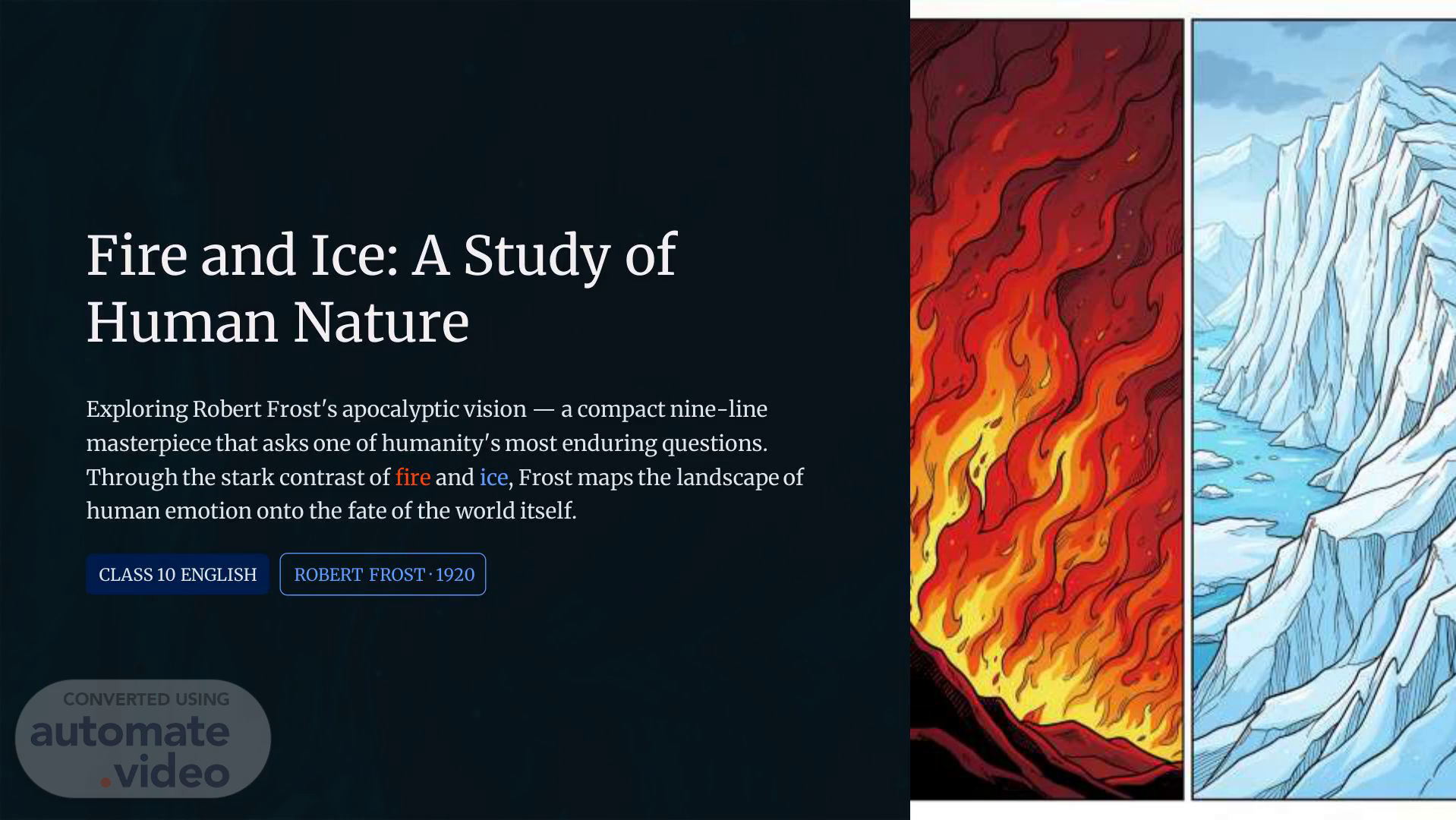
[Audio] Fire and Ice: A Study of Human Nature Exploring Robert Frost's apocalyptic vision — a compact nine-line masterpiece that asks one of humanity's most enduring questions. Through the stark contrast of fire and ice, Frost maps the landscape of human emotion onto the fate of the world itself. CLASS 10 ENGLISH ROBERT FROST · 1920.
Scene 2 (25s)
[Audio] The Poet's Voice: Who is Robert Frost? 4 9 Pulitzer Prizes Lines in the Poem Won for Poetry in 1924, 1931, 1937, and A complete philosophical argument in 1943 just nine lines 1920 Year Published Written in the aftermath of World War I Robert Frost (1874–1963) was one of America's most celebrated poets. He mastered the art of simple language carrying complex meaning. His poems often use New England landscapes and natural imagery as a doorway into questions about human nature, choice, and mortality. In "Fire and Ice," he uses the end of the world as a metaphor for the end of a soul — making the cosmic deeply personal..
Scene 3 (1m 17s)
[Audio] The Hook: How Will the World End? For centuries, philosophers, prophets, and poets have debated how the world will meet its end. Robert Frost entered this ancient conversation in 1920 with just nine lines — and changed it forever. Fire ❄️ Ice Represents the heat of human Represents the cold of hatred, passion, greed, and unchecked indifference, and emotional desire distance ⚖️ The Question Does the greater threat lie in our passion or our coldness?.
Scene 4 (1m 48s)
[Audio] The Text: Fire and Ice Reading the Poem Some say the world will end in fire, Some say in ice. Notice how the poem divides itself — the first four From what I've tasted of desire lines lean toward fire, while the final five I hold with those who favor fire. acknowledge the equal power of ice. Frost never But if it had to perish twice, declares a winner. He simply observes: both are I think I know enough of hate capable of total destruction. To say that for destruction ice Is also great And would suffice. The poem was published in Harper's Magazine in December 1920 and later appeared in Frost's collection New Hampshire (1923), which won the Pulitzer Prize..
Scene 5 (2m 39s)
[Audio] Visualizing the Symbols Frost uses two elemental forces as metaphors for human emotion. Each symbol carries its own color, temperature, and moral weight — yet both lead to the same inevitable conclusion. Fire — Desire ❄️ Ice — Hatred Color: Red-Orange Color: Blue-White Symbolizes: Unrestrained passion, greed, lust, and ambition Symbolizes: Cold indifference, hatred, intolerance, and isolation Quality: Consuming, fast, visible, explosive Quality: Slow, silent, rigid, numbing Both symbols represent emotional extremes — Frost suggests that neither passion nor coldness, when left unchecked, leads to anything but destruction..
Scene 6 (3m 31s)
[Audio] Fire: The Force of Desire Why does Frost align himself with those who "favor fire"? Because he has tasted desire — he knows it intimately. Fire is not just destruction; it is consumption. It grows, spreads, and devours everything in its path. Passion That Burns Out of Control The Danger of Wanting Too Much Unchecked ambition, greed, and lust consume not only Fire is seductive — it draws us in with its warmth and the object of desire but the desirer as well. Think of light. But desire, when it becomes obsession, leaves wars fought over resources, relationships destroyed by only ash. Frost warns us: the very thing that feels alive jealousy, or lives lost to addiction. can be what destroys us..
Scene 7 (4m 27s)
[Audio] Ice: The Force of Hatred If fire destroys with speed and drama, ice destroys with patience and silence. Hatred does not always announce itself — it seeps in slowly, hardening the heart until nothing warm can survive. Chilling and Silent Hatred operates quietly — in grudges held for years, in cold shoulders, in the refusal to forgive or understand. Slowly Kills Vitality Like frost on a plant, hatred kills from the outside in — freezing empathy, compassion, and human connection. Leaves Nothing Behind Frost's word "suffice" is chilling in its calmness. Ice doesn't need to be dramatic — it simply ends things..
Scene 8 (5m 12s)
[Audio] Literary Devices: How the Poem Hits Hard Frost's genius lies in how much meaning he packs into so few words. Every sound and structural choice is deliberate. Alliteration Consonance The repetition of "Some say" creates a haunting, chant-like The sharp "t" and "s" sounds throughout the poem — rhythm — as if the speaker is echoing an ancient prophecy "tasted," "destruction," "suffice" — mirror the biting, passed down through generations. cutting quality of ice itself. Rhyme Scheme Understatement The ABA ABC BCB pattern creates a circular, inescapable The final word "suffice" is a masterstroke of feeling. The rhymes trap the reader in the same cycle of understatement. Frost doesn't say ice would be better — destruction — there is no exit. just that it would be enough. The calmness is terrifying..
Scene 9 (6m 9s)
[Audio] Classroom Discussion: Which is Worse? Frost leaves the question open — and so should we. Use these prompts to spark debate in your classroom. Team Fire ❄️ Team Ice Argument: Desire and greed drive wars, environmental Argument: Hatred and indifference are slower but equally destruction, and social inequality. The 20th century's deadly. Genocide, systemic racism, and social isolation all greatest catastrophes were fueled by unchecked ambition. stem from the cold refusal to see others as human. Colonialism and resource exploitation The Holocaust and ethnic cleansing Consumer culture and climate change Bystander apathy in crises Personal relationships destroyed by jealousy Social media dehumanization Student Poll: Raise your hand — which force feels more prevalent in the world today: the fire of greed, or the ice of hatred? Be prepared to defend your choice..
Scene 10 (7m 15s)
[Audio] Conclusion: The Power of Balance "Fire and Ice" is not merely a poem about the apocalypse. It is a mirror held up to human nature. Frost challenges each of us to examine which force lives more powerfully within us — and to choose differently. Love Over Desire Empathy Over Hatred Balance as Survival Channel passion into creation, not Thaw the ice of indifference The antidote to both extremes is consumption. Desire directed through understanding. Every act moderation — a warm heart with a toward growth and connection of empathy is a small rebellion cool head. This is the wisdom Frost becomes a force for good. against destruction. leaves us with. Final Thought: Control your fire. Thaw your ice. The world does not have to perish — but the choice is ours, every single day..