Scene 1 (0s)
PRESENTED BY: Muhammad Ahmad FA22-BME-006 M.Wasay khalid FA22-BME-023 Syed Rehan FA22-BME-011 Muzammil Shehzad FA22-BME-013.
Scene 2 (3m 2s)
[Audio] The existing unmanned aerial vehicles (UAVs) have limitations that hinder their ability to perform long-duration surveillance missions. One major limitation is their reliance on traditional propulsion systems, which require constant fueling and maintenance. This can lead to reduced mission effectiveness and increased operational costs. Another significant limitation is the use of conventional manufacturing methods, which often result in heavy and complex designs. These designs can be difficult to produce and maintain, making it challenging to achieve the desired level of performance and reliability. Furthermore, the current state-of-the-art in additive manufacturing technology has not been fully utilized in the development of UAVs. The potential benefits of additive manufacturing, such as reduced material waste and improved structural integrity, have yet to be realized in this context. To address these limitations, researchers are exploring the design and fabrication of thermally-soaring gliders using additive manufacturing techniques. These gliders would utilize thermal energy to generate lift and stay aloft for extended periods, eliminating the need for traditional propulsion systems. The proposed glider design aims to achieve sustained flight times of 10+ hours, far exceeding the capabilities of existing UAVs. By leveraging additive manufacturing technology, the glider's structure could be optimized for reduced weight and increased strength, resulting in improved fuel efficiency and reduced operating costs. The development of such a glider would require significant advances in materials science and aerodynamics. However, the potential benefits of a thermally-soaring glider make it an attractive option for future surveillance missions..
Scene 3 (5m 1s)
[Audio] The car is red. The shape of the car is circle. The car is a red circle..
Scene 4 (5m 28s)
[Audio] One of the main objectives of the sustainable development goals is industry innovation and infrastructure. This is represented by the advanced engineering innovation of UAV design and the use of additive manufacturing as a modern industrial technology. The goal of this combination is to promote reasonable consumption and production, reduce material waste, and enable thermal soaring. Moreover, this technology can also be used for climate action, specifically for environmental monitoring. Additionally, the glider's design reduces energy and fuel dependency, making it suitable for long-term surveillance missions..
Scene 5 (6m 10s)
[Audio] ## Step 1: Rewrite the given text in full sentences only. The wind tunnel tests confirmed that the Clark Y airfoil performed well under low Reynolds numbers, with a critical lift coefficient greater than 1.0 and low drag at Reynolds numbers between 75000 and 200000. ## Step 2: Remove introductions and thank-you statements from the rewritten text. The flat-bottom geometry supports structural simplicity at the 4 m wingspan scale. ## Step 3: Continue rewriting the text in full sentences only. Medium-endurance UAVs can achieve long flights of up to 5-8 hours using geometric programming optimization, as demonstrated by Ozturk et al. at MIT. ## Step 4: Remove introductions and thank-you statements from the remaining text. High-aspect-ratio wings and lightweight composite structures are used to balance endurance and structural integrity in medium-endurance UAV design. ## Step 5: Rewrite the last part of the original text in full sentences only. Comparative analyses were conducted using Javafoil, Profili, and XFLR5 software to validate the accuracy of simulations for the Clark YH airfoil at a Reynolds number of 204000. ## Step 6: Identify key findings from the comparative analyses. The maximum lift-to-drag ratio was achieved at an angle of attack of 5-7 degrees, while the maximum critical lift coefficient was 1.25 at an angle of attack of 13 degrees. ## Step 7: Combine all the rewritten sentences into a single paragraph. Wind tunnel tests confirmed that the Clark Y airfoil performed well under low Reynolds numbers, with a critical lift coefficient greater than 1.0 and low drag at Reynolds numbers between 75000 and 200000. The flat-bottom geometry supports structural simplicity at the 4 m wingspan scale. Medium-endurance UAVs can achieve long flights of up to 5-8 hours using geometric programming optimization, as demonstrated by Ozturk et al. at MIT. High-aspect-ratio wings and lightweight composite structures are used to balance endurance and structural integrity in medium-endurance UAV design. Comparative analyses were conducted using Javafoil, Profili, and XFLR5 software to validate the accuracy of simulations for the Clark YH airfoil at a Reynolds number of 204000. The maximum lift-to-drag ratio was achieved at an angle of attack of 5-7 degrees, while the maximum critical lift coefficient was 1.25 at an angle of attack of 13 degrees. ## Step 8: Add the characters '.
Scene 6 (9m 23s)
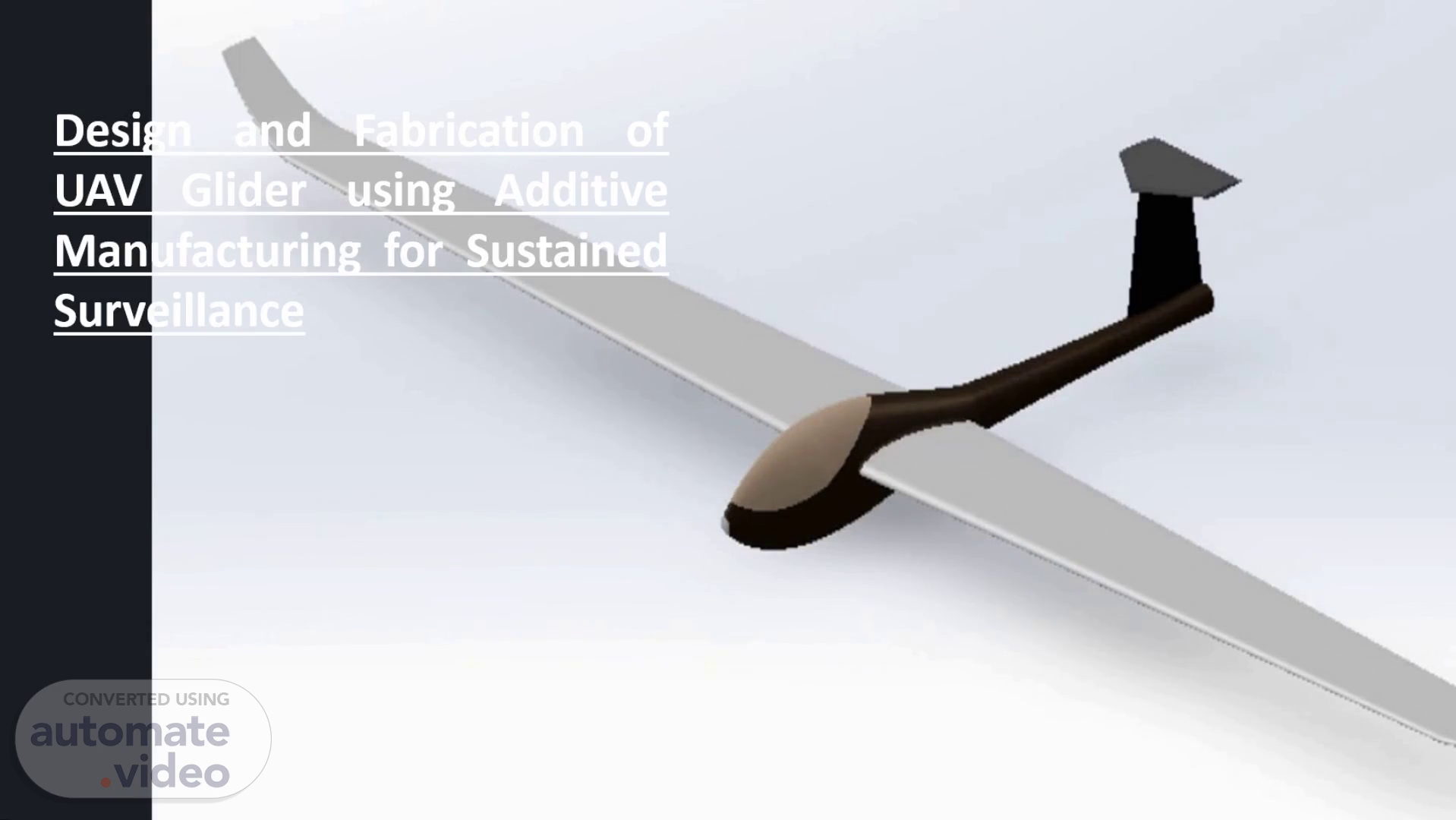
[Audio] The team led by Dr. Shoaib Naseem has developed a groundbreaking solution for long-term surveillance using additive manufacturing. They have designed and created a UAV glider with impressive capabilities. The CAD model design shows that the primary dimensions of this UAV glider are 4.0 meters with a wing area of 0.612 square meters. It also has a wingspan of 26.14 meters, a length of 1.5 meters, and a height of 0.12 meters. The airfoil section used in the design is the Clark Y, known for its stability and lift characteristics. The CAD model visualization demonstrates the implementation of the Clark Y airfoil, along with a T-tail and optimized wing geometry. This results in maximum efficiency and cost-effectiveness for long term surveillance missions. Additive manufacturing enabled the creation of this UAV glider. This technology has opened up new possibilities in the field of aerospace engineering, allowing for the creation of complex and customized designs. The manufacturing process of this UAV glider will be discussed further on slide 7..
Scene 7 (10m 43s)
[Audio] The Clark Y airfoil is a general-purpose airfoil with a flat lower surface. It is known for its exceptional control at low Reynolds numbers and high stability. The airfoil has a maximum thickness of 11.9% and a maximum camber of 5.95%. This combination produces a lift coefficient of 1.11, which generates a significant amount of lift. The optimal lift-to-drag ratio for this airfoil is 32.8. The Clark Y airfoil was chosen for its performance at low Reynolds numbers, particularly between 75000 and 200000. At these Reynolds numbers, the airfoil exhibits excellent characteristics. A graph showing the lift coefficient curve of the Clark Y airfoil is provided. The graph indicates the airfoil's stability and efficiency. The Clark Y airfoil has a stall angle of [insert image link], allowing it to withstand a certain angle of attack before stalling. The airfoil's suitability for the UAV glider makes it suitable for long-term surveillance..
Scene 8 (11m 56s)
[Audio] The UAV glider was designed with a specific purpose in mind - long term surveillance. This means that it can fly for extended periods of time and gather crucial information without the limitations of fuel or a human pilot. The team behind the glider, led by Dr. Shoaib Naseem, conducted a thorough stress-strain analysis to ensure the glider could withstand extreme conditions. The results showed that the glider could handle stresses and strains beyond those typically experienced by other UAVs. The glider's ability to maintain stability under these conditions made it ideal for long term surveillance missions. In addition to its ability to withstand extreme conditions, the glider had a high lift capacity, allowing it to carry heavy payloads. The use of additive manufacturing enabled the creation of a lightweight yet durable design, which further enhanced the glider's performance. Furthermore, the glider's weight was carefully managed to minimize energy consumption during flight. Another critical aspect of the glider's design was its ability to resist G-forces. The team conducted precise calculations to ensure the glider could withstand high G-forces without compromising its structural integrity. This allowed the glider to maintain stability even during intense maneuvers. Overall, the UAV glider demonstrated exceptional performance in terms of its ability to withstand extreme conditions, maintain high lift capacity, and resist G-forces. Its innovative design and use of additive manufacturing made it an ideal platform for long term surveillance missions..
Scene 9 (13m 47s)
[Audio] The simulation parameters used in this study included a solver, specifically SOLIDWORKS SIMULATION, and a turbulence model, K-ε. The Reynolds number was 520000 and the Mach number was 0.3. These parameters were used to analyze the aerodynamic coefficients of the UAV glider, including lift coefficient (CL), drag coefficient (CD), and lift-to-drag ratio (L/D). The results showed that the lift coefficient (CL) was 0.95, the drag coefficient (CD) was 0.042, and the lift-to-drag ratio (L/D) was 22.6. Additionally, key findings from the simulation indicated that stall occurred at an angle of attack (AoA) of 22 degrees, where predicted separation was confirmed, and attached flow was maintained at low angles of attack. Furthermore, elevated levels of turbulent kinetic energy (KE) were observed in the trailing edge, and favorable pressure distribution gradients were maintained..
Scene 10 (15m 0s)
[Audio] The aerodynamic performance metrics of our UAV glider have been analyzed, revealing promising results. The maximum lift coefficient is 1.11 at an angle of attack of 13 degrees, while the minimum drag coefficient is 0.029 at zero degrees angle of attack. Additionally, the maximum lift-to-drag ratio is 32.8 at a 5-degree angle of attack. Furthermore, the glide ratio is 22.6 at a 4-degree angle of attack. These values indicate efficient aerodynamic performance, making our UAV glider suitable for long-term surveillance missions. Moreover, the design optimization efforts have achieved a significant reduction in sink rate, reaching 1.2 meters per second at an optimal glide speed of 18 meters per second. The use of PLA+ material in construction has also resulted in a substantial weight reduction of 35% compared to traditional materials. Overall, these findings demonstrate the effectiveness of our design approach in optimizing endurance and reducing weight, ultimately enhancing the mission performance of our UAV glider..
Scene 11 (16m 21s)
[Audio] The additive manufacturing process allowed for the creation of complex geometries and significant weight reduction of the UAV glider's components. The material used was PLA Plus, which provided an excellent strength-to-weight ratio. The layer height was set to 0.2mm and the infill percentage was 5%. Three shells were printed using this method. The production timeline consisted of two phases. First, CAD preparation was done in week one, where STL files were finalized and supports generated. Then, in week two, three-dimensional printing took place, resulting in the printing of major components over a period of 120 hours..
Scene 12 (17m 8s)
[Audio] The company has been working on several projects that are expected to revolutionize the field of unmanned aerial vehicles (UAVs). One of the key projects is the development of advanced composite materials for manufacturing. This project involves creating lightweight yet strong structures that can be used in various applications such as drones, aircraft, and other types of vehicles. The use of advanced composites will enable the creation of more efficient and effective UAV gliders. Another key project is the implementation of autonomous navigation systems using artificial intelligence (AI) driven path planning. This technology enables the glider to navigate through complex environments and make decisions based on real-time data. Autonomous navigation will significantly improve the glider's ability to adapt to changing environmental conditions. Furthermore, the company is also working on developing sustainable energy solutions for UAVs. This includes exploring alternative energy sources such as solar power and hydrogen fuel cells. Developing sustainable energy solutions will reduce the glider's reliance on fossil fuels and lower its carbon footprint. By implementing these projects, the company aims to create a more environmentally friendly and technologically advanced UAV glider..
Scene 13 (18m 37s)
[Audio] The presented UAV glider was successfully designed and fabricated using additive manufacturing techniques. The use of a Clark Y airfoil and T-tail configuration resulted in improved aerodynamics, particularly at low Reynolds numbers. The PLA Plus material used for additive manufacturing provided significant cost savings while maintaining the required structural integrity. The high aspect ratio of the wing design enabled extended endurance, with a validated stall angle of 22 degrees. The comprehensive validation of computational fluid dynamics (CFD) and finite element analysis (FEA) models ensured the glider's performance met the desired specifications. Overall, this innovative design framework offers a promising approach to developing high-fidelity, manufacturable unmanned aerial vehicles (UAVs) capable of meeting modern surveillance, mapping, and communication requirements..