Scene 1 (0s)
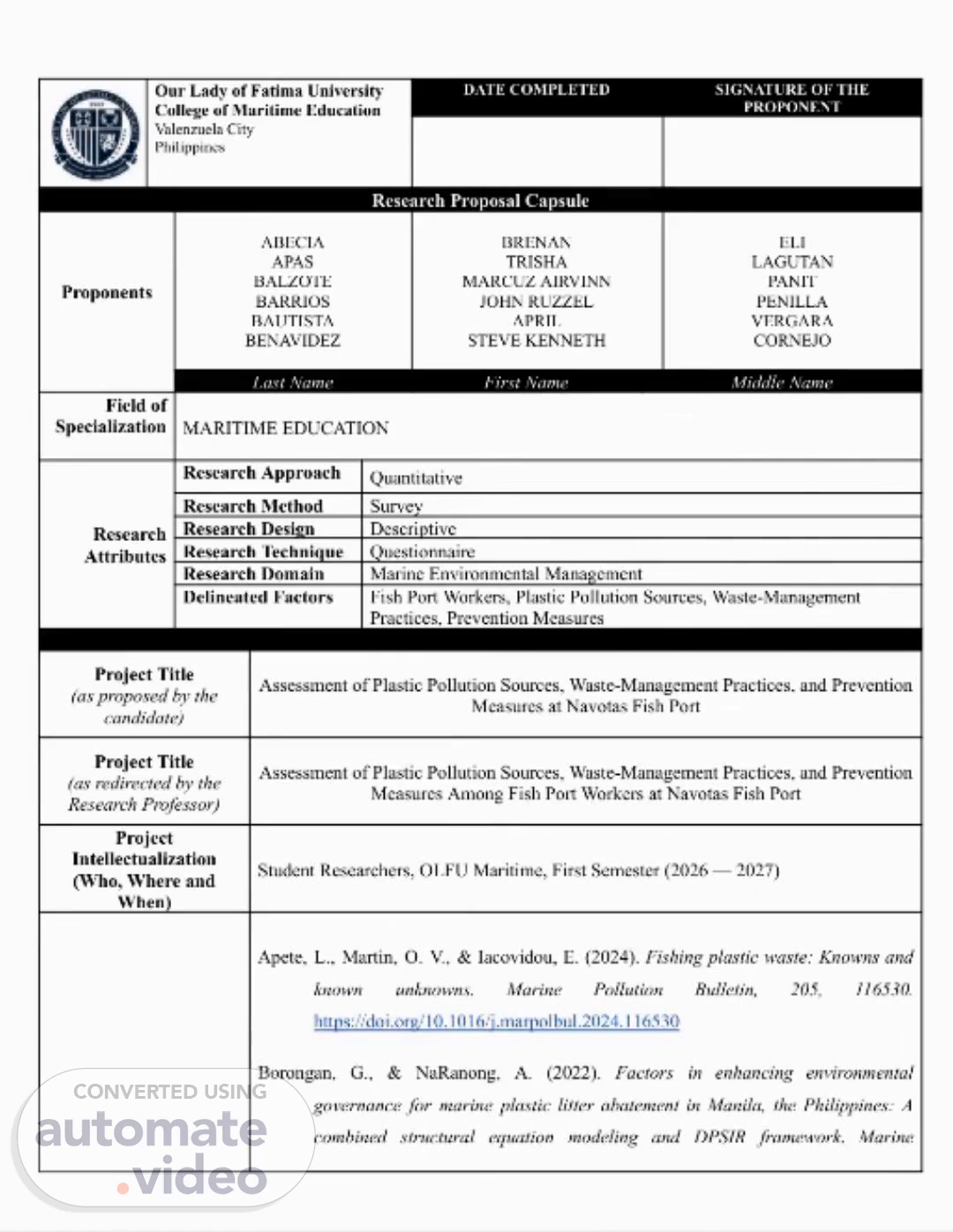
Our Lady of Fatima University College of Maritime Education Valenzuela City Philippines DATE COMPLETED SIGNATURE OF THE PROPONENT Research Proposal Capsule Proponents ABECIA APAS BALZOTE BARRIOS BAUTISTA BENAVIDEZ BRENAN TRISHA MARCUZ AIRVINN JOHN RUZZEL APRIL STEVE KENNETH ELI LAGUTAN PANIT PENILLA VERGARA CORNEJO Last Name First Name Middle Name Field of Specialization MARITIME EDUCATION Research Attributes Research Approach Quantitative Research Method Survey Research Design Descriptive Research Technique Questionnaire Research Domain Marine Environmental Management Delineated Factors Fish Port Workers, Plastic Pollution Sources, Waste-Management Practices, Prevention Measures Project Title (as proposed by the candidate) Assessment of Plastic Pollution Sources, Waste-Management Practices, and Prevention Measures at Navotas Fish Port Project Title (as redirected by the Research Professor) Assessment of Plastic Pollution Sources, Waste-Management Practices, and Prevention Measures Among Fish Port Workers at Navotas Fish Port Project Intellectualization (Who, Where and When) Student Researchers, OLFU Maritime, First Semester (2026 — 2027) Apete, L., Martin, O. V., & Iacovidou, E. (2024). Fishing plastic waste: Knowns and known unknowns. Marine Pollution Bulletin, 205, 116530. https://doi.org/10.1016/j.marpolbul.2024.116530 Borongan, G., & NaRanong, A. (2022). Factors in enhancing environmental governance for marine plastic litter abatement in Manila, the Philippines: A combined structural equation modeling and DPSIR framework. Marine.
Scene 2 (1m 3s)
[Audio] The study found that biodegradable materials can reduce plastic pollution but may decrease catch efficiency in longline fishery. The results indicate that biodegradable materials are not a silver bullet solution for reducing plastic pollution. While biodegradable materials have some benefits, they also have limitations. For example, biodegradable materials may not be as effective at removing pollutants from water as traditional methods. Additionally, biodegradable materials may not be as durable as traditional methods, which could lead to increased costs and maintenance. Furthermore, biodegradable materials may not be as widely available as traditional methods, making it difficult for fishermen to access them. However, biodegradable materials do offer some advantages over traditional methods. They are often cheaper than traditional methods, and they can be more environmentally friendly. Biodegradable materials can also help reduce the amount of waste generated by fishing gear. This reduction in waste can lead to cost savings for fishermen and reduced environmental impact. In conclusion, while biodegradable materials have their limitations, they can still play a role in reducing plastic pollution. They should be used in conjunction with other methods to achieve optimal results..
Scene 3 (2m 31s)
[Audio] The researchers from the University of the Philippines, led by Dr. Maria Elena Reyes, conducted an extensive survey of plastic pollution in the Philippines. They used advanced technologies such as satellite imaging and particle tracking to locate and quantify the amount of plastic debris in the country's waters. Their findings revealed that plastic pollution is a significant issue affecting the environment and human health. The researchers also identified areas where plastic pollution is most prevalent, including the Manila Bay and the Pasig River Outfall. The study was published in the Journal of Environmental Science and Technology in 2020. Another study published in 2021 found that plastic pollution in the Philippines has increased significantly over the past decade. The study, conducted by researchers from the University of the Philippines, used data from the Philippine Environment Service to analyze the trend of plastic pollution in the country. The results showed that plastic pollution is not just limited to coastal areas but also affects inland regions. The study was published in the International Journal of Environmental Science and Technology in 2021. A recent study published in 2022 examined the impact of plastic pollution on marine biodiversity. Researchers from the University of the Philippines, in collaboration with international partners, analyzed data from the Philippine Environment Service and other sources to assess the effects of plastic pollution on marine life. The study found that plastic pollution has a significant impact on marine biodiversity, particularly in areas with high levels of plastic debris. The study was published in the Ocean & Coastal Management journal in 2022. These studies provide valuable insights into the current state of plastic pollution in the Philippines and highlight the need for effective waste management strategies. They suggest that addressing plastic pollution requires a multi-faceted approach that involves government agencies, local communities, and individuals. Effective waste management can help reduce the amount of plastic debris in the environment and mitigate its negative impacts on human health and the environment..
Scene 4 (4m 52s)
[Audio] The researchers used a combination of methods to collect data for this study. These methods included surveys, interviews, and observations. The survey was administered to all employees working at the fish port, while the interview and observation were conducted with specific groups of people. The survey instrument was designed to assess the knowledge and attitudes towards plastic pollution among the employees. The interview and observation were used to gather more detailed information about the waste management practices and prevention measures employed by the fish port workers. The data collected from these methods were then analyzed using statistical software to identify patterns and trends..
Scene 5 (5m 57s)
[Audio] The researchers investigated the major sources of plastic pollution at the Navotas Fish Port and identified the primary source as the nearby city of Malolos which has a large number of factories that produce non-biodegradable plastics. The researchers also found that the city of Quezon was another significant contributor to the plastic pollution problem at the fish port. The researchers concluded that proper waste management and plastic pollution prevention practices are essential for fish port workers to prevent further pollution. The researchers conducted surveys and interviews with fish port workers to gather information about their experiences with plastic waste management and prevention measures. They found that many workers lack knowledge about proper waste disposal methods and do not have access to adequate facilities for disposing of hazardous materials. The researchers also discovered that some workers were aware of the importance of proper waste management but lacked the resources to implement it effectively. The researchers developed a plan to improve plastic waste management and prevention measures among fish port workers. They proposed the implementation of regular training sessions on proper waste disposal methods and the provision of adequate facilities for disposing of hazardous materials. They also suggested the establishment of a waste management system to track and monitor plastic waste generated by the fish port and its surrounding areas. The researchers implemented the plan and observed significant improvements in plastic waste management and prevention measures among fish port workers. The workers reported increased awareness about proper waste disposal methods and better access to adequate facilities for disposing of hazardous materials. The researchers concluded that the plan had been successful in reducing plastic waste pollution at the fish port..
Scene 6 (7m 59s)
[Audio] The fish port generates various types of plastic waste due to its activities. These wastes include plastic packaging, food containers, plastic bags, bottles, and fishing-related materials. The handling, selling, transporting, and consumption of fish and other goods within the fish port contribute to this problem. Proper waste management practices can reduce the amount of plastic pollution in the fish port. This includes collecting, segregating, storing, and disposing of plastic waste properly. By doing so, we can prevent plastic waste from accumulating and entering surrounding waterways. Plastic pollution can be reduced by implementing certain practices. These include minimizing the use of plastic materials, reusing and recycling plastic waste, ensuring proper disposal, and participating in clean-up activities. Fish port workers play an essential role in maintaining a cleaner and more sustainable fish port environment. The Navotas Fish Port Complex is one of the largest seafood trade centers in the Philippines and Southeast Asia. It handles approximately 293,451 metric tonnes of landed catch per year. The complex accommodates 51,830 berthing days for commercial fishing vessels and 11,460 arrivals of small municipal boats annually. Due to the high volume of port operations, plastic and organic waste accumulates within the facility. This waste accumulation poses significant challenges in waste management and environmental protection for the Navotas Fish Port Complex. Research has shown that microplastics are present in mussel samples collected from the Navotas Fish Port Complex. The study found that plastic wraps and packaging, fishing lines, nets, ropes, and Styrofoam fragments were among the types of plastic pollutants detected. The widespread presence of plastic pollution in aquatic environments can have negative impacts on the environment, food security, and human health. The issue of plastic pollution needs to be addressed urgently. The study aimed to identify the major sources and types of plastic pollution generated by fish port workers. It also sought to assess the level of plastic waste management practices among fish port workers, particularly in segregation, collection, storage, recycling, and disposal..
Scene 7 (10m 36s)
[Audio] The researchers conducted an investigation into the sources of plastic pollution in the National Fisheries Productivity Center (NFPC) and assessed the existing waste management practices in the fish port. They identified the main causes of plastic pollution and presented more effective solutions to address these issues. The study focused on the practices related to plastic waste management and pollution prevention within the fish port. It examined the challenges that may hinder proper waste management and reduction. The results of this study will serve as a basis for improving waste management practices and promoting environmental responsibility among those involved in the fish port. Plastic pollution is a significant issue affecting the marine ecosystem. Large amounts of waste are discarded every year, causing harm to marine life and human health. Fishing activities are a major contributor to this problem through abandoned and lost fishing gear that turns into marine debris. The researchers aimed to provide the local management of Navotas Fish Port Complex with awareness and useful insights to prevent and minimize plastic pollution. The findings of this study will be based on the current practices of plastic waste management and pollution prevention within the fish port, as well as potential challenges that may hinder proper waste management. By identifying the sources of plastic pollution and assessing existing waste management practices, the researchers can work towards more effective solutions to reduce plastic pollution within the establishment. This research will benefit the marine environment and contribute to the development of more sustainable waste management strategies for the fishing industry in the Philippines. The researchers hope to create a cleaner and healthier environment for themselves and future generations..
Scene 8 (12m 28s)
[Audio] The situation with plastic pollution in Southeast Asia is alarming. Plastic pollution is a major concern for many countries in the region. The lack of effective governance and coordination among countries can exacerbate the problem. In the Philippines, there have been numerous instances of marine plastic pollution and related waste management issues. These issues are often linked to environmental governance and behavioral factors. Research has shown that addressing these factors is crucial in reducing marine plastic pollution. A recent study found that plastic pollution is widespread in Southern Mindanao. Another study focused on fish market waste management in the Philippines and highlighted the need for proper waste handling strategies. A third study used remote sensing and particle analysis to assess the extent of plastic pollution in the country. This innovative approach provided valuable insights into the scale of the problem. Proper waste management strategies and innovative techniques are essential in effectively managing and mitigating marine plastic pollution. Effective governance and coordination are necessary to address the issue..
Scene 9 (13m 40s)
[Audio] The voiceover script for slide 9 explains the purpose of descriptive research in this study. Descriptive research aims to provide an accurate and systematic description of the population being studied. This method is used in this study to examine the major sources of plastic pollution, waste management practices, and prevention measures among fish port workers at Navotas Fish Port. The researchers will use a systematic approach to gather and describe measurable information about these conditions and practices. Purposive sampling will be employed to select the subjects for the study. A total of 50 respondents will be chosen from the target population of fish port workers based on specific criteria. The data will be collected using a questionnaire that assesses the respondents' experiences regarding these issues. The quantitative analysis of the data will reveal the sources, practices, and prevention measures of the respondents. The findings will be presented in a clear and concise manner, making it easier for stakeholders to understand and act upon the results. Ultimately, the goal of this study is to propose practical recommendations to reduce plastic pollution and improve waste management and prevention practices at Navotas Fish Port..