Scene 1 (0s)
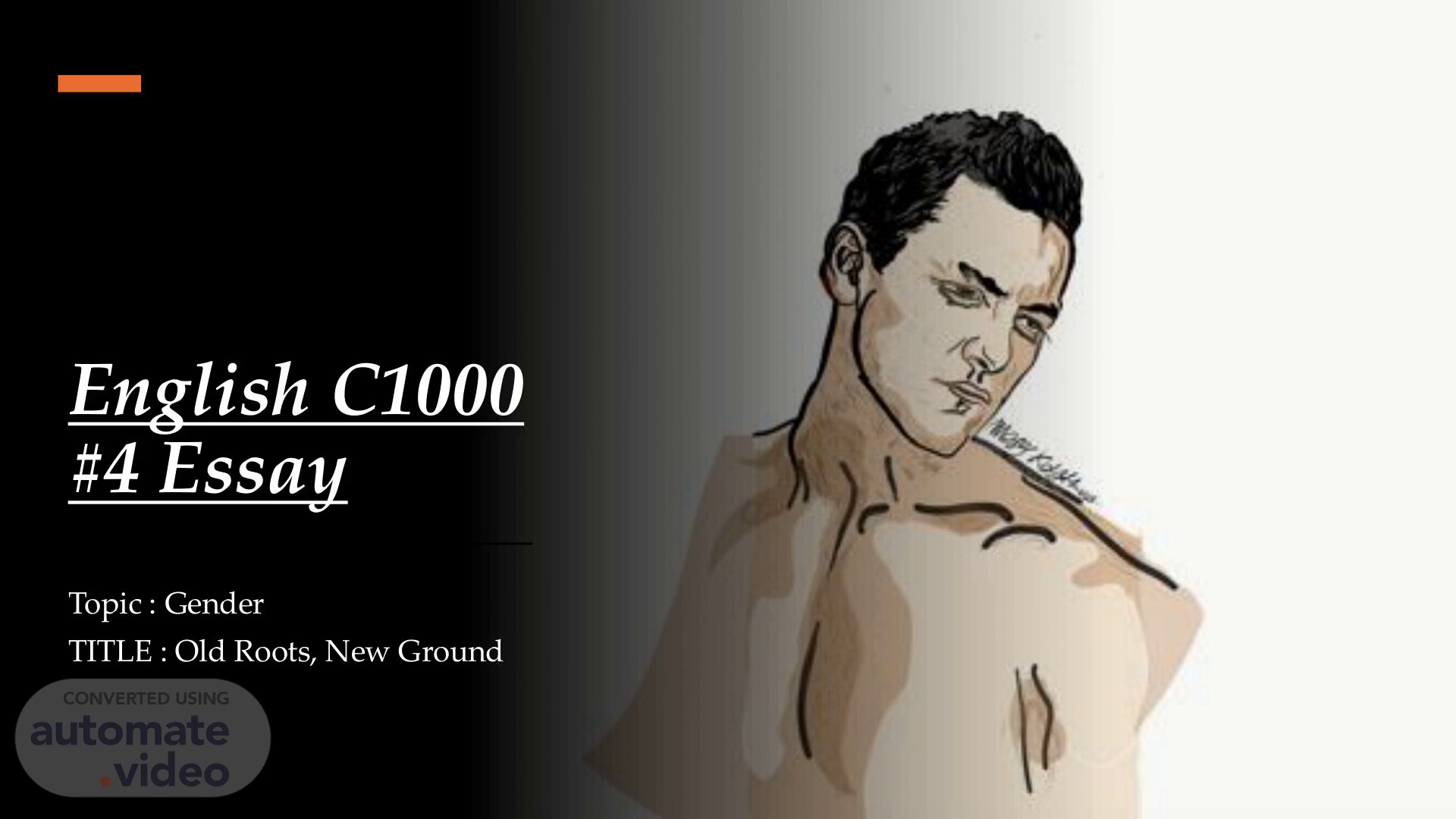
[Audio] English C1000 #4 Essay Topic : Gender TITLE : Old Roots, New Ground.
Scene 2 (7s)
[Audio] Proposed Question Can a man be called a man by accustoming today's norms?.
Scene 3 (15s)
[Audio] Thesis Statement A man cannot live up to the traditional definition of "being a man" while accustoming themselves to today's norms, as they will always be defined by their financial income, ostracized for choosing emotional intelligence over physical dominance, stigmatized when choosing to enter female dominated careers, and judged for prioritizing domestic roles..
Scene 4 (39s)
[Audio] Background Information The image of a man has been traditionally defined by his physical dominance, emotionally stoic, and the primary breadwinner yet in today's era men are told to change but are penalized when they do. In the past, the value of a man was based off the sized of his paycheck. While today's 21st century introduces new expectations for manhood to adapt to the norms of modern society, these shifts collide with the deep-rooted urge to be a strong, resilient provider..
Scene 5 (1m 11s)
[Audio] First Main Point Fundamentally, the definition of being a man is rooted of being a provider, a basic standard that causes it to be difficult for men to feel a sense of relief when they earn less than their significant other. Despite the new modern standards of equality of financial stability in relationships, most men still feel that their value is strictly to their income due to their past. When the role is changed, stated by researchers Zhang, Yin Junjie and Robert Breuning from the article "Female Breadwinning and domestic abuse: evidence from Australia" that their data suggests when man earned income is less than their partner, it can lead to increase of stress that potentially causes domestic problems within their relationship (Zhang). Moreover, the modern norm of shared economic responsibility becomes an internal issue within a man as they fail to become the lead provider for their family. This internal conflict is also supported by data from the Pew Research Center, which they have uncovered that a significant majority of society still believes it is more important for a man to be able to support his family financially than it is for his wife. Ultimately, creating a psychological barrier for men to adjust for societal norms. Throughout it all, if men are valued by the size of their pay, the more of a challenge it will be for them to fully accustomed to today's norms without feeling the failure of their masculinity to provide for their loved ones..
Scene 6 (2m 43s)
[Audio] Second Main Point However, beyond financial expectations, men often suffer regarding today's norms from choosing emotional intelligence over physical dominance. Yet in today's modern societal norms encouraged more men to be more communicative and open but contradict themselves and favors men who choose to be physically imposing. According to the book "Swole : the making of men and the meaning of muscle" by author Michael Andor Brodeur, he asserts "In our current moment where manfluencers on TikTok tease their audiences with their latest videos, where right wing men espouse the importance of being 'alpha'" (Brodeur). Nevertheless, the quote expresses how society is pushing to move forward, yet they compete against TikTokers who advocate men about their true manhood of being dominant. This is not accidental, according to research by the Center for Countering Digital Hate (CCDH) algorithmic feeds on platforms like TikTok or Instagram, steer young male users toward "Alpha" content usually within minutes after creating a brand-new account. Certainly, men will always face struggles living up to today's norms while the constant advertisement of being an 'alpha male' be labeled as the primary example of what a true successfulness of being a man is all about..
Scene 7 (4m 5s)
[Audio] Third Main Point Apart from this, men who choose to enter female dominated careers are often victims of ridicule as society strips them from their masculinity. Commonly, when a man decides to pursue a profession such as nursing or social work it is frequently viewed as a treachery among traditional male roles. As indicated in article "Social Norms and gendered occupational choices of men and women: Time to turn the tide?" by Professor Patricia Palffy, she emphasizes that interventions regarding gender typicality of career choices must not only be exclusively to women but to men as well, saying "encouraging boys to consider occupations in highgrowth sectors such as health and education). Incentivizing boys to break with traditional gender norms can be as crucial, or even more so, for labor market advancement toward gender equality as incentivizing girls" (Palffy). Moreover, proving that our current society doesn't naturally uphold men in these roles rather yet needing specific policy changes to facilitate men fracturing away from the traditional gender norms that regularly label these jobs as feminine. Likewise, research from the same article indicates that men suffer from "Identity loss" when they choose a career that doesn't align with their traditional gender roles, further causing them to accept harsher conditions to find a workplace that willingly will be more acceptable. Above all, society turns the other way as it fails to acknowledge when men pay physical and financial price to avoid being sneered..
Scene 8 (5m 41s)
[Audio] Fourth Main Point Not only, but also as years go by the underrepresented group of men who willingly prioritize domestic roles decline in numbers as today's norms fails to adapt. Although as today's era begin accepting increasingly "Stay at home dads" men who adopt this path are given lack of support in doing so, due to being seen as inferior for straying away from the stereotypical "man of the house". According to a study by the Pew Research Center, they discovered only 8% of Americans believe a child is better off with a stay-at-home father in contrast of the other half who favor more in a stay-at-home mother. Therefore, highlighting how modern society continue to struggle and validate men who step away from the traditional breadwinning roles. This reveals the true reality of men's value remains tied to his financial outcome rather than his caregiving trait. Overall, sending a clear discouraging message to men adapting today's domestic norms. In a study published "Caring is masculine: stay at home fathers and masculine identity" by researchers Joyce Y Lee and Shawna J Lee stated, "In addition, SAHFs identified social isolation and mixed reactions from people as the 2 main challenges against constructing and maintaining their new masculinity" (Lee). After all, the cost of adapting to today's social norms is a heavy burden on a man's mental health and social belonging as society expects modern masculinity to rise yet cannot fundamentally support basic community validation..
Scene 9 (7m 24s)
[Audio] Counter Argument & Rebuttal A few may argue that men can with ease adapt to today's norms because society has become more understanding, and open minded about gender roles. In a study conducted by Pew Research Center, they uncovered that nearly 70% of Americans believe marriage is more successful when both husband and wife divide equal domestic responsibilities. Overall, allowing men to be able to support their families financially yet as well taking on domestic roles. However, this new study fails to acknowledge and take into consideration that this data does not reflect everyday cultural traditions. The daily reality for men who step into these new social norms, tell a different story. As seen with stay-at-home fathers facing social isolation and disapproval from society or men in female dominated careers who experienced identity loss. As stated before, today's society tolerates the new adaptions but penalize men who put it in practice. True adaptation remains stagnant as society continues to measure men worth by his career and financial earnings..
Scene 10 (8m 38s)
[Audio] Conclusion Conclusively, in today's twenty first century demands men to adapt and evolve, yet modern society continuously penalizes men who opposed. To commence, men often suffer from internal stress and domestic friction when they aren't able to serve as the primary financial provider. Secondly, the advocation push for emotional vulnerability is often contradicted by big platforms like TikTok and Instagram who instead choose dominant male stereotypes. Furthermore, men who attempt to enter female dominated careers are often stripped from their masculine identity rather than accepted. At last, men who choose to be stay at home fathers are emotionally isolated by society that struggles to validate domestic roles for men outside their paycheck..
Scene 11 (9m 29s)
[Audio] Call To Action This world-evolving issue is important because society can't expect a genuine evolvement in masculinity if it continues to punish the very same behaviors it claims to encourage. To able to achieve advancement within today's norms, society and communities must actively stop measuring men's value by their financial outcome, only when can true gender equality become a reality..
Scene 12 (9m 55s)
[Audio] Work Cited Brodeur, Michael Andor. Swole : The Making of Men and the Meaning of Muscle. Beacon Press, 2025. Palffy, Patricia, et al. "Social Norms and Gendered Occupational Choices of Men and Women: Time to Turn the Tide?" Industrial Relations (Berkeley) [Berkeley], vol. 62, no. 4, October 2023, pp. 380– 410, https://doi.org/10.1111/irel.12332. Zhang, Yinjunjie, and Robert Breunig. "Female Breadwinning and Domestic Abuse: Evidence from Australia." Journal of Population Economics [Berlin/Heidelberg], vol. 36, no. 4, October 2023, pp. 2925–65, https://doi.org/10.1007/s00148-02300975-9. Joyce, L. Y. (2018, February 7). Apa PsycNet. American Psychological Association. https://psycnet.apa.org/record/201648136-001 Fry, R., Aragão, C., Hurst, K., & Parker, K. (2023, April 13). Husbands and wives earn similar wages in a growing share of marriages. Pew Research Center. https://www.pewresearch.org/social-trends/2023/04/13/in-a-growing-share-of-u-smarriages-husbands-and-wives-earn-about-the-same/.