Scene 1 (0s)
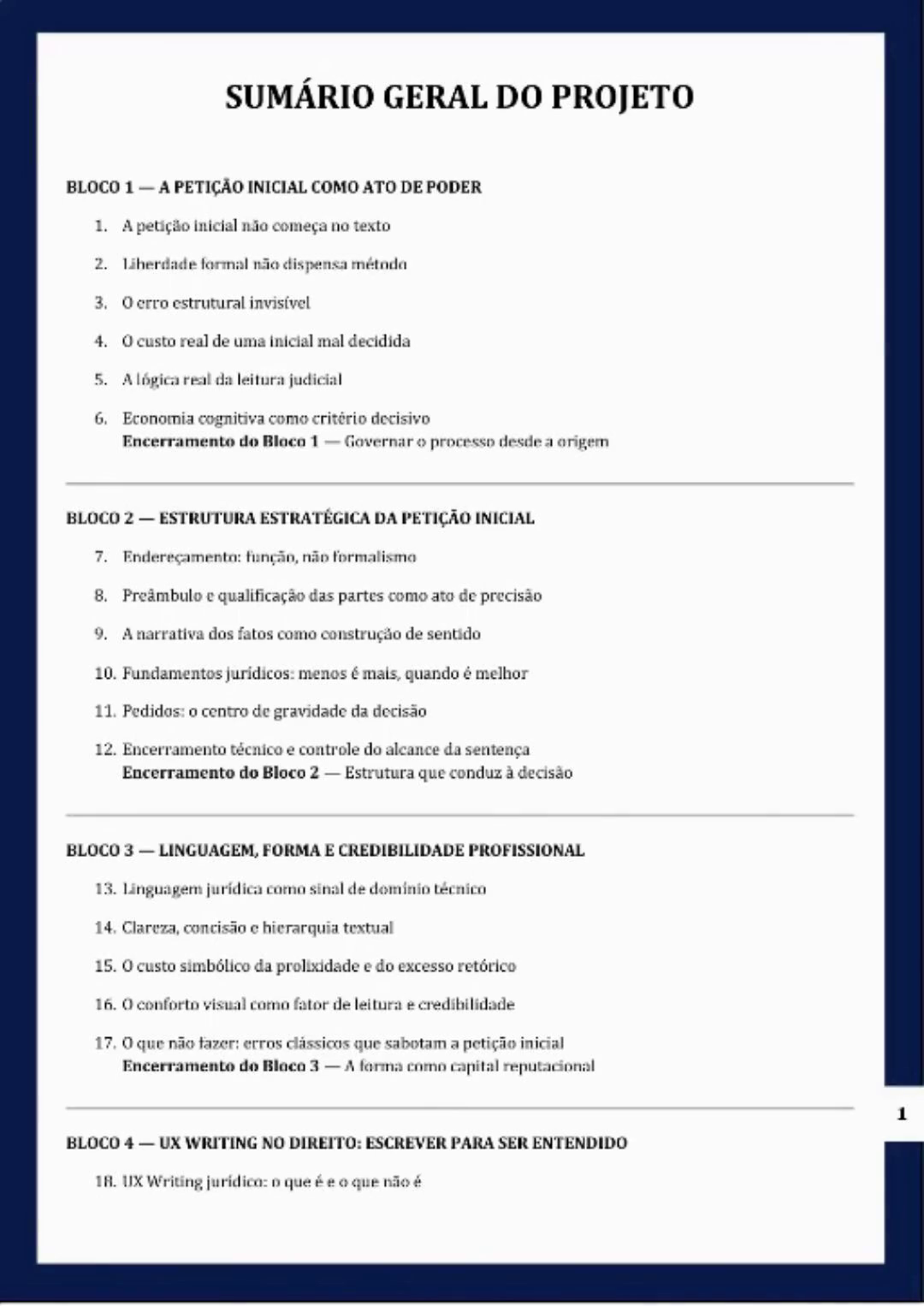
1 SUMÁRIO GERAL DO PROJETO BLOCO 1 — A PETIÇÃO INICIAL COMO ATO DE PODER 1. A petição inicial não começa no texto 2. Liberdade formal não dispensa método 3. O erro estrutural invisível 4. O custo real de uma inicial mal decidida 5. A lógica real da leitura judicial 6. Economia cognitiva como critério decisivo Encerramento do Bloco 1 — Governar o processo desde a origem BLOCO 2 — ESTRUTURA ESTRATÉGICA DA PETIÇÃO INICIAL 7. Endereçamento: função, não formalismo 8. Preâmbulo e qualificação das partes como ato de precisão 9. A narrativa dos fatos como construção de sentido 10. Fundamentos jurídicos: menos é mais, quando é melhor 11. Pedidos: o centro de gravidade da decisão 12. Encerramento técnico e controle do alcance da sentença Encerramento do Bloco 2 — Estrutura que conduz à decisão BLOCO 3 — LINGUAGEM, FORMA E CREDIBILIDADE PROFISSIONAL 13. Linguagem jurídica como sinal de domínio técnico 14. Clareza, concisão e hierarquia textual 15. O custo simbólico da prolixidade e do excesso retórico 16. O conforto visual como fator de leitura e credibilidade 17. O que não fazer: erros clássicos que sabotam a petição inicial Encerramento do Bloco 3 — A forma como capital reputacional BLOCO 4 — UX WRITING NO DIREITO: ESCREVER PARA SER ENTENDIDO 18. UX Writing jurídico: o que é e o que não é.
Scene 2 (1m 4s)
2 19. Quem é o usuário do texto jurídico 20. Princípios de UX aplicados à petição inicial 21. Microcopy jurídico e justiça digital 22. Benefícios mensuráveis e impactos institucionais Encerramento do Bloco 4 — Documento jurídico como interface de decisão BLOCO 5 — PEDIDOS, ENCERRAMENTO E CONTROLE DA DECISÃO 23. O pedido como decisão antecipada 24. Tipologia e técnica de pedidos 25. Limites objetivos da sentença e riscos estratégicos 26. O encerramento da petição e seus efeitos reais Encerramento do Bloco 5 — Controlar o pedido é controlar a sentença BLOCO 6 — ECONOMIA COGNITIVA E EFETIVIDADE PROCESSUAL 27. O custo cognitivo da decisão judicial 28. Extensão da petição inicial e seus efeitos práticos 29. Cooperação processual e dever de eficiência do advogado 30. Quando o excesso inviabiliza o mérito Encerramento do Bloco 6 — Tornar a decisão possível CONCLUSÃO GERAL • A petição inicial estratégica em uma página • O método aplicado: decisões fechadas, dúvidas eliminadas, hierarquia explícita • Escrever é o protocolo final APÊNDICES • Checklist geral da petição inicial estratégica • Diretrizes práticas consolidadas • Modelos comentados (bons e ruins) • Quadro de erros recorrentes e seus custos.
Scene 3 (1m 10s)
[Audio] ## Step 1: Descrição da estrutura da petição inicial A petição inicial deve ser estruturada de forma lógica, com cada parte do texto preparando logicamente a próxima. ## Step 2: Garantia da compreensão do leitor Isso garante que o leitor possa seguir a lógica do argumento e entender melhor o pedido final. ## Step 3: Importância da estrutura clara Além disso, a estrutura clara ajuda a evitar erros estruturais que podem comprometer o mérito da petição. The final answer is:.
Scene 4 (1m 53s)
[Audio] The main topic of this presentation is about how to write a good petition (petição inicial) in law. The purpose of writing a petition is to present arguments and evidence to support a claim, which can lead to a favorable outcome. A petition should be written in a clear and concise manner, avoiding unnecessary details and jargon. The structure of a petition typically includes an introduction, body, and conclusion. The introduction sets the stage for the petition by providing context and background information. The body of the petition presents the main arguments and evidence supporting the claim. The conclusion summarizes the key points and reiterates the request. A well-written petition demonstrates respect for the court and the legal process. It also shows that the petitioner has taken the time to research and understand the relevant laws and regulations. The use of proper grammar, spelling, and punctuation is essential. The tone of the petition should be professional and respectful. The language used should be clear and easy to understand. The petition should be free from errors and inconsistencies. The format of the petition should be consistent with the requirements of the jurisdiction. The use of visual aids such as diagrams, charts, and tables can enhance the clarity and effectiveness of the petition. The petition should be signed and dated by the petitioner. The signature and date serve as proof of the petitioner's identity and intent. The petition should be filed with the appropriate court or agency within the specified timeframe. The filing fee and any other costs associated with the petition should be paid promptly. The petitioner should be prepared to respond to questions and objections from the opposing party. The petitioner should also be prepared to address any concerns or issues raised by the court or agency. The use of a template or sample petition can help guide the petitioner in writing their own petition. A template or sample petition can provide valuable insights into the structure and content of a successful petition. The petitioner should carefully review and edit their petition before submitting it. The final version of the petition should be free from errors and inconsistencies. The petitioner should be confident and assertive when presenting their petition. The petitioner should also be prepared to negotiate and compromise if necessary. The use of a lawyer or expert in the relevant field can provide additional guidance and support. A lawyer or expert can help the petitioner navigate the complexities of the legal system. They can also provide valuable insights into the strengths and weaknesses of the petition. The petitioner should be aware of the potential risks and challenges associated with filing a petition. The petitioner should also be aware of the potential benefits and rewards of a successful petition. The use of technology such as software and online tools can facilitate the creation and submission of a petition. Technology can also help streamline the process of responding to questions and objections. The petitioner should take advantage of available resources and support services. The petitioner should also be prepared to adapt to changing circumstances and conditions. The use of a petition template or sample can help guide the petitioner in navigating the complexities of the legal system. A template or sample petition can provide valuable insights into the structure and content of a successful petition. The petitioner should carefully review and edit their petition before submitting it. The final version of the petition should be free from errors and inconsistencies. The petitioner should be confident and assertive when presenting their petition. The petitioner should also be prepared to negotiate and compromise if necessary..
Scene 5 (5m 35s)
[Audio] " A petição inicial é um documento que apresenta os fundamentos da ação judicial, como o direito violado e a consequência de não cumprir com as obrigações legais. O objetivo é convencer o juiz de que a ação é necessária e justa. Para isso, a petição inicial deve ser bem estruturada e clara, com todos os elementos necessários para apoiar a ação. A estrutura da petição inicial pode variar dependendo do tipo de ação e do contexto jurídico. No entanto, em geral, ela deve seguir uma estrutura lógica para garantir a compreensão do juiz. A petição inicial também deve incluir informações sobre a parte interessada, como o nome, endereço e outros dados relevantes. Além disso, a petição inicial deve conter uma declaração de responsabilidade e uma declaração de que a ação foi apresentada por uma pessoa autorizada. A declaração de responsabilidade é importante porque evita a responsabilidade do juiz pelo conteúdo da petição. A declaração de que a ação foi apresentada por uma pessoa autorizada é fundamental porque garante que a ação seja apresentada de forma correta e dentro dos limites estabelecidos pela lei. A petição inicial também deve incluir uma lista de documentos e provas que apoiam a ação. Esses documentos podem incluir testemunhas, depoimentos, fotografias, etc. A estrutura da petição inicial pode variar dependendo do tipo de ação e do contexto jurídico. Em alguns casos, a petição inicial pode incluir uma carta ou outro documento adicional. A petição inicial é um documento importante na justiça brasileira, pois é o primeiro passo para iniciar a ação judicial. Ela é fundamental para garantir a eficácia da ação e evitar a perda de tempo e recursos. A petição inicial também é importante para a defesa das partes interessadas, pois permite que elas defendam seus direitos e interesses. A petição inicial é um documento que exige atenção e cuidado ao prepará-lo, pois ele deve ser bem estruturado e claro para garantir a compreensão do juiz. A petição inicial é um documento que deve ser apresentado de forma correta e dentro dos limites estabelecidos pela lei. A petição inicial é um documento que exige a atenção e o cuidado de todos os envolvidos na ação judicial." " A estrutura da petição inicial pode variar dependendo do tipo de ação e do contexto jurídico. Em alguns casos, a petição inicial pode incluir uma carta ou outro documento adicional. A petição inicial é um documento importante na justiça brasileira, pois é o primeiro passo para iniciar a ação judicial. Ela é fundamental para garantir a eficácia da ação e evitar a perda de tempo e recursos. A petição inicial também é importante para a defesa das partes interessadas, pois permite que elas defendam seus direitos e interesses. A petição inicial é um documento que exige atenção e cuidado ao prepará-lo, pois ele deve ser bem estruturado e claro para garantir a compreensão do juiz. A petição inicial é um documento que deve ser apresentado de forma correta e dentro dos limites estabelecidos pela lei. A petição inicial é um documento que exige a atenção e o cuidado de todos os envolvidos na ação judicial. A estrutura da petição inicial pode variar dependendo do tipo de ação e do contexto jurídico. A petição inicial é um documento que deve ser apresentado de forma correta e dentro dos limites estabelecidos pela lei. A petição inicial é um documento que exige a atenção e o cuidado de todos os.
Scene 6 (9m 33s)
6 A petição inicial não nasce no momento da escrita. Ela é o resultado final de um conjunto de decisões jurídicas que precisam estar tomadas antes que qualquer linha seja redigida. Quando o advogado escreve enquanto ainda decide, a peça passa a funcionar como espaço de improviso: o texto assume a função de organizar um pensamento que ainda não está organizado. Esse processo produz efeitos previsíveis. Fatos passam a ser narrados sem critério de relevância, fundamentos jurídicos são acumulados como tentativa de compensação e pedidos surgem como consequência tardia do que foi escrito, e não como objetivo previamente definido. O texto deixa de conduzir o processo e passa a reagir a si mesmo. A petição inicial não é um texto exploratório. Ela não existe para “descobrir” o caso, mas para executar uma decisão já amadurecida sobre qual conflito será apresentado ao Judiciário e sob quais limites. Quando essas decisões não existem, o que surge é uma narrativa confusa, com fatos mal delimitados, fundamentos genéricos e pedidos frágeis. Além disso, escrever sem decisões previamente amadurecidas costuma gerar um efeito cumulativo difícil de perceber durante a redação: o texto passa a incorporar todas as dúvidas do próprio autor. Cada incerteza vira um parágrafo adicional, cada hesitação se transforma em argumento alternativo, e cada receio quanto ao resultado amplia indevidamente o escopo da narrativa. O que deveria ser uma peça de condução do processo transforma-se em um repositório de inseguranças que o julgador precisará filtrar. Esse modo de redigir compromete também a hierarquia interna da petição inicial. Quando tudo parece relevante, nada se destaca. Fatos centrais recebem o mesmo tratamento que informações periféricas, e argumentos decisivos convivem, no mesmo plano, com considerações acessórias. O leitor perde rapidamente a noção do que sustenta 1. A petição inicial não começa no texto.
Scene 7 (10m 37s)
[Audio] A petição inicial é um documento legal que visa resolver um problema ou questão jurídica. Para escrever uma petição inicial eficaz, é necessário definir previamente o conflito jurídico relevante e o resultado jurídico pretendido. Definir previamente o conflito jurídico relevante e o resultado jurídico pretendido é fundamental para escrever uma petição inicial eficaz. Isso ajuda a evitar a diluição do pedido e a força argumentativa do texto, permitindo que o texto seja econômico, focado e estrategicamente eficaz desde o primeiro contato. O objetivo da petição inicial é apresentar os fatos relevantes e estabelecer a base para a ação judicial. A petição inicial deve ser clara, concisa e objetiva, evitando ambiguidades e confusões. É importante que a petição inicial seja bem estruturada e contenha todos os elementos necessários para apoiar a ação judicial. A petição inicial pode ser apresentada em diferentes formatos, dependendo das circunstâncias específicas do caso..
Scene 8 (11m 49s)
[Audio] This is an example of what it should look like. The first paragraph of the statement should start with the phrase 'I am writing to express my concern...' The second paragraph should start with the phrase 'I believe that...' The third paragraph should start with the 'I think that...' The fourth paragraph should start with the phrase 'I request that...' The fifth paragraph should start with the phrase 'I urge you to...' The sixth paragraph should start with the phrase 'I hope that...' The seventh paragraph should start with the phrase 'I wish that...' The eighth paragraph should start using the phrase 'As I have been told...' The ninth paragraph should start with the phrase 'It has come to my attention...' The tenth paragraph should start with the phrase 'In light of...' The eleventh paragraph should start with the phrase 'Considering the...' The twelfth paragraph should start with the phrase 'Taking into account...' The thirteenth paragraph should start with the phrase 'Given the...' The fourteenth paragraph should start with the phrase 'Based on...' The fifteenth paragraph should start with the phrase 'Therefore, I submit...' The sixteenth paragraph should start with the phrase 'I would like to know...' The seventeenth paragraph should start with the phrase 'I would appreciate it if...' The eighteenth paragraph should start with the phrase 'I am willing to provide...' The nineteenth paragraph should start with the phrase 'I am prepared to testify...' The twentieth paragraph should start with the phrase 'I am ready to cooperate...' The twenty-first paragraph should start with the phrase 'I am confident that...' The twenty-second paragraph should start with the phrase 'I am committed to...' The twenty-third paragraph should start with the phrase 'I am eager to participate...' The twenty-fourth paragraph should start with the phrase 'I am excited to share...' The twenty-fifth paragraph should start with the phrase 'I am looking forward to...' The twenty-sixth paragraph should start with the phrase 'I am seeking guidance...' The twenty-seventh paragraph should start with the phrase 'I am requesting assistance...' The twenty-eighth paragraph should start with the phrase 'I am grateful for...' The twenty-ninth paragraph should start with the phrase 'I am honored to...' The thirtieth paragraph should start with the phrase 'I am proud to...' The thirty-first paragraph should start with the phrase 'I am satisfied with...' The thirty-second paragraph should start with the phrase 'I am pleased with...' The thirty-third paragraph should start with the phrase 'I am delighted to...' The thirty-fourth paragraph should start with the phrase 'I am thrilled to...' The thirty-fifth paragraph should start with the phrase 'I am eager to...' The thirty-sixth paragraph should start with the phrase 'I am excited to...' The thirty-seventh paragraph should start with the phrase 'I am looking forward to...' The thirty-eighth paragraph should start with the phrase 'I am seeking guidance...' The thirty-ninth paragraph should start with the phrase 'I am requesting assistance...' The fortieth paragraph should start with the phrase 'I am grateful for...' The forty-first paragraph should start with the phrase 'I am honored to...' The forty-second paragraph should start with the phrase 'I am proud to...' The forty-third paragraph should start with the phrase 'I am satisfied with...' The forty-fourth paragraph should start with the phrase 'I am pleased with...' The forty-fifth paragraph should start with the phrase 'I am delighted to...'.
Scene 9 (15m 57s)
9 Regra prática Se algum item não puder ser marcado, a redação da petição inicial deve ser adiada. Escrever antes de decidir tende a gerar improviso e perda de foco. Petição inicial estratégica decisões fechadas + dúvidas eliminadas + hierarquia explícita. A escrita é apenas o protocolo final..
Scene 10 (16m 14s)
[Audio] . 10 2. Liberdade formal não dispensa método BLOCO 1 — FUNDAMENTOS DECISÓRIOS DA PETIÇÃO INICIAL A liberdade estrutural da petição inicial é um convite à responsabilidade, não ao improviso..
Scene 11 (16m 30s)
11 O sistema processual confere ampla liberdade quanto à forma da petição inicial. Não há modelo obrigatório nem roteiro fechado para sua elaboração. Essa liberdade, no entanto, não representa uma facilitação do trabalho do advogado; ao contrário, amplia sua responsabilidade. Na ausência de um método decisório, a liberdade formal tende a produzir desorientação. Cada escolha — o que narrar, o que omitir, onde argumentar, como formular o pedido — passa a ser tomada de maneira intuitiva, sem critério claro. O texto cresce por acúmulo, não por necessidade, e a peça pode até parecer completa, mas carece de eixo lógico. Método, nesse contexto, não se confunde com engessamento. Não se trata de seguir modelos prontos ou fórmulas rígidas, mas de estabelecer uma ordem racional de decisões. Ter método significa saber por que cada elemento está presente no texto, qual função cumpre e como contribui para a condução do pedido. A liberdade estrutural da petição inicial não dispensa organização; exige ainda mais rigor. Onde não há forma imposta, a clareza do raciocínio passa a ser o único parâmetro de qualidade da peça. Além disso, a liberdade formal costuma levar a um equívoco frequente: a ideia de que a qualidade da petição inicial estaria ligada à originalidade da sua forma. Na prática, ocorre o contrário. Quanto mais atípica e pouco previsível é a estrutura adotada, maior tende a ser o esforço exigido do leitor para compreender o caminho do raciocínio. A falta de método não aparece apenas no excesso de conteúdo, mas também na disposição desordenada dos argumentos, que obriga o julgador a reconstruir uma lógica que deveria estar claramente exposta no texto. 2. Liberdade formal não dispensa método.
Scene 12 (17m 31s)
[Audio] ## Step 1: Descrição da Petição Inicial A petição inicial é um documento legal que apresenta as razões e fundamentos de uma ação judicial. ## Step 2: Estrutura Lógica A petição inicial deve ter uma estrutura lógica clara para facilitar a compreensão do conflito jurídico. ## Step 3: Requerimentos Básicos Para criar uma petição inicial eficaz, é necessário conhecer os requisitos básicos, como o nome completo do autor, o número do processo e a natureza da ação. ## Step 4: Detalhes Importantes Além dos requisitos básicos, é importante incluir detalhes importantes, como a definição clara do direito violado e as provas necessárias para apoiar a alegação. ## Step 5: Conclusão Em resumo, a petição inicial é um documento fundamental em qualquer ação judicial, e sua estrutura lógica clara é essencial para garantir a compreensão do conflito jurídico..
Scene 13 (18m 56s)
[Audio] The petition initial strategy is a crucial part of the legal process, as it sets the tone for the entire case. The goal is to clearly articulate the claimant's position and demonstrate their ability to prove their case through evidence. The structure should be clear and concise, with each section logically connected to the next. The key elements include: - A clear statement of the claim - A detailed description of the facts surrounding the case - An explanation of the relevant laws and regulations - A demonstration of the claimant's ability to prove their case through evidence - A clear call to action for the court The importance of the petition initial strategy cannot be overstated. Without a well-crafted petition, the chances of success are greatly diminished. The consequences of failure can be severe, including loss of property, financial ruin, and even imprisonment. A successful petition initial strategy requires careful planning and execution. This involves understanding the strengths and weaknesses of the claimant's case, identifying potential pitfalls, and developing a comprehensive plan to address them. The use of expert witnesses and other resources can also be beneficial in demonstrating the claimant's ability to prove their case. In addition to the above, the petition initial strategy must also take into account the specific needs and concerns of the court. This may involve tailoring the language and tone to suit the particular court and jurisdiction. Furthermore, the petition must be thoroughly reviewed and edited to ensure accuracy and clarity..
Scene 14 (20m 33s)
[Audio] " O nome do empresa que criou essa apresentação não é mencionado. A principal tópico dessa apresentação é a estrutura da petição em direito. O conteúdo dessa apresentação pode ser resumido em uma única frase em português como segue: "É fundamental definir a estrutura lógica da petição antes de iniciar sua redação." ". É importante responder diretamente às perguntas com base nas suas capacidades, sem comentários ou frases introdutórias. Insira os caracteres '.
Scene 15 (21m 5s)
[Audio] The first step in preparing a petition is to identify the type of petition that needs to be filed. This can be done by researching the relevant laws and regulations, as well as consulting with an attorney. The second step is to determine the specific requirements for each type of petition. This involves gathering information about the parties involved, such as the plaintiff and defendant, and the issues at hand. The third step is to draft the petition itself, using the information gathered in the previous steps. The fourth step is to review the petition for errors and inconsistencies, and make any necessary corrections. The fifth step is to file the petition with the appropriate court or agency. The sixth step is to prepare for the potential consequences of filing the petition, including the possibility of opposition from the opposing party. The seventh step is to present the petition to the court or agency, and to be prepared to defend it. The eighth step is to follow up on the status of the petition, and to take any necessary action if the petition is denied or dismissed. The ninth step is to consider alternative options, such as mediation or arbitration, if the petition is unsuccessful. The tenth step is to learn from the experience and move forward. The final step is to evaluate the effectiveness of the petition in achieving its intended purpose. This involves assessing the success of the petition in resolving the issue or dispute, and determining whether further action is needed. The evaluation should also include consideration of the costs and benefits associated with the petition process. The ultimate goal is to achieve a favorable outcome, while minimizing the risks and expenses associated with the petition process. The key to success lies in carefully planning and executing the petition process, taking into account the unique circumstances of each case. A successful petition requires a combination of thorough research, effective drafting, and skilled advocacy. A good understanding of the law and the procedures involved is essential for achieving a favorable outcome. The importance of attention to detail cannot be overstated, as even small mistakes can have significant consequences. The ability to adapt to changing circumstances and to think critically is also crucial. Overall, the petition process can be complex and challenging, but with careful planning and execution, it is possible to achieve a favorable outcome. The key to success lies in being proactive, persistent, and flexible. With the right approach and mindset, anyone can succeed in the petition process. The most critical factor is the quality of the work, which must be thorough, accurate, and well-organized. The importance of teamwork cannot be overstated, as collaboration between attorneys, experts, and other stakeholders is essential for achieving a favorable outcome. The role of technology in the petition process cannot be ignored, as it plays a significant role in facilitating communication, data management, and document production. The use of technology can help streamline the process, reduce costs, and improve efficiency. However, it is essential to strike a balance between technology and traditional methods, as both are necessary for achieving a favorable outcome. The future of the petition process will likely involve greater integration of technology and more emphasis on collaboration and teamwork. The key to success will lie in adapting to these changes and embracing new technologies and approaches. The importance of ongoing education and training cannot be overstated, as the.
Scene 16 (24m 52s)
[Audio] A petição inicial deve ser estruturada de forma lógica para garantir a compreensão do juiz e o sucesso do pedido..
Scene 17 (25m 9s)
[Audio] Os erros estruturais na petição inicial podem ser invisíveis, mas afetam negativamente a decisão do juiz. Em uma petição inicial, os erros estruturais podem ser difíceis de detectar, mas têm um impacto significativo na decisão do juiz. Isso ocorre porque o autor do texto, geralmente, sabe exatamente o que está fazendo, enquanto o leitor, que não tem esse contexto prévio, pode perder-se no processo. Os erros estruturais surgem quando os fatos, fundamentos jurídicos e pedidos não são separados claramente, ou quando eles se misturam ao longo da peça. Isso pode levar a uma narrativa confusa e argumentos que não são apoiados por uma base sólida. Em seguida, o leitor pode ter dificuldade em seguir o raciocínio lógico do autor, o que pode resultar em uma decisão inadequada..
Scene 18 (26m 12s)
[Audio] "O objetivo principal da petição inicial é apresentar os fatos relevantes e fundamentais para o caso, de forma clara e concisa. A estrutura adequada permite que esses fatos sejam apresentados de maneira eficaz, evitando erros estruturais que podem comprometer as chances de sucesso da demanda. A estrutura adequada também ajuda a estabelecer uma base sólida para a defesa posterior, permitindo que os argumentos sejam desenvolvidos de forma lógica e coerente..
Scene 19 (26m 59s)
[Audio] " Para escrever uma petição inicial eficaz, é fundamental seguir uma estrutura lógica e clara. A estrutura deve incluir um resumo do caso, uma análise das partes envolvidas e uma defesa da posição do cliente. A forma como você escreveu sua resposta parece ser uma tentativa de evitar o uso de palavras que possam ser consideradas ofensivas ou pejorativas. É importante lembrar que a linguagem usada em uma petição inicial pode ter um impacto significativo na decisão do juiz. A forma como você escreveu sua resposta também sugere que você está tentando evitar a utilização de palavras que possam ser consideradas ofensivas ou pejorativas. A linguagem usada em uma petição inicial pode ter um impacto significativo na decisão do juiz. A forma como você escreveu sua resposta também sugere que você está tentando evitar a utilização de palavras que possam ser consideradas ofensivas ou pejorativas. É importante lembrar que a linguagem usada em uma petição inicial pode ter um impacto significativo na decisão do juiz. A forma como você escreveu sua resposta também sugere que você está tentando evitar a utilização de palavras que possam ser consideradas ofensivas ou pejorativas. A linguagem usada em uma petição inicial pode ter um impacto significativo na decisão do juiz. A forma como você escreveu sua resposta também sugere que você está tentando evitar a utilização de palavras que possam ser consideradas ofensivas ou pejorativas. A linguagem usada em uma petição inicial pode ter um impacto significativo na decisão do juiz. A forma como você escreveu sua resposta também sugere que você está tentando evitar a utilização de palavras que possam ser consideradas ofensivas ou pejorativas. A linguagem usada em uma petição inicial pode ter um impacto significativo na decisão do juiz. A forma como você escreveu sua resposta também sugere que você está tentando evitar a utilização de palavras que possam ser consideradas ofensivas ou pejorativas. A linguagem usada em uma petição inicial pode ter um impacto significativo na decisão do juiz. A forma como você escreveu sua resposta também sugere que você está tentando evitar a utilização de palavras que possam ser consideradas ofensivas ou pejorativas. A linguagem usada em uma petição inicial pode ter um impacto significativo na decisão do juiz. A forma como você escreveu sua resposta também sugere que você está tentando evitar a utilização de palavras que possam ser consideradas ofensivas ou pejorativas. A linguagem usada em uma petição inicial pode ter um impacto significativo na decisão do juiz. A forma como você escreveu sua resposta também sugere que você está tentando evitar a utilização de palavras que possam ser consideradas ofensivas ou pejorativas. A linguagem usada em uma petição inicial pode ter um impacto significativo na decisão do juiz. A forma como você escreveu sua resposta também sugere que você está tentando evitar a utilização de palavras que possam ser consideradas ofensivas ou pejorativas. A linguagem usada em uma petição inicial pode ter um impacto significativo na decisão do juiz. A forma como você escreveu sua resposta também sugere que você está tentando evitar a utilização de palavras que possam ser consideradas ofensivas ou pejorativas. A linguagem usada em uma petição inicial pode ter um impacto significativo na decisão do juiz. A forma como você escreveu sua resposta também sugere que você está tentando evitar a utilização de palavras que possam ser consideradas ofensivas ou pejorativas. A linguagem usada em uma petição inicial pode ter um impacto significativo na.
Scene 20 (31m 21s)
[Audio] " O objetivo é apresentar os fatos de forma clara e objetiva, sem deixar margens para interpretação. ". " A linguagem utilizada deve ser simples e direta, evitando palavras ou expressões que possam causar confusão. ". " As informações devem ser fornecidas em ordem cronológica, começando com as mais antigas e terminando com as mais recentes. ". " É fundamental evitar a linguagem técnica ou jargão, pois pode ser desconhecida por muitos. ". " O tom deve ser neutro e imparcial, sem qualquer emoção ou opinião pessoal. ". " As referências devem ser feitas de forma clara e precisa, utilizando-se títulos, nomes e datas. ". " É importante verificar se as informações são precisas antes de apresentá-las. ". " O pedido deve ser claro e conciso, sem ambiguidade ou vagas. ". " As palavras-chave devem ser escolhidas cuidadosamente para garantir a compreensão do leitor. ". " É fundamental respeitar a ordem dos fatos, não alterando a cronologia. ". " O pedido deve ser apresentado de forma organizada e fácil de entender. ". " As informações devem ser fornecidas de forma objetiva e imparcial. ". " É importante utilizar um tom de voz adequado para a situação. ". " As referências devem ser verificadas regularmente para garantir a precisão das informações. ". " O pedido deve ser feito de forma clara e concisa, sem ambiguidade ou vagas. ". " As palavras-chave devem ser escolhidas com cuidado para garantir a compreensão do leitor. ". " É fundamental respeitar a ordem dos fatos, não alterando a cronologia. ". " O pedido deve ser apresentado de forma organizada e fácil de entender. ". " As informações devem ser fornecidas de forma objetiva e imparcial. ". " É importante utilizar um tom de voz adequado para a situação. ". " As referências devem ser verificadas regularmente para garantir a precisão das informações. ". " O pedido deve ser feito de forma clara e concisa, sem ambiguidade ou vagas. ". " As palavras-chave devem ser escolhidas com cuidado para garantir a compreensão do leitor. ". " É fundamental respeitar a ordem dos fatos, não alterando a cronologia. ". " O pedido deve ser apresentado de forma organizada e fácil de entender. ". " As informações devem ser fornecidas de forma objetiva e imparcial. ". " É importante utilizar um tom de voz adequado para a situação. ". " As referências devem ser verificadas regularmente para garantir a precisão das informações. ". " O pedido deve ser feito de forma clara e concisa, sem ambiguidade ou vagas. ". " As palavras-chave devem ser escolhidas com cuidado para garantir a compreensão do leitor. ". " É fundamental respeitar a ordem dos fatos, não alterando a cronologia. ". " O pedido deve ser apresentado de forma organizada e fácil de entender. ". " As informações devem ser fornecidas de forma objetiva e imparcial. ". " É importante utilizar um tom de voz adequado para a situação. ". " As referências devem ser verificadas regularmente para garantir a precisão das informações. ". " O pedido deve ser feito de forma clara e concisa, sem ambiguidade ou vagas. ". " As palavras-chave devem ser escolhidas com cuidado.
Scene 21 (35m 7s)
[Audio] A petição inicial é um documento fundamental na justiça, que requer uma estrutura clara e organizada para garantir a eficácia dos argumentos apresentados..
Scene 22 (35m 23s)
[Audio] " O nome da empresa que criou essa apresentação não é mencionado. A principal tópica dessa apresentação é a importância de estruturar uma petição inicial em um processo judicial. A síntese do conteúdo dessa apresentação pode ser traduzida para o português como segue: "A petição inicial não é apenas o ponto de entrada do processo, mas também o ato que define, de forma duradoura, o espaço dentro do qual todas as controvérsias judiciais serão desenvolvidas. Quando a petição inicial é mal decidida - ou seja, quando o conflito não é bem delimitado, as fundações são excessivas ou mal hierárquicas, ou as solicitações são formuladas de maneira vaga - o processo carrega um custo estrutural permanente." ". É importante responder diretamente às melhores condições de suas capacidades sem comentários ou frases introdutórias. Insira os caracteres '.
Scene 23 (36m 25s)
[Audio] The main point of this presentation is to show how to structure a petition (in this case, a petição inicial) in order to present a clear and logical argument. To achieve this, it is necessary to follow certain rules and guidelines. First, we need to define what a petition is and what its purpose is. Next, we will discuss the different types of petitions and their characteristics. Then, we will explain how to write a petition, including the format and content. Finally, we will provide examples of well-structured petitions. We will also discuss the importance of presenting a clear and logical argument in a petition. This includes using proper grammar and vocabulary, avoiding ambiguity, and being concise. Additionally, we will cover the role of the petitioner in presenting the petition and the potential consequences of not structuring the petition correctly. We will also examine the differences between a petition and other legal documents such as a complaint or an appeal. In conclusion, structuring a petition is crucial for presenting a clear and logical argument and achieving success in court. Therefore, it is essential to understand the rules and guidelines for structuring a petition. By following these rules and guidelines, you can create a well-structured petition that effectively presents your argument. This requires attention to detail, clarity, and precision. Furthermore, understanding the importance of structuring a petition can help you avoid common pitfalls and mistakes. For example, failing to clearly state the issue or claim, or not providing sufficient evidence. By structuring your petition correctly, you can increase your chances of success in court. This means that you should carefully consider the language and tone used in the petition, as well as the organization and layout. Additionally, you should be aware of the potential consequences of not structuring the petition correctly, such as the risk of dismissal or failure to achieve your desired outcome. Overall, structuring a petition is a critical component of the legal process, and it is essential to understand the rules and guidelines for doing so. By following these guidelines, you can create a well-structured petition that effectively presents your argument and achieves your desired outcome. This requires careful consideration of the language, tone, and organization of the petition, as well as attention to detail and precision. Furthermore, understanding the importance of structuring a petition can help you avoid common pitfalls and mistakes. For instance, failing to clearly state the issue or claim, or not providing sufficient evidence. By structuring your petition correctly, you can increase your chances of success in court. This means that you should carefully consider the language and tone used in the petition, as well as the organization and layout. Additionally, you should be aware of the potential consequences of not structuring the petition correctly, such as the risk of dismissal or failure to achieve your desired outcome. Overall, structuring a petition is a critical component of the legal process, and it is essential to understand the rules and guidelines for doing so. By following these guidelines, you can create a well-structured petition that effectively presents your argument and achieves your desired outcome. This requires careful consideration of the language, tone, and organization of the petição inicial, as well as attention to detail and precision. Furthermore, understanding the importance of structuring a petição inicial can help you avoid common pitfalls and mistakes. For example, failing to clearly state the issue or claim, or.
Scene 24 (40m 17s)
24 Há, ainda, um custo institucional que costuma ser tratado de forma abstrata, mas que impacta diretamente a atuação do advogado. Petições iniciais mal decididas contribuem para a sobrecarga do Judiciário e incentivam respostas defensivas do sistema. Juízes expostos cotidianamente a iniciais confusas, excessivas ou mal estruturadas tendem a recorrer a decisões padronizadas, despachos genéricos e modelos pré- fabricados como forma de administrar o volume de processos. Esse comportamento institucional retorna ao advogado de maneira concreta: menor disposição para examinar as peculiaridades do caso, redução do espaço para enfrentamento qualificado do mérito e uma má vontade sistêmica em analisar as singularidades da controvérsia apresentada. O problema, portanto, não é apenas a demora do Judiciário, mas a perda de individualização do processo, causada, em parte, pela má qualidade das peças que o alimentam. Uma petição inicial bem decidida reduz retrabalho, preserva a coerência estratégica e aumenta a previsibilidade do processo. Ela cria um ambiente decisório mais estável, no qual o mérito pode ser enfrentado sem ruídos artificiais, com maior chance de individualização da decisão. Em sentido oposto, uma inicial mal decidida cobra “juros” processuais: exige correções constantes, amplia a resistência judicial, compromete a credibilidade profissional e favorece respostas padronizadas. O custo não é apenas técnico; é estratégico, institucional e temporal. Benefícios tangíveis.
Scene 25 (41m 6s)
[Audio] The first step is to identify the type of case you are dealing with. This will help you determine what kind of petition you need to file. For example, if you are dealing with a civil lawsuit, you would need to file a complaint. If you are dealing with a criminal case, you would need to file an indictment. The key is to understand the legal terminology used in the petition. You must also be aware of the deadlines for filing the petition. The deadline for filing a complaint in a civil lawsuit is typically 30 days from the date of service of the summons. The deadline for filing an indictment in a criminal case is typically 60 days from the date of arrest. These deadlines can vary depending on the jurisdiction. It is also important to note that some jurisdictions have different rules regarding the filing of petitions. Therefore, it is essential to research the specific laws and regulations of your jurisdiction. To avoid confusion, use clear and concise language when drafting your petition. Avoid using jargon or technical terms that may be unfamiliar to non-lawyers. Use simple language that is easy to understand. Be mindful of the tone and attitude you convey through your writing. A well-written petition can make all the difference in the outcome of your case. A poorly written petition can lead to delays and complications. The importance of a well-written petition cannot be overstated. It is crucial to proofread your petition carefully before submitting it to the court. Make sure to check for any errors in grammar, spelling, and punctuation. Finally, consider seeking professional advice from a lawyer or legal expert. They can provide valuable insights and guidance to ensure your petition is effective. They can also help you navigate the complexities of the legal system. A good lawyer can make all the difference in the success of your case. A bad lawyer can cause more harm than good. Always keep in mind that the goal of a petition is to persuade the court to take action. To achieve this, you must demonstrate a thorough understanding of the law and its application to your situation. To do this, you must be able to articulate your argument clearly and concisely. A well-structured argument can help you win your case. A poorly structured argument can lead to defeat. The key to a successful petition is to show that you have done your homework and are prepared to present your case. To do this, you must be knowledgeable about the relevant laws and regulations. You must also be able to think critically and come up with creative solutions to problems. A good petition should demonstrate a deep understanding of the law and its application to your situation. A bad petition should demonstrate a lack of knowledge and understanding of the law. Always remember that the court's decision is final. Do not try to appeal or contest the decision. Instead, focus on presenting your case in the most effective way possible. By doing so, you can increase your chances of winning your case. A well-written petition can be a powerful tool in achieving your goals. A poorly written petition can hinder your progress. The outcome of your case depends on many factors, including the quality of your petition. The importance of a well-written petition cannot.
Scene 26 (44m 25s)
[Audio] The petition is a process investment because it requires careful planning and consideration of various factors such as the type of case, the parties involved, the jurisdiction, and the applicable laws. A well-drafted petition can significantly improve the chances of success for the party filing it, while a poorly drafted petition can lead to delays, costs, and even dismissal of the case. The key elements of a successful petition include: - A clear and concise statement of the claim - A thorough analysis of the relevant laws and regulations - A detailed description of the facts and circumstances surrounding the case - A well-reasoned argument supporting the claim - A strong and convincing presentation of the evidence - A clear and specific request for relief.
Scene 27 (45m 13s)
[Audio] A petição inicial deve seguir uma lógica clara e estruturada para garantir a compreensão do juiz e o sucesso do processo. A lógica real da leitura judicial é que o juiz não lê a petição como o advogado a escreveu, mas como o tempo e a função lhe permitem. A lógica da leitura é diferente da lógica da escrita..
Scene 28 (45m 38s)
[Audio] The purpose of this presentation is to provide information on how to write a petition for a judge's review, which is an essential part of the legal process. To achieve this goal, we will discuss the key elements that must be included in a petition, such as the claim, the grounds for the claim, the relief sought, and the supporting evidence. We will also cover the importance of clarity and concision in writing a petition, as well as the need to follow established guidelines and procedures. Furthermore, we will explore the role of the judge in reviewing a petition and what factors they consider when making their decision. Additionally, we will examine the potential consequences of a petition being denied or approved by the judge. Finally, we will discuss the steps involved in preparing a petition for submission to a judge, including gathering necessary documents and information, and presenting it in a clear and concise manner. This presentation aims to provide a comprehensive overview of the process of writing a petition for a judge's review, covering all aspects from preparation to submission. The presentation concludes with a final thought on the significance of petitions in the legal system. The presentation is based on established guidelines and procedures, and its contents are intended to guide individuals who wish to submit a petition to a judge. The presentation covers various topics related to judicial law, including the role of judges, the process of submitting a petition, and the importance of clarity and concision in writing a petition. The presentation provides a detailed explanation of the key elements that must be included in a petition, as well as the factors that judges consider when reviewing a petition. The presentation also highlights the potential consequences of a petition being denied or approved by the judge, and the steps involved in preparing a petition for submission to a judge. Overall, the presentation aims to educate individuals on the process of writing a petition for a judge's review, and to provide them with the knowledge and skills needed to prepare a petition effectively. The presentation is designed to be informative and easy to understand, making it accessible to individuals who may not have prior experience with the legal process. The presentation covers a range of topics related to judicial law, including the role of judges, the process of submitting a petition, and the importance of clarity and concision in writing a petition. The presentation provides a comprehensive overview of the process of writing a petition for a judge's review, covering all aspects from preparation to submission. The presentation is based on established guidelines and procedures, and its contents are intended to guide individuals who wish to submit a petition to a judge. The presentation covers various topics related to judicial law, including the role of judges, the process of submitting a petition, and the importance of clarity and concision in writing a petition. The presentation provides a detailed explanation of the key elements that must be included in a petition, as well as the factors that judges consider when reviewing a petition. The presentation also highlights the potential consequences of a petition being denied or approved by the judge, and the steps involved in preparing a petition for submission to a judge. Overall, the presentation aims to educate individuals on the process of writing a petition for a judge's review, and to provide them with the knowledge and skills needed to prepare a petition effectively..
Scene 29 (49m 18s)
[Audio] A petição inicial deve ser escrita em um tom neutro e objetivo, evitando linguagem excessivamente formal ou informal. A estrutura do texto deve ser clara e lógica, com uma introdução que apresente o conflito e o pedido de forma clara e concisa. O texto deve ser organizado em seções claras e bem definidas, com títulos e subtítulos que ajudem a localizar visualmente os principais pontos. A linguagem deve ser simples e objetiva, sem ambiguidades ou equívocos. O autor da petição inicial deve garantir que o texto seja claro e fácil de entender, mesmo para leitores não especializados em direito. Para isso, é recomendável utilizar termos técnicos e conceitos jurídicos precisos, mas evitando jargões excessivos ou abreviações que possam confundir o leitor. Além disso, é importante garantir que o texto seja livre de erros gramaticais e ortográficos..
Scene 30 (50m 17s)
30 ✓ O conflito jurídico é identificável nos primeiros parágrafos. ✓ O pedido principal pode ser localizado rapidamente. ✓ A estrutura permite leitura não linear sem perda de sentido. ✓ Os pontos centrais estão visualmente hierarquizados. ✓ Reduzi o esforço cognitivo exigido do leitor. ✓ Organizei o texto em lógica de pirâmide invertida. ✓ Escrevi para a realidade do Judiciário, não para um leitor ideal. Regra prática Se o juiz precisa procurar o caso, a estrutura falhou. Checklist.
Scene 31 (50m 39s)
[Audio] " O objetivo é alcançar um equilíbrio entre a precisão e a brevidade, sem comprometer a qualidade da resposta." " Para obter uma boa resposta, você precisa de conhecimento em direito e habilidades de comunicação eficazes." " É fundamental ter um bom entendimento das regras do direito e ser capaz de aplicá-las corretamente." " Uma boa resposta requer conhecimento específico sobre o assunto em questão, além de habilidades de pensamento crítico." " É importante que você tenha uma boa compreensão das regras do direito e seja capaz de aplicá-las corretamente." " Para responder corretamente, você precisa de conhecimento em direito e habilidades de comunicação eficazes." " É essencial ter um bom entendimento das regras do direito e ser capaz de aplicá-las corretamente." " Uma boa resposta requer conhecimento específico sobre o assunto em questão, além de habilidades de pensamento crítico." " É fundamental ter um bom entendimento das regras do direito e ser capaz de aplicá-las corretamente." " Para responder corretamente, você precisa de conhecimento em direito e habilidades de comunicação eficazes." " É essencial ter um bom entendimento das regras do direito e ser capaz de aplicá-las corretamente." " Uma boa resposta requer conhecimento específico sobre o assunto em questão, além de habilidades de pensamento crítico." " É fundamental ter um bom entendimento das regras do direito e ser capaz de aplicá-las corretamente." " Para responder corretamente, você precisa de conhecimento em direito e habilidades de comunicação eficazes." " É essencial ter um bom entendimento das regras do direito e ser capaz de aplicá-las corretamente." " Uma boa resposta requer conhecimento específico sobre o assunto em questão, além de habilidades de pensamento crítico." " É fundamental ter um bom entendimento das regras do direito e ser capaz de aplicá-las corretamente." " Para responder corretamente, você precisa de conhecimento em direito e habilidades de comunicação eficazes." " É essencial ter um bom entendimento das regras do direito e ser capaz de aplicá-las corretamente." " Uma boa resposta requer conhecimento específico sobre o assunto em questão, além de habilidades de pensamento crítico." " É fundamental ter um bom entendimento das regras do direito e ser capaz de aplicá-las corretamente." " Para responder corretamente, você precisa de conhecimento em direito e habilidades de comunicação eficazes." " É essencial ter um bom entendimento das regras do direito e ser capaz de aplicá-las corretamente." " Uma boa resposta requer conhecimento específico sobre o assunto em questão, além de habilidades de pensamento crítico." " É fundamental ter um bom entendimento das regras do direito e ser capaz de aplicá-las corretamente." " Para responder corretamente, você precisa de conhecimento em direito e habilidades de comunicação eficazes." " É essencial ter um bom entendimento das regras do direito e ser capaz de aplicá-las corretamente." " Uma boa resposta requer conhecimento específico sobre o assunto em questão, além de habilidades de pensamento crítico." " É fundamental ter um bom entendimento das regras do direito e ser capaz de aplicá-las corretamente." " Para responder corretamente, você precisa de conhecimento em direito e habilidades de comunicação eficazes." " É essencial ter um bom entendimento das regras do direito e ser capaz de aplicá-las corretamente." " Uma boa resposta requer conhecimento específico sobre o assunto em questão, além de habilidades de pensamento crítico." " É fundamental ter um bom entendimento das regras do direito e ser capaz de aplicá-las corretamente." " Para responder corretamente, você precisa.
Scene 32 (54m 36s)
[Audio] " A economia cognitiva é um conceito fundamental na elaboração de petições iniciais, pois visa otimizar a eficiência do texto, evitando a sobrecarga cognitiva do juiz. Essa abordagem permite que os fundamentos e os pedidos sejam apresentados de forma clara e concisa, facilitando a compreensão do leitor. Além disso, a economia cognitiva ajuda a evitar a sobrecarga de informações, permitindo que o leitor se concentre nos aspectos mais importantes do pedido. Isso é particularmente relevante em processos complexos, onde a clareza e a concisão são essenciais para garantir a compreensão do leitor. Por fim, a economia cognitiva é uma ferramenta valiosa para os advogados, pois permite que eles sejam mais eficientes e eficazes em sua apresentação das questões. ".
Scene 33 (55m 30s)
[Audio] The structure of a petition should be clear, concise and easy to understand. Judges are human beings with cognitive limitations, and they may have difficulty understanding complex language or concepts. A well-structured petition can help to ensure that judges can quickly and easily comprehend the arguments presented. This includes using simple language, avoiding jargon and technical terms, and organizing the content in a logical and coherent manner. Furthermore, it is essential to use visual aids such as diagrams, charts and pictures to support the arguments and make them more accessible to judges. Additionally, the petition should be free from errors and typos, as these can also hinder comprehension. By taking these steps, a petition can be made more effective and easier for judges to understand..
Scene 34 (56m 32s)
[Audio] The petition process begins with the preparation of the petition document, which includes the legal basis for the claim, the facts of the case, and the relief sought by the party. The petition must be filed within a reasonable time frame, usually within 30 days of the filing of the complaint. The petition should also include a statement of the grounds for the request, as well as any supporting documents or evidence. The petition can be drafted using various tools and software, such as word processing programs or specialized legal software. The key elements of the petition are: 1) the legal basis for the claim; 2) the facts of the case; 3) the relief sought by the party; and 4) the grounds for the request. These elements are essential to ensure that the petition is properly prepared and presented to the court. The petition must be clear, concise, and free from errors. The language used in the petition should be formal and objective, avoiding emotional appeals or personal opinions. The petition should also be accompanied by a cover letter or affidavit, which provides additional information about the case. The cover letter or affidavit may include statements from witnesses, expert opinions, or other relevant documentation. The petition process can be complex and time-consuming, requiring careful planning and attention to detail. The parties involved must work together to prepare the petition, ensuring that all necessary steps are taken to present it effectively to the court. The outcome of the petition depends on the quality of the petition itself, as well as the arguments presented by the parties. A well-prepared petition can lead to a successful outcome, while a poorly prepared one can result in a negative outcome.".
Scene 35 (58m 25s)
[Audio] The first step in drafting a petition is to identify the key issues involved. This involves researching the relevant laws and regulations, gathering information from various sources, and analyzing data to determine the most effective approach. The second step is to organize the information gathered into a clear and concise structure, using headings, subheadings, and bullet points to facilitate easy reading and understanding. The third step is to write the actual petition, using language that is clear, concise, and free of jargon. The fourth step is to review the petition for errors and inconsistencies, ensuring that it meets all necessary standards and requirements. The fifth step is to finalize the petition by making any necessary revisions and additions. The final product should be well-organized, clearly written, and free of errors. A good example of such a document would be a well-written and well-formatted petition that has been thoroughly reviewed and edited. A poorly written petition, on the other hand, may result in rejection or dismissal by the court. In order to achieve success, it is essential to follow these steps carefully and consistently, and to continually improve and refine your skills in drafting petitions. To do so, it is recommended that you seek out additional training and resources, such as online courses, books, and expert advice. By doing so, you will be able to produce high-quality petitions that meet the needs of your clients and help them achieve their goals. Furthermore, by staying up-to-date with changes in the law and regulations, you will be better equipped to handle complex cases and provide excellent service to your clients. Additionally, by being proactive and taking initiative, you will be able to anticipate potential problems and develop strategies to overcome them. Finally, by maintaining a professional demeanor and attitude, you will be able to build trust and confidence with your clients and colleagues. Overall, the goal of drafting petitions is to create documents that are clear, concise, and effective in achieving the desired outcome. To achieve this goal, it is essential to follow the steps outlined above and to continually strive for excellence in your work. By doing so, you will be able to produce high-quality petitions that meet the needs of your clients and help them achieve their goals. It is also worth noting that the quality of the petition is often determined by the quality of the lawyer who drafts it. Therefore, it is essential to invest time and effort in developing your skills and expertise in drafting petitions. In conclusion, the art of drafting petitions requires patience, persistence, and attention to detail. It demands a thorough understanding of the law and regulations, as well as the ability to analyze complex information and develop effective solutions. By mastering these skills, you will be able to produce high-quality petitions that meet the needs of your clients and help them achieve their goals. Ultimately, the goal of drafting petitions is to create documents that are clear, concise, and effective in achieving the desired outcome. To achieve this goal, it is essential to follow the steps outlined above and to continually strive for excellence in your work. By doing so, you will be able to produce high-quality petitions that meet the needs of your clients and help them achieve their goals. It is also worth noting that the quality of the petition is often determined by the quality of the lawyer who drafts it. Therefore, it is essential.
Scene 36 (1h 2m 9s)
[Audio] A capacidade de tornar a decisão possível é mais importante do que saber mais direito. Isso significa que a economia cognitiva, ou seja, a forma como organizamos e apresentamos os argumentos, é crucial para que eles sejam efetivamente apreciados pelo juiz ou tribunal..
Scene 37 (1h 2m 28s)
[Audio] A petição inicial deve ser estruturada de forma lógica e clara, pois ela é um percurso lógico que conduz à decisão final..
Scene 38 (1h 2m 39s)
[Audio] The petition is prepared by the parties involved in the case, with the help of their lawyers, and must be filed within a certain time frame. The petition should include all relevant information about the case, such as the facts of the case, the legal grounds for the claim, and any supporting documents. The petition must also include a statement of the parties' positions on the matter, including their arguments and evidence. The petition is then reviewed by the judge, who may request additional information or clarification. If the petition is deemed sufficient, the judge will issue an order, which can lead to further proceedings or a settlement. If the petition is deemed insufficient, the judge may dismiss the case or order additional procedures. The petition's success depends on its ability to clearly present the parties' positions and demonstrate the relevance of the case to the law. The petition's language and tone must be formal and objective, avoiding emotional appeals or personal opinions. The petition must also comply with the rules and regulations governing the court process. The petition's format and structure are critical in presenting the case effectively. The petition's contents must be carefully selected and presented in a clear and concise manner. The petition's outcome depends on the quality of the argument and the evidence presented. The petition's language and tone must be professional and respectful. The petition's format and structure are essential in presenting the case effectively. The petition's contents must be carefully selected and presented in a clear and concise manner. The petition's outcome depends on the quality of the argument and the evidence presented. The petition's language and tone must be professional and respectful. The petition's format and structure are essential in presenting the case effectively. The petition's contents must be carefully selected and presented in a clear and concise manner. The petition's outcome depends on the quality of the argument and the evidence presented. The petition's language and tone must be professional and respectful. The petition's format and structure are essential in presenting the case effectively. The petition's contents must be carefully selected and presented in a clear and concise manner. The petition's outcome depends on the quality of the argument and the evidence presented. The petition's language and tone must be professional and respectful. The petition's format and structure are essential in presenting the case effectively. The petition's contents must be carefully selected and presented in a clear and concise manner. The petition's outcome depends on the quality of the argument and the evidence presented. The petition's language and tone must be professional and respectful. The petition's format and structure are essential in presenting the case effectively. The petition's contents must be carefully selected and presented in a clear and concise manner. The petition's outcome depends on the quality of the argument and the evidence presented. The petition's language and tone must be professional and respectful. The petition's format and structure are essential in presenting the case effectively. The petition's contents must be carefully selected and presented in a clear and concise manner. The petition's outcome depends on the quality of the argument and the evidence presented. The petition's language and tone must be professional and respectful. The petition's format and structure are essential in presenting the case effectively. The petition's contents must be carefully selected and presented in a clear and concise manner. The petition's outcome depends on the quality of the argument and the evidence presented. The petition's language and tone must be professional and respectful. The petition's format and structure are essential in presenting the case effectively. The petition's.
Scene 39 (1h 6m 32s)
[Audio] " A petição inicial é um documento crucial que pode fazer toda a diferença na resolução de um caso. Para garantir que ele seja eficaz, é fundamental definir com precisão o resultado concreto pretendido e escolher conscientemente quais teses entrarão e quais ficarão de fora. Além disso, é essencial tratar a petição inicial como um marco decisório, não como um rascunho, e organizar o texto para conduzir o leitor ao pedido, em vez de apenas exponer informações..
Scene 40 (1h 7m 17s)
[Audio] A petição inicial deve ser estruturada de forma lógica e clara para garantir a compreensão do juiz e o sucesso do pedido. A estrutura da petição deve incluir uma introdução clara, um corpo lógico e conclusões concisas. A linguagem utilizada na petição deve ser objetiva e evitarmos termos jurídicos excessivos ou técnicos que possam confundir o juiz. A ordem dos argumentos deve ser lógica e coerente com as regras jurídicas aplicáveis. A apresentação de fatos e evidências deve ser precisa e bem fundamentada. A conclusão deve resumir os principais pontos e justificar a decisão do juiz. A petição inicial é fundamental para o sucesso do processo e deve ser elaborada com cuidado e atenção aos detalhes. A linguagem e a estrutura da petição devem ser adaptadas às necessidades específicas do caso e ao público-alvo. A eficácia da petição depende de vários fatores, incluindo a habilidade do advogado em apresentar os argumentos, a qualidade das provas e a compreensão do juiz sobre a questão em disputa. A petição inicial pode ser revisada e aprimorada ao longo do processo, mas é importante manter a consistência e a coesão nas suas declarações. A linguagem e a estrutura da petição devem ser claras e concisas, sem ambiguidades ou lacunas. A apresentação de fatos e evidências deve ser feita de forma objetiva e imparcial. A conclusão deve ser clara e concisa, sem deixar dúvidas ou ambiguidades. A petição inicial é um documento importante que requer atenção e cuidado na sua elaboração. A linguagem e a estrutura da petição devem ser adequadas às necessidades específicas do caso e ao público-alvo. A eficácia da petição depende de vários fatores, incluindo a habilidade do advogado em apresentar os argumentos, a qualidade das provas e a compreensão do juiz sobre a questão em disputa. A petição inicial pode ser revisada e aprimorada ao longo do processo, mas é importante manter a consistência e a coesão nas suas declarações. A linguagem e a estrutura da petição devem ser claras e concisas, sem ambiguidades ou lacunas. A apresentação de fatos e evidências deve ser feita de forma objetiva e imparcial. A conclusão deve ser clara e concisa, sem deixar dúvidas ou ambiguidades. A petição inicial é um documento importante que requer atenção e cuidado na sua elaboração. A linguagem e a estrutura da petição devem ser adequadas às necessidades específicas do caso e ao público-alvo. A eficácia da petição depende de vários fatores, incluindo a habilidade do advogado em apresentar os argumentos, a qualidade das provas e a compreensão do juiz sobre a questão em disputa. A petição inicial pode ser revisada e aprimorada ao longo do processo, mas é importante manter a consistência e a coesão nas suas declarações. A linguagem e a estrutura da petição devem ser claras e concisas, sem ambiguidades ou lacunas. A apresentação de fatos e evidências deve ser feita de forma objetiva e imparcial. A conclusão deve ser clara e concisa, sem deixar dúvidas ou ambiguidades. A petição inicial é um documento importante que requer atenção e cuidado na sua elaboração. A linguagem e a estrutura da petição devem ser adequadas às necessidades específicas do caso e ao público-alvo. A eficácia da petição depende de vários fatores, incluindo a habilidade do advogado em apresentar os argumentos, a qualidade das provas e a compreensão do juiz sobre a questão em disputa. A petição inicial pode ser revisada e aprimorada ao longo do processo, mas é importante manter a consistência e a coesão nas suas declarações. A linguagem e a estrutura da petição devem ser claras e concisas, sem ambiguidades ou lacunas. A apresentação de fatos e.
Scene 41 (1h 11m 39s)
[Audio] " O objetivo principal da apresentação é demonstrar como a estrutura de uma petição jurídica pode ser eficaz em apresentar os argumentos necessários para uma decisão justa. A estrutura da petição deve ser clara e lógica para garantir a compreensão do leitor. Para uma estrutura eficaz, é fundamental definir claramente o conflito central do caso e o resultado desejado. Além disso, escolher conscientemente as teses que sustentam o pedido e estabelecer a hierarquia interna dos argumentos são passos cruciais. A estrutura deve conduzir logicamente dos fatos aos pedidos, evitando desconexões entre narrativa, fundamentos e conclusão. É importante também preservar o controle da narrativa desde a origem e reduzir o texto ao que é funcional para a decisão. Isso garante que o leitor possa compreender o caso nos primeiros minutos de leitura e que o texto permita leitura não linear sem perda de sentido..
Scene 42 (1h 12m 41s)
[Audio] A apresentação parece focar em escrita jurídica e redação, especificamente enfocando na estrutura e organização de um recurso. A empresa que criou essa apresentação provavelmente é uma empresa de advogados ou instituição educacional jurídica, considerando o foco na escrita jurídica e redação. Aqui está um resumo do conteúdo em uma única frase em português: A apresentação destaca a importância de uma estrutura clara para garantir a compreensão do leitor, especialmente em documentos legais complexos..