Scene 1 (0s)
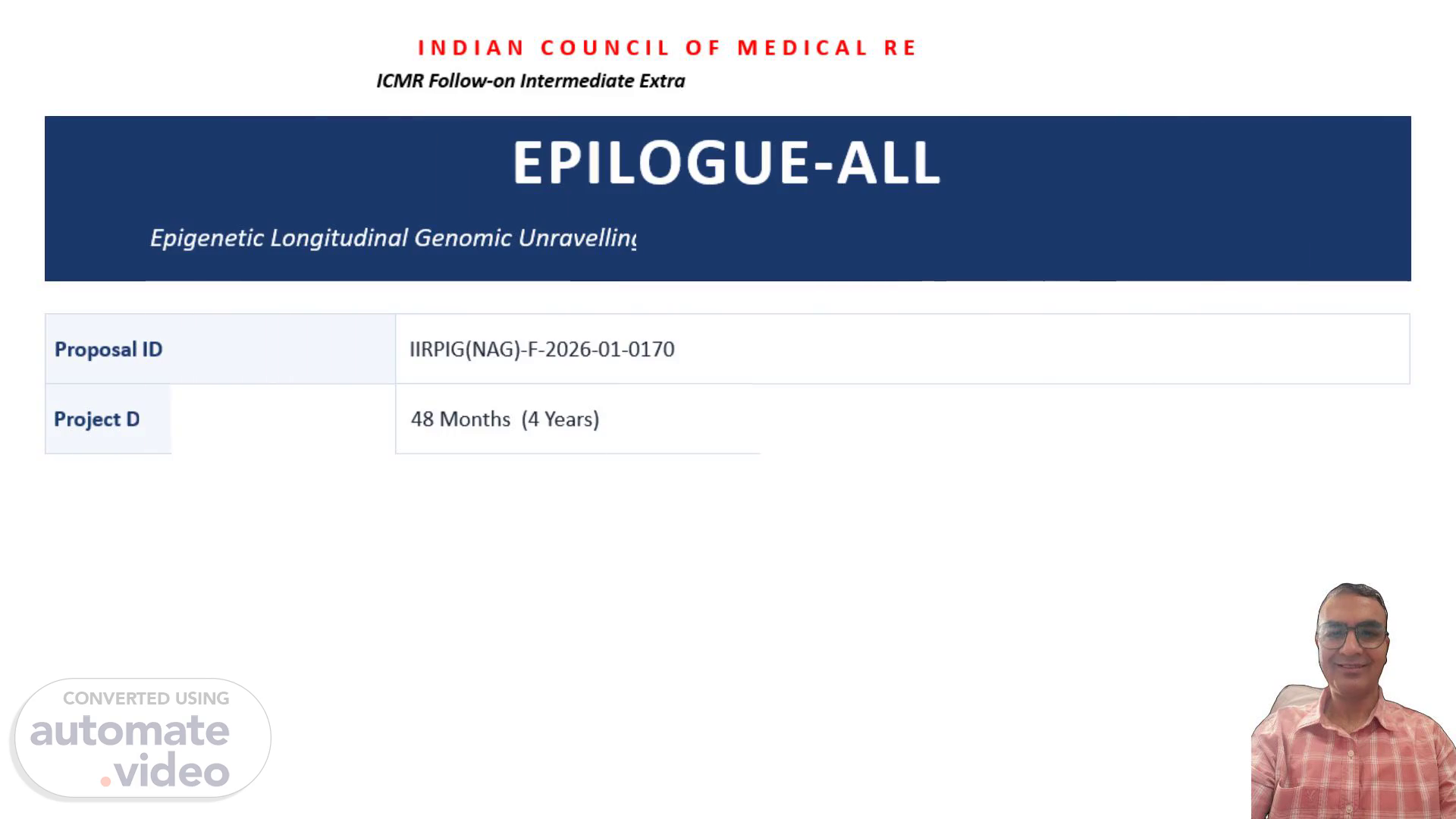
Indian Council Of Medical Research ICMR Follow on Intermediate Extramural Grant (NISCHAYAK ANVESHAN) – 2026 Epilogue all Epigenetic Longitudinal Genomic Unravelling and Evaluation of Relapse in Acute Lymphoblastic Leukemia Proposal ID Iirpig(nag)-f-2-0-2-6--01-0-1-7-0 Project Duration 48 Months (4 Years) Principal Investigator Dr Prateek Bhatia — Additional Professor, Department of Paediatrics Institute Postgraduate Institute of Medical Education & Research (PGIMER), Chandigarh Co Investigators Prof. Amita Trehan | Dr Sreejesh Sreedharanunni | Dr Minu Singh Date of Submission: 20 March 2026.
Scene 2 (57s)
[Audio] Background & Rationale M-R-D 10–15% 80–85% of children with B-ALL relapse — the leading cause of disease mortality overall survival achieved with risk adapted chemotherapy fails to capture E-A-R-L-Y epigenetic changes driving therapy resistance The Problem Why Epigenetics? Relapse prediction relies on genetic profiling and M-R-D monitoring. These tools fail to capture early epigenetic alterations that precede overt resistance. No integrated longitudinal epigenetic risk model currently exists. Limits early intervention and precision guided therapy decisions. Epigenetic changes are dynamic, reversible and respond to therapy pressure. D-N-A methylation, chromatin accessibility & enhancer activity drive therapy evasion without new mutations. Longitudinal profiling can detect relapse specific regulatory elements early. Machine learning integration → Epigenetic Relapse Risk Score (E-R-R-S-) for early, precision guided intervention. EPILOGUE-ALL | I-C-M-R Follow on Intermediate Grant 2026 | PI: Dr Prateek Bhatia, PGIMER.
Scene 3 (2m 19s)
[Audio] Preliminary Work — LEUK-PAN-CLEAR (ICMR, Completed) Multi modal genomic characterization pipeline: cohort & biobank → genetic subtyping → WES & clonal evolution → integrative bioinformatics → relapse signatures..
Scene 4 (2m 50s)
[Audio] Preliminary Work — LEUK-PAN-CLEAR (Publications).
Scene 5 (3m 30s)
[Audio] Research Question & Objectives Research Question Does dynamic epigenetic reprogramming — progressive D-N-A methylation changes, altered chromatin accessibility and super enhancer remodeling — an early precursor or driver of relapse in pediatric B-ALL, and can an integrated longitudinal Epigenetic Relapse Risk Score (E-R-R-S-) predict relapse better than M-R-D-? Longitudinal Methylation Signature Chromatin Accessibility Dynamics Define D-N-A methylation changes from diagnosis through therapy timepoints using long read PromethION sequencing. Map single cell atac seq profiles to identify temporal alterations in epigenetic regulatory landscape. Machine Learning E-R-R-S Tool Prospective Validation Develop 1050 model integrating epigenomic, clinical, tumour biology and genomic data to predict relapse risk. Validate E-R-R-S at multiple therapy timepoints in independent cohort using adaptive long read methylation sequencing. EPILOGUE-ALL | I-C-M-R Follow on Intermediate Grant 2026 | PI: Dr Prateek Bhatia, PGIMER.
Scene 6 (4m 54s)
[Audio] Methodology — Longitudinal Epigenetic Analysis Pipeline Discovery Cohort: 80 pediatric B-ALL patients | 240 samples across 3 longitudinal timepoints (D0-D35-MM/EOM) plus 10–15 relapse samples Diagnosis (D0) End Induction (D35) Mid Maintenance Relapse (if any) ERRS Score (0–1) Sample Collection Chromatin Access. 1050 Model Training Adaptive Validation Long Read Methylation > > > > > PBMCs at 4 timepoints (EDTA, processed & biobanked) PromethION P2 Solo 5mC plus 5hmC native calling scATAC-seq single cell resolution PCA / lasso / R-F-E Random Forest plus XGBoost Low <0.3 | High >0.7 Relapse risk stratification Independent cohort (n=50 at 3 timepoints; 150 samples) Targeted CpG enrichment ERRS Output Interpretation Low Risk (<0.3) Intermediate (0.3–0.7) High Risk (>0.7) Epigenetic remission — chromatin normalized Close monitoring & re assessment Therapy resistant clones — early intervention Validation: 50 prospective patients × 3 timepoints = 150 samples plus 5–10 relapse cases | Adaptive long read sequencing on ERRS-informative CpGs.
Scene 7 (6m 39s)
[Audio] Project Timeline — G-A-N-T-T Chart (48 Months) Year 1 Year 2 Year 3 Year 4 S.No | Objective 6 M 12 M 6 M 12 M 6 M 12 M 6 M 12 M A Sample Collection B Long Read Sequencing (PromethION 2 Solo) A Single Cell atac Seq B Development of E-R-S-S Score A ERSS Score validation cohort at different therapy timepoints using adaptive long read methylation sequencing Key Milestones Y1 Cohort enrolment plus biobanking complete; long read methylation pipeline operational Y2 Methylation profiling complete; scATAC-seq initiated; preliminary 1050 feature selection Y3 E-R-R-S model locked & internally cross validated; validation cohort recruitment begins Y4 Prospective validation via adaptive sequencing; clinical correlation; manuscript/patent submission.
Scene 8 (7m 51s)
[Audio] Expected Outcomes & Public Health Impact Atlas Score Patent Longitudinal Epigenetic Atlas ERRS Predictive Tool Patent plus Validation Platform Time resolved D-N-A methylation plus chromatin accessibility map of pediatric B-ALL — diagnosis, induction, maintenance, relapse. Machine learning–based Epigenetic Relapse Risk Score predicting relapse better than conventional MRD; clinically actionable algorithm. Patent application for E-R-R-S algorithm/software; scalable adaptive long read sequencing platform for prospective use. Clinical & Public Health Impact Earlier Detection Precision Medicine Indigenous Capacity Identify relapse bound patients before gross clinical or hematological relapse→ timely re intervention. Risk adapted therapy; reduced over treatment and chemotherapy toxicity. Strengthens India's pediatric oncology genomics ecosystem; cost effective scalable diagnostics. Key Takeaway The E-R-R-S model integrates longitudinal epigenetic data with machine learning to predict B-ALL relapse better than conventional MRD — enabling precision guided therapeutic decision making in children..
Scene 9 (9m 15s)
[Audio] Budget Break up with Justification — PGIMER (₹ in Lakhs) S.No Item Y1 Y2 Y3 Y4 Total Justification 1 Manpower PRS-II plus PRS-I (Non Medical) 17.71 17.71 18.60 18.60 72.62 PRS-II for atac and A-I tool generation; PRSc I for sample collection, P-B-M-C isolation, DNA/RNA extraction, Long Read Sequencing. 2 Contingencies 0.30 0.50 0.50 0.50 1.80 Miscellaneous & administrative expenses. 3 Consumables Long read seq, scATAC-seq, adaptive seq, BioAnalyzer kits, cryo containers 18.10 37.50 32.00 12.00 99.60 Long read sequencing (n=250 @ ₹14k); scATAC-seq (n=35); adaptive long read methylation seq (n=160 @ ₹15k); BioAnalyzer HS DNA kits; cryofreeze containers. 4 Equipment (Non Recurring) A Vacuum Concentrator B CycloneSeq Nanopore Sequencer 30.00 — — — 30.00 Vacuum concentrator (₹5L) and CycloneSeq Nanopore sequencer (₹25L) for high throughput long read sequencing experiments. 5 Travel — 1.00 1.00 1.00 3.00 Presentation of project work at national/international conferences. 6 Overhead charges (3%) 1.08 1.67 1.53 0.93 5.22 Institutional overhead as per I-C-M-R norms. GRAND total (₹ in Lakhs) 67.20 58.38 53.63 33.03212.24 Total Budget: ₹ 2,1223976 (~₹ 2.12 Crore) All values in I-N-R Lakhs. Budget aligns with I-C-M-R Follow on Intermediate Grant norms. Institutional infrastructure (PromethION P2 Solo, Illumina NextSeq 2000, BSL-2 facilities, bioinformatics servers) available at PGIMER Pediatric Hematology Lab..