Scene 1 (0s)
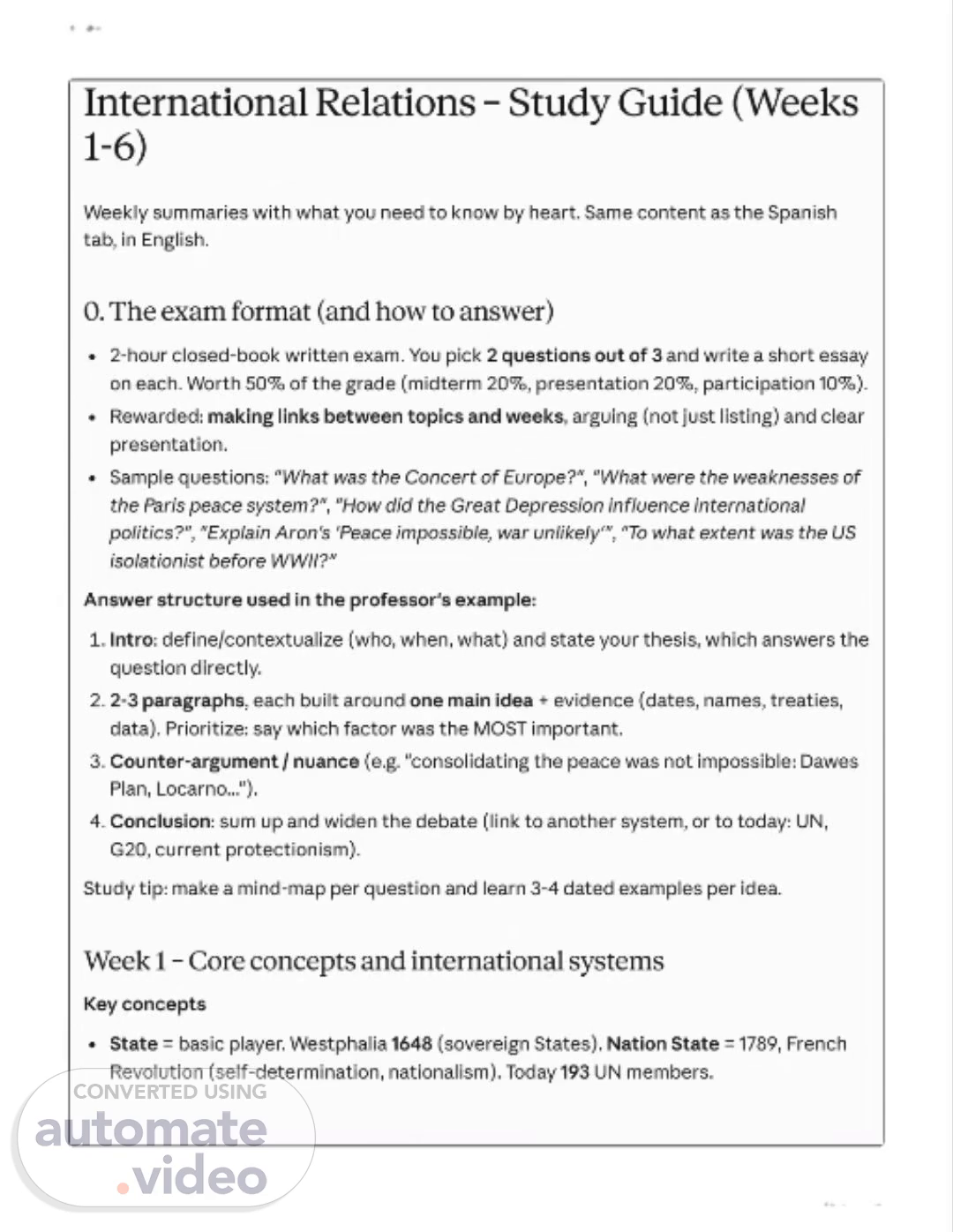
International Relations – Study Guide (Weeks 1-6) Weekly summaries with what you need to know by heart. Same content as the Spanish tab, in English. 0. The exam format (and how to answer) 2-hour closed-book written exam. You pick 2 questions out of 3 and write a short essay on each. Worth 50% of the grade (midterm 20%, presentation 20%, participation 10%). Rewarded: making links between topics and weeks, arguing (not just listing) and clear presentation. Sample questions: "What was the Concert of Europe?", "What were the weaknesses of the Paris peace system?", "How did the Great Depression influence international politics?", "Explain Aron's 'Peace impossible, war unlikely'", "To what extent was the US isolationist before WWII?" Answer structure used in the professor's example: 1. Intro: define/contextualize (who, when, what) and state your thesis, which answers the question directly. 2. 2-3 paragraphs, each built around one main idea + evidence (dates, names, treaties, data). Prioritize: say which factor was the MOST important. 3. Counter-argument / nuance (e.g. "consolidating the peace was not impossible: Dawes Plan, Locarno..."). 4. Conclusion: sum up and widen the debate (link to another system, or to today: UN, G20, current protectionism). Study tip: make a mind-map per question and learn 3-4 dated examples per idea. Week 1 – Core concepts and international systems Key concepts State = basic player. Westphalia 1648 (sovereign States). Nation State = 1789, French Revolution (self-determination, nationalism). Today 193 UN members. English Page 1 of 10.
Scene 2 (4m 59s)
[Audio] We're discussing the English Power, which emphasizes the sovereignty and formal equality of states. Great powers are those capable of sharing responsibility for managing the international order through military and economic influence. We have hard power, which refers to military and economic influence, and soft power, which is about influencing others through culture, values, and ideas, a concept introduced by Joseph Nye in 1990. Geopolitics is about the relationship between continental and sea powers. We have different values and ideologies, including conservatism, which emphasizes the importance of monarchy, nobility, and the Christian religion, and liberalism, which focuses on democracy and free trade. Nationalism and fascism also play a role, as do socialism and communism. The international system is governed by either a realist or liberal approach. The realist approach emphasizes the balance of power, great powers, and alliances, while the liberal approach prioritizes collective security, multilateralism, and international law. The concept of hegemonic stability is also relevant, referring to the dominance of a single power, such as the UK until 1914 or the US since 1945. It's essential to remember the 5 historical international systems. We have the Vienna/Concert of Europe system, which operated from 1814 to 1914, characterized by the balance of power and diplomacy, and conservative values. The Bismarck system, which dominated from 1871 to 1890, featured the rise of Germany, the Triple Alliance, and the Triple Entente. The Paris system, which emerged in 1919, focused on collective security through the League of Nations, but ultimately failed. The Cold War system, which lasted from 1947 to 1989, saw the rise of superpowers, capitalism, and communism, with the UN and US hegemony playing significant roles. The current American system, which began in 1991, is characterized by US unipolarity, the UN, and European integration, with concerns about the Thucydides' trap between the US and China potentially leading to a multipolar world. We're now moving from the Concert of Europe to the Paris Peace System, which operated from 1900 to 1919, setting the stage for the outbreak of World War I. We're discussing the English Power, which emphasizes the sovereignty and formal equality of states. Great powers are those capable of sharing responsibility for managing the international order through military and economic influence. We have hard power, which refers to military and economic influence, and soft power, which is about influencing others through culture, values, and ideas, a concept introduced by Joseph Nye in 1990. Geopolitics is about the relationship between continental and sea powers. We have different values and ideologies, including conservatism, which emphasizes the importance of monarchy, nobility, and the Christian religion, and liberalism, which focuses on democracy and free trade. Nationalism and fascism also play a role, as do socialism and communism. The international system is governed by either a realist or liberal approach. The realist approach emphasizes the balance of power, great powers, and alliances, while the liberal approach prioritizes collective security, multilateralism, and international law. The concept of hegemonic stability is also relevant, referring to the dominance of a single power, such as the UK until 1914 or the US since 1945. It's essential to remember the 5 historical international systems. We have the Vienna/Concert of Europe system, which operated from 1814 to 1914, characterized by the balance of power and diplomacy, and conservative values. The Bismarck system, which dominated from 1871 to 1890, featured the.
Scene 3 (9m 44s)
[Audio] The European Union has been a dominant force in international relations since its inception in 1957. Its influence extends far beyond its borders, shaping global politics, economies, and cultures. The EU's power is not limited to its member states; it also exerts significant control over non-member countries through various mechanisms such as trade agreements, economic aid, and diplomatic pressure. Furthermore, the EU plays a crucial role in maintaining peace and stability in Europe and beyond, often serving as a mediator in conflicts between nations. The EU's ability to facilitate dialogue and cooperation among its member states has enabled it to address complex issues like climate change, migration, and terrorism. However, some critics argue that the EU's dominance can lead to a lack of accountability and democratic deficit within its institutions..
Scene 4 (10m 50s)
[Audio] The company has been working on a new project for several years, but it has not yet reached its full potential. The team has been struggling with various issues such as lack of resources, inadequate training, and poor communication. Despite these challenges, the team remains committed to achieving their goals. The company's leadership has taken steps to address some of these issues by providing additional funding and resources. However, more needs to be done to overcome the remaining obstacles. The team is eager to work together to find solutions and make progress. The company's vision is to become a leading player in the industry, and they are taking concrete steps towards that goal. They have set clear objectives and are working diligently to achieve them. The team is motivated by the prospect of success and is driven by a sense of purpose. Despite the challenges, the team remains optimistic about their future prospects. They believe that with continued hard work and dedication, they can overcome any obstacle and achieve their goals. The company's commitment to excellence is evident in their actions and decisions. The team is currently focused on implementing the company's strategy and making progress towards its objectives. They are working closely together to identify areas for improvement and develop effective solutions. The company's leadership is supportive and encouraging, which helps to foster a positive and productive work environment. The team is excited about the opportunities ahead and is looking forward to the future. They are confident that with the right support and resources, they can overcome any challenge and achieve great things. The company's vision for the future is inspiring and motivating, and it gives the team the drive to keep pushing forward." Here is the rewritten text:.
Scene 5 (12m 44s)
[Audio] The collapse of the post-WWI settlement was a major problem for the League of Nations. The League's inability to prevent the Japanese invasion of Manchuria in 1931, the Italian invasion of Ethiopia in 1935, and the Japanese invasion of China in 1937, marked its failure to maintain international order. The League's inability to stop the Spanish Civil War, which began in 1936, further highlighted its ineffectiveness. The League's inability to prevent the Anschluss with Austria in 1938, and the subsequent annexation of Czechoslovakia, demonstrated its inability to enforce its decisions. The League's failure to address the growing tensions between Germany and Italy, as well as the rising tensions between Japan and China, ultimately led to the outbreak of World War II. The League's inability to resolve the conflict over the status of the Rhineland, which had been occupied by Germany since 1920, also contributed to the war. The League's failure to take decisive action against aggressive powers like Germany and Italy, and its inability to provide adequate support to countries under attack, left many countries feeling vulnerable and insecure. The League's inability to establish a stable and effective system of collective security, which would have provided a framework for resolving conflicts peacefully, meant that it was unable to prevent the outbreak of war..
Scene 6 (14m 15s)
[Audio] The League of Nations failed due to fragile treaties, lack only inclusiveness, and weak enforcement. However, it achieved consolidation in the 1920s with the signing of the Locarno Pact and Germany's admission to the League in 1926. This period of relative peace was short-lived, as the Great Depression led to the rise of nationalism, fascism, protectionism, and militarism, ultimately contributing to the outbreak of World War II. With the onset of the Cold War, the bipolar system emerged, characterized by the Grand Alliance between the US, UK, and USSR. This alliance led to the creation of new international institutions, including the United Nations, which was established in 1945 with 51 founding members and today comprises 193 member states. The UNSC permanent members were the US, USSR, UK, France, and China, while economic institutions like the IMF and World Bank were established through the Bretton Woods Agreement in 1944. The origins of the Cold War can be attributed to ideological differences between communism and liberalism/capitalism, with non-alignment emerging as a third option. The balance of power shifted, with the US maintaining global hegemony and containment, while the USSR sought to impose its social system on occupied territories. The path to the Cold War was marked by key events, including the Truman Doctrine, Marshall Plan, and the division of Europe and Asia. In the 1950s, the concept of peaceful coexistence emerged, with principles such as sovereignty and territorial integrity, nonaggression, and non-interference guiding international relations. Khrushchev's proposal of peaceful coexistence at the 20th Party Congress in 1956 marked a turning point in the Cold War era. The bipolar system of the Cold War era was characterized by the US and USSR as superpowers, with the UN serving as a platform for international cooperation and conflict resolution. The period was marked by the Korean War, the division of Europe and Asia, and the rise of communism and liberalism/capitalism as dominant ideologies. The Cold War came to an end with the collapse of the Soviet Union in 1991, but its legacy continues to shape international relations today..
Scene 7 (16m 55s)
Military deadlock (MAD): Soviet bomb 1949, NSC68, Cuba missile crisis 1962 → Raymond Aron: "Peace impossible, war unlikely" (no direct confrontation). Consolidation of the camps: NATO / Warsaw Pact, Budapest 1956, Berlin Wall 1961. Cooperation and competition: Austria 1955, IAEA 1956, Sputnik 1957, Gagarin 1961, summits. Indirect confrontation in the Third World (Cuba, Vietnam). Week 5 – Decolonization, Third World, international economy, sustainable development Decolonization = the process whereby an imperial power gives up its authority over its colonies. Basis: self-determination (14 Points, Atlantic Charter, UN Charter) + weakening of European powers. America: 1776 USA, 1822 Latin America (Monroe Doctrine), 1867 Canada, 1902 Cuba. Middle East (ex-Ottoman): 1920 League mandates (Sykes-Picot 1916 / San Remo 1920), Egypt 1922, Iraq 1930, Lebanon and Syria 1946, Palestine/Israel 1948, Libya 1951, Morocco and Tunisia 1956, Algerian War 1954-62. Asia: Korea 1945, Philippines 1946, Indochina War 1946-54, India/Pakistan 1947, Burma 1948, Indonesia 1949, Singapore 1963. Africa: South Africa 1910, Ghana 1957, Guinea 1958, French Africa and Congo 1960, Spanish/Portuguese colonies 1975, Namibia 1990. Third World Term coined by Alfred Sauvy (1952) ≈ "Third Estate". South vs North. Bandung Conference 1955 (29 States): two claims = decolonization and development. Non-aligned movement: Brioni 1956 (Nasser, Nehru, Tito), Belgrade summit 1961 (25 States; today 120), majority in the UN General Assembly after 1960. "Global South" (Carl Oglesby, 1969). But the Cold War was fought in the Third World. Economic empowerment: OPEC 1960, UNCTAD/G77 1964, first oil shock 1973, New International Economic Order 1974, North-South dialogue Paris 1976, second shock 1979, Cancun 1981. Economic globalization Western integration (US role): Bretton Woods 1944 (IMF, World Bank), GATT 1947, Marshall Plan 1947 (OEEC), Keynesian consensus (Welfare state). English Page 7 of 10.
Scene 8 (18m 0s)
[Audio] We are now looking at the English Crisis of the West after 1970, which began with the US deficit and dollar devaluation in 1971. This led to the end of the Bretton Woods system in 1976, and the oil shocks of 1973 and 1979 resulted in stagflation. The G7 was formed in 1975-76 to address this crisis, and neoliberal solutions were proposed by Thatcher in 1979 and Reagan in 1980. Simultaneously, the communist model was facing a crisis, particularly in China with the Great Leap Forward in 1958 and the Cultural Revolution in 1966. The Soviet bloc also faced the collapse of its planned economy from 1989-91. The crisis of the South led to the East Asian success story, including Japan and the 4 Dragons, while the debt crisis in Mexico in 1982 prompted the Washington consensus in 1990. This led to a fragmented Third World, which was later addressed by the Monterrey consensus in 2002. The rise of the US as a global hegemon led to the formation of the WTO in 1995, with China joining in 2001 and Russia in 2012. The Asian crisis in 1997 prompted the G20, and the 2007-09 crisis led to the first G20 summit in 2008 and the formation of the BRIC group in 2009, which later became the BRICS in 2011. The environment has also been a growing concern, with the Club of Rome's Limits to Growth in 1972, the Brundtland Report's concept of sustainable development in 1987, and the Paris Agreement and Sustainable Development Goals in 2015. However, globalization is facing threats, including failed regulation, inequality, populism and nationalism, protectionism, climate change, COVID-19, and the US-China/Russia rivalry. Meanwhile, we're moving on to the week of Détente and the end of the Cold War, which spanned from 1962-1991. Let's examine the causes of the Détente from 1962-1968. One key factor was the nuclear arms race and arms control, including the Soviet bomb in 1949 and the missile gap following Sputnik in 1957. The Cuba missile crisis in October 1962 brought the world to the brink of nuclear war, but led to the red telephone and nuclear test limitation in 1963. This, in turn, led to the Nuclear Non-Proliferation Treaty in 1968, which recognized five official nuclear states: the US, USSR, UK, France, and China. Another significant event during this period was the Vietnam War, which saw Vietnam divided in 1954 and US military engagement from 1964, resulting in 500000 troops and 60000 dead. The Vietnamization of the war in 1969 and the Paris accords in 1973 ultimately led to the fall of Saigon in 1975 and the Vietnam Syndrome. The crisis of the bipolar system was also evident during this period, with the Third World and non-aligned nations playing a significant role. The Sino-Soviet split in 1960 led to border incidents in 1969, while the US was weakened by the Vietnam War and the rise of French nuclear power under De Gaulle in 1958-69. The Soviet Union faced challenges in the East, including Tito's Yugoslavia in 1948, Romania's Ceaușescu, and the Prague Spring in 1968. The Warsaw Pact was also tested, particularly with Albania's departure in 1960. The period of Détente itself, from 1968-1979, was marked by a series of diplomatic efforts aimed at reducing tensions between the US and USSR. We'll explore the specifics of this period and its significance in shaping the course of international relations..
Scene 9 (22m 44s)
New US leadership: Nixon + Kissinger (realism, balance of power, negotiation by "linkages", reference to Metternich and Bismarck). Multipolar world: China (bomb 1964, joins the UN 1971, relations with US 1979, Kissinger in Beijing 1971), India (war with China 1962, treaty with USSR 1971, nuclear 1974), Japan (2nd world economy 1968), more united Western Europe, 1973 oil shock → G7. Achievements: China in the UN (1971); SALT I (1972) and SALT II (1979); end of Vietnam War (1973); Willy Brandt's Ostpolitik (West-East Germany normalization 1970-73); CSCE / Helsinki Final Act 1975 (35 countries); Israel-Egypt peace (Camp David 1978). Last phase (1979-1991) New tensions: arms race (Euromissiles, missile defence, MIRV), failure of Carter's moral policy, Soviet invasion of Afghanistan 1979-89 (100,000 troops), Cold War in the Third World (Nicaragua, Vietnam/Laos/Cambodia, Africa). Weakening of the USSR: Reagan (1980-88): Grenada, "Star Wars" 1983, rearmament; Gorbachev (1985-91): perestroika and glasnost. End: INF Treaty (Washington, 1987), withdrawal from Afghanistan 1989, fall of the Berlin Wall 9 Nov 1989, German reunification 1990, Gulf War 1990-91, dissolution of the USSR 1991 → US "unipolar moment" (only superpower). Final summary: connecting threads (highly rewarded in the exam) Hegemonic stability: UK until 1914 → vacuum in the interwar period (weak UK, isolationist US → Depression) → US since 1945 (Bretton Woods, GATT, dollar) → possible decline (1971, today US vs China, "Thucydides' trap"). Collective security: Concert of Europe → League of Nations (no US, no force) → UN (with US, USSR and the Security Council). Great powers as permanent members is a legacy of the Concert. Shared values: Vienna (conservatism) worked; Paris (no common values) failed; Cold War (capitalism vs communism) → stable bipolarity (MAD); post-1991 liberalism. Economic lessons: interwar reparations and protectionism → Bretton Woods + GATT in 1944-47 → the 2008 G20 prevented the financial crisis from becoming a political one. Today: protectionism and nationalism are back. Germany over time: 1871 (unification, Bismarck system) → 1919 (Versailles, "Diktat") → 1933 (Hitler) → 1945 (divided) → 1949 (FRG/GDR) → Ostpolitik 1970s → 1989-90 (Wall and reunification). English Page 9 of 10.
Scene 10 (23m 49s)
[Audio] The revisionist powers, led by Germany, Russia, and Italy, sought to challenge the existing international order established by the Treaty of Versailles and the League of Nations. They aimed to expand their territories, increase their influence, and gain greater control over global events. In contrast, the status quo powers, represented by France, the United Kingdom, and the Central European states, sought to maintain the existing order and resist any attempts to alter it. The revisionist powers' aggressive expansion and militaristic policies ultimately led to the outbreak of World War II..