Scene 1 (0s)
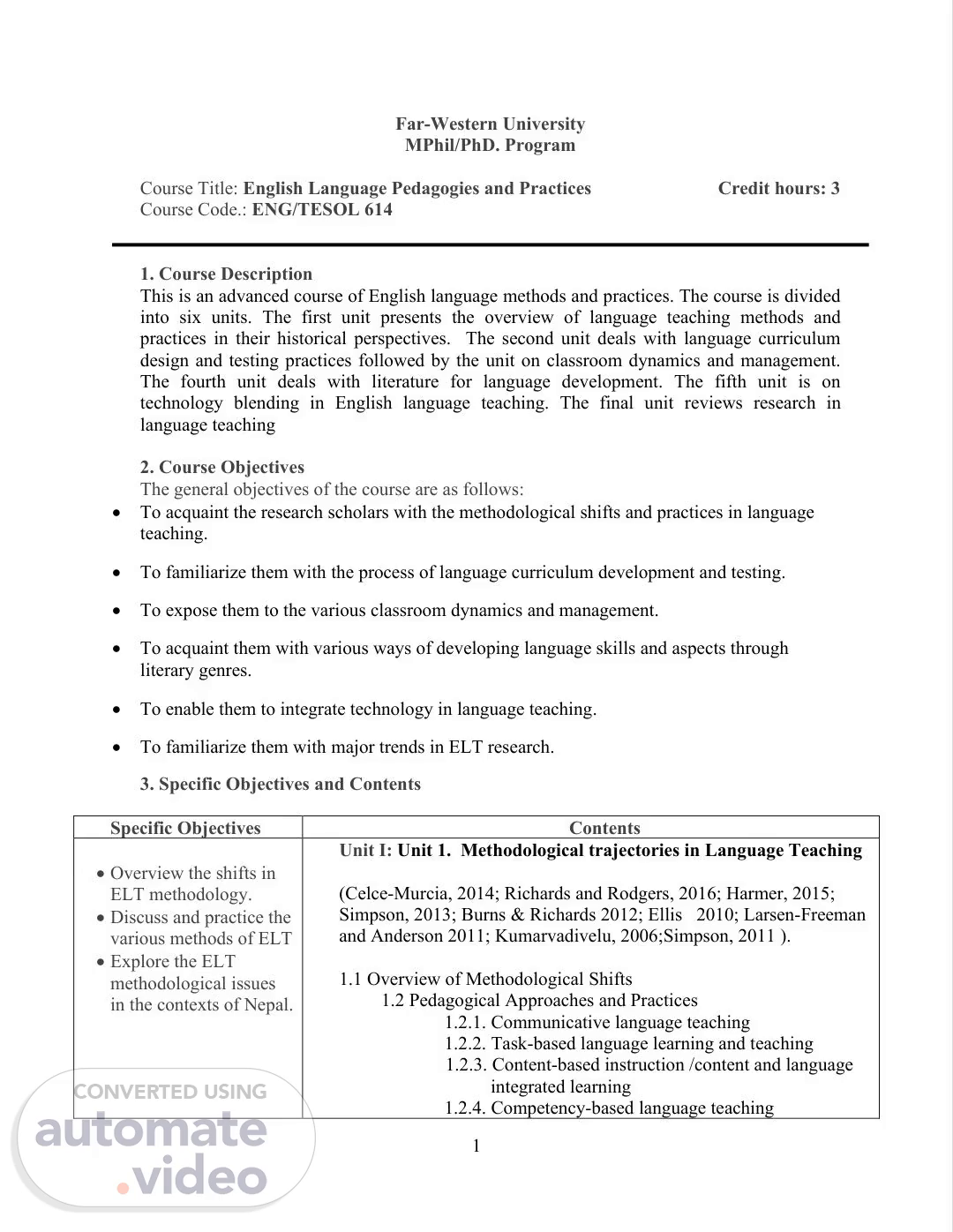
[Virtual Presenter] Far-Western University MPhil/PhD. Program Course Title: English Language Pedagogies and Practices Credit hours: 3 Course Code.: ENG/TESOL 614 1. Course Description This is an advanced course of English language methods and practices. The course is divided into six units. The first unit presents the overview of language teaching methods and practices in their historical perspectives. The second unit deals with language curriculum design and testing practices followed by the unit on classroom dynamics and management. The fourth unit deals with literature for language development. The fifth unit is on technology blending in English language teaching. The final unit reviews research in language teaching 2. Course Objectives The general objectives of the course are as follows: To acquaint the research scholars with the methodological shifts and practices in language teaching. To familiarize them with the process of language curriculum development and testing. To expose them to the various classroom dynamics and management. To acquaint them with various ways of developing language skills and aspects through literary genres. To enable them to integrate technology in language teaching. To familiarize them with major trends in ELT research. 3. Specific Objectives and Contents Specific Objectives Contents Overview the shifts in ELT methodology. Discuss and practice the various methods of ELT Explore the ELT Unit I: Unit 1. Methodological trajectories in Language Teaching (Celce-Murcia, 2014; Richards and Rodgers, 2016; Harmer, 2015; Simpson, 2013; Burns & Richards 2012; Ellis 2010; Larsen-Freeman and Anderson 2011; Kumarvadivelu, 2006;Simpson, 2011 ). 1.1 Overview of Methodological Shifts 1.2 Pedagogical Approaches and Practices methodological issues in the contexts of Nepal. 1.2.1. Communicative language teaching 1.2.2. Task-based language learning and teaching 1.2.3. Content-based instruction /content and language integrated learning 1.2.4. Competency-based language teaching 1.
Scene 2 (2m 43s)
[Audio] 1.2.5 Text-based language teaching 1.2.6. Cooperative learning 1.2.7. Multiple intelligences 1.2.8. Literary based language teaching 1.2.9. Post-method pedagogy 1.2.10. ELT Methodological issues in the contexts of Nepal Explain the process of language curriculum design. Discuss the various models of curriculum and issues pertinent to them. Explain the approaches and issues to language testing. Use technology for language testing Unit II: Language curriculum design and testing (Richards and Renandya, 2010; Coombe et al. 2012: Richards, 2010; Graves 2010;Simpson 2013; Celce-Murcia 2014; Fulcher & Davidson 2011, 2012; Hall,2016;Simpson,2011). 2.1. Process of curriculum design 2.2. Models of curriculum planning 2.3. Approaches to language testing 2.4. Alternative assessment 2.5Assessing second language skills and aspects 2.6.Technology for language testing 2.7.Fairness and ethics in language testing 2.8.Issues related to language curriculum designing and language testing Assess language skills and aspects Maintain ethics in language testing Plan lessons for large and multi-level classes Explore various learning strategies Discuss various issues related to classroom dynamics Unit III: Classroom Dynamics and Management (Burns and Richards, 2012; Ur, 2012; Harmer, 2015; Scrivener 2013; Richards and Renandya, 2010) 3.1. Learner diversity and classroom management 3.2. Learner strategies 3.3. Motivation 3.4. Teaching mixed- level classes 3.5. Teaching large classes 3.6. Classroom interaction 3.7. Issues related to classroom management in the context of Nepal Select and use literary genres for language development. Use Shakespearean plays in the English classroom. Discuss issues related to Unit IV: Unit 4. Literature for Language development (Lazar 2010, 2009; Lau & Tso 2017; Celce-Murcia 2014; Hall 2017) 4.1. Using literature in ELT 4.2. Materials and teaching stories, plays and poems for language development 4.5. Shakespeare in the language classroom 4.6. Issues related to literature in the language classroom in Nepal language and literature teaching Explore the technology Unit V: Technology and language teaching 2.
Scene 3 (6m 5s)
[Audio] used in language learning and teaching. Use appropriate (Richards and Renandya 2010; Simpson 2013; Hinkel vols. I & II; Dudeney& Hockly, 2007; Brian, Tomlinson & Whittaker, 2013;Simpson, 2011;Burns & Richards, 2012). 5.1.Technology in language learning and teaching technology in the ELT classroom. Discuss the benefits of 5.2.Computer- assisted language learning computer-assisted language learning 5.3.Mobile –assisted language learning Use blended learning in 5.4.Technology in the classroom English Discuss the issues 5.5. Blended learning in English 5.6. Digital divide related to Technology integration in ELT in Nepal 5'7. Issues related to Technology in ELT classrooms in Nepal Discuss the role of Unit V1: Research trends in language teaching (Hayes, 2018; Hinkel, 2005,2011,2017; Brown & Coombe,2015; 6.1.Research in language learning and teaching research in language teaching Conduct classroom 6.2.Using research in the classroom 6.3.Critical research in TESOL and language education research such as teacher research/ action research 6.4.Action research Explore critical research 6.5.Ethics in research in TESOL and education Maintain ethics in 6.6.Research issues in ELT in Nepal research writing 5. Evaluation Internal Presentation on the topic provided by the course instructor 10 Book review report 10 Research article review 10 A research paper (publishable) of 3000 words 10 Or Mid-term written examination External A field based research paper and its conference presentations 60 Or End semester examination of three hours 6. Recommended Books 1..
Scene 4 (8m 27s)
[Audio] 2. Brown, J.D. & C. Coombe (eds.)(2015). The Cambridge guide to research in language teaching and learning. Cambridge. 3. Burns,A. (2010). Doing action research in English language teaching. Routledge. 4. Burns, A. & J C Richards (2012). The Cambridge guide to pedagogy and practice in second language teaching. CUP. 5. Coombe, C. P. Davidson, B. O'Sullivan, Stoynoff (2012) (eds.) The Cambridge guide to second language assessment. CUP. 6. Dudeney,G.& N.Hockly (2007). How to teach English with technology. Pearson Longman. 7. Ellis, R.(2010). Task-based language learning and teaching. Oxford. 8. Fulcher, G. & F. Davidson (2012) The routledge handbook of language testing. Routledge. 9. Fulcher, G. & F. Davidson (2011). Language assessment and testing. London: Routledge. 10. Graves, K. (2010) Teachers as course developers.CUP 11. Gao, X. (2019). Second language handbook of English language teaching. Springer. 12. Hall, G. (2016). The routledge hand book of English language teaching. Routledge 13. Harmer, J. (2015). The practice of English language teaching. Pearson. 14. Hayes, D. (ed.) (2018). English language teaching in Nepal: Research, reflection and practice. British Council. 15. Hinkel, E.(2005,2011,2017) Handbook of research in language teaching and learning. (Vols. I, II, III). London: Lawrence Erlbaum Publishers. 16. Holliday, A. (2010). Appropriate methodology and social context. CUP 17. Kumarvadivelu, B. (2006). Understanding language teaching: from method to post method. Lawrence Erlbaum Associates. 18. Larsen-Freeman, D. & M. Anderson (2016). Techniques and principles in language teaching. OUP. 19. Lazar, G. (2010) Literature in language teaching. CUP. 20. Richards, J.C. (2010). Curriculum Development in language teaching. CUP. 21. Richards, J C & T.S. Rodgers (2016). Approaches and methods in language teaching. CUP. 22. Richards, J.C. & W. A. Renandya (2010) (eds) Methodology in language teaching. CUP. 23. Scrivener, J. (2012). Classroom management techniques. CUP. 24. Shohamy, E. et al. (2017). Language testing and assessment. Springer. 25. Willis, D. & J. Willis (2015). Doing task-based teaching. Oxford. 26. Ur, P. (2012). A course in English language teaching. CUP 4.