Scene 1 (0s)
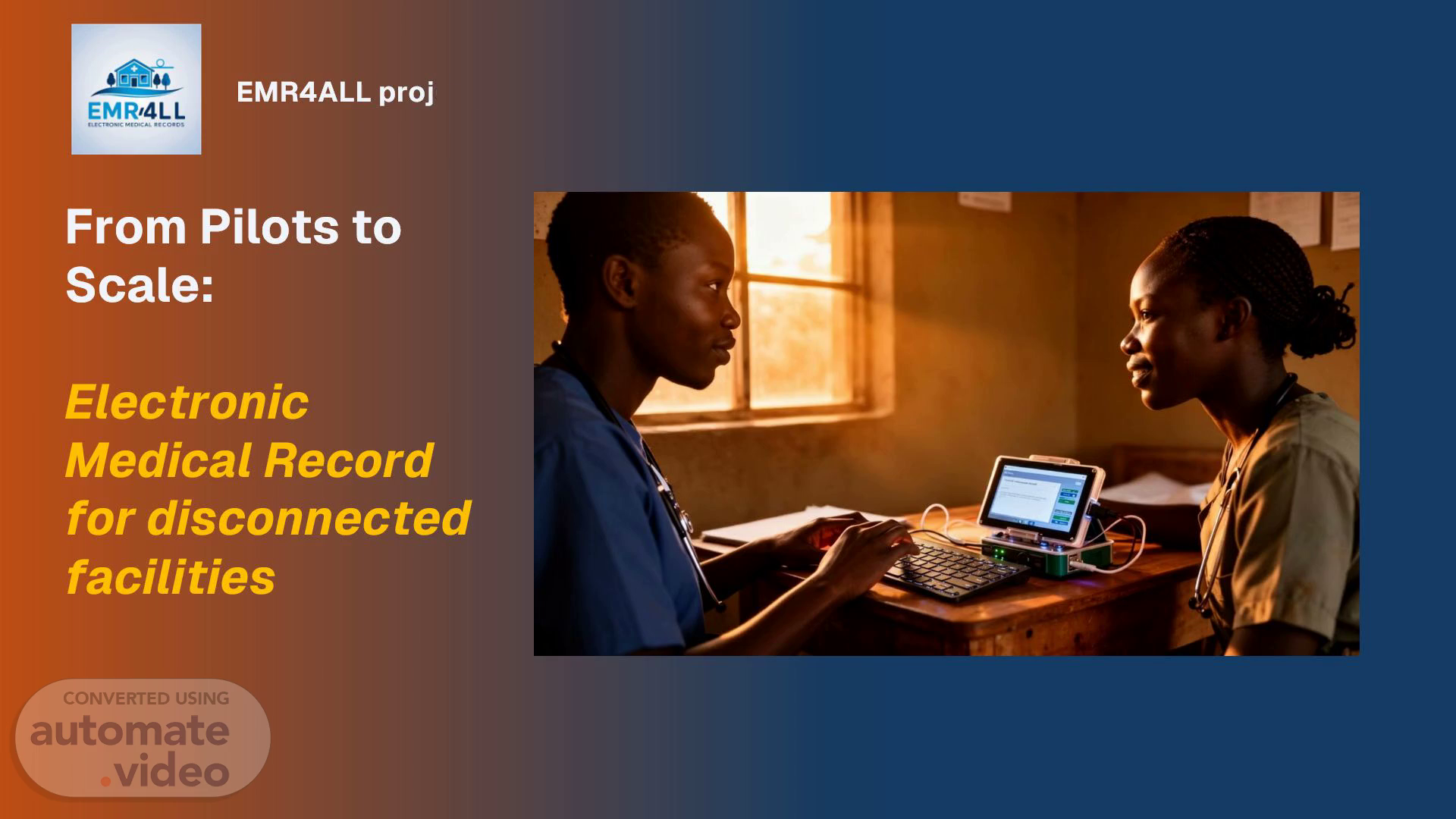
From Pilots to Scale: Electronic Medical Record for disconnected facilities.
Scene 2 (11s)
THE PROBLEM. Across many remote and underserved communities, digital health remains out of reach. Primary Healthcare Centres (PHCs), in these regions often operate without the most basic infrastructure..
Scene 3 (45s)
THE PROBLEM. CASE OF NIGERIA. The Need for an Offline Electronic Medical Record (EMR) for Nigeria's Primary Healthcare Centres.
Scene 4 (1m 27s)
Offline EMR (HER). Built on the trusted, open-source OpenMRS 3 platform and affordable Raspberry Pi hardware. It brings secure, scalable, and interoperable solutions to the settings that need them most..
Scene 5 (1m 58s)
QQuuiicckk LLiinnkkss OpenMRS Documentation Communuty Calendar OpenMRS Slack OpenMRS Forum GitHub.
Scene 6 (2m 37s)
Docker image installation Docker based installation of O3 and Bahmni on Raspberry PI to create new images..
Scene 7 (3m 13s)
EMR4ALL Offline Solutions. OpenMRS 3 (O3) on Raspberry Pi.
Scene 8 (3m 51s)
The EMR4ALL MED Kit Hardware. Raspberry Pi based.
Scene 9 (4m 20s)
Data Sharing & Interoperability. EMR4All connects seamlessly with national health information systems and international standards, ensuring your data works across platforms and borders..
Scene 10 (4m 49s)
SUCCESSFUL Implementation. Sen. Dr. Idris Ibrahim Kuta Memorial Primary Healthcare, Minna - Nigeria.
Scene 11 (5m 20s)
+ 5 Health Facilities in CHANGA local Government Area , Niger State.
Scene 12 (6m 1s)
ADVOCACY. Stakeholder engagement & Parnership Model.
Scene 13 (6m 8s)
Stakeholder Engagement Model. Stakeholder Engagement & Business Model For potential adopters and funders.
Scene 14 (6m 49s)
Match with their existing strategy plans Sustainability strategy Data & System ownership: Be clear, it’s the MOH who owns What MoHs want: Integrated with Analytics Software is part of Infrastructure Messaging we want: Feeds into your existing Dashboards / National Information System / Ntl HIS so you can see: How many pts have access to drugs; certain types of care… (eg DHIS2, SuperSet) Demo: How to see / book (key convo entry point) Offline-friendly; data syncing well No more systems with loopholes (e.g. DHIS2 - data not properly syncing; Huawei data collection) What does MOH/Govt need to see, to have confidence? E.g. Zambia MoH Collaborative approach with small surviving TWG players/ vendors; new ideas have to be a shared team effort Examples: Rasp. Pi’s can sync to central DB Help connect to National Insurance systems, w Unique Patient IDs Works even if your networks don’t; even if power is flaky Help with Training support to reduce costs/HR challenges Govts don’t like being forced into donors’ funding cycles Confirm it is more/as affordable as manual/paper collection (Malawi 2012 study) E.g. Ethiopia: Trying to solve lack of clinical staff by encouraging clinics to operate as businesses with basic bookkeeping; bring in their own revenue Does not require travel to update Setup quickly; plug-and-play; start it and it runs (w PI, solar; put on wall and working) Troubleshooting courses online How to handle turnover in key Govt positions? MOU with Govt I.d How you’re using existing infrastructure to achieve → less costly Build trust between MoH + Imp. Partners (+ funder) Focus on Implementers so country vendor ecosystem has good understanding Knowledge transfer: Prepare handover; training platform online (could use OpenMRS academy) Cost / Cost Savings: affordably meet Primary Healthcare needs.
Scene 15 (7m 55s)
Let’s work together. Website : www.emr4all.org OpenMRS : OpenMRS blog | OpenMRS wiki | OpenMRS Partners Stay connected: OpenMRS talk | LinkedIn | Twitter.