Scene 1 (0s)
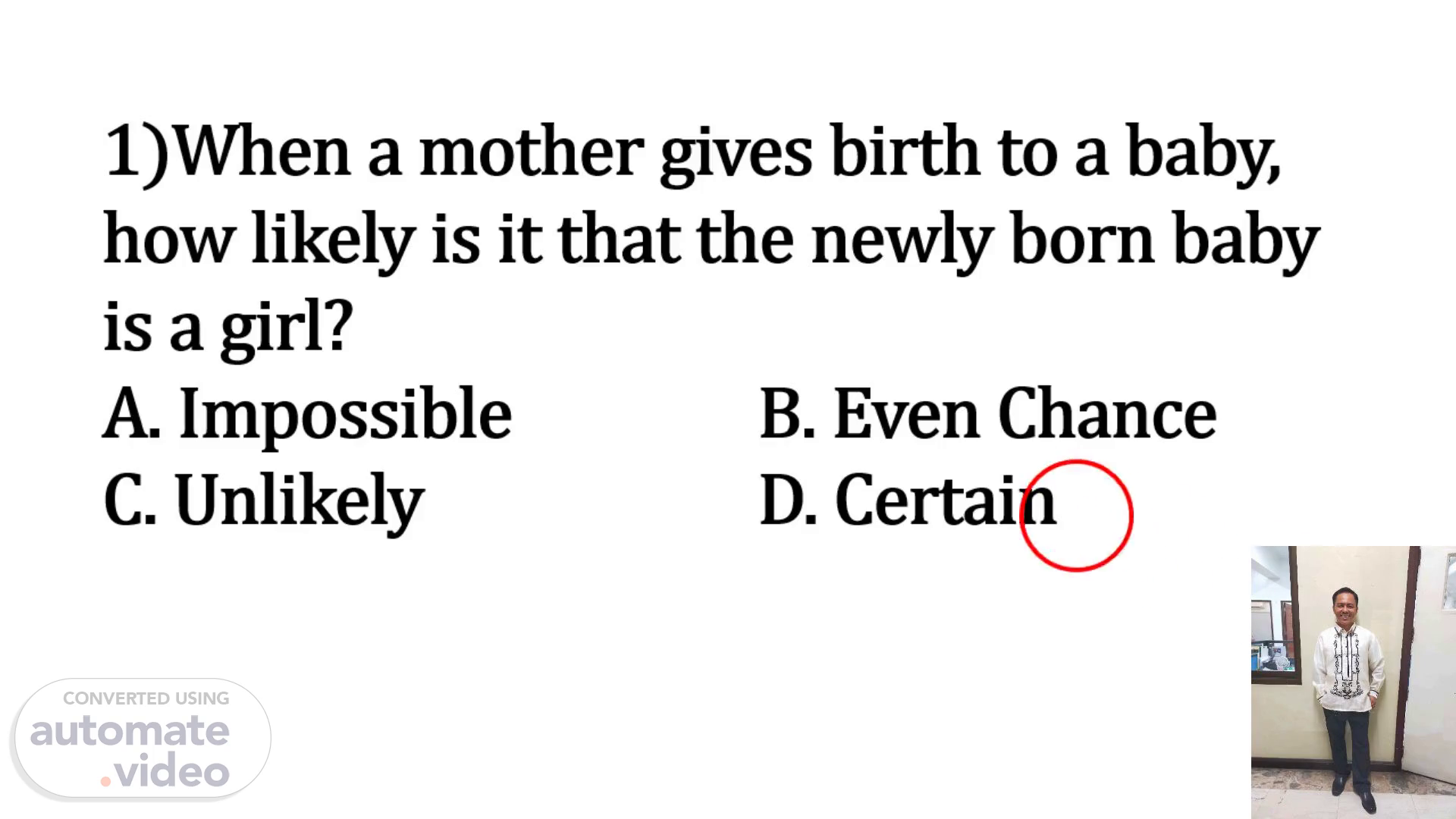
1)When a mother gives birth to a baby, how likely is it that the newly born baby is a girl? A. Impossible B. Even Chance C. Unlikely D. Certain.
Scene 2 (26s)
[Audio] The probability of a baby being born a girl is 50/50, which is an even chance. This means that half of the babies born will be girls and half will be boys. The probability of a baby being born a girl is not affected by any external factors such as family background or social status. The probability of a baby being born a girl is determined by the genetic makeup of the parents. The sex chromosomes of the parents determine whether the baby will be a boy or a girl. If the parents are both males, the baby will be a boy. If the parents are both females, the baby will be a girl. If one parent is male and the other is female, the baby will be a mix of both sexes. The probability of a baby being born a girl is also influenced by the presence of certain medical conditions or genetic disorders. However, these influences are relatively minor compared to the overall probability of 50/50. In conclusion, the probability of a baby being born a girl is 50/50, which is an even chance. This is due to the genetic makeup of the parents and the laws of Mendelian inheritance..
Scene 3 (1m 39s)
[Audio] Here is the rewritten text: The percentage equivalent of 35 out of 100 children experiencing hunger is B. 25%..
Scene 4 (1m 50s)
[Audio] The probability of getting a 7 when rolling a fair die is impossible or certain. Instead, it is an even chance. Remember this for your future probability calculations..
Scene 5 (2m 1s)
[Audio] The probability of a newborn baby being a girl is not impossible, but it is also not certain. The probability of getting well when a doctor sends you home is unlikely. However, these probabilities are based on the assumption that the doctor has made a correct diagnosis. If the doctor makes a mistake, then the probability changes. In statistics, probability is defined as the number of favorable outcomes divided by the total number of possible outcomes. Probability is often used to make predictions about future events. For example, if a coin is flipped, there are two possible outcomes - heads or tails. The probability of getting heads is 1/2, while the probability of getting tails is also 1/2. This means that both outcomes are equally likely. In real-life situations, however, the outcome may be influenced by various factors such as weather conditions, surface roughness, etc. Therefore, the actual probability of getting heads may vary depending on the specific circumstances. In statistics, this is known as conditional probability. Conditional probability takes into account the influence of additional variables on the outcome. For instance, if we know that the coin is fair and the surface is smooth, then the probability of getting heads is still 1/2. But if we know that the surface is uneven, then the probability of getting heads decreases. This is because the uneven surface affects the outcome. In conclusion, probability is a fundamental concept in statistics that helps us understand how likely something is to happen. By understanding probability, we can make more informed decisions in our daily lives.".
Scene 6 (3m 47s)
[Audio] The die has six faces, each with a different number from one to six. The numbers are arranged in such a way that when two dice are rolled together, the total sum of the numbers on both dice is always even. This is known as the "dual nature" of dice. The dual nature of dice refers to the fact that when two dice are rolled together, the sum of the numbers on both dice is always even. This property makes dice useful for certain statistical calculations..
Scene 7 (4m 19s)
[Audio] The probability of an event occurring is the likelihood of that event happening. The probability of getting a specific number when rolling a die is a good example of this. For instance, consider the character Naruto from a popular anime series. He is playing a game where he needs to roll a die and get a specific number. In this case, Naruto is hoping to get a "7" when he rolls the die. What are the chances of that happening? There are four options to choose from: A, B, C, and D. Let's examine each one of them. Option A states "n(E) = 0", meaning the number of events that can result in a "7" is zero. If we were to roll a die multiple times, there would be no chance of getting a "7". Moving on to option B, it states "n(E) = 1". This means there is only one event out of all the possible outcomes that can result in a "7". There is a very slim chance, but it is still possible. Now, let's take a look at option C, which states "n(E) = 7". This means that out of all the possible outcomes, there are seven events that can result in a "7". Is this a likely scenario? Lastly, option D states "n(E) = 6". This means that there are six events out of all the possible outcomes that can result in a "7". Again, is this a likely outcome? I will leave it to you to think about which option is the correct answer. Remember, probability is all about chances, and in this case, we are looking at the chances of getting a specific number when rolling a die..
Scene 8 (5m 58s)
[Audio] The sample space refers to all possible outcomes of an event. In this case, we are looking at the possible results when rolling a fair die. The options given represent different sets of numbers, but only one includes all six possible outcomes (1, 2, 3, 4, 5, 6). Therefore, the correct answer is option D, which represents the entire set of possible outcomes..
Scene 9 (6m 24s)
Graphical user interface Description automatically generated.
Scene 10 (6m 30s)
[Audio] The event in a probability problem is the specific outcome that we are interested in. In order to calculate the probability of an event, we need to know the number of favorable outcomes and the total number of possible outcomes. The favorable outcomes are those that satisfy the condition of the event. For example, if we want to find the probability of rolling a six on a fair die, the favorable outcomes would be rolling a six with either heads or tails. If we roll a six with heads, the outcome is . If we roll a six with tails, the outcome is . These two outcomes represent the favorable outcomes for the event of rolling a six. The total number of possible outcomes can be found by counting the total number of equally likely outcomes. In this case, there are 36 possible outcomes: , , , , , , , , , , , . The probability of an event is calculated using the formula P(event) = (number of favorable outcomes) / (total number of possible outcomes). Using this formula, we can calculate the probability of rolling a six on a fair die. There are 6 favorable outcomes: , , , , , , , . However, note that and are actually the same outcome, as well as and and and . We must remove duplicates from the list of favorable outcomes. After removing duplicates, there are 6 unique favorable outcomes: , , , , , . Now, let's consider another example. Suppose we have a deck of cards with 52 cards, including 13 cards of each suit. We want to find the probability of drawing a heart. To do this, we need to determine the number of favorable outcomes and the total number of possible outcomes. The favorable outcomes are the hearts, which are 13 in number. The total number of possible outcomes is the total number of cards in the deck, which is 52. Therefore, the probability of drawing a heart is P(heart) = (number of favorable outcomes) / (total number of possible outcomes) = 13/52. Simplifying this fraction gives us P(heart) = 1/4..
Scene 11 (8m 49s)
[Audio] The spinner has 10 numbers from 1 to 10. The spinner has 5 even numbers and 5 odd numbers. What is the probability of rolling a 6 on the spinner? ## Step 1: Identify the total number of possible outcomes. There are 10 numbers on the spinner. ## Step 2: Determine the number of favorable outcomes. We want to roll a 6, so there is only 1 favorable outcome. ## Step 3: Calculate the probability. Probability = (Number of favorable outcomes) / (Total number of possible outcomes) = 1/10 The final answer is: $\boxed}$.