Scene 1 (0s)
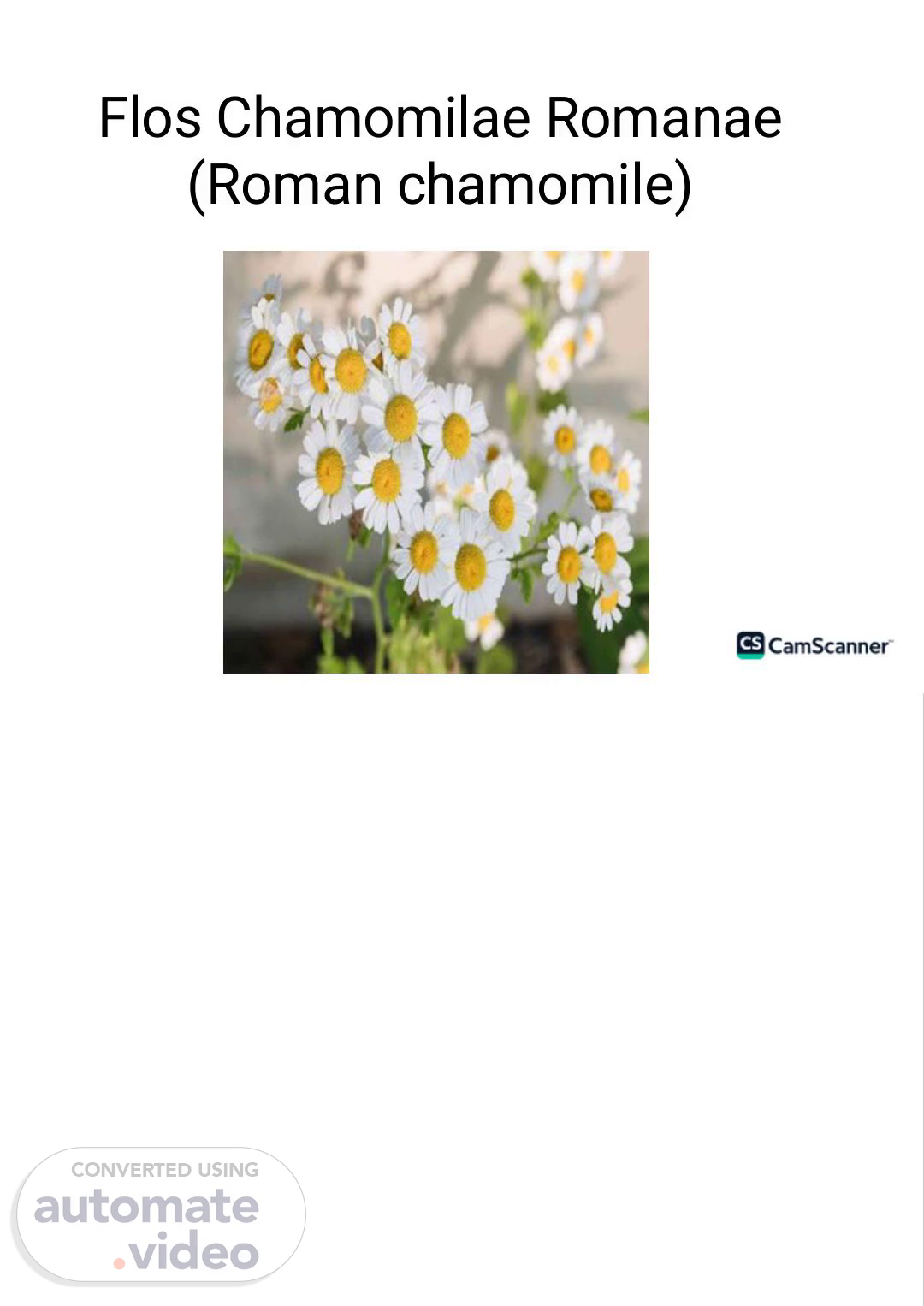
[Audio] Flos Chamomilae Romanae (Roman chamomile).
Scene 2 (6s)
[Audio] Introduction Chamomile is an aromatic annual medicinal herb widely used in pharmacy and herbal medicine. The official pharmaceutical species is Matricaria chamomilla (German Chamomile), while Chamaemelum nobile (Roman Chamomile) is used in aromatherapy. Historically, chamomile was used by ancient Egyptians, Greeks, and Romans for various therapeutic purposes. It is well-known for its calming effects, digestive support, and anti-inflammatory properties.�.
Scene 3 (41s)
[Audio] Botanical Origin� The dried flower heads of the cultivated double variety of Anthemis nobilis� L F. Compositae�.
Scene 4 (50s)
[Audio] Geographical Source (Where it grows)� Native Regions: Southern and Eastern Europe, North Africa, and Western Asia.� Major Global Producers:� 1. Egypt: One of the world's leading exporters of high-quality German Chamomile.� 2. Germany & Hungary: Known for technical cultivation and high-grade extracts.� 3. France: Specializes in Roman Chamomile for the perfume and cosmetic industries..
Scene 5 (1m 27s)
[Audio] POWDER� Color: Yellowish-green� Odor: Aromatic (Apple-like)� Taste: Faintly bitter� Texture: Fine, soft powder� Pollen Grains: Appear as small, spherical structures with a distinctive spiny outer wall (exine).� Glandular Trichomes: Multicellular, oval-shaped glands responsible for secreting the plant's essential oils.� Epidermal Cells: Characterized by wavy walls and the presence of papillae (small projections) and stomata. Structural Elements: Include covering trichomes (long hairs) spiral xylem vessels, and cluster crystals of calcium oxalate.
Scene 6 (2m 12s)
08 12 GScanner.
Scene 7 (2m 17s)
[Audio] THECHAMAZULENE (VOLATILEOIL)TEST� Objective:ToidentifythepresenceofChamazulene,theprimaryanti-inflammatorycompound.� Procedure:� 1.MixasmallamountofChamomilepowderwithanorganicsolvent(likeEtherorChloroform). 2.Filterthemixturetoobtainaclearextract.� 3.TreattheextractwithasolutionofSudanIIIorperformSteamDistillationofthepowder.� Observation/Result:TheappearanceofadistinctDeepBlueorBluish-Violetcolorintheoillayer�.
Scene 8 (2m 56s)
[Audio] 2. Active Constituents (Chemical Profile)� Chamomile contains over 120 secondary metabolites. The most important are:� Volatile Oils (0.5%-1.5%):� Chamazulene: Formed during steam distillation; gives the oil its intense deep blue color. It is a potent anti-inflammatory.� a-Bisabolol: Provides anti-irritant and antimicrobial properties.� Flavonoids:� Apigenin: The most significant constituent. It binds to GABA receptors in the brain, acting as a mild sedative.� Quercetin & Luteolin: Strong antioxidants�.
Scene 9 (3m 45s)
[Audio] Uses: Herbal Tea� Chamomile flowers are dried and used to make tea,� known for a mildcalming effect. This is one of the oldest traditional uses� Cosmetics & Personal Care The plant is included in soaps, creams, shampoos, and skin products for its soothing� properties and gentle scent.�.
Scene 10 (4m 4s)
[Audio] Traditional Medicine Chamomile has been traditionally used for:� Calming anxiety and improving sleep� Digestive comfort (bloating, indigestion)� Mild anti-inflammatory actions� Used historically for fevers, coughs, female disorders, and more in ancient� cultures.
Scene 11 (4m 24s)
[Audio] Modern Herbal Products� Chamomile appears in many supplements and herbal remedies such as teas, extracts, essential oils, tinctures, and capsules.�.
Scene 12 (4m 35s)
[Audio] 4.1 composite hair Spiny pollen grains� Pyrethrum Flower� T shaped hair.
Scene 13 (4m 43s)
[Audio] FLOS CAMOMILLAE Origin: it is the dried flower- heads of Matricaria chamomilla Linne Fam. Condition: fresh, entire Shape: hemispherical. Color: …………….. Odor: aromatic. Taste: bitter. Position: ---------------- Kind: racemose, capitulum Receptacle: The receptacle is conical in shape and hollow Axis: ------------------ Bracts: The involucre consist of 2 to 3 rows of overlapping bracts with membranous wings and hairy thick parts. Distribution of the flowers: The flower head consists of one whorl of ray florets in the margin and numerous tubular or disc florets in the center. Ray Florets Disc Florets Kind: mostly actinomorphic, Kind: zygomorphic, incomplete and pistilate . incomplete and hermaphrodite. Calyx : absent. Corolla: Insertion: sessile. Calyx: absent . Corolla:- - cohesion: sympetalous. Cohesion: sympetalous. - No. of petals: 5. - No of petals: 3 petals, united, the 29.
Scene 14 (6m 12s)
[Audio] middle is more protruding. - Insertion: epigenous. - Insertion: epigenous. - Peculiarities: yellow in color. Androecium:- - Peculiarities: It is strap- like ( ligulate) with a short tube at the Androecium : absent -Cohesion: synginesious united by their anthers Gynaecium : - No. staments: 5 Cohesion: syncarpous. - insertion: epipetalous - Insertion: inferior. - Filements: short and free - Ovary: small, ovoid, unilocular with one basal ovule. - Peculiarities: Gynaecium:- - Style: long thread- like and brown in colour. - Cohesion: syncarpous - stigma: bifid - No. of carpels: two carpels - Insertion: inferior - Style: long thread-like and brown in colour. stigma: bifid 30.
Scene 15 (7m 17s)
[Audio] The powder:- Color: The powder is yellowish brown to greenish yellow. Odour: agreeable aromatic odour . Taste: slight bitter taste. Test for identification: About 1 gm of the powder is extracted with 10 ml. chloroform. The filtered extract is concentrated, heated in a test tube in a water bath with 2 drops of Williamson's reagent (glacial acetic acid / phosphoric acid mixture (1: 1)) where a bluish green colour is produced. Compositae hair in T.V and S.V Fibrous layer of the anther Papillosed stigma Spiny pollen grains 31 Part of ovary wall showing clusters of ca.ox.
Scene 16 (8m 4s)
cs CamScan e.