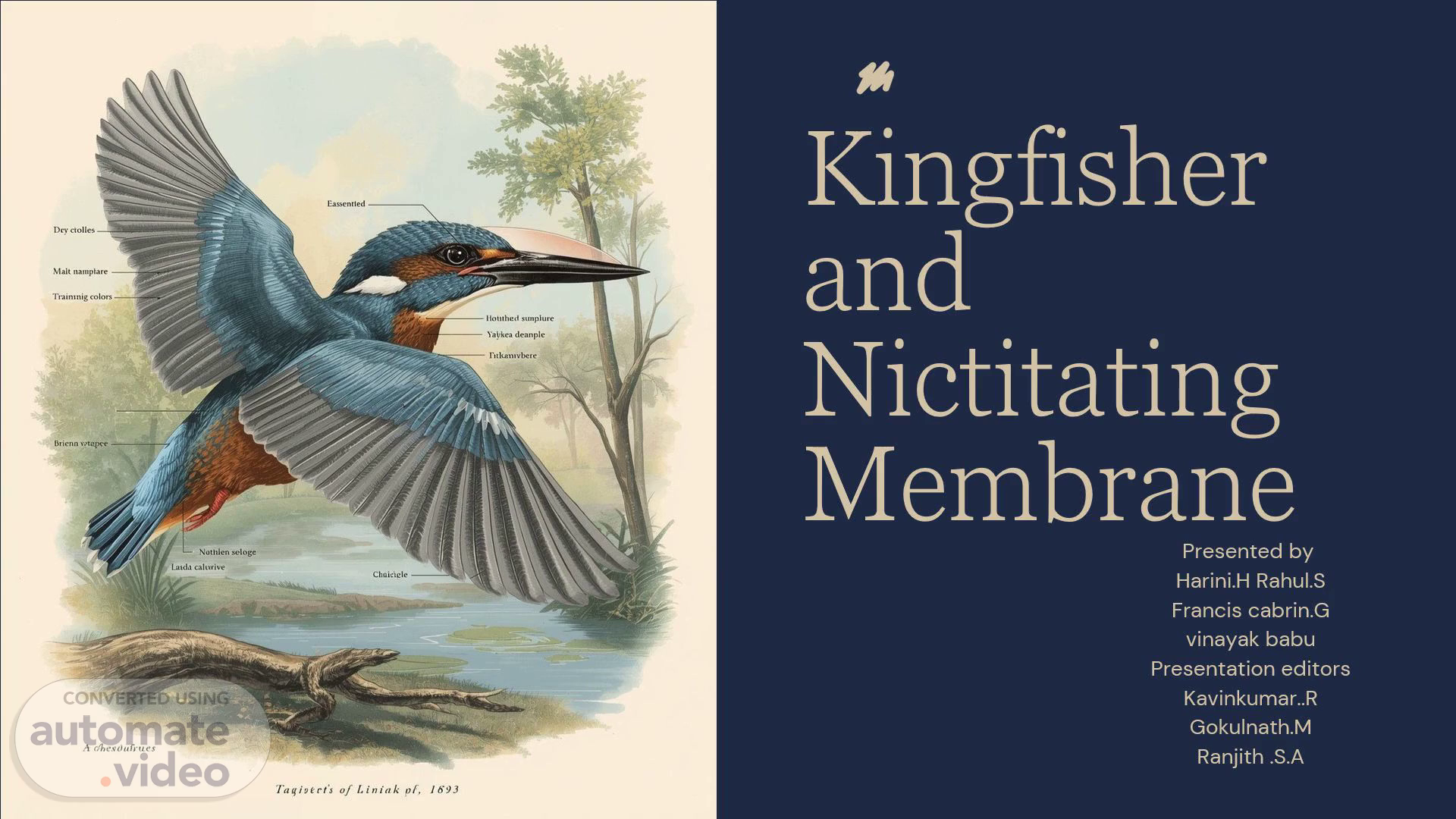
Scene 1 (0s)
[Audio] Hello and welcome to our presentation which will cover the Kingfisher bird's incredible diving abilities and the unique protection provided by its nictitating membrane. Our team, consisting of Harini, Rahul, Francis, Vinayak, Kavinkumar, Gokulnath, and Ranjith, has extensively researched and prepared a thorough overview of how this remarkable feature has influenced advancements in technology. We are eager to share our findings with you today. So, without delay, let's delve into the wonders of the Kingfisher bird and its nictitating membrane. Thank you for joining us..
Scene 2 (40s)
[Audio] The Kingfisher, a family of colorful diving birds found worldwide, particularly in tropical areas, has remarkable abilities. These birds use a distinctive hunting method of diving at high speeds to capture their prey. One may wonder how they protect their eyes from the water. This is where the "Nictitating Membrane" comes into play. This thin, translucent layer covers and safeguards the Kingfisher's eyes while diving. Without this membrane, the water could harm their vision, hindering their ability to catch prey. This presentation will explore the intriguing adaptation of the Kingfisher and how the "Nictitating Membrane" aids in their survival in their aquatic habitat. Let's dive in and discover more about this unique feature of these beautiful birds..
Scene 3 (1m 28s)
[Audio] Slide number 3 out of 16: Nictitating Membrane. The Nictitating Membrane plays a vital role in protecting the eye by acting as a barrier against potential threats like dust or debris. It is a transparent "third eyelid" found in certain species of birds, reptiles, and mammals. This membrane is located in the inner corner of the eye and can be voluntarily controlled by the animal, allowing for both protection and visibility..
Scene 4 (2m 0s)
[Audio] "Slide number 4 out of 16. The kingfisher bird has a unique adaptation for survival in nature - a sleek, transparent body and a nictitating membrane. This thin, transparent inner eyelid acts as a hydrodynamic lubricating fluid, allowing the bird to see clearly and move swiftly through water. This natural adaptation is essential for its hunting and survival, showcasing the wonders of evolution. However, this feature is not exclusive to kingfishers, as many other creatures also have similar adaptations to aid in their survival. Nature never ceases to amaze with its ability to adapt and overcome challenges. Let's appreciate the beauty and complexity of these adaptations as we continue to study and learn from the natural world. We can also look to nature for inspiration in our own designs and innovations. As we move forward, let's remember the kingfisher and its nictitating membrane, a testament to the incredible power of adaptation in nature..
Scene 5 (3m 9s)
[Audio] Slide number 5 out of 16 In this slide, we will focus on the impressive protection ability of the kingfisher during its high-speed dives. As seen in previous slides, the kingfisher is adept at maintaining clear vision underwater, but what sets it apart is its nictitating membrane. This thin, translucent membrane, also known as the third eyelid, acts as a shield during the kingfisher's dives, allowing it to see clearly and protecting its eyes from the impact of the water. The precision and coordination required for this process is astounding, enabling the kingfisher to successfully hunt and survive in its aquatic habitat. In addition to protection, the nictitating membrane also plays a crucial role in maintaining the kingfisher's overall eye health by keeping it moist and preventing debris and bacteria from entering. Let us take a moment to appreciate this remarkable adaptation and its role in the kingfisher's survival. Our exploration of the kingfisher's remarkable abilities will continue in the following slides..
Scene 6 (4m 15s)
[Audio] Today's presentation will discuss the remarkable vision of Kingfishers and their unique ability to reduce distortion underwater. We will also compare this ability with that of sharks. Kingfishers have a clear advantage when hunting in the underwater environment due to their Nictitating Membrane, a third eyelid that acts as a protective layer and allows for clear vision without distortion caused by water. This membrane also protects their eyes from potential threats in the water. On the other hand, sharks have a different method of vision that allows for clearer images in low light conditions, but they do not have the ability to reduce distortion underwater like Kingfishers. Studies have shown that Kingfishers have a higher visual acuity in water compared to sharks, giving them a significant advantage in spotting prey and navigating their environment. In conclusion, the vision of Kingfishers, with the help of their Nictitating Membrane, is not only remarkable, but also crucial for their survival underwater, setting them apart from other creatures such as sharks. We hope this comparison has shed some light on the unique vision of Kingfishers. Thank you for your attention, and we will now move on to our next topic..
Scene 7 (5m 29s)
[Audio] Slide 7 delves into the intriguing world of Kingfishers and the significance of the nictitating membrane in their vision. This thin, see-through third eyelid aids these birds in seeing clearly while underwater. But how exactly does it function? Kingfishers are renowned for their impressive fishing skills, diving into the water at high speeds to catch their prey. However, the bending of light in water can distort their vision, making it challenging to accurately spot their target. This is where the nictitating membrane comes in. By covering the eye and reducing the amount of light entering, the membrane enhances clarity and reduces distortion for the Kingfisher. This allows them to better perceive their surroundings and accurately locate their prey, making them more proficient hunters. Additionally, the nictitating membrane serves as a barrier, safeguarding the Kingfisher's eyes from potential damage while diving. This further highlights the important role of the membrane in the bird's survival. This is just one example of nature equipping different species with unique adaptations, enabling them to thrive in their respective habitats. Moving on to our next slide, we will explore another fascinating aspect of these remarkable birds. Stay tuned for more insights on the world of Kingfishers..
Scene 8 (6m 54s)
[Audio] Slide 8 presents our research on the nictitating membrane, which has been greatly influenced by human studies. Through the use of advanced techniques, such as high-speed videography and microscopy, we have uncovered the dynamic behavior and optical properties of this intriguing adaptation. These findings have significantly improved our knowledge of the nictitating membrane and its specific function in nature. With each study, our understanding of the complexities of this extraordinary feature continues to deepen..
Scene 9 (7m 26s)
[Audio] We are now on slide number 9 out of 16. Our presentation focuses on the world of kingfishers and their unique attributes. At this point, we will discuss the membrane structure and optical characteristics. The cross-section view reveals the delicate and intricate design of the membrane, which plays a crucial role in the kingfisher's ability to see underwater. One key feature that sets the kingfisher apart from other birds is its nictitating membrane. This third eyelid, which is thin and transparent, not only protects the eye, but also enables the kingfisher to maintain clear vision while diving at high speeds. Let's examine the anatomy of this remarkable membrane and how it aids in the kingfisher's hunting success. Along with its unique structure, the optical measurements of the nictitating membrane have uncovered interesting information. These measurements have shown that the membrane can adjust and regulate the amount of light that enters the eye, allowing the kingfisher to have clear vision both in and out of the water. In summary, the nictitating membrane plays a crucial role in the kingfisher's survival and success in the water. Now that we have a better understanding of its structure and functions, we will move on to our next set of findings..
Scene 10 (8m 49s)
[Audio] Slide number 10 delves into the fascinating world of interdisciplinary research on the Kingfisher and its nictitating membrane. This small but crucial feature, also known as the third eyelid, has captured the interest and curiosity of scientists across various fields. Collaboration across biology, physics, and materials science is necessary in order to study this unique structure. Bringing together experts with diverse perspectives allows for a deeper understanding of the nictitating membrane and its functions. This interdisciplinary research not only reveals the mysteries of the membrane, but also drives innovation in various fields and expands our knowledge about its properties and functions. This highlights the complexity and beauty of nature, and emphasizes the importance of collaboration in scientific discoveries. As we continue our journey to uncover the secrets of the nictitating membrane, we are reminded of the power of working together and the endless possibilities that can arise from interdisciplinary research..
Scene 11 (10m 0s)
[Audio] Slide number 11 out of 16 is dedicated to exploring bioinspiration from nature. We will discuss the amazing ways in which nature has influenced technology. One example is the underwater camera lenses, modeled after the eyes of the Kingfisher bird. The lenses have a nictitating membrane, which reduces glare and improves vision in murky waters. This technology has greatly improved underwater photography and is used in industries such as marine research and videography. The nictitating membrane's ability to filter out certain wavelengths of light also inspired the development of smart goggles and diving masks for enhanced vision in different environments. In the field of high-speed aircraft and drones, lenses with a protective layer, similar to the nictitating membrane, have greatly improved aerodynamics and reduced drag. Nature's protective coatings found on animals' eyes have also inspired the development of optical coatings, reducing light reflection and glare in modern lenses. The Kingfisher bird's nictitating membrane has been a valuable source of inspiration for technology advancements, with endless applications from underwater photography to high-speed flight. This overview aims to spark interest in the field of bioinspiration from nature..
Scene 12 (11m 24s)
[Audio] Slide number 12 of our presentation on Kingfisher and Nictitating Membrane discusses the technological advancements inspired by this adaptation. One such innovation is the underwater camera lens, designed to mimic the Kingfisher's nictitating membrane, providing enhanced clarity and a wider range of focus. Additionally, we have developed smart goggles using similar materials, revolutionizing the way we see and navigate through different environments. This is a prime example of the adaptability and ingenuity found in nature. Our team of presentation editors have worked diligently to bring you this information and we hope it has been both informative and inspiring. The following slides will further explore the incredible influence of the Kingfisher's nictitating membrane..
Scene 13 (12m 14s)
[Audio] Today, we will be discussing the nictitating membrane of the kingfisher and its impact on innovative technologies in the field of optics. This unique third eyelid serves as a transparent and protective layer for the kingfisher's eyes, allowing for clear vision while diving and protecting them from high-speed dives. Inspired by this design, scientists and engineers have developed advanced technologies such as underwater cameras, smart goggles, and high-speed aircraft lenses. These inventions have greatly improved optical clarity and protection, utilizing the properties of the nictitating membrane. For example, underwater cameras now have a similar third eyelid to protect their lenses from water droplets, ensuring clear images. Similarly, smart goggles use this technology to provide users with a clear and uninterrupted view while swimming or diving. The nictitating membrane has also inspired high-speed aircraft lenses, aiding pilots in maintaining visual clarity and protecting their eyes at high speeds and altitudes. This natural design has proven to be a valuable source of innovation and highlights the possibilities of bioinspiration. Thank you for your attention on slide number 13, and in the remaining slides, we will continue to explore the world of bioinspired applications..
Scene 14 (13m 41s)
[Audio] Slide 14 of our presentation, "Kingfisher and Nictitating Membrane," discusses underwater camera lenses and their use of the nictitating membrane found in Kingfisher birds. One challenge in clear underwater imaging is the difference in refractive properties between air and water. The nictitating membrane, found in the eyes of Kingfisher birds, serves a protective role. Similarly, underwater camera lenses use optical coatings to enhance clarity and reduce distortion, minimizing refraction and maintaining the correct focal length for sharper, more accurate images. This advanced technology has allowed for stunning photographs and videos of marine life without compromising quality, a significant breakthrough in underwater photography and deep-sea exploration. In addition to mimicking the nictitating membrane, these coatings also provide protection against water damage and scratches, making them essential for underwater photographers and videographers. The nictitating membrane of Kingfisher birds has inspired the development of underwater camera lenses with similar properties, revolutionizing underwater photography and giving us a new perspective on the ocean's hidden wonders. In conclusion, the use of advanced underwater camera lenses is a testament to nature's power and the potential of technology..
Scene 15 (15m 10s)
[Audio] Smart goggles and high-speed lenses have revolutionized the field of optics and enhanced visibility in unprecedented ways. These innovative technologies, equipped with advanced sensors and technology, are not just regular eyewear but provide augmented reality and real-time data overlay. Their enhanced visibility, by filtering out unwanted light and improving contrast in low light situations, is particularly valuable in sports, gaming, military, and industrial applications. High-speed lenses, designed with precision and speed in mind, allow for ultra-fast focusing and quick image capture in fast-paced environments, making them a popular choice for professional photographers and videographers. These lenses are distinct from traditional lenses in their optical comparison, mimicking the structure and function of birds' and reptiles' nictitating membrane for seamless focusing. In conclusion, the amalgamation of smart goggles and high-speed lenses has pushed the boundaries of visual experience and proven their membrane-inspired design. Thank you for joining us for this presentation..
Scene 16 (16m 25s)
[Audio] Thank you for joining us, ladies and gentlemen, for this presentation on the topic of Kingfisher and Nictitating Membrane. We hope you have found it informative and enlightening. As we reach the final slide, we would like to express our gratitude for your attention and engagement throughout. We hope our exploration of the nictitating membrane's anatomy and function, as well as the different species and behaviors of kingfishers, has sparked further interest in this fascinating topic. Through visuals and descriptions, we have delved into the role of the nictitating membrane in the kingfisher's hunting and survival, as well as its important place in various ecosystems. We hope this presentation has shed light on the amazing adaptations and abilities of the kingfisher, and how its nictitating membrane is crucial to its success. We would like to thank Harini.H, Rahul.S, Francis cabrin.G, Vinayak babu, Kavinkumar.R, Gokulnath.M, and Ranjith .S A for their contributions and hard work in creating this presentation. Thank you once again for your attention and participation. We hope you have enjoyed this journey into the world of the kingfisher and its fascinating nictitating membrane. Thank you and have a wonderful day..