Scene 1 (0s)
[Audio] The left inferior frontal gyrus (LIFG), also known as Broca's area, is a region located on the surface of the brain that plays a crucial role in language processing. The LIFG is situated at the junction of the frontal lobe and the temporal lobe, near the primary motor cortex. This region is responsible for speech production, including articulation, phonology, and syntax. It is also involved in other cognitive processes such as memory, attention, and decision-making. The LIFG is activated when individuals engage in complex tasks that require linguistic skills, such as reading, writing, and conversation..
Scene 2 (44s)
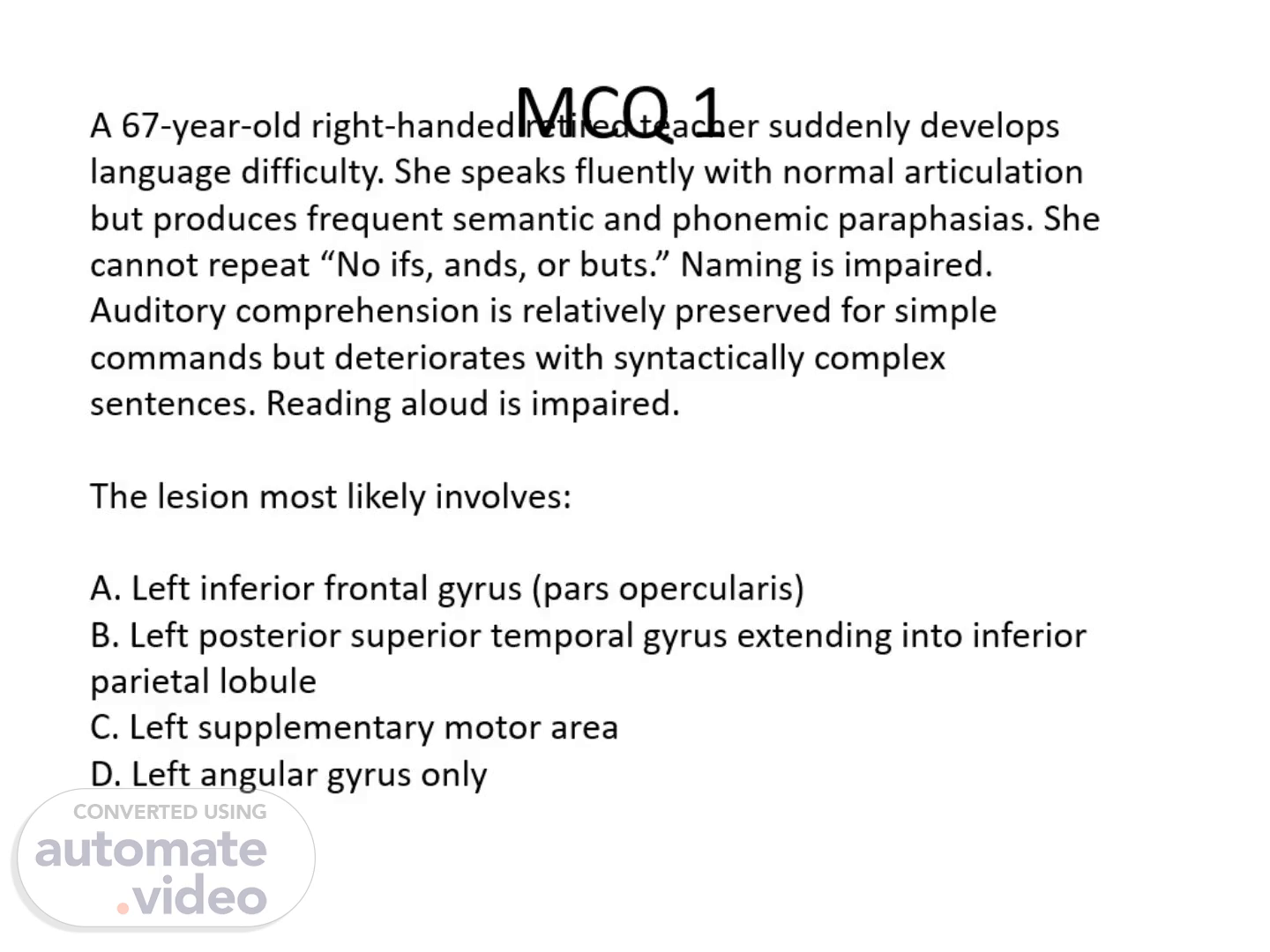
[Audio] Answer 1 Explanation: This is Wernicke aphasia. Fluent speech with paraphasias, impaired repetition, impaired naming, and impaired comprehension for complex syntax localize to the dominant posterior superior temporal gyrus extending into the inferior parietal region. Why others are incorrect: A. Broca area → non-fluent aphasia. C. SMA → transcortical motor aphasia. D. Angular gyrus alone more typically causes alexia/agraphia and Gerstmann syndrome. References: Mesulam MM. Principles of Behavioral and Cognitive Neurology, 3rd ed. Bradley's Neurology in Clinical Practice, 9th ed..
Scene 3 (1m 35s)
[Audio] A person with a severe case of Broca's aphasia would be unable to speak at all, while a person with apraxia of speech would have difficulty articulating words but could still speak. In contrast, a person with transcortical motor aphasia would be able to speak but would struggle with finding the right words and organizing them into coherent sentences. Meanwhile, a person with aphonia would not be able to produce any sound whatsoever. All four conditions are relatively rare and can be caused by various factors such as brain injury, stroke, or genetic disorders. The symptoms of these conditions can vary greatly depending on the individual and the specific circumstances surrounding their condition.".
Scene 4 (2m 22s)
[Audio] The patient has a history of stroke, which may have affected the frontal lobe. Transcortical motor aphasia is characterized by preserved comprehension and writing but significantly impaired spontaneous speech. This condition is often associated with damage to the frontal lobe, particularly the prefrontal cortex. The frontal lobe plays a crucial role in initiating speech, and its disruption can lead to difficulties in articulating words and forming coherent sentences. In this case, the patient's ability to comprehend written language and write their own thoughts remains intact, but their spontaneous speech is severely impaired. The perisylvian language network, which includes areas such as Broca's area and Wernicke's area, is also spared. This suggests that the patient's language abilities are not entirely disrupted, despite the significant impairment of spontaneous speech. The patient's symptoms align with those of transcortical motor aphasia, which is typically characterized by preserved comprehension and writing, but significantly impaired spontaneous speech. The frontal lobe's role in initiating speech makes it a likely candidate for damage, leading to the observed symptoms. The fact that the perisylvian language network is spared further supports this diagnosis. References: Mesulam MM. Principles of Behavioral and Cognitive Neurology, 3rd ed. Adams & Victor's Principles of Neurology, 12th ed. ".
Scene 5 (4m 2s)
[Audio] The patient was shown a pen and was able to identify it amongst multiple objects, but was unable to name it. The patient had semantic memory impairments, which referred to the loss of knowledge about word meanings and concepts. However, the patient was able to recognize the pen visually. The patient also experienced visual agnosia, which referred to the inability to recognize objects despite having intact vision. But the patient was able to identify the pen despite experiencing visual agnosia. Furthermore, the patient suffered from lexical retrieval failures, also known as anomia, where the patient was unable to retrieve words from memory. The patient was able to identify the pen, but was unable to name it. Therefore, the correct classification for this deficit is lexical retrieval failure, also known as anomia. This is important to keep in mind when assessing and treating patients with aphasia, as it can help guide our interventions and improve their language abilities..
Scene 6 (5m 10s)
[Audio] ## Step 1: Understand the context The patient's response to a question is marked as C, indicating anomia, a lexical retrieval failure. ## Step 2: Identify the symptoms The patient has preserved semantic knowledge but is unable to retrieve the correct lexical label for a word or object. ## Step 3: Consider the implications This symptom is common in patients with brain lesions and is crucial for localizing these lesions. ## Step 4: Provide additional resources For further reading, Blumenfeld's Neuroanatomy through Clinical Cases and Mesulam's Principles of Behavioral and Cognitive Neurology are recommended. ## Step 5: Move forward Continue to the next slide for the next case study..
Scene 7 (5m 26s)
[Audio] Here is the rewritten text: The patient presents with fluent spontaneous speech, excellent repetition, and preserved grammar, but is unable to comprehend spoken language and only echoes questions. The most likely vascular territory involved in this case is the inferior division of the left MCA, sparing the perisylvian cortex. This option is the best because the other options do not match the symptoms described..
Scene 8 (5m 57s)
[Audio] The character of a person can be described as being very good at what they do, but also having some flaws that make them less effective than others. This is true for many people who are highly skilled in their profession. However, it's not just about skills; there are other factors that contribute to a person's overall effectiveness. One such factor is their ability to work well with others. A person may have exceptional skills, but if they cannot collaborate effectively with colleagues, friends, or family members, then their abilities will be hindered by poor communication and teamwork. Another factor is a person's emotional intelligence. Emotional intelligence refers to a person's ability to recognize and understand emotions in themselves and others. People with high emotional intelligence tend to be more empathetic and better able to manage conflicts. They are also more likely to be self-aware, which means they have a clear understanding of their own strengths and weaknesses. Self-awareness is essential for personal growth and development, as it allows individuals to identify areas where they need improvement and work on those areas. A third factor is a person's resilience. Resilience refers to a person's ability to bounce back from adversity. People with high resilience tend to be more optimistic and better equipped to handle stress and pressure. They are also more likely to learn from their mistakes and use those experiences to improve themselves. Resilience is an important quality for anyone looking to succeed in life, whether personally or professionally. Finally, a person's values and principles guide their behavior and decision-making. Values and principles are the foundation upon which a person builds their relationships and interactions with others. When a person's values and principles align with their actions, they are more likely to achieve success and happiness. On the other hand, when values and principles conflict with one's actions, it can lead to feelings of guilt, shame, and regret. Therefore, it is essential for individuals to have a clear understanding of their values and principles and to live according to them. In conclusion, a person's effectiveness is influenced by multiple factors beyond just their skills. While skills are certainly important, they are not the only consideration. A person's ability to work well with others, their emotional intelligence, their resilience, and their values and principles all play a significant role in determining their overall effectiveness. By focusing on these aspects, individuals can improve their performance and achieve greater success in life.".
Scene 9 (8m 49s)
[Audio] The 61-year-old woman had been experiencing symptoms since her stroke. She had difficulty speaking and understanding spoken words. Her doctor ordered her to undergo a series of tests to determine the extent of her damage. The first test was the Boston Naming Test, which involved naming objects from a list of pictures. She struggled to name many of the objects, indicating that her language skills were severely impaired. The second test was the Token Test, which involved giving her a set of tokens and asking her to follow simple commands involving concepts and sequences. She found it difficult to follow some of the commands, indicating that her auditory attention was also impaired. The third test was the Ideomotor Praxis Examination, which tested her ability to perform tasks such as drawing shapes and writing letters. She performed poorly on these tasks, indicating that her motor skills were also affected. The results of all three tests were used to determine the extent of her damage. The doctors concluded that she had suffered significant damage to her brain due to the stroke. The damage was located in the left posterior temporal cortex, which is responsible for language processing. The doctors then decided to conduct further testing to determine the specific location of the damage within the left posterior temporal cortex. They conducted a series of tests using different stimuli, including visual and auditory cues. These tests helped to pinpoint the exact location of the damage. The doctors then used the results of these additional tests to develop a treatment plan for the patient. The treatment plan included physical therapy, occupational therapy, and speech therapy. The goal of the treatment plan was to help the patient regain her lost functions and improve her overall quality of life. The patient underwent physical therapy, occupational therapy, and speech therapy. She made progress in regaining her lost functions, but she still experienced difficulties with communication. Despite the efforts of the medical team, the patient continued to struggle with language comprehension and production. The patient's condition remained stable over time, and she continued to experience difficulties with communication. She never fully regained her pre-stroke language abilities. The patient's case highlights the importance of early intervention and rehabilitation in the event of a stroke. Early intervention can significantly impact the outcome of a stroke victim's recovery. The patient's story serves as a reminder that every individual's response to a stroke is unique, and there is no one-size-fits-all approach to treatment. Each person's situation requires careful consideration and tailored treatment plans. The patient's case demonstrates the complexity of language processing and the challenges of treating individuals with aphasia. Aphasia is a complex condition that affects both language comprehension and production. It requires a comprehensive treatment plan that addresses multiple aspects of cognitive function. Aphasia can affect anyone, regardless of age or background. It is a common consequence of stroke, traumatic brain injury, or other types of brain damage. Aphasia can cause significant distress and impairment in daily life. It can affect relationships, work, and overall well-being. Early detection and intervention are critical in managing aphasia. Early diagnosis can lead to more effective treatment and improved outcomes. Aphasia can be challenging to diagnose, especially in its early stages. Diagnosing aphasia often requires a combination of clinical evaluation, imaging studies, and behavioral assessments. Diagnosis typically involves assessing language comprehension and production, as well as evaluating cognitive function. Aphasia can be caused by various factors, including stroke, traumatic brain injury, or neurodegenerative diseases. Causes of aphasia can vary widely depending on the underlying condition. Aphasia can result in significant changes in behavior and.
Scene 10 (13m 14s)
[Audio] The Token Test is used to evaluate the patient's ability to comprehend increasingly complex verbal commands. This test is useful for detecting subtle receptive aphasia, which can be difficult to diagnose because it often involves a lack of attention to the task at hand. The test minimizes attentional confounders by presenting the commands in a way that requires the patient to focus on the meaning of the words rather than their literal meaning. The test consists of two parts: the first part presents simple verbal commands such as "pick up the pen", while the second part presents more complex commands such as "point out the red car". The patient must respond correctly to both types of commands in order to pass the test. The Token Test has been widely used in clinical settings to assess patients with suspected receptive aphasia. It is also useful for evaluating the effectiveness of treatments for this condition. References: DeJong's The Neurologic Examination, 8th ed., Mesulam MM. Principles of Behavioral and Cognitive Neurology, 3rd ed..