Microsoft PowerPoint - Digital-Wellness-for-Teenagers [Compatibility Mode]
Scene 1 (0s)
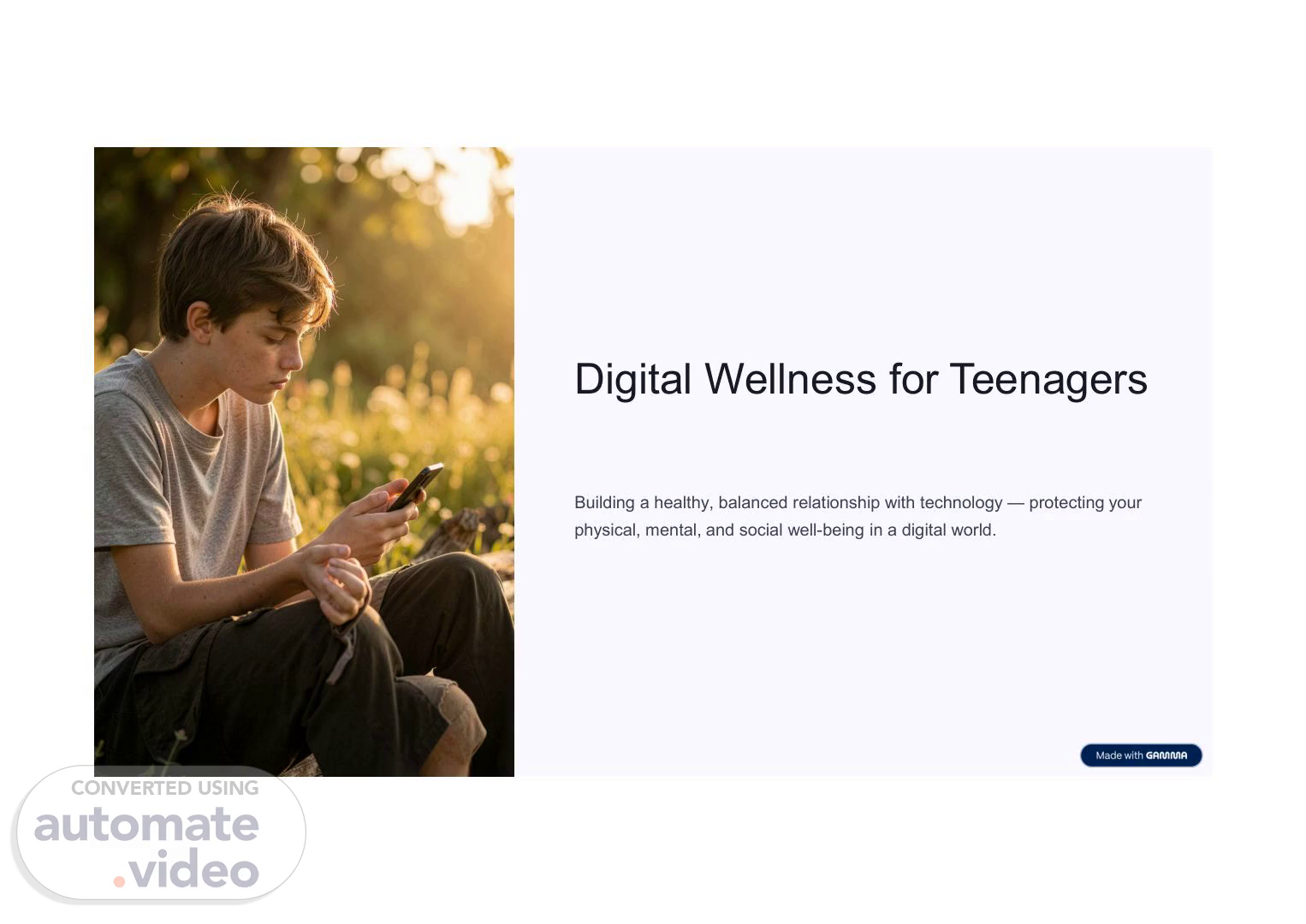
[Audio] Digital Wellness for Teenagers Building a healthy, balanced relationship with technology — protecting your physical, mental, and social well-being in a digital world..
Scene 2 (10s)
[Audio] What is Digital Wellness? Digital wellness means using technology in a healthy, balanced, and responsible way — not just limiting screen time, but using tech intentionally to protect mental health and well-being. 🧠 Mental Physical 🧠 Mental Physical Protects from stress and anxiety Prevents excessive screen time 🤝 Social Promotes safe, respectful behavior.
Scene 3 (36s)
[Audio] Why Digital Wellness Matters Prevents Excessive Screen Time Improves Focus & Performance Reduces overuse and digital fatigue Better academic outcomes with balanced use Protects Mental Health Encourages Healthy Sleep Reduces stress, anxiety, and negative comparisons Screen-free wind-down improves rest quality.
Scene 4 (1m 0s)
[Audio] HEALTHY HABITS Manage Your Screen Time Set Daily Limits Limit non-school screen time to ~2 hours/day for entertainment apps Take Regular Breaks 5–10 minute break every hour 20-20-20 Rule Every 20 minutes, look at something 20 feet away for 20 seconds.
Scene 5 (1m 20s)
[Audio] Sleep & Online Safety Prioritize Sleep Avoid screens at least 1 hour before bedtime. Keep devices away from the bed. Use "Do Not Disturb" at night. Disturb" at night. Stay Safe Online Never share personal info with strangers. Use strong passwords. Think before posting..
Scene 6 (1m 42s)
[Audio] Real-Life Connections & Mental Health 🤝 Stay Connected 🧠 Protect Your Mind Spend time with family and Follow positive and educational friends. Participate in sports, content. Avoid comparing friends. Participate in sports, content. Avoid comparing hobbies, and outdoor activities. yourself to others on social media. Seek Support If online experiences cause stress, reach out to trusted adults — getting help is strength, not weakness..
Scene 7 (2m 21s)
[Audio] What Digital Wellness Includes Mindful Use Notice how apps affect your mood; pause when something feels negative Intentional Control Turn off notifications, unfollow harmful content, set app limits Balance ~2 hrs/day non-school screen time; prioritize movement, hobbies, friendships, rest Balance ~2 hrs/day non-school screen time; prioritize movement, hobbies, friendships, rest Sleep Protection No screens 1 hour before bed; use "Do Not Disturb" at night Thinking Skills Challenge "thinking traps" — ask: Is this 100% true? What's the evidence? Support Reach out to trusted adults when online feels overwhelming.
Scene 8 (3m 12s)
[Audio] Quick Tips for Teens 1 2 Be Conscious Curate Your Feed Track which activities feel positive vs. draining Follow inspiring accounts; mute negative words like "ugly" or "fake" 3 4 Create Tech-Free Zones Plan for Tough Moments No devices at meals, no screens in bedrooms If something scares or upsets you, pause and talk to someone you trust Remember: Think before you click. Balance screen time with play time. Be kind online. Sleep well, live well. Use technology to learn and create..
Scene 9 (3m 50s)
[Audio] FOR PARENTS Supporting Your Teen Talk Without Judging Discuss how tech affects mood openly and honestly Model Healthy Habits Start with small changes — your behavior sets the tone Keep Communication Open Support and protect, not punish.
Scene 10 (4m 6s)
[Audio] The Digital Wellness Pledge "I will use technology wisely, balance my online and offline life, stay safe on the internet, and use digital tools to learn, create, and grow." Control Technology Before Technology Controls You! ⚖ Find Balance Be Intentional Online and offline life in harmony Shift from passive to proactive use aligned with your values Grow & Create Use digital tools to learn and thrive.
Scene 11 (4m 36s)
[Audio] Digital Wellness & Managing FOMO A classroom discussion guide for middle and high school students — exploring how social media shapes emotions, relationships, and selfesteem, and what we can do about it. CLASSROOM DISCUSSION DIGITAL WELLBEING.
Scene 12 (4m 53s)
[Audio] Icebreaker: Let's Be Honest 5 minutes. Ask students to respond anonymously with slips of paper or a quick show of hands. No judgment — just honesty. 1 2 Ever felt left out online? How often do you check your phone? your phone? How many times a day do you Have you seen friends' posts reach for it without thinking? and felt excluded or less-than? 3 Stayed up late scrolling? How many times has social media kept you awake past your bedtime?.
Scene 13 (5m 29s)
[Audio] Discussion Starter: The Big Question "Does social media connect us more — or make us feel left out more?" Write this on the board and divide the class into two groups. Give each side 3–5 minutes to prepare their arguments before sharing with the class. Group A Group B Social media has more benefits Social media creates more problems Staying connected with distant friends FOMO and social comparison Access to information and communities Screen time replacing real connection Creative expression and inspiration Impact on mood and self-esteem.
Scene 14 (6m 8s)
[Audio] REAL-LIFE SCENARIO What Would You Do? "A student sees photos of classmates at a party they weren't invited to. They feel sad and keep checking social media all evening." 1 What emotions might this student feel? 2 Is social media showing the full picture? 3 What could they do instead of scrolling? 4 Have you seen this happen among friends?.
Scene 15 (6m 32s)
[Audio] Understanding FOMO Fear of Missing Out is the anxious feeling that others are having rewarding experiences you're not part of — and social media makes it constant. The Comparison Trap Edited Reality Impact on Self-Esteem We compare our behind-the-scenes to Filtered photos and curated posts create Constant exposure to "perfect" lives can everyone else's highlight reel — an unfair an unrealistic standard. Nobody posts quietly chip away at how we feel about comparison by design. their bad days. ourselves. Key message for students: People usually post their best moments — not their everyday reality..
Scene 16 (7m 15s)
[Audio] Digital Wellness Reflection Before talking about habits, let's take an honest look at our own screen use. Ask students to reflect quietly on these questions: How much screen time ⏰ Which apps consume Refreshed or exhausted How much screen time do you have daily? ⏰ Which apps consume most of your time? Refreshed or exhausted after scrolling? Check your phone's screen time Be honest. Which apps do you How does social media actually report — the number might surprise open without even thinking? make you feel when you close the you. app?.
Scene 17 (7m 51s)
[Audio] Healthy vs. Unhealthy Digital Habits Use this as a class discussion tool — ask students which habits they recognize in themselves and which ones they want to work on. ✅ Healthy Digital Habits ⚠ Unhealthy Digital Habits Taking intentional screen breaks Endless, mindless scrolling Taking intentional screen breaks Endless, mindless scrolling Charging phone outside the bedroom Late-night screen use before sleep Prioritizing face-to-face conversations Ignoring people nearby for your phone Following positive, uplifting content Constant comparison with others online Turning off non-essential notifications Checking phone immediately upon waking.
Scene 18 (8m 33s)
[Audio] Group Activity: FOMO Solutions In small groups, students brainstorm practical ways to reduce FOMO. Encourage them to think of solutions they'd actually try — not just ideal answers. ⏱ Set Time Limits Mute Notifications Use app timers or schedule specific "phone-free" hours Turn off alerts that pull you back in without a reason. each day. each day. Invest in Hobbies Practice Gratitude Sports, music, art — real-world activities that build confidence. Focus on what you have, not what you're missing out on. Remember: It's a Highlight Reel Go Offline Together Plan phone-free time with family and friends in person. Social media shows the best moments — not the full story..
Scene 19 (9m 28s)
[Audio] Exit Ticket Last 2 minutes of class. Have every student complete this before leaving. Collect them to gauge understanding — or let students keep them as a personal commitment. One thing I learned about digital wellness… 1 What surprised you or stuck with you from today's discussion? One habit I will try this week… 2 Be specific. What's one small change you'll actually make? One way I can manage FOMO… 3 What strategy from today feels most doable for you?.
Scene 20 (10m 4s)
[Audio] Key Takeaways for Your Students Close the discussion by reinforcing these core ideas — and remind students that digital wellness is a practice, not a perfect state. Social media is a tool — you control how it's used. Intentional use feels very different from passive scrolling. Comparison is the thief of joy. What you see online is a curated version of someone's life, not the whole truth. Small changes add up to big shifts. One habit, one boundary, one screen-free hour at a time. Teacher tip: Consider revisiting exit tickets in a week to check in on progress and keep the conversation going..
Scene 21 (10m 47s)
[Audio] Navigating Social Media Influence & Digital Wellness for Teens Question Set 1. Social media can lead to negative experiences such as cyberbullying and ______. 2. Understanding the difference between online personas and ______ is crucial for teens. 3. Setting specific time frames for social media use can help reduce ______. 4. Teens should be aware of the potential risks associated with ______ personal information online. 5. Practicing mindfulness can help teens engage in activities that foster a sense of 5. Practicing mindfulness can help teens engage in activities that foster a sense of ______. 6. Which of these is a good way to practice digital wellness?Ignoring friends who want to meet up. Spending all day on social media. Setting time limits for online use. Following accounts that make you feel bad..
Scene 22 (11m 54s)
[Audio] 7. What does 'curate your feed' mean for social media?Sharing all your personal thoughts online. Choosing what content you want to see. Making your profile look very neat. Posting many pictures of your food. 8. A teen feels stressed after seeing many perfect posts. What mindfulness technique 8. A teen feels stressed after seeing many perfect posts. What mindfulness technique could help?Posting more perfect pictures. Taking a break to meditate. Comparing their life to others. Spending more time online..
Scene 23 (12m 25s)
[Audio] 9. Why are face-to-face talks important for teens, even with social media?They teach teens how to code. They help teens learn to type faster. They make online games more fun. They build real social skills. 10. A teen sees an ad for a 'magic' drink online. What should they do first?Post a picture of the ad. picture of the ad. Buy the drink right away. Check if the ad is real. Share the ad with friends..
Scene 24 (12m 56s)
[Audio] Topic:Navigating Social Media Influence & Digital Wellness for Teens Name: Anusuya V Hiremath Palce : Dharwad School: J S S Kannada Medium School,Vidyagiri ,Dharwad Designation: School Teacher Phone Number: 9916343280 Profession: Educator in Computer Science, Mathematics.