Scene 1 (0s)
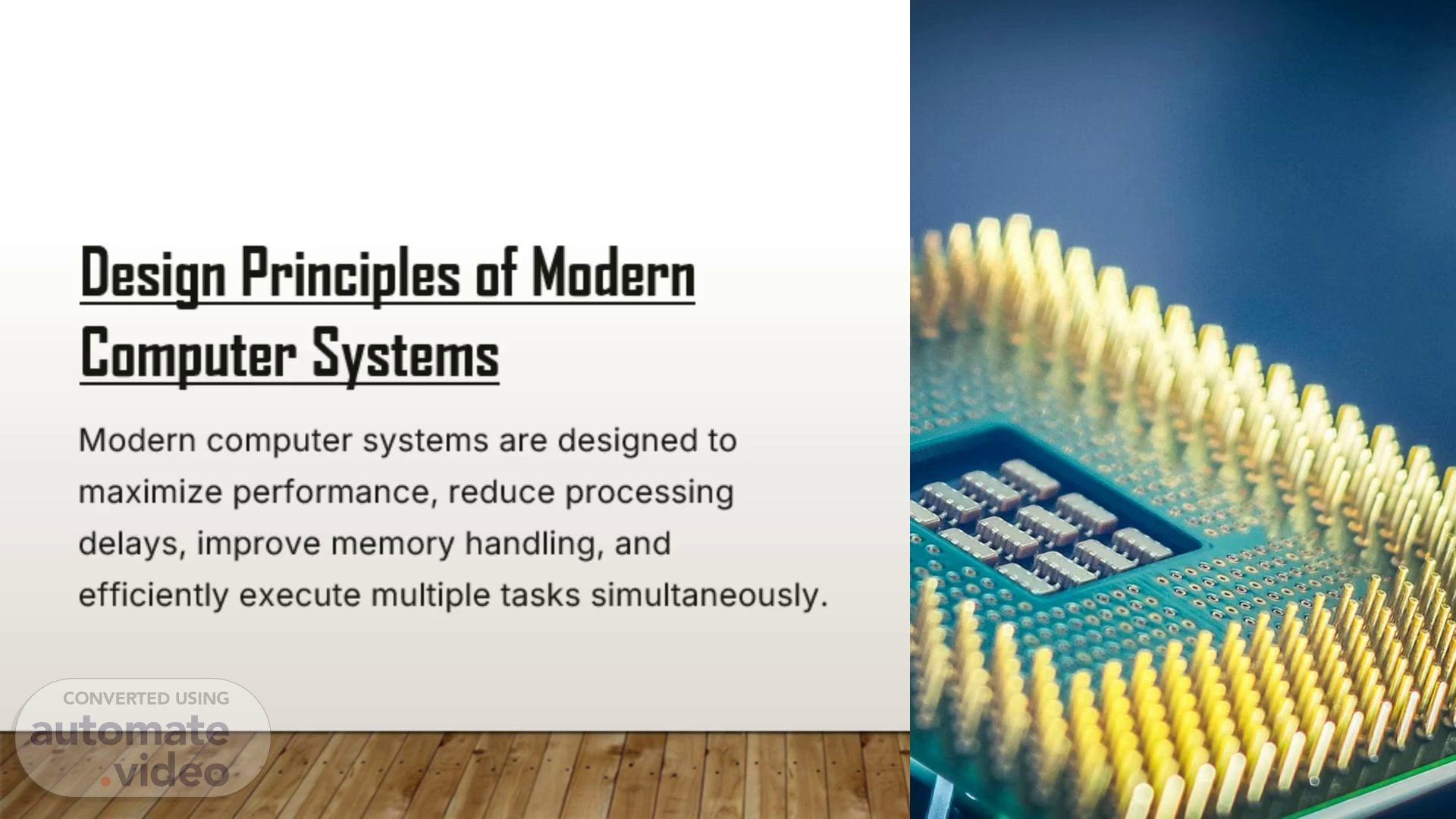
[Audio] Good morning everyone .It`s me Pranit. Today I am going to present on the topic 'Design Principles of Modern Computer Systems.' Modern computer systems are designed to improve speed, efficiency, and overall performance. In this presentation, I will discuss important principles such as efficient memory utilization, cache memory, input/output improvement, pipelining, parallel processing, and multi-core systems..
Scene 2 (27s)
[Audio] First, let us understand what a modern computer system means. A modern computer system is designed to handle high-speed processing, multitasking, and efficient resource management. As computer engineers, our focus is not only on making systems faster but also reliable, power-efficient, and scalable. The main goal of modern system design is to process more data in less time while using resources efficiently..
Scene 3 (57s)
[Audio] This slide explains efficient memory utilization. Memory utilization means using memory resources effectively without wasting space or slowing down performance. If memory is managed properly, programs execute faster and multitasking becomes smoother. Modern systems use techniques such as paging, segmentation, virtual memory, and memory optimization to improve performance. For example, when we open many applications at the same time, proper memory management prevents the system from lagging..
Scene 4 (1m 33s)
[Audio] Now I will discuss cache memory. Cache memory is a high-speed memory placed between the CPU and RAM. Its main purpose is to reduce the time required to access frequently used data. There are different cache levels: L1 cache is the fastest and smallest, located closest to the processor core. L2 cache is larger but slightly slower. L3 cache is shared among multiple cores and has a larger capacity. This layered system improves processor speed and reduces waiting time..
Scene 5 (2m 6s)
[Audio] This slide explains memory hierarchy. Modern computer systems organize memory in levels such as registers, cache memory, RAM, and storage devices like SSD or hard disk. The closer memory is to the CPU, the faster but smaller it becomes. This hierarchy helps achieve a balance between speed, storage capacity, and cost. For example, frequently used data is stored in cache so that applications open faster.
Scene 6 (2m 48s)
[Audio] Now let us talk about improvements in input and output mechanisms. Input/output systems are responsible for communication between the processor and external devices. Modern systems use high-speed technologies such as SSDs, USB-C, Direct Memory Access or DMA, and fast networking systems. These improvements reduce CPU workload and increase responsiveness. For example, SSD storage significantly reduces system boot time compared to traditional hard drives..
Scene 7 (3m 23s)
[Audio] This slide explains pipelining. Pipelining is a technique where multiple instruction stages are processed simultaneously instead of waiting for one instruction to finish completely. The stages include fetching, decoding, execution, memory access, and write back. This increases processing efficiency and throughput. A simple real-life example is a factory assembly line, where different workers perform tasks at the same time to speed up production.
Scene 8 (3m 53s)
[Audio] Now I will discuss parallel processing. Parallel processing means executing multiple tasks at the same time. This is especially important for applications such as artificial intelligence, gaming, simulations, and graphics rendering. Instead of using a single processor for all work, tasks are divided and executed simultaneously, which reduces execution time and improves performance.
Scene 9 (4m 19s)
[Audio] This slide explains multi-core systems. A multi-core processor contains multiple processing units, called cores, inside one CPU. Each core can execute separate tasks simultaneously, improving multitasking and computational performance. For example, while using a browser, coding software, and video calling together, multiple cores help the system run smoothly without lag..
Scene 10 (4m 47s)
[Audio] To conclude, modern computer systems are designed to maximize performance and efficiency. We discussed efficient memory utilization, cache hierarchy, improved input/output mechanisms, pipelining, parallel processing, and multi-core systems. All these principles help modern systems process information faster and more efficiently. Thank you..