Scene 1 (0s)
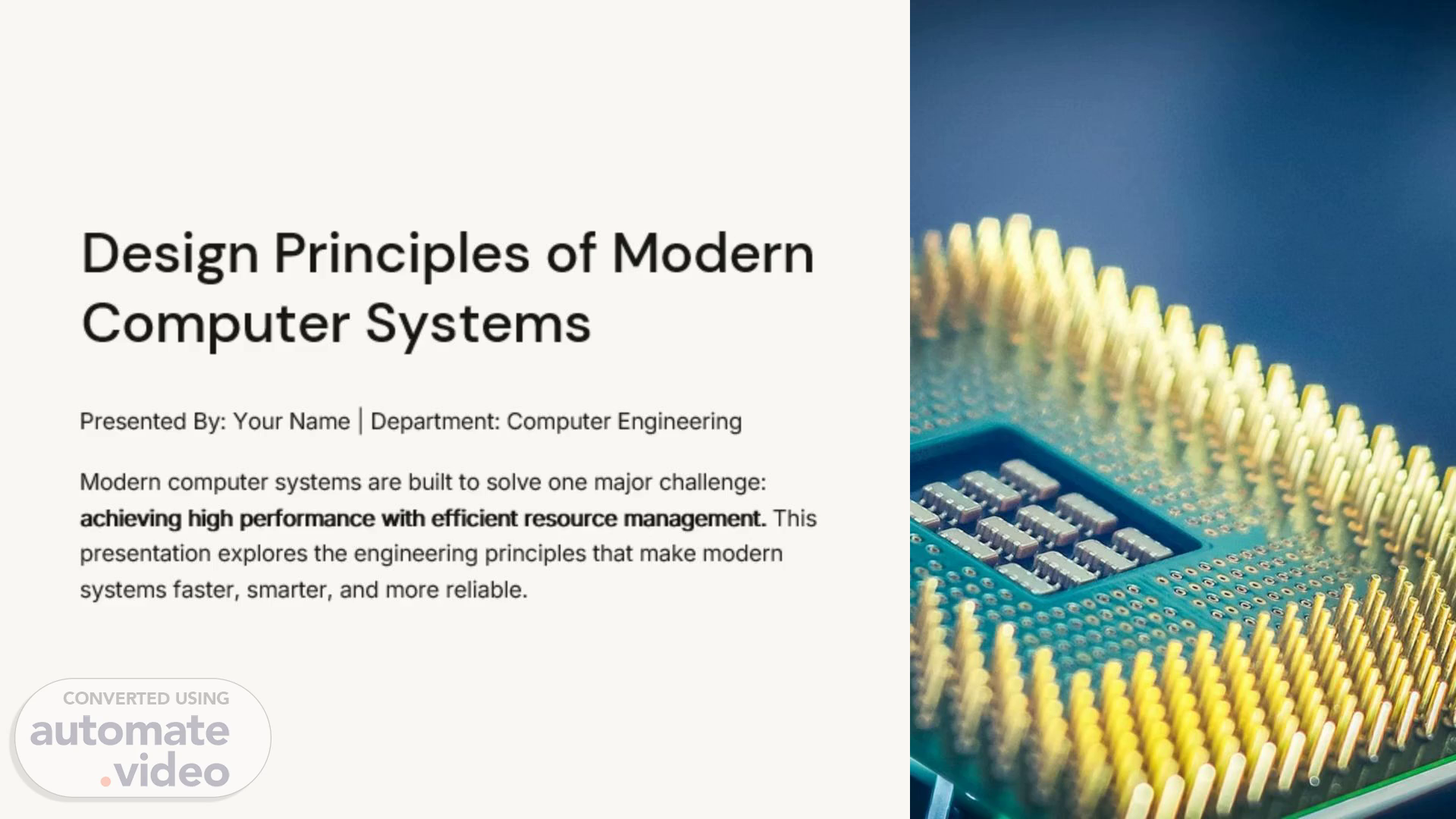
[Audio] "Good morning everyone. Today I am going to present on the topic 'Design Principles of Modern Computer Systems.' As technology grows rapidly, computer systems must process more information faster and more efficiently. In this presentation, I will explain the important engineering principles used in modern systems, such as efficient memory utilization, cache architecture, improved input/output systems, pipelining, parallel processing, and multi-core systems.".
Scene 2 (31s)
[Audio] "Before discussing the technical concepts, we should understand why modern system design is important. Today's systems need to handle large data, multitasking, high-speed communication, and real-time processing. For example, smartphones and computers run many applications at once. As computer engineers, our goal is to design systems that are not only fast but also efficient, reliable, and power optimized. In simple words, a modern system should perform better while wasting fewer resources.".
Scene 3 (1m 4s)
[Audio] "This slide explains efficient memory utilization. Memory is one of the most important resources in any computer system. Efficient memory utilization means using available memory smartly to avoid wastage and improve speed. Modern systems use techniques such as virtual memory, paging, segmentation, and dynamic memory allocation to manage data efficiently. For example, when multiple programs are running together, the operating system allocates memory dynamically so the system does not slow down or crash.".
Scene 4 (1m 39s)
[Audio] Now I will discuss cache architecture. One major challenge in computer systems is that processors work much faster than RAM. To reduce this speed difference, cache memory is used. Cache memory stores frequently used data closer to the processor. There are different levels of cache. L1 cache is the fastest and smallest. L2 cache provides more storage but slightly slower speed. L3 cache is shared among processor cores and supports coordination. This architecture helps improve processing speed and reduces waiting time.".
Scene 5 (2m 15s)
[Audio] This slide explains memory hierarchy. Modern systems organize memory into layers such as registers, cache, RAM, and storage devices like SSD or hard disk. The closer memory is to the processor, the faster it works, but usually the storage size becomes smaller. This hierarchy helps balance performance, storage capacity, and cost. A practical example is when frequently used programs open quickly because important data remains stored closer to the CPU..
Scene 6 (2m 50s)
[Audio] Now let us discuss improvements in input and output mechanisms. Input/output systems allow communication between the processor and external devices. Modern computers use advanced technologies such as DMA, NVMe SSDs, USB-C, and high-speed networking to improve communication speed. These technologies reduce CPU workload and improve system responsiveness. For example, SSD storage loads files and boots systems much faster than traditional hard drives..
Scene 7 (3m 23s)
[Audio] This slide focuses on pipelining. Pipelining is a technique used to improve processor performance by dividing instruction execution into different stages. Instead of waiting for one instruction to finish completely, the processor performs multiple stages at the same time. These stages include fetching, decoding, execution, memory access, and storing results. An easy real-life example is a factory production line where different workers handle different tasks simultaneously to speed up production.
Scene 8 (3m 55s)
[Audio] Now I will explain parallel processing. Parallel processing means dividing work into smaller tasks and executing them simultaneously. This technique is very important for modern applications like artificial intelligence, graphics rendering, scientific simulations, and gaming. Instead of solving one task at a time, the system processes multiple operations together, which saves time and improves efficiency. For example, video editing software performs rendering faster by processing many operations simultaneously.
Scene 9 (4m 30s)
[Audio] This slide explains multi-core systems. A multi-core processor contains multiple cores inside a single CPU chip. Each core can execute instructions independently, allowing several tasks to run simultaneously. This improves multitasking, system speed, and energy efficiency. For example, when we browse the internet, write code, and attend online meetings together, different cores help maintain smooth performance..
Scene 10 (5m 3s)
[Audio] To conclude, modern computer systems are designed to maximize performance and efficiency. We discussed efficient memory utilization, cache systems, memory hierarchy, advanced input/output mechanisms, pipelining, parallel processing, and multi-core architecture. All these principles work together to make systems faster, smarter, and more efficient. As computer engineers, understanding these principles helps us design better computing systems for future technologies. Thank you..