Scene 1 (0s)
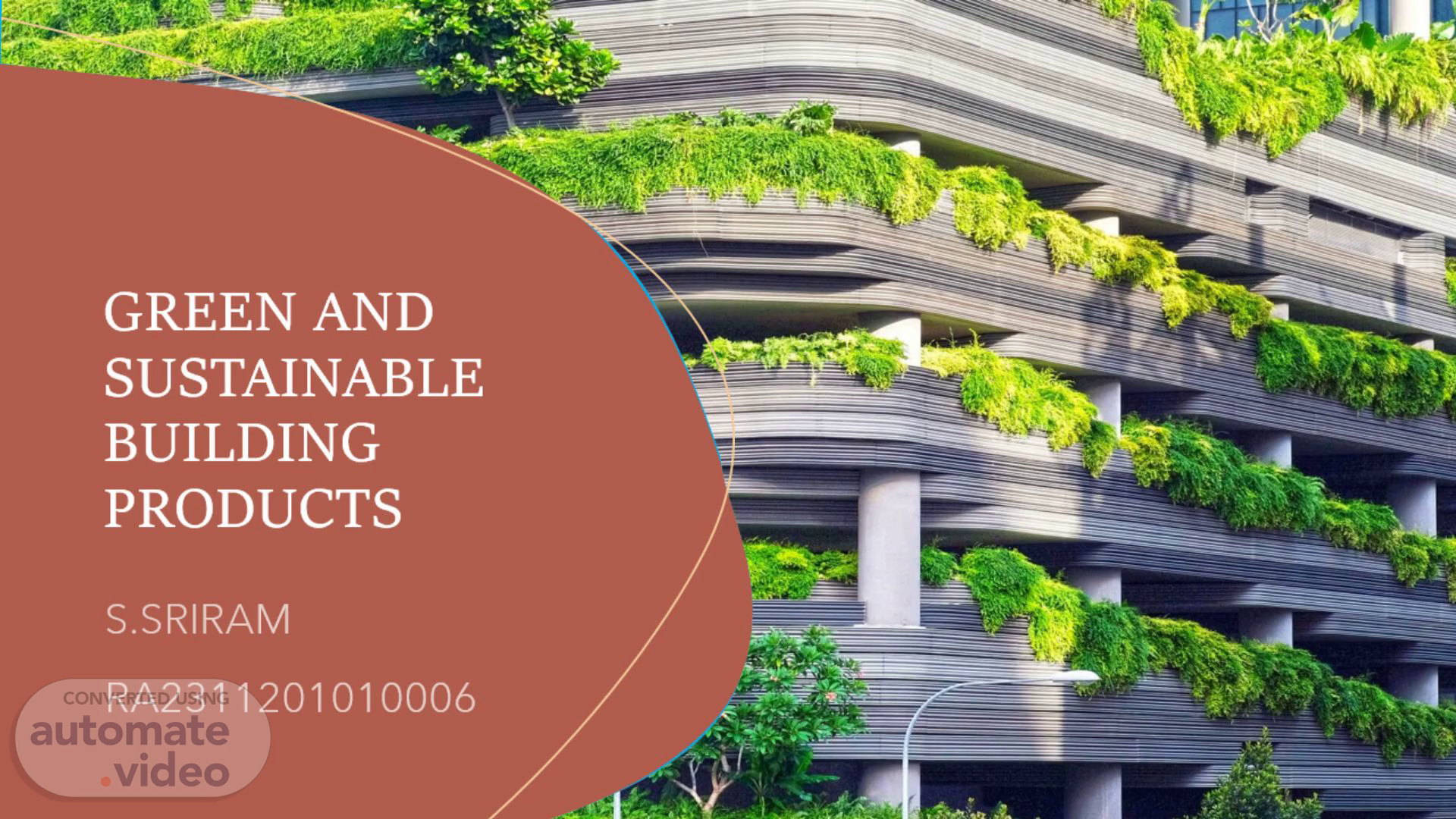
GREEN AND SUSTAINABLE BUILDING PRODUCTS. S.SRIRAM RA2311201010006.
Scene 2 (7s)
AIM OF THE STUDY. Reduce environmental impact by lowering carbon emissions, waste, and resource depletion Conserve natural resources through the use of renewable, recycled, and locally available materials Improve energy efficiency of buildings across their life cycle (construction, use, and demolition) Enhance indoor environmental quality, leading to healthier living and working spaces Promote long-term economic benefits by reducing operating, maintenance, and energy costs.
Scene 3 (29s)
Introduction. Green and sustainable building products are materials designed to minimize environmental impact, conserve resources, and enhance occupant health throughout their lifecycle, from sourcing to disposal..
Scene 4 (42s)
Sample Footer Text. 4. Green and sustainable building materials are classified into three main types:.
Scene 5 (1m 32s)
TYPES OF GREEN AND SUSTAINABLE BUILDING MATERIALS.
Scene 6 (1m 43s)
BAMBOO. LOCATION:INDONESIA. Bamboo is a rapidly renewable, eco-friendly, and lightweight construction material, renowned for its exceptional tensile strength, often comparable to steel. It serves as a sustainable alternative to traditional materials (timber/concrete) for structural elements like beams, columns, and roofing, offering high flexibility that makes it ideal for earthquake-resistant designs..
Scene 7 (2m 2s)
SILICATE PAINT. Silicate paint (or mineral paint) is a highly durable, eco-friendly coating based on potassium silicate ("water glass") that chemically bonds with mineral substrates like concrete, stone, or plaster.
Scene 8 (2m 15s)
CARPET TILES. 2/4/2026. 8. Carpet tiles, also known as modular carpets or carpet squares, are individual, manageable pieces of carpet—typically 50×5050 cross 50 50×50 cm, though they come in other sizes and shapes like planks. Featuring a sturdy backing made of PVC, bitumen, or rubber, they offer a durable, easy-to-install, and easily replaceable flooring alternative to traditional wall-to-wall carpets..
Scene 9 (2m 36s)
SOLAR PANEL. 2/4/2026. 9. A solar panel, or photovoltaic (PV) panel, is a device that converts sunlight into electricity using multiple interconnected PV cells, usually made of silicon. When exposed to sunlight, these cells generate direct current (DC) electricity via the photoelectric effect, which is then converted into alternating current (AC) by an inverter to power homes, businesses, or charge batteries..
Scene 10 (2m 55s)
DESIGN PHILOSOPHY. 10. Use of Local & Sustainable Materials Vernacular Indonesian Architecture Climate-Responsive Design Community-Oriented Space Structural Innovation with Bamboo..
Scene 11 (3m 5s)
SELECTED CASES. BAMBOO-CANGGU AND CO INDONESIA. CARPET TILES BRICOFLOR GERMANY.
Scene 12 (3m 16s)
12. HOW ARE THE STORED?. Carpet tiles are packed and stored in boxes, typically containing 20 tiles, with standard dimensions of 50cm x 50cm..
Scene 13 (3m 45s)
13. HOW ARE THE PRODUCTS ARE DISPLAYED?. Showrooms often include curated spaces, such as 17 multi-purpose rooms, bedrooms, and children's rooms, designed as "open catalogues" to showcase how paints look in a furnished, real-life setting..
Scene 14 (4m 20s)
14. COMPARATIVE STUDY. Material Renewable Source Resource Intensity Paint Not renewable (petrochemical base in conventional) Moderate energy use in production; some bio-based paints exist Bamboo Highly renewable – fastest-growing plant (~3-5 years maturity) Low compared to timber; captures carbon while growing Carpet Tiles May include recycled content (e.g., recycled nylon) but raw materials often synthetic Moderate to high energy for fiber production Solar Panels Requires mined materials (silicon, silver, aluminum) High upfront energy/carbon; long-term payoff through clean energy.