Scene 1 (0s)
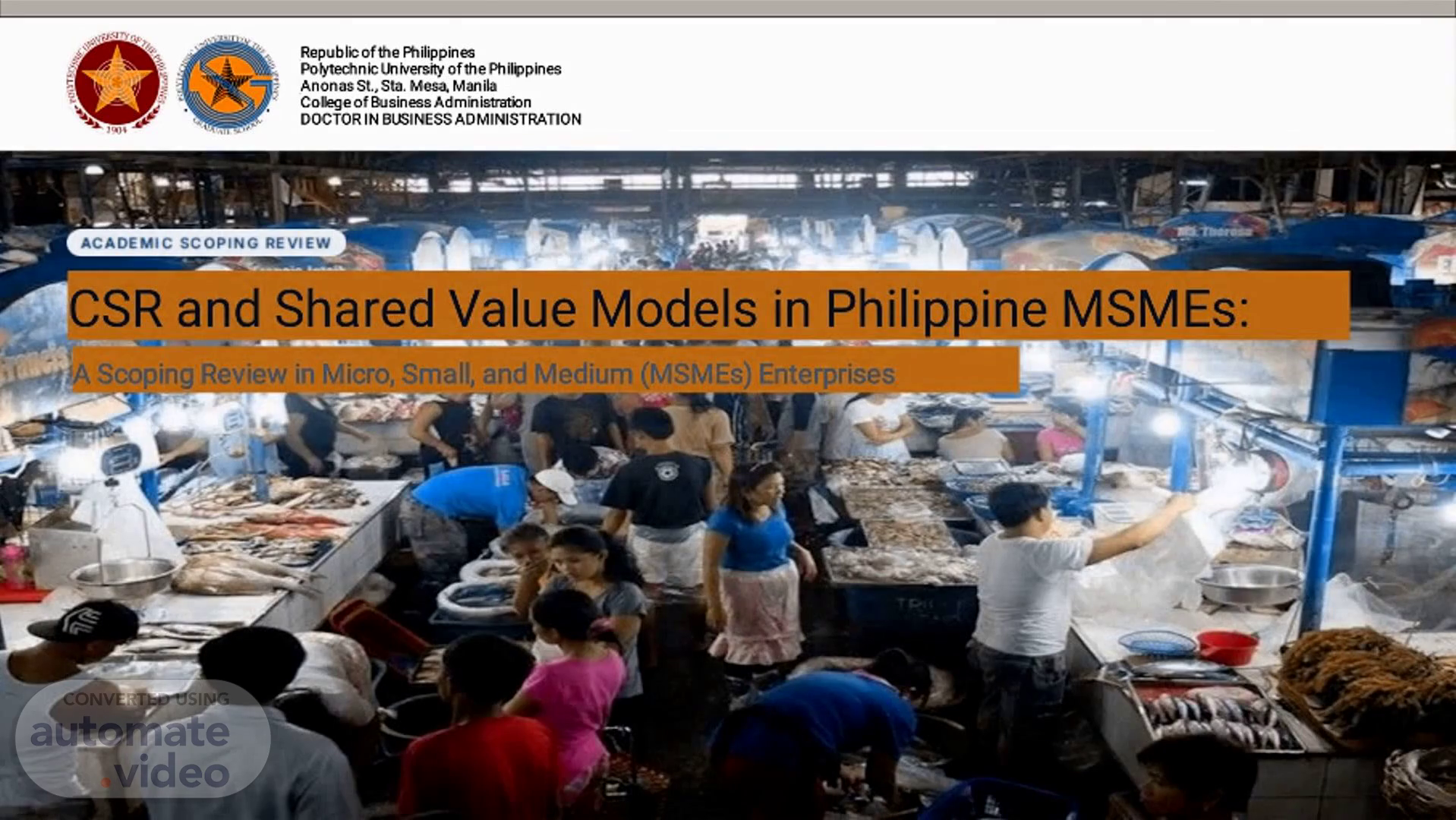
CSR and Shared Value Models in Philippine MSMEs:� A Scoping Review in Micro, Small, and Medium (MSMEs) Enterprises� Republic of the Philippines � Polytechnic University of the Philippines � Anonas St., Sta. Mesa, Manila � College of Business Administration � DOCTOR IN BUSINESS ADMINISTRATION �.
Scene 2 (48s)
[Audio] The Philippines is a country with a rich history and culture that spans over four thousand years. The country has been inhabited by various ethnic groups, including the indigenous peoples who have lived on the islands for thousands of years. The Philippines has a population of around 109 million people, making it one of the most populous countries in Southeast Asia. The country has a diverse geography, ranging from tropical rainforests to mountainous regions and coastal plains. The climate varies greatly depending on the region, with some areas experiencing heavy rainfall and others being dry and arid. The Philippines has a long history of colonization, having been ruled by several European powers, including Spain, Portugal, and the United States. The country gained independence in 1948, but was occupied by Japan during World War II. The Philippines has a unique cultural heritage, shaped by its complex history and the influence of various cultures. The country has a vibrant arts scene, with many festivals and celebrations throughout the year. The Philippines has made significant progress in reducing poverty rates, with the government implementing policies aimed at promoting economic growth and social welfare. However, despite these efforts, the country still faces challenges related to income inequality and environmental degradation..
Scene 3 (2m 18s)
[Audio] The majority of small businesses in the Philippines are owned by individuals rather than corporations. Approximately 99.5% of all registered businesses in the country are owned by individuals. This means that microenterprises, which are typically small businesses, hold a significant portion of these businesses. In fact, microenterprises make up about 90.5% of all registered businesses in the Philippines. The remaining 9.5% are larger enterprises, known as macroenterprises. Microenterprises play a crucial role in driving economic growth and development in the country. They account for 62% of total domestic employment. Furthermore, microenterprises have traditionally been established using informal, imported corporate structures. These structures were introduced from the West and have been adopted by many Filipino entrepreneurs. As a result, many small businesses in the Philippines operate under these informal corporate systems..
Scene 4 (3m 23s)
[Audio] The micro-enterprises are driving this change by adopting new technologies and processes to improve efficiency and productivity. They are also engaging with local communities to develop sustainable livelihoods and promote economic development. The government has implemented policies to support the growth of micro-enterprises, such as tax incentives and subsidies for training and equipment. These initiatives aim to reduce poverty and inequality by providing access to markets and resources..
Scene 5 (3m 54s)
[Audio] The company's philanthropic efforts are focused on supporting small businesses and entrepreneurs, particularly those in low-income communities. The company has established a program to provide financial assistance to these businesses, including loans and grants. Additionally, the company offers training programs for employees to develop skills that will help them start their own businesses. The company also partners with other organizations to provide resources and expertise to its supported businesses..
Scene 6 (4m 27s)
[Audio] The researchers conducted a comprehensive literature review on CSR practices in the Philippines. They identified several key concepts that were relevant to their study. The researchers then developed a conceptual framework to organize their findings. This framework included five key components: stakeholder engagement, social responsibility, environmental sustainability, economic viability, and governance. The researchers also sought to understand the role of indigenous innovation in driving CSR adoption. They found that indigenous innovation played a significant role in creating shared value for small and medium-sized enterprises (SMEs). The researchers concluded that indigenous innovation was a critical factor in driving CSR adoption among SMEs..
Scene 7 (5m 24s)
[Audio] The Philippines has a large number of Micro Small and Medium Enterprises (MSMEs) which are the backbone of its economy. These enterprises have been around since the early days of the country's history. They provide employment opportunities for millions of people. Many of these small businesses are informal, lacking formal documentation and licenses. However, they contribute significantly to the country's GDP. The government has recognized the importance of these enterprises and has implemented policies to support them..
Scene 8 (5m 59s)
[Audio] The scoping review protocol was developed using the Arksey & O'Malley (2005) framework, which provides a systematic approach to mapping heterogeneous literature. The framework has been refined over time by Levac et al. (2010), who emphasized the importance of transparency and clarity in reporting. The Preferred Reporting Items for Systematic Reviews and Meta-Analyses extension for Scoping Reviews (PRISMA-ScR) guidelines were followed to ensure that all reports were consistent with established standards. A comprehensive literature search was conducted across multiple databases, including Scopus, Web of Science, ScienceDirect, JSTOR, and Google Scholar. All peer-reviewed empirical studies were carefully selected and filtered based on their relevance and quality, with a focus on specific contextual areas such as Philippine enterprise and strategic CSR models..
Scene 9 (6m 59s)
[Audio] The scoping review protocol was developed under the guidance of Arksey and O'Malley (2005), which provides a systematic approach for mapping heterogeneous literature. The framework has been refined over time, with Levac et al. (2010) providing further clarification and guidelines. The PRISMA-ScR (Preferred Reporting Items for Systematic Reviews and Meta-Analyses of Scoping Reviews) compliance ensures that the study adheres to established reporting standards. A thorough database search yielded results from multiple sources, including peer-reviewed journals and conference proceedings. The studies were then filtered based on their relevance and focus on Philippine enterprises and strategic corporate social responsibility (CSR) models..
Scene 10 (7m 51s)
[Audio] The PCC Framework Strategy incorporates elements such as Inclusion Criteria, Exclusion Criteria, Population, Concept, and Context. These components form the basis of the framework strategy. The inclusion criteria are used to identify individuals who meet specific requirements for participation in a study. The exclusion criteria are used to exclude individuals who do not meet these requirements. The population refers to the group of people that will be studied. The concept represents the theoretical framework that guides the research. The context provides information about the environment in which the research takes place. All these components work together to provide a comprehensive understanding of the research. They help researchers design studies that are relevant and effective..
Scene 11 (8m 40s)
[Audio] The theoretical foundations guiding our understanding of social and economic value creation in emerging MSMEs include the concepts of corporate social responsibility, creating shared value, and sustainable development. These frameworks provide conceptual lenses through which we can analyze the complex relationships between businesses, society, and the environment. By examining these theoretical anchors, we can gain insights into the ways in which MSMEs create social and economic value in their respective contexts. This knowledge can inform strategies for promoting inclusive socio-economic growth and reducing poverty. Furthermore, it highlights the importance of considering the broader social and economic implications of business decisions, rather than solely focusing on financial returns. By adopting a more holistic approach to value creation, MSMEs can contribute to more equitable and sustainable outcomes..
Scene 12 (9m 42s)
[Audio] The primary theoretical foundations underpin our understanding of business and its role in society. The stakeholder theory suggests that a company's success depends on its ability to meet the needs of all its stakeholders, including shareholders, customers, employees, and the wider community. The natural resource-based view posits that a company's long-term success is dependent on its ability to manage resources effectively. The shared value theory proposes that a company should strive to create value for all its stakeholders by identifying opportunities to improve the well-being of both people and the planet. Freeman's work from 1984 highlights the importance of balancing economic goals with social responsibilities. Hart's contribution in 1995 emphasizes the connection between sustainability and competitiveness. Porter and Kramer's work in 2011 underscores the significance of survival in the face of environmental challenges. By reconceiving products and markets, businesses can create value across local communities while preventing pollution and promoting product stewardship. This approach enables companies to integrate technology and enhance productivity, ultimately benefiting employees, suppliers, and owners alike..
Scene 13 (11m 2s)
[Audio] The presentation highlights key findings from the scoping review of existing literature on CSR and MSMEs in the Philippines. The study reveals that MSMEs play a crucial role in driving economic growth and employment opportunities in the country. The findings also indicate that there is a need for a structural transition towards creating shared value models that embed social and environmental solutions into core business operations. Furthermore, the study identifies different types of CSV typologies, operational impact, and systemic drivers that influence the adoption of CSV models in MSMEs. These include socio-cultural drivers, such as cultural values and norms, and systemic drivers, such as regulatory frameworks and institutional support. Understanding these factors is essential for developing effective CSV models that can drive poverty alleviation and inclusive socio-economic growth. The presentation concludes by emphasizing the importance of adopting a holistic approach to CSR, one that takes into account the unique characteristics and needs of MSMEs. By doing so, businesses can create positive social and environmental impacts while also contributing to sustainable economic growth..
Scene 14 (12m 28s)
[Audio] The socio-cultural drivers of Corporate Social Responsibility (CSR) are implicit in the way people think about CSR. For instance, the concept of bayanihan, which means "solidarity" in Filipino, emphasizes the importance of community and social responsibility. Pakisama, on the other hand, refers to a sense of harmony and cooperation among individuals and groups. Faith and ethics also play a significant role in shaping CSR practices. These drivers shape the behavior of micro, small, and medium enterprises in the Philippines. They influence how CSR is practiced and perceived by these businesses. The four drivers highlight the unique cultural context of MSMEs in the Philippines..
Scene 15 (13m 21s)
[Audio] The four operational CSV models are focused on different aspects of creating shared value. Product realignment involves changing the way companies produce and sell their products. Supply sourcing focuses on finding alternative suppliers for goods and services. Circular loops involve recycling materials and reusing them in new products. Cluster development aims to bring together multiple businesses to work together to achieve common goals. Integrating local microenterprises into formal systems allows small businesses to access resources and markets they may not otherwise be able to reach. Each model has its own set of benefits. Adopting a waste-to-resource design can help reduce waste and increase efficiency. Designing affordable eco-friendly products can make it easier for consumers to adopt environmentally friendly practices. Partnering with local farmers and artisans can provide access to fresh, high-quality ingredients and unique products..
Scene 16 (14m 23s)
[Audio] The operational and financial impacts of implementing Creating Shared Value (CSV) models in Micro, Small and Medium Enterprises (MSMEs) are numerous. These impacts include increased productivity and efficiency through improved supply chain management and logistics. MSMEs can enhance their competitiveness by innovating and diversifying their products and services. Furthermore, they can improve access to finance through partnerships with financial institutions and other stakeholders. The costs associated with compliance with regulations and standards can be reduced. Additionally, MSMEs can generate additional revenue streams through the development of new products and services. They can better align with changing customer needs and preferences. Moreover, MSMEs can make more effective use of resources through the implementation of lean management practices..
Scene 17 (15m 25s)
[Audio] The Philippine government has implemented various policies to support the growth of Micro, Small, and Medium Enterprises (MSMEs). One of these policies is the National Legislative Framework, which includes laws like RA 9501 and RA 10771 that provide critical policy support for green transition and MSME development. These laws also help to create an enabling environment for businesses to adopt sustainable practices. Another factor that drives the growth of MSMEs is ESG (Environmental, Social, and Governance) compliance. Multinational companies with global supply chains often require their suppliers to meet certain environmental and social standards. This requirement can be seen as a commercial incentive for local MSMEs to adopt sustainable practices. These drivers and enablers play a crucial role in shaping the business environment and influencing the adoption of sustainable practices among MSMEs. They are essential for creating a supportive ecosystem that fosters innovation and entrepreneurship..
Scene 18 (16m 44s)
[Audio] The Philippine government has implemented various initiatives to support micro, small, and medium enterprises (MSMEs) in adopting sustainable practices. However, despite these efforts, systemic barriers and constraints remain, limiting the potential for growth and development. The main challenge facing MSMEs is the lack of access to financing, which hinders their ability to invest in sustainable technologies and practices. Many MSMEs struggle with limited financial resources, making it difficult for them to adopt environmentally friendly technologies and reduce their carbon footprint..
Scene 19 (17m 23s)
[Audio] The critical appraisal of literature involves evaluating the quality and validity of existing research studies related to the topic. This includes assessing the methodology used, the sample size and population, data collection methods, and the conclusions drawn from the data. A critical appraisal also examines the gaps in the literature, identifying areas where further research is needed. Additionally, it evaluates the limitations of the current methodologies and frameworks used in the field. Furthermore, it assesses how well the study fits within the broader contextual framework, taking into account factors such as cultural, economic, and political environments. By conducting a thorough critical appraisal, researchers can gain a deeper understanding of the strengths and weaknesses of existing research, ultimately informing their own research design and methodology..
Scene 20 (18m 17s)
[Audio] The limitations of cross-sectional studies are that they rely heavily on single case studies with limited longitudinal data on financial returns on investment. Most studies focus geographically on Metro Manila and major urban centers in Luzon, which leaves out other regions. The research tends to concentrate on agri-business and food manufacturing, while service and technology sectors receive less attention. Western CSV models often fail to account for informal cultural practices such as Utang na Loob, or reciprocal gratitude. These limitations can lead to biased results and a narrow perspective on the economy..
Scene 21 (19m 0s)
[Audio] The presentation highlights the key findings and implications of the scoping review on corporate social responsibility (CSR) and micro small and medium enterprises (MSMEs) in the Philippines. The study shows that creating shared value models can help alleviate poverty and promote inclusive socio-economic growth. The roadmap for future research and policy development provides strategic recommendations for stakeholders, including policymakers, enterprise managers, and researchers. These recommendations stress the importance of cooperation among stakeholders to support MSMEs in adopting CSV models, promoting sustainable practices, and fostering a culture of social responsibility. By implementing these strategies, the Philippines can benefit economically from CSR and MSMEs, which will contribute to the country's sustainable development goals..
Scene 22 (19m 56s)
[Audio] The company has developed several strategic action pathways to address environmental concerns and promote sustainable development. One such pathway involves the adoption of clean technologies, which can help reduce greenhouse gas emissions and mitigate climate change. The company has also implemented various measures to improve supply chain management, including the integration of smallholder farmers into its operations. This includes direct integration with smallholder farmers, as well as the deployment of rooftop solar panels and energy efficiency loops. The company aims to slash long-term utility overheads by adopting Environmental, Social, and Governance (ESG) standards. Furthermore, the company seeks to unlock new export markets and promote resilient agricultural raw materials..
Scene 23 (20m 51s)
Questions & Discussion�.
Scene 24 (20m 57s)
[Audio] The sources of the images used in this presentation include an image of a proud sari-sari store owner taken from godaddy.com. This image represents the important role of Micro, Small, and Medium-sized Enterprises (MSMEs) in the Philippine economy. Another image depicts the traditional Filipino practice of bayanihan, taken from sinaunangpanhons.com. This image symbolizes the concept of unity and community, which is essential in creating shared value models for Corporate Social Responsibility (CSR) in MSMEs. An image from billionbricks.org highlights the importance of environmental solutions in driving poverty alleviation and inclusive socio-economic growth. A successful example of a sustainable business model that creates shared value for the community can be seen in an image from aimr.asia. The government and private sector's cooperation in promoting CSR in MSMEs is showcased in an image from pna.gov.ph. Finally, an image from blog.fast.com.ph demonstrates the use of renewable energy in warehouse operations, which is essential in achieving sustainable development. These images were sourced from various websites and are intended to visually enhance the discussion on the evolution of CSR in MSMEs in the Philippines..
Scene 25 (22m 29s)
[Audio] Dr. Christopher M. Lee is a student pursuing his Doctor of Philosophy in Business Administration at the Polytechnic University of the Philippines - Manila. He is currently engaged in research related to Corporate Social Responsibility (CSR) and its evolution in emerging markets, specifically focusing on Micro, Small, and Medium-sized Enterprises (MSMEs). His research interests include understanding the macroeconomic importance and paradigm shift of CSR in MSMEs, with a view to creating shared value models that can drive poverty alleviation and inclusive socio-economic growth. Dr. Lee's work aims to contribute to the development of effective strategies for promoting sustainable development and improving the livelihoods of individuals and communities in emerging economies. As a researcher, he seeks to explore innovative approaches to addressing social and environmental challenges through CSR practices. Dr. Lee holds a Master's degree in Business Administration from the same university. He is committed to applying theoretical knowledge to real-world problems and contributing to the advancement of knowledge in the field of business administration..