Scene 1 (0s)
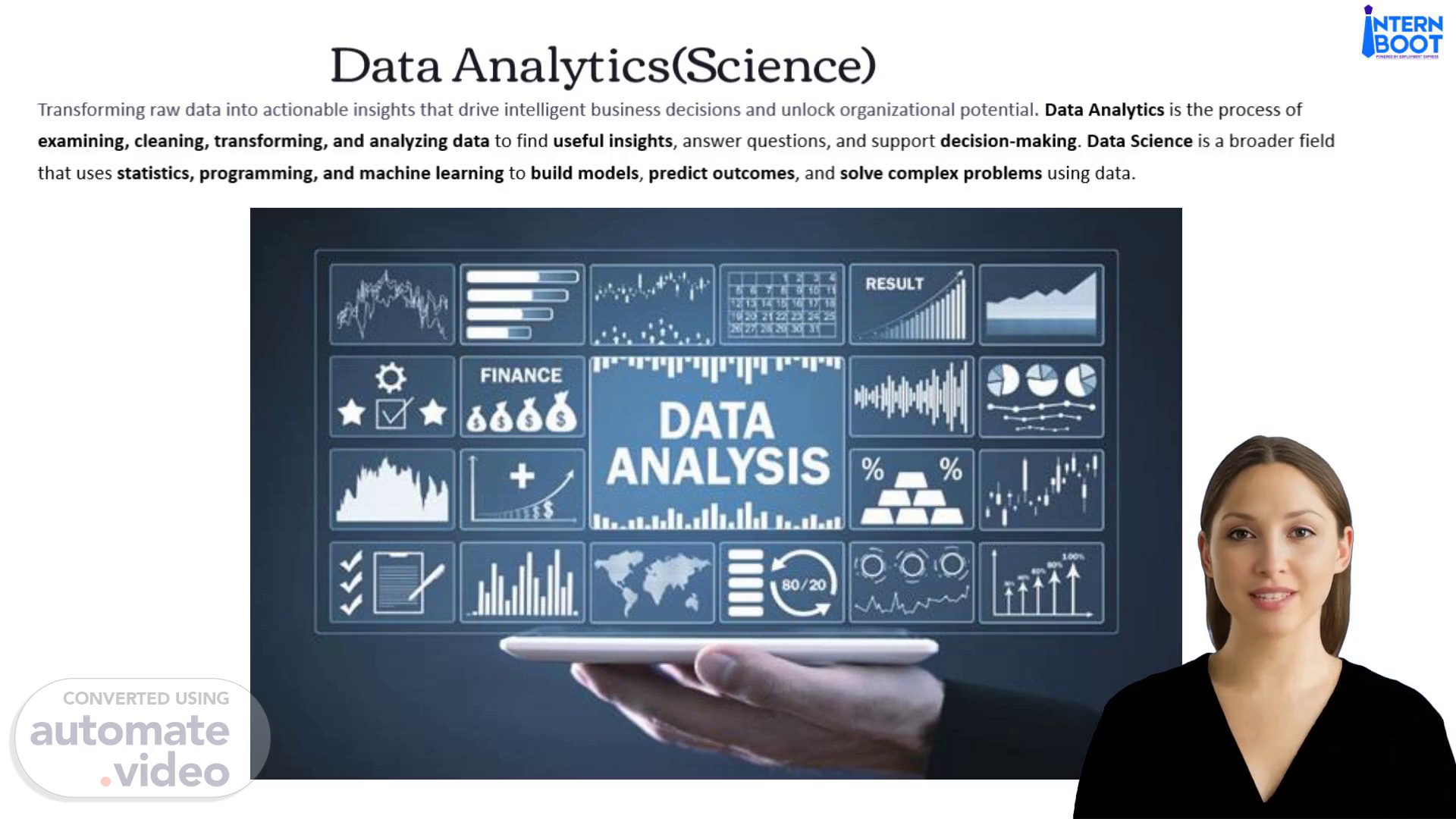
[Virtual Presenter] Data Analytics is a systematic process that involves collecting, cleaning, analyzing, and visualizing data to extract meaningful insights and support informed decision-making. This process enables organizations to transform raw information into actionable intelligence, which can inform strategy across various functions within the organization. Data Analytics also encompasses a broader field known as Data Science, which utilizes advanced statistical methods, programming, and machine learning techniques to build predictive models, analyze complex patterns, and solve intricate problems. By applying these methodologies, organizations can harness the power of data to drive business success and stay competitive in today's fast-paced market..
Scene 2 (52s)
[Audio] The process of data analytics involves several steps including data collection, data cleansing, data analysis, and data visualization. Data collection involves gathering data from various sources such as databases, social media, and other external sources. Data cleansing is the process of ensuring that the collected data is accurate and reliable. Data analysis involves using statistical methods and machine learning algorithms to identify patterns and trends in the data. Data visualization helps to present the findings in a clear and concise manner. Data analytics can be applied to various industries such as finance, healthcare, and retail. In finance, data analytics can help with risk management, portfolio optimization, and forecasting. In healthcare, data analytics can aid in disease diagnosis, patient outcomes, and quality improvement. In retail, data analytics can assist with customer segmentation, marketing, and supply chain management. The key benefits of data analytics include increased efficiency, reduced costs, and improved decision-making. By applying data analytics techniques, organizations can reduce their reliance on manual processes and automate tasks. This leads to increased productivity and competitiveness. Additionally, data analytics enables organizations to make more informed decisions based on empirical evidence rather than intuition..
Scene 3 (2m 27s)
[Audio] Data analytics plays a critical role in driving organizational success. It allows companies to better understand their customers, optimize their operations, and make informed decisions. By leveraging data analytics, organizations can gain a competitive advantage over their rivals. This is achieved through improved efficiency, reduced costs, and enhanced customer experiences. Furthermore, data analytics enables organizations to streamline their processes, eliminate waste, and optimize resource allocation, leading to increased productivity and profitability. Additionally, it facilitates innovation and catalysts for growth, allowing businesses to stay ahead of the competition..
Scene 4 (3m 14s)
[Audio] The organization's current situation is one of uncertainty and instability. The company faces significant challenges in terms of revenue growth, market share, and customer satisfaction. The management team recognizes the need for a more effective approach to decision-making, but lacks the necessary skills and resources to implement it. The organization needs a strategic plan to address these challenges and improve its overall performance..
Scene 5 (3m 42s)
[Audio] The company's financials are not the only thing being analyzed. Descriptive analytics also looks at customer behavior, market trends, and operational efficiency. It helps organizations identify areas for improvement by providing insights into customer needs, preferences, and pain points. By analyzing these factors, businesses can develop targeted marketing strategies and improve their overall competitiveness..
Scene 6 (4m 10s)
[Audio] The company has been experiencing a significant decline in sales over the past year. The decline started from Q1 but accelerated in Q2 and continued through Q3. The decline was not uniform across all products, with some products showing a decrease while others showed an increase. The decline was also not uniform across all regions, with some regions experiencing a greater decline than others. The decline was attributed to various factors including changes in consumer behavior, increased competition, and economic downturns. However, despite these factors, the company still managed to maintain its market share. The decline in sales was not solely due to one factor, but rather a combination of several factors. The company's ability to adapt to changing circumstances and respond quickly to new challenges is essential for maintaining market share. The decline in sales highlights the importance of continuous monitoring and analysis of business performance. The decline in sales also underscores the need for companies to be proactive in addressing potential issues before they become major problems. The decline in sales serves as a reminder that even successful companies can experience setbacks and declines in sales..
Scene 7 (5m 34s)
[Audio] The use of predictive analytics has become increasingly popular among organizations due to its ability to provide accurate predictions about future events. Many companies have adopted this technology to gain a competitive advantage over their rivals. The primary goal of predictive analytics is to forecast future outcomes based on historical data and statistical models. By using advanced algorithms and machine learning techniques, predictive analytics can help companies make informed decisions that drive business growth..
Scene 8 (6m 7s)
[Audio] The use of prescriptive analytics in organizations has been increasing rapidly over the past few years. Many companies are now using this technology to gain insights into their operations and make more informed decisions. The key benefits of prescriptive analytics include improved decision-making, increased efficiency, and enhanced customer satisfaction. By analyzing data and identifying patterns, prescriptive analytics provides actionable insights that help businesses achieve their goals. However, there are some challenges associated with implementing prescriptive analytics, such as high costs, limited access to data, and difficulties in interpreting complex results. Despite these challenges, many organizations are finding ways to overcome them and reap the rewards of prescriptive analytics..
Scene 9 (7m 1s)
[Audio] Data analytics follows a systematic lifecycle that transforms raw data into actionable insights. Each stage builds upon the previous one, creating a comprehensive framework for extracting value from information. This lifecycle consists of several key stages, which we will now outline. First, data collection involves gathering data from various sources such as databases, APIs, sensors, and user interactions. Next, data cleaning ensures that the data is accurate and reliable by removing errors and handling missing values. Then, data transformation converts and structures the data into formats suitable for analysis. After that, data analysis applies statistical methods and algorithms to extract patterns and insights from the data. Finally, data visualization shares findings with stakeholders through compelling narratives that drive action and decision-making. By understanding this lifecycle, individuals can develop the skills necessary to navigate each stage and unlock the full potential of data analytics..
Scene 10 (8m 15s)
[Audio] Data analytics is a multifaceted field that encompasses both technical skills and a mindset that enables organizations to operate and compete effectively. Mastering the four types of analytics - descriptive, diagnostic, predictive, and prescriptive - and understanding the complete data lifecycle are essential to harnessing the full potential of data analytics. Organizations must apply these concepts to drive evidence-based decision-making across all business functions. A solid foundation in descriptive analytics is necessary, followed by the application of predictive and prescriptive analytics to drive transformation and growth. Strategic thinking and technical skills are equally important, as they enable organizations to extract value from information and make informed decisions. The ability to analyze complex data sets and identify patterns is critical for success in data analytics. Effective communication of findings is also vital, as it allows stakeholders to understand the insights gained from data analysis..