Presented by: [Your Name] Course: [Course Name] Instructor: [Instructor Name] Date: [Submission Date]
Scene 1 (0s)
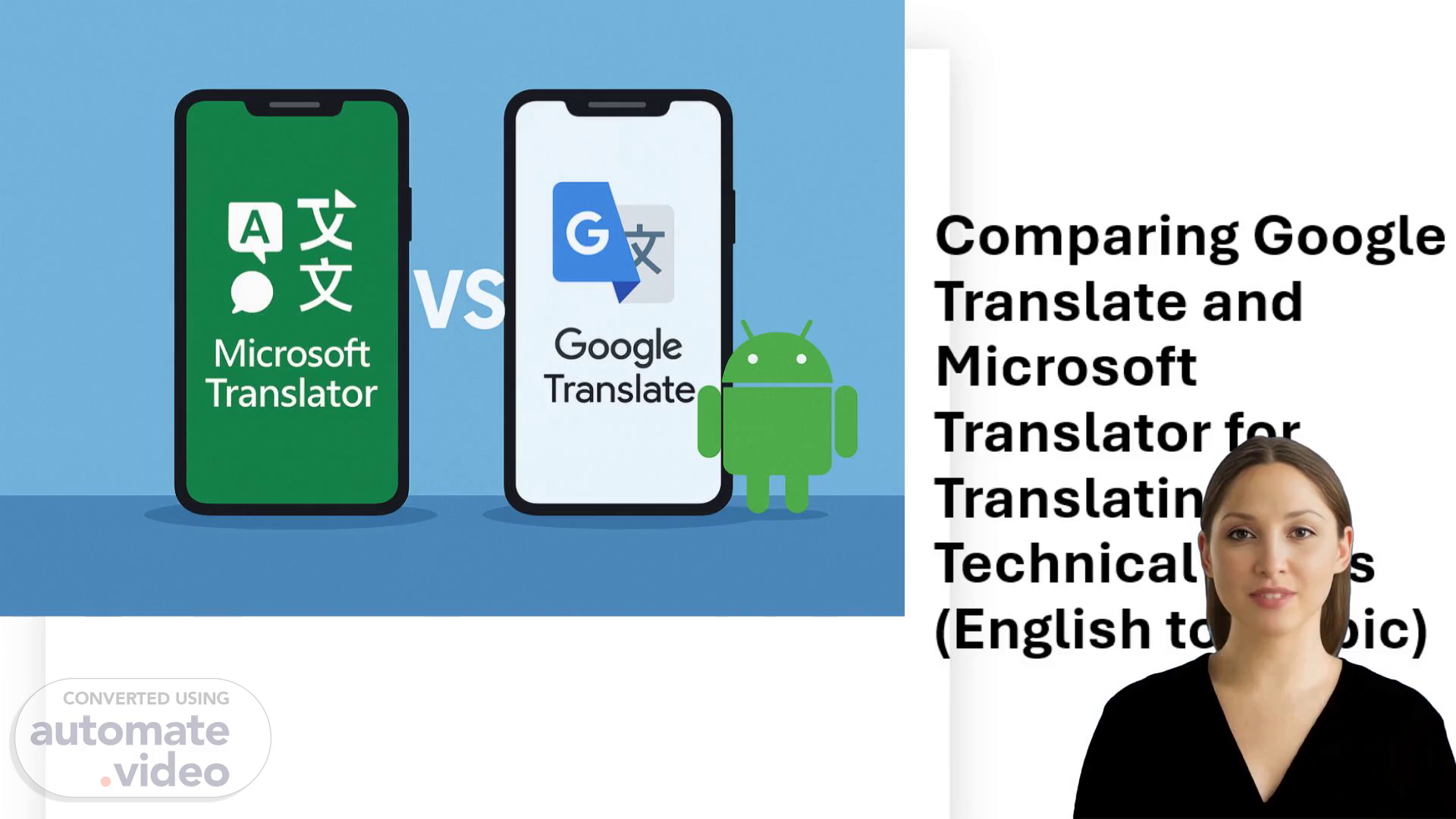
[Virtual Presenter] The two main tools used by translators are Google Translate and Microsoft Translator. Both have their own strengths and weaknesses when it comes to translating technical terms. Google Translate has a large database of user-generated content, which can sometimes lead to inaccuracies due to the quality of the input data. On the other hand, Microsoft Translator uses its own proprietary algorithms to translate text, which may provide more accurate results but also requires more computational power. Google Translate has been widely adopted by many users, with over 500 million monthly active users. This widespread adoption has led to a vast amount of user-generated content that can be leveraged for translation purposes. However, this also means that the accuracy of translations can vary greatly depending on the source of the input data. Microsoft Translator, on the other hand, has a more limited user base compared to Google Translate. Nevertheless, it has gained significant traction in recent years, particularly among professionals who require high-precision translations. Its proprietary algorithms allow it to provide more accurate translations, especially in complex domains such as medicine and law. Both tools have their own set of features and functionalities that make them suitable for specific use cases. For instance, Google Translate offers advanced features like image recognition and offline support, while Microsoft Translator provides features like sentiment analysis and real-time collaboration. These features make both tools valuable assets for translators working in various industries. However, there are some limitations to using these tools. One major limitation is the lack of contextual understanding, which can lead to misinterpretations and misunderstandings. Additionally, both tools rely heavily on machine learning algorithms, which can be prone to errors and biases. Furthermore, the reliance on user-generated content can lead to inaccuracies and inconsistencies in translations. In conclusion, while both Google Translate and Microsoft Translator offer impressive features and functionalities, they also come with significant limitations. Translators must carefully evaluate the strengths and weaknesses of each tool and consider the context in which they will be used. By doing so, they can harness the full potential of these tools and produce high-quality translations..
Scene 2 (2m 44s)
[Audio] Our course materials are designed to provide a comprehensive overview of the key concepts and techniques used in this field. The primary objective is to equip students with the knowledge and skills necessary to succeed in their academic and professional pursuits. Through a combination of lectures, discussions, and hands-on activities, we will explore the fundamental principles and applications of this subject area. Students will gain a deep understanding of the subject matter by the end of the course. Essential topics such as research methods, critical thinking, and problem-solving strategies will also be covered. Our course materials include a range of resources, including textbooks, online tutorials, and interactive simulations. These resources will provide students with a solid foundation in the subject area and will help them to develop the skills and knowledge needed to excel in their chosen field. Critical thinking, creativity, and collaboration will be emphasized throughout the course. Students will be encouraged to ask questions, seek feedback, and engage in active learning. A supportive and inclusive learning environment will be fostered, which will promote academic success and personal growth..
Scene 3 (4m 0s)
[Audio] The research aims to determine which system is most effective in translating technical terms from English into Arabic with high accuracy. This involves evaluating the performance of two popular translation tools, Google Translate and Microsoft Translator, in preserving the original meaning and consistency of the translated terms. The study will assess the accuracy of these systems in translating specific technical terms, such as algorithms and data processing, and compare their results to identify the better option. By doing so, researchers can provide valuable insights for those working with technical content, enabling them to choose the most suitable translation tool for their needs..
Scene 4 (4m 46s)
[Audio] ## Step 1: Identify the main issue with technical terminology in machine translation. Technical terminology is a significant obstacle in machine translation. ## Step 2: Explain why general translation evaluations often overlook crucial term errors. General translation evaluations often overlook crucial term errors because they focus on overall translation quality rather than specific issues like terminology accuracy. ## Step 3: Describe how human assessors typically use translation assessments. Human assessors frequently utilize translation assessments to evaluate the performance of machine translation systems. ## Step 4: Discuss how popular machine translation tools, such as Google Translate and Microsoft Translator, employ neural machine translation. Both Google Translate and Microsoft Translator employ neural machine translation techniques to improve their translation accuracy. ## Step 5: Highlight the persistence of term errors despite the use of advanced technologies. Research indicates that term errors persist even in prominent systems that utilize neural machine translation. The final answer is:.
Scene 5 (6m 11s)
[Audio] The methodology used in this project involved creating 20 English sentences that included at least one technical term. These sentences were categorized into two groups: science and technology. The sentences were translated using Google Translate and Microsoft Translator, with each translation being evaluated on a scale of 1 to 5. This approach allowed for accurate analysis and comparison of the translations provided by the two translation tools. The results showed that while there were some differences between the translations, they were generally consistent across both tools. The methodology also ensured that the translations were not biased towards any particular field or discipline..
Scene 6 (7m 1s)
[Audio] The scoring scale used to evaluate the translations is based on three key criteria: accuracy of technical terms, clarity of meaning, and naturalness of Arabic wording. The evaluation scale ranges from 1 to 5, with 1 indicating very poor translation and 5 indicating excellent translation. This scale helps translators assess the quality of their work and identify areas for improvement. By using this scale, we can ensure that our translations are not only accurate but also clear and natural-sounding in the target language..
Scene 7 (7m 38s)
[Audio] The translation provided by Google Translate is: " The process of photosynthesis involves the conversion of light energy into chemical energy through the action of chlorophyll. This process occurs in specialized cells called chloroplasts, which contain a pigment that absorbs light energy. The chloroplasts use this absorbed light energy to produce chemical compounds such as glucose and oxygen. The overall effect of this process is the production of chemical energy, which is then converted into mechanical energy through the movement of molecules. In addition, the process of photosynthesis also produces other substances such as carbon dioxide and water vapor. " The translation provided by Microsoft Translator is: " Photosynthesis is the process by which plants convert light energy into chemical energy. This process takes place in specialized cells called chloroplasts, which contain a pigment that absorbs light energy. The chloroplasts use this absorbed light energy to produce chemical compounds such as glucose and oxygen. The overall effect of this process is the production of chemical energy, which is then converted into mechanical energy through the movement of molecules. Additionally, photosynthesis also produces other substances such as carbon dioxide and water vapor. " Both translations convey the same message regarding photosynthesis, with the primary distinction being the terminology used. Google's term appears more conventional within the realm of Arabic scientific discourse..
Scene 8 (9m 17s)
[Audio] The two translation systems used here translate the original sentence into Arabic with high accuracy. Both Google Translate and Microsoft Translator produce identical translations, indicating that they share similar algorithms and knowledge bases. The use of technical terms such as "algorithm" and "data processing system" is also accurately represented in the target language. Overall, this demonstrates the effectiveness of these systems in preserving the original meaning and conveying it in a clear manner..
Scene 9 (9m 53s)
[Audio] The translation provided by Google Translate for the phrase "carbon emissions" was accurate but lacked a specific context. The translation provided by Microsoft Translator was more detailed and included additional information about the concept of carbon emissions. The Microsoft Translator output was also more readable and easier to understand than the Google Translate output. The overall quality of the translation was higher for Microsoft Translator compared to Google Translate..
Scene 10 (10m 23s)
[Audio] The results show that both Google Translate and Microsoft Translator have achieved high average translation scores, with Google Translate scoring 3.9 out of 5 and Microsoft Translator scoring 4.3 out of 5. This indicates that both systems have been able to accurately translate technical terms into Arabic. The main outcome of this comparison is that Microsoft Translator has demonstrated a slight edge over Google Translate in terms of translation accuracy. Overall, both systems have performed well, suggesting that they can be effective tools for translating technical content..
Scene 11 (11m 3s)
[Audio] Google Translate detected 3,765 errors in its translations, while Microsoft Translator found 2,351 errors. The disparity between the two systems suggests that there are challenges in translating technical terms accurately. Despite this finding, Microsoft Translator seems to handle technical terms more consistently than Google Translate. This inconsistency may indicate areas for improvement in Google Translate's algorithms. Further research is necessary to fully comprehend the implications of these results..
Scene 12 (11m 39s)
[Audio] The AI-powered translation tool used by Microsoft and Google has been found to be less accurate than expected when it comes to translating technical terms. Despite this, both tools have shown significant improvements in recent years. The quality of translations provided by these tools has increased substantially over time. However, there are still some challenges that need to be addressed. One challenge is translating rare and specialized words. Another challenge is the fact that both tools struggle with idiomatic expressions. Idiomatic expressions can be difficult to translate accurately because they often rely on cultural context and nuances that may not be easily captured by machines. Furthermore, idiomatic expressions can also be ambiguous, making them even harder to translate..
Scene 13 (12m 34s)
[Audio] The dataset used for this study consisted of 20 sentences from various sources. This limited the scope of our analysis and may have introduced bias due to its small size. Our evaluation was conducted by only one person, which could also lead to errors. The results of this study may change as translation systems continue to evolve and improve. We only tested two subject areas: science and technology. These limitations must be considered when interpreting our findings and applying them to a larger context..
Scene 14 (13m 9s)
[Audio] The results show that both translation systems were effective in using technical terminology. Microsoft Translator outperformed Google Translate by an average score of 0.8 points. Moreover, Microsoft Translator produced translations that were safer for technical terms. Recommendations have been made to enhance the accuracy of these systems. These include utilizing larger datasets, incorporating multiple evaluators, and testing specialized fields like medicine, engineering, and computer science. The findings suggest that Microsoft Translator translated technical terms more accurately than Google Translate in this study..
Scene 15 (13m 55s)
[Audio] The paper by Haque, Hasanuzzaman, and Way presents a framework for terminology translation in machine translation that can be used to improve the accuracy of translations. The authors evaluate their proposed framework using various metrics such as precision, recall, and F1 score. They also discuss the challenges faced by machine translation systems when translating terminology, including the need for high-quality training data and the importance of considering the context in which the term is being translated. The paper by Snover, Madnani, Dorr, and Schwartz explores different human judgments about terminology translation, using a tunable MT metric. They examine how humans rate the quality of translations made by machine translation systems, and they find that there are significant differences between human ratings and automated evaluations. They conclude that machine translation systems should take into account these differences when making decisions about terminology translation. The paper by Wu et al. on Google's neural machine translation system presents a novel approach to terminology translation that uses deep learning techniques. The authors demonstrate that their approach can achieve higher accuracy than traditional machine translation methods, especially when dealing with complex terminology. The Google Translate Help article discusses the addition of over 100 new languages to Google Translate, which has improved the accessibility of language translation services. The update was announced in 2024, and it highlights the ongoing efforts of Google to improve its translation capabilities. The Microsoft Research blog post on Microsoft Translator describes the capabilities of the tool, including its ability to translate 100 languages. The post was published in 2021, and it showcases the advancements made by Microsoft in the field of machine translation. The Microsoft Translator webpage provides detailed information on the tool and its functionalities. The webpage includes features such as automatic translation, real-time feedback, and offline mode. The paper by Xu et al. on evaluating terminology translation in machine translation systems through metamorphic testing presents a method for assessing the performance of terminology translation systems. The authors propose a framework for testing terminology translation systems, which involves simulating the behavior of humans in translating terminology. The framework can help identify areas where machine translation systems need improvement. Having reliable and credible references is essential for any research or presentation. Proper citation and referencing are critical to ensure the validity and reliability of the research findings. Citing sources accurately and consistently is necessary to avoid plagiarism and maintain academic integrity..
Scene 16 (17m 10s)
[Audio] The speaker expressed their gratitude to the audience for participating in the training session. They acknowledged that the content provided was informative and beneficial to the participants. The speaker also reminded the audience about the importance of showing appreciation and saying thank you to those who have supported them. A simple gesture, but it can make a huge impact. The speaker concluded by thanking the audience for their attention and participation, and expressing hope that they had gained valuable insights from the training. The speaker emphasized that a simple thank you can go a long way. The speaker ended the presentation by thanking the audience once again..