PptxGenJS Presentation


Scene 1 (0s)
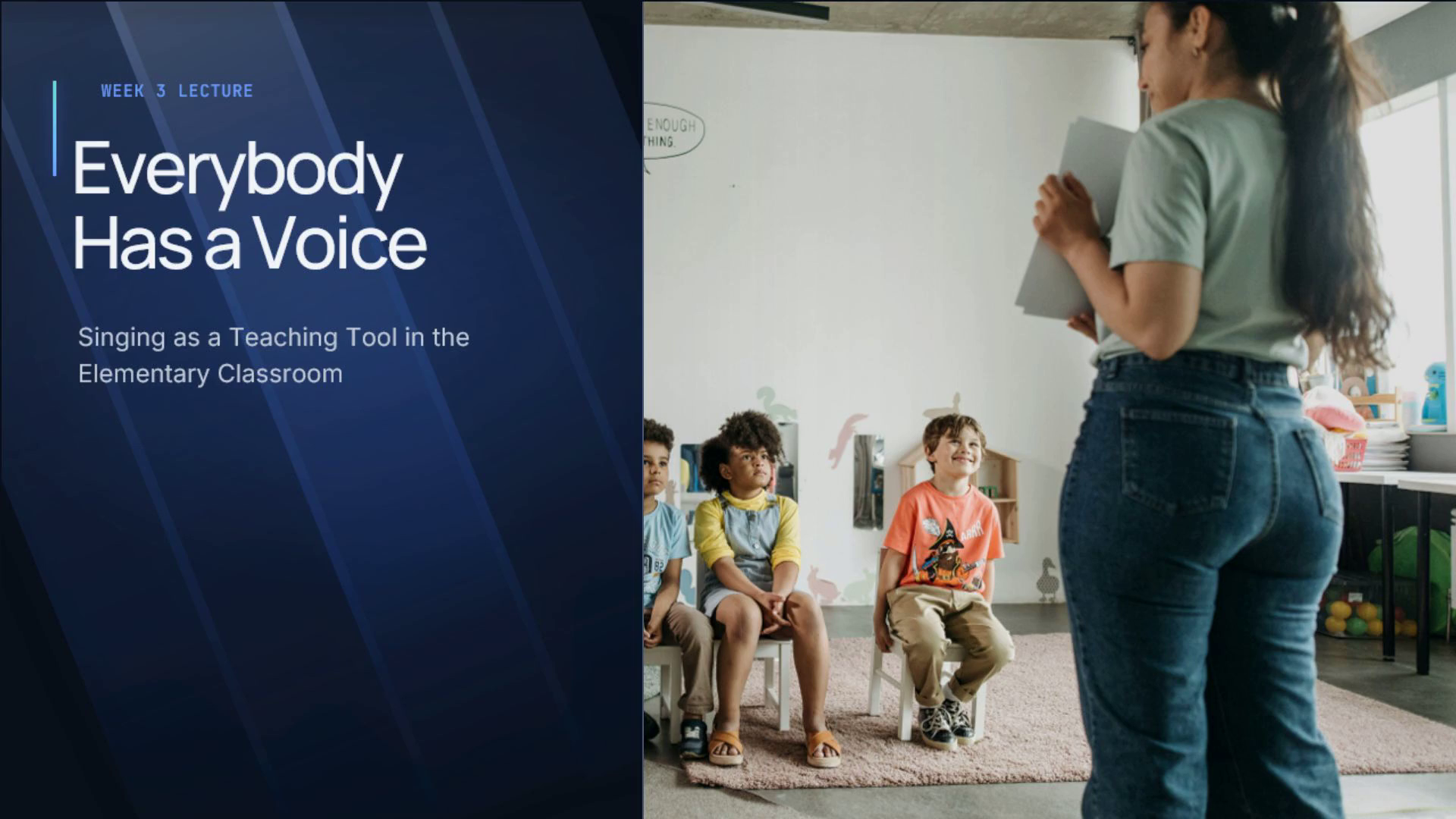
[Audio] Welcome to Week 3 of MUSI 232001: Music in the Elementary Classroom. Today's lecture focuses on the idea that everybody has a voice and explores singing as a teaching tool in the elementary classroom. We will consider how singing together can build community, encourage participation, and support student learning. As we move through the lesson, think about the many ways singing can be incorporated into classroom activities and how every student can be encouraged to participate, regardless of musical experience or confidence..
Scene 2 (36s)
[Audio] Singing can bring up very different feelings for different children. For some, it connects to positive memories of school, church, family, or favorite songs. For others, singing may create performance anxiety. They may worry about singing incorrectly, being laughed at, or sounding different from their peers. Our goal is to create a classroom where children can experience the joy of singing without feeling that they have to be perfect. Encourage participation, celebrate individual voices, and make space for children to engage in ways that feel comfortable and safe..
Scene 3 (1m 14s)
[Audio] Children begin developing musical understanding long before they learn formal music theory. Through familiar songs such as the ABC Song, "Twinkle, Twinkle, Little Star," "Old MacDonald," "The Wheels on the Bus," and "Head, Shoulders, Knees, and Toes," they practice rhythm, pitch, repetition, sequencing, and listening. These songs also connect music with language, movement, memory, and play. By singing and participating, children are already building foundational musical skills—without needing to know terms like melody, tempo, or rhythm..
Scene 4 (1m 53s)
[Audio] A single song can support many different kinds of learning at the same time. As children listen and participate, they practice language, build vocabulary, and strengthen memory by recalling words and patterns. Songs also help children understand sequencing as they follow the order of lyrics, movements, or repeated verses. Adding actions develops movement and coordination, while singing together encourages social interaction and musical expression. Singing is more than a musical activity—it is also an effective instructional strategy that turns active participation into meaningful practice..
Scene 5 (2m 31s)
[Audio] Music gives information a shape that is easier to remember. For example, the familiar melody of "A, B, C, D, E, F, G" helps us recall the alphabet. Melody organizes information, while rhythm organizes time and repetition reinforces key ideas. Lyrics add meaning and help connect words to concepts. Educational songs can support learning in many areas, including multiplication facts, vocabulary, historical information, science concepts, and classroom routines..
Scene 6 (3m 2s)
[Audio] A child's voice is still developing, both physically and musically, so it should not be expected to sound like an adult voice or perform with an adult range or style. Healthy classroom singing begins with comfortable posture and relaxed breathing. Encourage students to use clear speech and diction, along with a light and natural vocal production rather than forcing or pushing the voice. Give students opportunities to listen, explore pitch, and sing within an appropriate vocal range. These practices support healthy vocal development and help children build confidence as young singers..
Scene 7 (3m 42s)
[Audio] Encourage children to discover the different voices they already use in everyday life. This approach helps make singing feel less intimidating and more familiar. Begin with the speaking voice, then explore the whispering voice and the calling voice. From there, guide children toward their singing voice, helping them notice how it differs while still feeling connected to the voices they know. The goal is to make voice exploration playful and comfortable, allowing each child to participate without pressure..
Scene 8 (4m 17s)
[Audio] Good morning! Before students can accurately match a pitch, they need to listen carefully to the sound they hear. Pitch matching means hearing a pitch and reproducing it accurately with the voice. Begin with a simple call-and-response: the teacher sings or speaks "Good morning," and the students echo it back. Encourage students to focus on the melody, the rhythm, and the exact pitch. Careful listening is the first step toward developing strong pitch-matching skills..
Scene 9 (4m 51s)
[Audio] Call-and-response gives students an immediate way to participate in music while practicing essential classroom skills. The teacher models a simple instruction, such as "Clap it once," and students respond by clapping. As the directions become more complex, students practice counting, listening carefully, following directions, and keeping a steady rhythm. This structure also supports classroom management because students learn to focus, respond together, and transition quickly into musical activities..
Scene 10 (5m 22s)
[Audio] When choosing songs, select music that children can enter successfully and experience with confidence. First, consider developmental fit: Is the song appropriate for the age, abilities, and experiences of these children? Look closely at the lyrics and vocal range. Can students understand the words, and can they sing the pitches comfortably? Also consider the song's educational value. What can children learn through singing, listening, movement, or discussion? Cultural respect is equally important. Make sure the people, traditions, and experiences represented in the song are portrayed accurately and respectfully. Finally, think about participation and connection. Can children sing, move, respond, or create in meaningful ways? Does the song connect to and support the curriculum? These questions can help you choose songs that are accessible, engaging, and purposeful for every child..
Scene 11 (6m 20s)
[Audio] Begin with the learning objective, rather than starting with the song itself. Instead of saying, "Today we're going to sing a song about numbers," clearly explain what students are expected to learn. For example, you might say, "Today we're learning to count by fives. We're going to use rhythm, movement, and singing to help us recognize the pattern." In this approach, rhythm, movement, and singing are instructional tools that support the learning goal. The music should have a clear educational purpose and help students practice or understand the concept—not simply provide entertainment..
Scene 12 (6m 57s)
[Audio] Singing can support learning across the entire school day by making lessons active, memorable, and engaging. In mathematics, students can sing while counting by 2s, 5s, or 10s. In literacy, they can practice rhyming words and vowel sounds through songs. Science concepts such as evaporation, condensation, precipitation, and collection can be reinforced by creating a song about the water cycle. Songs can also help students explore historical periods and cultural traditions in social studies. For social-emotional learning, students can sing about emotions, friendship, kindness, and conflict resolution. By connecting music with different subjects, teachers create opportunities for participation while helping students remember and apply what they are learning..
Scene 13 (7m 48s)
[Audio] You do not need a professional singing voice to teach students how to sing. What students need most is a teacher who is willing to model, encourage, participate, and create alongside them. Begin with accessible activities such as chants, spoken rhythms, recorded examples, call-and-response, body percussion, and movement. You can then introduce simple melodies using just two or three notes. The goal is to create a supportive environment where students feel comfortable exploring their voices. Let them know, "We're going to learn this song together.".
Scene 14 (8m 23s)
[Audio] Intentional questions help turn music from an engaging activity into purposeful pedagogy. Begin by identifying what you are teaching and the learning objective. Then ask why music is the right tool to support that objective. Consider what students will do during the activity and how those actions connect to their learning. Finally, determine how you will assess whether students have learned what you intended. These questions ensure that music is not just an add-on, but a meaningful part of the learning experience..
Scene 15 (8m 55s)
[Audio] When children sing together, they are doing much more than learning the words to a song. They are developing listening skills, expanding their language, strengthening memory, and learning to participate with others. Singing also helps build a sense of community. Every child has the opportunity to contribute, whether by singing, moving, echoing, or simply listening. The human voice is one of the most accessible instructional tools available to a teacher. It requires no special equipment and can support learning in any classroom, at any time..