Scene 1 (0s)
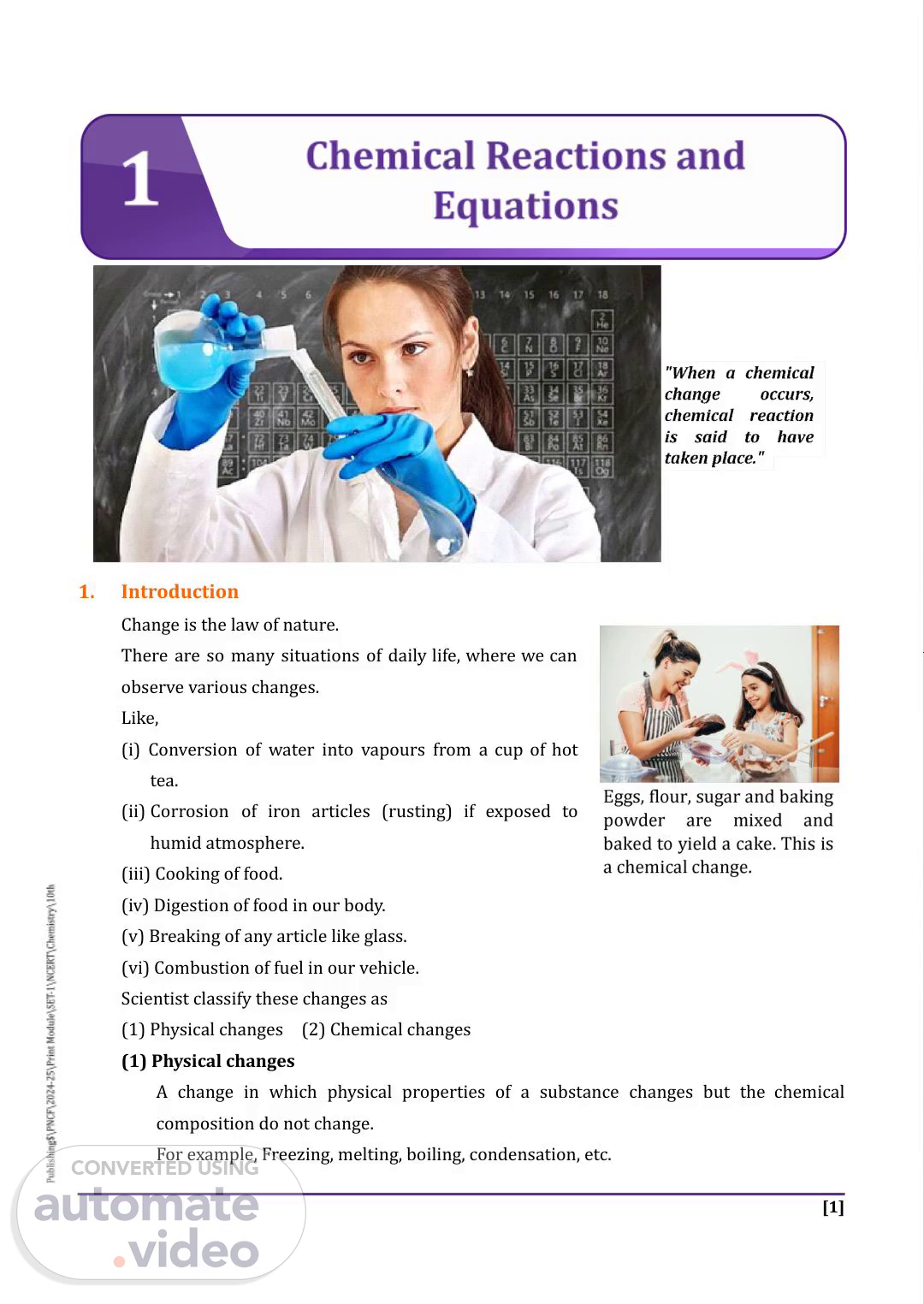
[Audio] 1. Introduction Change is the law of nature. There are so many situations of daily life, where we can observe various changes. Like, (i) Conversion of water into vapours from a cup of hot tea. (ii) Corrosion of iron articles (rusting) if exposed to humid atmosphere. (iii) Cooking of food. (iv) Digestion of food in our body. (v) Breaking of any article like glass. (vi) Combustion of fuel in our vehicle. Scientist classify these changes as (1) Physical changes (2) Chemical changes (1) Physical changes A change in which physical properties of a substance changes but the chemical composition do not change. For example, Freezing, melting, boiling, condensation, etc. [1].
Scene 2 (56s)
[Audio] Characteristic features of physical changes (1) The identity of the substance is maintained. (2) The change is generally temporary. (3) Heat change may or may not take place. (4) Only the physical state or some of the physical properties of the substances are changed. (2) Chemical changes A change in which one or more substances change into new substances with a different chemical composition. For example, burning of a candle, rusting of iron, combustion of fuel, etc. Characteristic features of chemical changes (1) The identity of original substance is completely lost. (2) The change is generally permanent. (3) The change is generally accompanied by energy change. (4) The change cannot be reversed generally. 1. From the given examples, identify the chemical changes. (a) Fermentation of grapes. (b) Burning of a candle. (c) Evaporation of alcohol. (d) Freezing of water. (e) Turning brown of a freshly cut apple in the air. (f) Growth of a plant. (g) Dissolution of sugar in water. (h) Fading of coloured clothes in the sun. ★ In earlier standards, we have seen how compounds are formed by chemical combination of element. ★ We have also learnt that the driving force behind formation of a chemical bond is to attain an electronic configuration with a complete octet. ★ The atoms attain a complete octet by giving, taking or sharing of electrons with each other. 2. Chemical reaction and its characteristics [2].
Scene 3 (2m 44s)
[Audio] The process in which a substance or substances undergo a chemical change to produce new substances, with entirely new properties are known as chemical reaction. Aim To study the reaction between magnesium and oxygen to form magnesium oxide. Caution Perform this activity in the presence of a teacher. It would be better to wear eye protection (as used by welders). Materials Required Burner, tong, magnesium ribbon, sand paper, watch glass. Method (i) Clean a magnesium ribbon about 2 cm long, by rubbing it with sand paper. (ii) Hold it with a pair of tongs. Burn it using a spirit lamp or burner and collect the ash so formed in a watch glass. Burn the magnesium ribbon keeping it as far as possible from your eyes. Burning of a magnesium ribbon in air and collection of magnesium oxide in a watch glass. Now answer What do you observe? Observation It is observed that magnesium ribbon burns with a dazzling white light and changes into a white powder. This powder is magnesium oxide. Conclusion Magnesium burns in air to combine with oxygen to form magnesium oxide. [3].
Scene 4 (4m 0s)
[Audio] Aim To study the reaction between lead nitrate solution and potassium iodide solution. Materials required Test tube, lead nitrate solution, potassium iodide solution. Method (i) Take lead nitrate solution in a test tube. (ii) Add potassium iodide solution to this. Observation It is observed that a yellow solid (precipitate) is formed. Conclusion Lead nitrate solution reacts with potassium iodide solution to form a yellow precipitate of lead iodide. Pb(NO3)2(aq) + 2KI(aq) ⎯→ PbI2(s)(↓) + 2KNO3(aq) Lead nitrate Potassium iodide Lead (II) iodide Potassium nitrate (Colourless) (Colourless) (Yellow ppt.) (Colourless) Aim To study the reaction between zinc and sulphuric acid or hydrochloric acid. Materials required Conical flask or test tube, zinc granules, dilute hydrochloric acid or sulphuric acid. Method (i) Take a few zinc granules in a conical flask or a test tube. (ii) Add dilute hydrochloric acid or sulphuric acid to this. [4].
Scene 5 (5m 26s)
[Audio] ★ Handle the acid with care because acid is corrosive in nature. Now answer Touch the conical flask or test tube. Is there any change in the temperature? Observation and discussion Bubbles of hydrogen gas are found to rise briskly from the surface of zinc pieces. The gas evolved can be tested by bringing a lighted candle. It is found to burn with a popping sound. Further, the flask is found to be hot. Conclusion Zinc reacts with dilute sulphuric acid or hydrochloric acid with the evolution of hydrogen gas and heat (i.e., reaction is exothermic). Formation of hydrogen gas by the action of dilute sulphuric acid on zinc. Zn(s) + ) + Heat 𝑑𝑖𝑙. 𝐻2𝑆𝑂4(𝑎𝑞) → 𝑍𝑛𝑆𝑂4(𝑎𝑞) + 𝐻2(𝑔)(↑ Zinc Sulphuric acid Zinc sulphate Hydrogen (gas) With the help of above activities, we have seen that whenever a chemical reaction has taken place, some changes are observed. These observable changes are called the characteristics of a chemical reaction. Characteristics of chemical reactions (i) Change in state: The physical state of the substances normally changes. For example, Formation of solid MgO from solid Mg and gaseous O2. 2Mg(s) + O2(g) 2MgO(s) Magnesium Oxygen Magnesium oxide (from air) (White powder) (ii) Change in colour: In some of the chemical reactions, change in colour can be observed. For example, [5].
Scene 6 (7m 18s)
[Audio] (a) Formation of reddish-brown rust on grey iron nails. (b) Formation of yellow ppt. of lead iodide from colourless solution of Pb(NO3)2 and KI. (iii) Evolution of a gas: In some cases, a gas may be evolved. For example, Evolution of gas, in the reaction between Zn and dil HCl. 𝐻2 Zn + 2HCl ⎯→ ZnCl2 + H2(g)↑ (iv) Change in temperature: Most of the reactions are accompanied by temperature change i.e. increase or decrease in temperature. For example, (a) In the reaction between Zn and H2SO4, flask was found to be warm. Thus, rise in temperature has taken place (Exothermic). (b) If a reaction between barium hydroxide (Ba(OH)2) and ammonium chloride, (NH4Cl) is carried out in a test tube, it is observed that the bottom of the test tube becomes cooler (Endothermic). [6].
Scene 7 (8m 28s)
[Audio] 1. Chemical changes are a, b, e, f and h. ★ Here is some important chemical formulae which you have learnt in your previous class that can help you in writing a chemical equation. Name of the Compound Formula 1. Calcium hydroxide (Lime water) (Slaked lime) Ca(OH)2 2. Calcium carbonate (Marble, lime stone) CaCO3 3. Calcium oxide (Quick lime) CaO 4. Iron (II) oxide FeO 5. Iron (III) oxide Fe2O3 6. Magnesium oxide MgO 7. Lead nitrate Pb(NO3)2 8. Lead iodide PbI2 9. Potassium iodide KI 10. Ammonium chloride NH4Cl 11. Ammoniun hydroxide NH4OH 12. Potassium chlorate KClO3 13. Lead oxide PbO 14. Aluminium oxide Al2O3 15. Silver chloride AgCl [7].
Scene 8 (9m 42s)
[Audio] 16. Cuprous oxide Cu2O 17. Cupric oxide CuO 18. Silver nitrate AgNO3 19. Barium chloride BaCl2 20. Barium sulphate BaSO4 3. Writing a chemical equation Whenever a chemical reaction takes place, a number of steps are involved. Thus, description of chemical reaction in sentence form becomes long. So, some short-hand representation of chemical reaction is followed. It can be done in two ways: (a) Word equation Chemical equation which represents a chemical reaction briefly in words is called word equation. For example, the word equation can be written as: Magnesium + Oxygen ⎯→ Magnesium oxide (b) Chemical equation A chemical equation is a short-hand method that describes a chemical reaction in terms of symbols and formulae of different reactants and products. For example, the chemical equation can be written as Mg + O2 → MgO Rules for writing a chemical equation (i) The symbols and formulae of the reactants are always written on the L.H.S. (left hand side) of arrow and a plus (+) sign is put between them. (ii) The symbols and formulae of the products are always written on the R.H.S. (right hand side) of arrow and a plus (+) sign is put between them. (iii) An arrow (⎯→) sign is put between the reactants and the products, pointing from reactants towards products. For example, Na + H2O → NaOH + H2 A chemical equation expressed in symbols and formulae, such that the number of atoms of different elements towards the side of the reactants is not equal to the number of atoms of different elements towards the side of the products, is called skeletal equation or unbalanced equation. To make this equation meaningful, this equation is balanced according to law of conservation of mass, then it is called balanced chemical equation. [8].
Scene 9 (11m 58s)
[Audio] 1. Write chemical equations for the following word equations. (a) Potassium chlorate ⎯→ Potassium chloride + Oxygen (b) Methane + Oxygen ⎯→ Carbon dioxide + Water (c) Nitrogen + Hydrogen ⎯→ Ammonia (d) Calcium carbonate ⎯→ Calcium oxide + Carbon dioxide (e) Graphite + Oxygen ⎯→ Carbon dioxide (f) Quicklime + Water ⎯→ Calcium hydroxide How to balance an unbalanced chemical equation According to the law of conservation of mass, the total mass of products must be equal to the total mass of the reactants (as mass can neither be created nor destroyed). This is possible only if the number of atoms of each element is equal on the two sides of the equation. Balancing of a chemical equation means making the number of atoms of each element equal on both sides of the equation. (i) To understand this, let us consider the following word equation for Zinc + Sulphuric acid ⎯→ Zinc sulphate + Hydrogen Chemical equation for the above word equation will be, Zn + 𝐻2𝑆𝑂4 ⎯→ 𝑍𝑛𝑆𝑂4 + 𝐻2 Let us examine the number of atoms of different elements on both the sides of the arrow. Elemen Number of Number of atoms in t atoms in R.H.S. L.H.S. Zn 1 1 H 2 2 S 1 1 O 4 4 As the number of atoms of each element is same on both sides of the arrow, the equation can be said a balanced chemical equation. (ii)Now consider another chemical equation. [9].
Scene 10 (13m 45s)
[Audio] Fe + 𝑂2 + 𝐻2𝑂 ⎯→ 𝐹𝑒2𝑂3. 𝐻2𝑂 On counting number of different atoms on both the sides of the arrow, we will find that, this equation is not balanced. Elemen Number of t Number of atoms in atoms in R.H.S. L.H.S. Fe 1 2 O 3 4 H 2 2 Let us learn about balancing a chemical equation step by step. Step-I : Write the word equation for the given chemical reaction. Step-II : Convert the formed word equation in the chemical equation (Skeletal chemical equation). Step-III : Formula of each reactant and product has to be enclosed in boxes, so that during balancing, formula of substances cannot be changed. Step-IV : Listing of number of reactants and products is done. Step-V : Balancing should be started with compound which have biggest formula. Step-VI : Then, balancing of different elements is done one by one. Step-VII : Finally, the equation is checked. (iii) Let us balance some of the chemical reactions by following the above steps. Magnesium metal reacts with hydrochloric acid to form magnesium chloride and hydrogen. Law of conservation of mass Step-I : Word equation Magnesium + Hydrochloric acid ⎯→ Magnesium chloride + Hydrogen Step-II : Chemical equation, Mg + HCl ⎯→ MgCl2 + H2 Step-III : Enclose all formulae into boxes. [10].
Scene 11 (15m 24s)
[Audio] Step-IV : Count the number of atoms for all elements. Elemen Number of Number of t atoms in atoms in R.H.S. L.H.S. Mg 1 1 Cl 1 2 H 1 2 We can see that number of Mg is same on both sides but Cl and H atoms differs on both sides. Step-V : As the number of atoms is deficient at reactant side, let's begin from here. At reactant side HCl is the bigger formula, so we will start with it. Step-VI : Put coefficient 2 before HCl to make chlorine equal to reactant side. Mg + 2HCl → 𝑀𝑔𝐶𝑙2 + 𝐻2 Here, we can see that H, automatically gets balanced. Step-VII : Now, check the number of atoms of different elements on both sides of the equation. These are equal. This means that the equation is balanced. Balancing of equations Steam is passed over red hot iron to form Iron (II, III) oxide and hydrogen in presence of air. Step-I : Iron + Steam ⎯→ Iron (II, III) Oxide + Hydrogen Step-II : Fe + 𝐻2𝑂 ⎯→ 𝐹𝑒3𝑂4 + 𝐻2 Step-III : Elemen Number of Number of t atoms in atoms in R.H.S. L.H.S. Fe 1 3 H 2 2 O 1 4 Step-IV : Formula selected is Fe3O4 to start balancing oxygen, (i) To balance O-atoms, multiply in LHS by 4. 𝐻2𝑂 [11].
Scene 12 (17m 6s)
[Audio] (ii) Now balance Fe atoms. (iii) Balance H atoms. Note: Mixture of ferrous oxide (FeO) and ferric oxide (Fe2O3) is also known as magnetic oxide of iron. Step-V : On checking the number of all elements, we found that equation is balanced now. 3Fe + 4H2O ⎯⎯→ Fe3O4 + 4H2 The reaction between methane and oxygen. 1. (a) 2𝐾𝐶𝑙𝑂3→2𝐾𝐶𝑙 + 3𝑂2 (b) 𝐶𝐻4 + 2𝑂2 → 𝐶𝑂2 + 2𝐻2𝑂 (c) 𝑁2 + 3𝐻2→2𝑁𝐻3 (𝑑) 𝐶𝑎𝐶𝑂3→𝐶𝑎𝑂 + 𝐶𝑂2 (e) 𝐶 + 𝑂2→𝐶𝑂2 (𝑓) 𝐶𝑎𝑂 + 𝐻2𝑂→ 𝐶𝑎 𝑂𝐻 ( )2 [12].
Scene 13 (17m 57s)
[Audio] Write the balanced equation for the reaction involving the combustion of methane in presence of oxygen to form carbon dioxide and water. Explanation Step-I : Methane + Oxygen ⎯→ Carbon dioxide + Water Step-II : 𝐶𝐻4 + 𝑂2⎯→ 𝐶𝑂2 + 𝐻2𝑂 Step-III : Step-IV : Element Number of atoms Number of atoms in L.H.S. in R.H.S. C 1 1 H 4 2 O 2 3 Step-V : Balancing different elements (i) C is already balanced. (ii) For H, place 2 before in R.H.S. 𝐻2𝑂 (iii) For O, as after (ii) number of oxygen atoms becomes 4 in R.H.S. therefore, place 2 before in L.H.S. 𝑂2 Step-VI : Check the correctness of the balanced equation Element Number of atoms Number of atoms in L.H.S. in R.H.S. C 1 1 H 4 4 O 4 4 Hence, the equation is balanced. Making chemical equations more informative On examining a balanced chemical equation, we observe that it does not give any information about the physical state of the reactant and product. [13].
Scene 14 (19m 14s)
[Audio] Let's make balanced chemical equation more informative by following instructions. (1) Writing symbols for the physical state of reactants and the products, (s) for solid state () for liquid state (g) for gaseous state (aq) for aqueous solution i.e. solution prepared in water. (2) Sometimes a gas evolved in a reaction is shown by the symbol (↑) i.e. by an arrow pointing upwards. Similarly, the precipitate if formed during the reaction is indicated by the symbol (↓) i.e. by an arrow pointing downwards. The abbreviation 'ppt' is also used to represent the precipitate if formed. (3) The conditions of temperature, pressure and the presence of catalyst, if any, may be represented by writing these conditions above and / or below the arrow (⎯→) between the reactants and the products. Few examples, CO(g) + OH (g) 2𝐻2(𝑔) 340 𝑎𝑡𝑚 → 𝐶𝐻3 6 (g) 𝐶𝑂2(𝑔) + 6𝐻2𝑂(𝑔) ⎯⎯⎯→𝐶ℎ𝑙𝑜𝑟𝑜𝑝ℎ𝑦𝑙𝑙 𝑆𝑢𝑛𝑙𝑖𝑔ℎ𝑡 𝐶6𝐻12𝑂6(𝑎𝑞) + 6𝑂2 2Na(s) + (g) ⎯→ 2NaOH(aq) + ↑ 2𝐻2𝑂 𝐻2(𝑔) 𝑜𝑟 𝐻2 Ca (g) ⎯→ CaCO3(↓) (or ppt) + (g) (𝑂𝐻 )2(𝑎𝑞) + 𝐶𝑂2 𝐻2𝑂 C(s) + (g) ⎯→ (g) + heat 𝑂2 𝐶𝑂2 N2(g) + (g) + heat ⎯→ 2NO(g) 𝑂2 Write the balanced chemical equations for the following reactions (a) Phosphorus burns in oxygen to form phosphorus pentaoxide. [14].
Scene 15 (21m 5s)
[Audio] (b) Marble (calcium carbonate) dissolves in hydrochloric acid to give calcium chloride, water and carbon dioxide. (c) Ethyne gas burns in oxygen to form carbon dioxide and water along with (𝐶2𝐻2) evolution of heat. (d) Liquid hydrogen peroxide decomposes to form water and oxygen gas. Why is it necessary to balance the chemical equation? Explanation In order to make law of conservation of mass applicable on the given chemical equation, it is necessary to make number of atoms of all elements equal in L.H.S. and R.H.S. Thus, balancing of equation is required. 4. Types of chemical reactions Accordingly, the reactions are classified in different types. (i) Combination Reaction The reactions in which two or more substances combine to form a single new substance are called combination reaction. Aim To study combination reaction between calcium oxide, i.e., quick lime and water. Materials required Beaker, water, calcium oxide or quick lime Method (i) Take a small amount of calcium oxide or quick lime in a beaker. (ii) Slowly add water to this. [15].
Scene 16 (22m 33s)
[Audio] (iii) Touch the beaker. Formation of slaked lime by the reaction of calcium oxide with water. Now answer Do you feel any change in temperature? Observation and discussion A vigorous reaction is found to occur and the beaker is found to become very hot. Conclusion Calcium oxide combines with water to form calcium hydroxide (slaked lime) and this reaction is highly exothermic. CaO(s) + () ⎯→ Ca (aq) + Heat 𝐻2𝑂 (𝑂𝐻 )2 Calcium oxide Water Calcium hydroxide (Quick lime) (Slaked lime) Which solution is used for white washing of walls and which compound gives a shiny finish to the walls? Explanation A solution of slaked lime produced by the reaction above is used for white washing of walls. Calcium hydroxide reacts slowly with the carbon dioxide in the air to form a thin layer of calcium carbonate on the walls. Calcium carbonate is formed after two to three days of white washing and gives a shiny finish to the walls. Ca (g) ⎯→ CaCO3(s) + (g) (𝑂𝐻 )2(𝑎𝑞) + 𝐶𝑂2 𝐻2𝑂 Some more examples of combination reactions (i) Burning of Coal C(s) + (g) ⎯→ (g) 𝑂2 𝐶𝑂2 Carbon Oxygen Carbon dioxide (ii) Formation of Water (g) ⎯→ () 2𝐻2(𝑔) + 𝑂2 2𝐻2𝑂 [16].
Scene 17 (24m 10s)
[Audio] Hydrogen Oxygen Water (iii) Burning of Magnesium in air 2Mg(s) + (g) ⎯→ 2MgO(s) 𝑂2 Magnesium Oxygen Magnesium oxide (iv) Formation of Iron sulphide Fe(s) + S(s) ⎯→ FeS(s) Iron Sulphur Iron sulphide (v) Formation of Ammonium chloride NH3(g)+ HCl(g) ⎯→ Cl(s) 𝑁𝐻4 Ammonia Hydrogen Ammonium Chloride Chloride (vi) Formation of Calcium Carbonate CaO(s) + (g) ⎯→ (s) 𝐶𝑂2 𝐶𝑎𝐶𝑂3 Calcium oxide Carbon Calcium (Quick lime) dioxide carbonate (vii) Reaction of carbon monoxide with oxygen 2CO(g) + (g) ⎯→ (g) 𝑂2 2𝐶𝑂2 This is also an exothermic reaction. (viii) 2NO(g) + (g) ⎯→ (g) 𝑂2 2𝑁𝑂2 How the process of respiration is said exothermic? Explanation (g) ⎯→ () + energy 𝐶6𝐻12𝑂6(𝑎𝑞) + 6𝑂2 6𝐶𝑂2(𝑔) + 6𝐻2𝑂 Glucose Oxygen Carbon dioxide Water Since energy is liberated, we can say that respiration is an exothermic reaction. (ii) Decomposition Reaction The reaction in which a single compound breaks up into two or more simpler substances is known as decomposition reaction. The decomposition reaction generally takes place when energy in some form such as heat, electricity or light is supplied to the reactants. Types of decomposition reaction [17].
Scene 18 (26m 14s)
[Audio] (a) Thermal decomposition: The reaction in which a single compound breaks up into two or more simpler substances by the action of heat is called thermal decomposition reaction. Following activity shows thermal decomposition reaction: Aim To study the decomposition of ferrous sulphate on heating. Materials required Burner, boiling tube, tong, ferrous sulphate crystals Method (i) Take about 2g ferrous sulphate crystals in a dry boiling tube. (ii) Note the colour of ferrous sulphate crystals. (iii) Heat the boiling tube over the flame of a burner or spirit lamp. (iv) Observe the colour of the crystals after heating. ★ Always remember not to point the mouth of boiling tube at your neighbours or yourself. Correct way of holding the boiling tube is given below. Correct way of heating the boiling tube containing crystals of ferrous sulphate and of smelling the odour. Observation [18].
Scene 19 (27m 14s)
[Audio] It is observed that green coloured ferrous sulphate crystals (FeSO4.7H2O) on heating first change colour by losing water to form FeSO4 which on further heating decomposes to leave behind a reddish-brown residue along with evolution of sulphur dioxide and sulphur trioxide gases. Conclusion The reddish-brown residue is of ferric oxide. Hence, the following decomposition reaction takes place: 𝐹𝑒𝑆𝑂4. 7𝐻2𝑂 𝑠 ( ) 𝐻𝑒𝑎𝑡 → 𝐹𝑒𝑆𝑂4(𝑠) + 7𝐻2𝑂(𝑙) Ferrous sulphate Anhydrous crystals ferrous sulphate (Green) (White) 2𝐹𝑒𝑆𝑂4(𝑠) 𝐻𝑒𝑎𝑡 → 𝐹𝑒2𝑂3 𝑠 ( ) + 𝑆𝑂2 𝑔 ( ) + 𝑆𝑂3(𝑔) Anhydrous ferrous Ferric oxide Sulphur Sulphur Sulphate (White) (Reddish Brown) dioxide trioxide SO2 is a colourless gas which smells like burnt matches and turns moist blue litmus paper red. It also turns acidified potassium dichromate solution from orange to green. It is collected by downward displacement of water and is a pungent smelling gas. Heating of lead nitrate and emission of nitrogen dioxide Aim To study the thermal decomposition of lead nitrate. Materials required Burner, test tube holder/tong, boiling tube, lead nitrate powder Method (i) Take about 2 g lead nitrate powder in a boiling tube. [19].
Scene 20 (28m 42s)
[Audio] (ii) Hold the boiling tube with a pair of tongs and heat it over the flame. Observation Brown fumes of nitrogen dioxide (NO2) are found to evolve and a yellow residue is left in the test tube. Conclusion Solid lead nitrate decomposes on heating to give out brown fumes of NO2 and a yellow residue of lead (II) oxide. 2Pb(NO3)2(s) 2PbO(s) + 4NO2(g) + O2(g) Lead nitrate Lead (II) oxide Nitrogen dioxide Oxygen (white) (Yellow) (Brown fumes) In the above two activities, it is seen that chemical reaction has taken place on absorption of heat. These type of decomposition reactions are called thermal decomposition reactions. Some more examples of thermal decomposition reactions. (i) Decomposition of limestone on heating CaCO3 CaO + CO2(g) Limestone Quick lime Carbon dioxide (Calcium carbonate) (Calcium oxide) (ii) Decomposition of zinc carbonate on heating ZnCO3 ZnO + CO2(↑) Zinc carbonate Zinc oxide Carbon dioxide (b) Electric Decomposition: The reaction in which a single compound breaks up into two or more simpler substances by the action of electricity is called electric decomposition reaction. Following activity shows electric decomposition reaction: Aim To study electrolytic decomposition, i.e., electrolysis of water. Materials required Plastic mug, rubber stoppers, carbon electrodes, battery, water, dilute sulphuric acid, test tubes, candle. Method (i) Take a plastic mug. Drill two holes at its base and fit rubber stoppers in these holes. Insert carbon electrodes in these rubber stoppers. (ii) Connect these electrodes to a 6-volt battery. [20].
Scene 21 (30m 52s)
[Audio] (iii) Fill the mug with water such that the electrodes are immersed. Add a few drops of dilute sulphuric acid to the water. (iv) Take two test tubes filled with water and invert them over the two carbon electrodes. (v) Switch on the current and leave the apparatus undisturbed for some time. (vi) It will be observed that formation of bubbles takes place at both the electrodes. These bubbles displace water in the test tubes. (vii) Once the test tubes are partially filled with the respective gases, remove them carefully. (viii) Test these gases one by one by bringing burning candle close to the mouth of the test tubes. Electrolysis of water Now answer (i) Is the volume of the gas collected the same in both the test tubes? (ii) What happens in each test tube on bringing close to the burning candle? (iii) Which gas is present in each test tube? Observation and discussion It is observed that the volume of gas collected over the cathode is double than that collected over the anode. The gas with double volume burns with a popping sound whereas the other gas supports burning (combustion). Thus, the gas with double the volume is hydrogen whereas the gas in the other tube is oxygen. Conclusion [21].
Scene 22 (32m 16s)
[Audio] Acidified water undergoes electrolysis producing H2 and O2 gases in the ratio of 2 : 1 by volume + O2(g) 2𝐻2𝑂 𝑙( ) 𝐸𝑙𝑒𝑐𝑡𝑟𝑜𝑙𝑦𝑠𝑖𝑠 → 2𝐻2(𝑔) Water Hydrogen Oxygen (Burns with a popping sound) (Supporter of combustion) These kind of reactions in which electric current is passed through the compound in liquid (or molten) or aqueous solution are called electrolytic decomposition reactions or simply electrolysis. Some more examples of electrolysis. (i) Electrolysis of molten sodium chloride. 2NaCl 2Na + Cl2(↑) Sodium chloride (molten) Sodium metal Chlorine (ii) Electrolytic decomposition of molten alumina. 2Al2O3 4Al + 3O2(↑) Alumina (molten) Aluminium Oxygen (c) Photo decomposition: The reaction in which a single compound breaks up into two or more simpler substances by the action of light is called photo decomposition reaction. Note: Photolysis of AgBr is used in black and white photography. Following activity shows photo decomposition reaction. Aim To study photo-decomposition of silver chloride. Materials required China dish, silver chloride Method [22].
Scene 23 (33m 48s)
[Audio] (i) Take about 2 g of silver chloride in a china dish. Note its colour. (ii) Place this china dish in sunlight for some time. (iii) Observe the colour of the silver chloride after some time. Observation It is observed that white crystals of silver chloride turn grey in the sunlight. Conclusion Silver chloride decomposes into grey silver and chlorine in the presence of light. 2AgCl(s) 𝑆𝑢𝑛𝑙𝑖𝑔ℎ𝑡 →2𝐴𝑔(𝑠) + 𝐶𝑙2(𝑔) Silver chloride Silver Chlorine (white) (grey) (Greenish yellow) These types of decomposition reactions which take place on absorption of light are called photo decomposition reactions or simply photolysis. Some more examples of photolysis (i) Photolysis of silver bromide 2AgBr(s) 2Ag(s) + Br2(g) (Yellow) (Grey) (Reddish brown) (ii) Photolytic decomposition of hydrogen peroxide. 2H2O2 2H2O + O2(↑) Hydrogen peroxide Water Oxygen Here, we can see that all decomposition reactions need energy in one or other form. Reactions which need energy (or energy is absorbed) are called endothermic reactions. Note: Hydrogen peroxide is kept in amber coloured bottles so as to cut off light. [23].
Scene 24 (35m 27s)
[Audio] If 2 g of barium hydroxide is added to 1 g of ammonium chloride, in a test tube, it was observed that bottom of test tube becomes cold. Give an explanation. Explanation When barium hydroxide is added to ammonium chloride, an endothermic reaction takes place. Since heat is absorbed, so the bottom of the test tube becomes cold. 𝐵𝑎 𝑂𝐻 ( )2 + 2𝑁𝐻4𝐶𝑙 ∆→ 𝐵𝑎𝐶𝑙2 + 2𝑁𝐻4𝑂𝐻 (iii) Displacement reactions A reaction in which a more reactive element displaces a less reactive element from its compounds is called displacement reaction. The elements involved may be metals or non-metals. Relative reactivity of metals Different metals possess different reactivities. The arrangement of metals in a vertical column in order of their decreasing reactivity from top to bottom is called reactivity series or activity series of metals. [24].
Scene 25 (36m 34s)
[Audio] ★ Here is a tip to memorise the activity series of some metals which can help you to perform displacement reaction. Aim To study displacement of copper from copper sulphate solution by iron. Materials required Test tubes, iron nails, sand paper, copper sulphate solution, test tube stand. Method (i) Take three iron nails and clean them by rubbing with sandpaper. (ii) Take two test tube marked as (A) and (B). In each test tube, take about 10 mL copper sulphate solution. (iii) Tie two iron nails with a thread and immerse them carefully in the copper sulphate solution in test tube B for about 20 minutes. Keep one iron nail aside for comparison. (iv) After 20 minutes, take out the iron nails from copper sulphate solution. (v) Compare the intensity of the blue colour of copper sulphate solutions in test tubes (A) and (B). (vi) Also compare the colour of the iron nails dipped in copper sulphate solution with the one kept aside. [25].
Scene 26 (37m 43s)
[Audio] Iron nails and copper sulphate solutions compared before and after the experiment. Observation It is observed that iron nail becomes brownish in colour and the blue colour of copper sulphate solution fades and changes to light green colour. Conclusion Iron displaces copper from copper sulphate solution forming Iron (II) Sulphate in the solution, which has a light green colour. Hence, blue colour of copper sulphate solution fades. The displaced copper is deposited on the iron nail, giving it a brownish colour. Fe(s) + ⎯→ + Cu(s) 𝐶𝑢𝑆𝑂4(𝑎𝑞) 𝐹𝑒𝑆𝑂4 𝑎𝑞 ( ) Iron Copper sulphate Ferrous sulphate Copper (Blue solution) (Light green solution) (Brown) Relative reactivity of some non-metals Among halogens, fluorine is most reactive, and iodine is least reactive. [26].
Scene 27 (38m 44s)
[Audio] F2 > Cl2 > Br2 > I2 Some more examples of displacement reactions. (i) Zn(s) + ⎯→ + Cu(s) 𝐶𝑢𝑆𝑂4(𝑎𝑞) 𝑍𝑛𝑆𝑂4(𝑎𝑞) Zinc Copper sulphate Zinc sulphate Copper (Bluish-Silver) (Blue) (Colourless) (Reddish Brown) (ii) Cu(s) + ⎯→ + 2Ag(s) 2𝐴𝑔𝑁𝑂3(𝑎𝑞) 𝐶𝑢 𝑁𝑂3 ( ) 2 (𝑎𝑞) Copper Silver nitrate Copper nitrate Silver (Dark blue) (iv) Double displacement reactions Those reactions in which two different atoms or groups of atoms are exchanged are called double displacement reactions or double decomposition reactions or metathesis reactions. Aim To study double decomposition reaction between barium chloride solution and sodium sulphate solution. Materials required Test tube, sodium sulphate solution, barium chloride solution Method (i) Take about 3 mL of sodium sulphate solution in a test tube. (ii) In another test tube, take about 3 mL of Barium Chloride solution. (iii) Mix the two solutions. Observation It is observed that a white solid insoluble in water is formed. This white insoluble solid is called precipitate. [27].
Scene 28 (40m 19s)
[Audio] Formation of barium sulphate and sodium chloride. Conclusion Barium chloride solution reacts with sodium sulphate solution to form a white precipitate of barium sulphate along with sodium chloride in the solution. + 2NaCl(aq) 𝐵𝑎𝐶𝑙2 𝑎𝑞 ( ) + 𝑁𝑎2𝑆𝑂4 𝑎𝑞 ( ) ⎯→ 𝐵𝑎𝑆𝑂4 𝑆 ( ) Barium chloride Sodium Barium sulphate Sodium chloride solution sulphate solution (White ppt.) solution The above reaction is a double displacement reaction as well as precipitation reaction. In the above reaction, an insoluble compound i.e. is formed because of double 𝐵𝑎𝑆𝑂4 displacement reaction. This type of double displacement reaction where precipitate formation takes places, is called precipitation reaction. (v) Oxidation and reduction reactions The reaction which involves addition of oxygen or removal of hydrogen from a substance is called oxidation reaction. The reaction which involves addition of hydrogen or removal of oxygen from a substance is called reduction reaction. [28].
Scene 29 (41m 23s)
[Audio] Aim To study oxidation of copper to copper (II) oxide. Materials required China dish, copper powder, burner, tripod stand, wire gauze Method Heat a China dish containing about 1g copper powder. Observation It is observed that the brown copper powder gets coated with black copper (II) oxide. Conclusion Copper (brown in colour) on heating combines with oxygen to form black copper (II) oxide. 2Cu(s) + → 2CuO(s) 𝑂2(𝑔) Copper Oxygen Copper (II) oxide (Brown) (Black) Here, we can say that copper is being oxidised, as it is gaining oxygen. In the above activity, if hydrogen gas is passed over the product (CuO) then black coating on the surface becomes brown because reverse reaction takes place. CuO(s) + () 𝐻2(𝑔) ∆→ 𝐶𝑢(𝑠) + 𝐻2𝑂 Here, we can say that copper oxide is being reduced, as it is loosing oxygen and hydrogen is being oxidised, as it is gaining oxygen. OR One reactant (H2) gets oxidised and other (CuO) gets reduced during this reaction. [29].
Scene 30 (42m 52s)
[Audio] ★ Here is a tip to learn electronic concept of oxidation and reduction. Such reactions where both oxidation and reduction reactions take place are called oxidation- reduction reactions or redox reactions. Some other examples of redox reactions are: (i) (ii) (iii) (iv) Memory map [30].
Scene 31 (43m 17s)
[Audio] 5. Corrosion The chemical or electrochemical reaction between a material, usually a metal, and its environment that produces a deterioration of the material and its properties is called corrosion. The corrosion causes damage to building, ships and many other articles especially made of iron. During corrosion, metal gets changed into its oxide, sulphide, carbonate etc. Most common example of corrosion is rusting of iron. Rust Iron corrodes readily when exposed to moisture and gets covered with a brown flaky substance called rust. It is called as rusting of iron. Rust is hydrated Iron (III) oxide [Fe2O3.2H2O] Some more examples of corrosion (i) Copper reacts with moist carbon dioxide in the air and slowly loses its shiny brown surface and acquires a green coating of basic copper carbonate. (ii) Silver articles become black after sometime when exposed to air. Rancidity The oxidation of oils or fats in food, resulting into a bad taste and bad smell is called rancidity. It is caused due to prolonged exposure of food in air. Oxygen present in air oxidise fats / oils present in food and form volatile substances, which have bad odour. Prevention of rancidity (i) Rancidity can be prevented by adding antioxidants to foods containing fats and oils. Antioxidants are reducing agents which when added to food, the food do not get oxidised easily and hence do not turn rancid easily. Common antioxidants are: (a) BHA (Butylated Hydroxy Anisole) (b) BHT (Butylated Hydroxy Toluene) [31].
Scene 32 (45m 16s)
[Audio] Vitamin-E (tocopherol) and vitamin-C (ascorbic acid) are the two naturally occuring antioxidants. (ii) Rancidity can be prevented by packaging fat and oil containing foods in the presence of nitrogen gas. (iii) It can be retarded by keeping food in refrigerator. (iv) It can also be retarded by storing food in airtight containers. (v) It can be retarded by storing foods away from light. (a) P4 + 5O2 → 2P2O5 (b) CaCO3 + 2HCl → CaCl2 + H2O + CO2 (c) 2C2H2 + 5O2 → 4CO2 + 2H2O + heat (d) 2H2O2 → 2H2O + O2 Basic terminology 1. Tongs - Clips to hold test-tube or any other substance. 2. Decomposition - To break down. 3. Slaked lime - Lime water Ca(OH)2 4. Antioxidant - Prevents oxidation. 5. Precipitate - An insoluble substance which settles at the bottom of test tube in solid form. 6. Briskly - In an active, quick, or energetic way 7. Evolution - The giving off of a gaseous product 8. Coefficients - Constant quantity placed before and multiplying the variable in a reaction 9. Vigorous - Strong and full of energy 10. Liberated - Release (gas, energy, etc.) as a result of chemical reaction 11. Wafting - To pass gently through the air 12. Residue - A substance that remains after a process or reaction 13. Pungent - Having a sharply strong taste or smell 14. Fumes - An amount of gas or vapour that smells strongly or is dangerous to inhale [32].
Scene 33 (47m 17s)
[Audio] 15. Electrodes - A conductor through which electricity enters or leaves an object 16. Invert - Put upside down or in the opposite position 17. Extraction - A way to separate a desired substance 18. Molten - Liquefied by heat 19. Acquires - To obtain 20. Retarded - Delay or hold back in terms of progress Memory Map [33].
Scene 34 (47m 44s)
[34].
Scene 35 (47m 50s)
[35].