Scene 1 (0s)
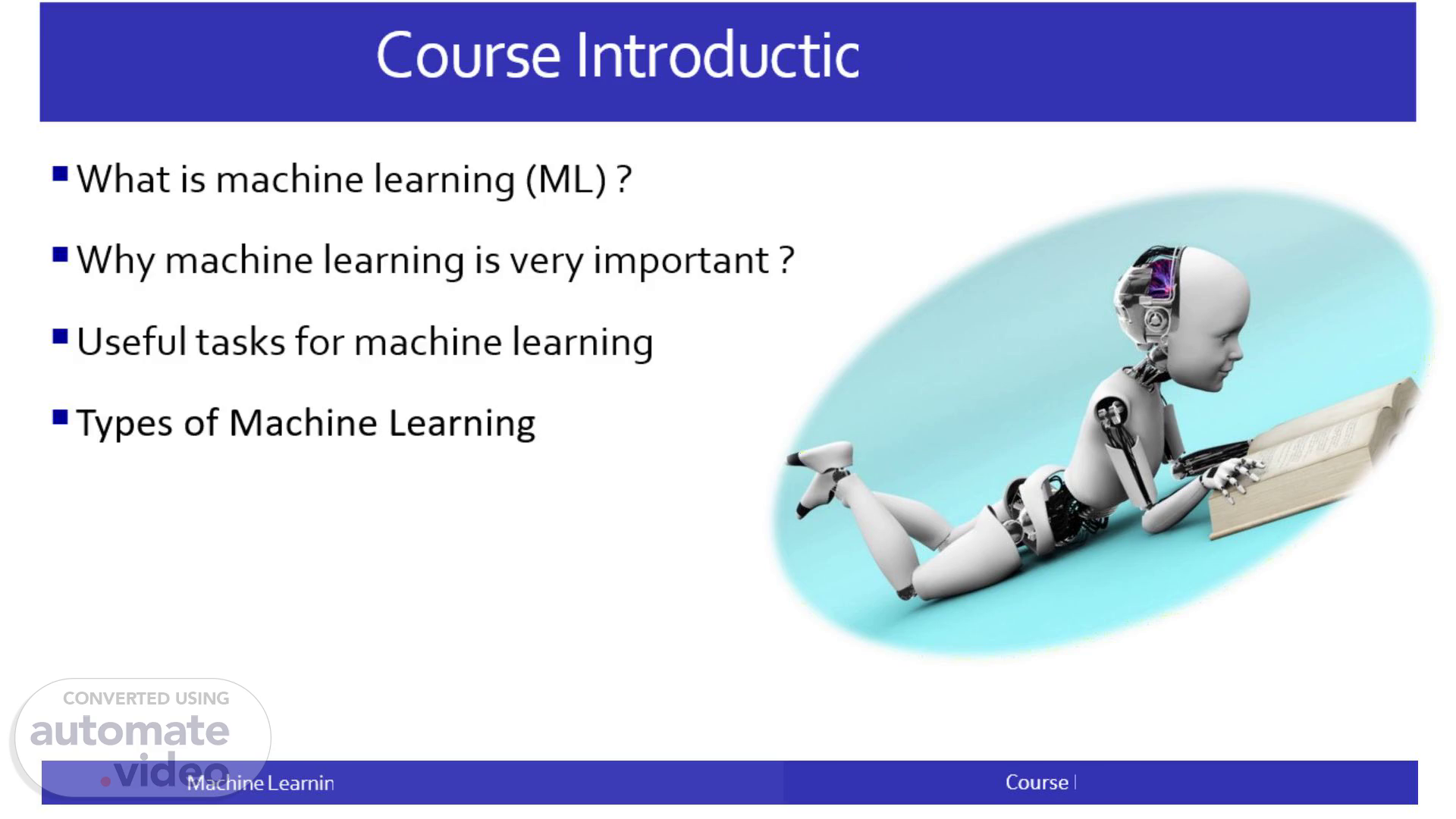
Course Introduction. What is machine learning (ML) ? Why machine learning is very important ? Useful tasks for machine learning Types of Machine Learning.
Scene 2 (11s)
Traditional Programming. Machine Learning. Data Output.
Scene 3 (28s)
Why ML is very important ?. Recently, ML is applied for solving tasks for large- scale application domains. The industry starts rethinking to incorporate machine learning (AI solutions) to automate its process..
Scene 4 (43s)
Useful tasks for machine learning. 1. Classification: Determine the target category of an input ( sample).
Scene 5 (53s)
Useful tasks for machine learning. Example of a classification task.
Scene 6 (1m 1s)
Useful tasks for machine learning. Classification: determine the target category of an input (the sample or example). Recognizing patterns: speech recognition, facial identity, etc..
Scene 7 (1m 13s)
Useful tasks for machine learning. Example of a speech recognition task.
Scene 8 (1m 21s)
Useful tasks for machine learning. Classification: Determine the target category of an input (the sample or example). Recognizing patterns: Speech Recognition, facial identity, etc. Recommender Systems: Recommendation to users (e.g., Amazon, Netflix)..
Scene 9 (1m 35s)
Useful tasks for machine learning. Example of a recommendation task.
Scene 10 (2m 5s)
Useful tasks for machine learning. Classification: Determine the target category of an input (the sample or example). Recognizing patterns: Speech Recognition, facial identity, etc. Recommender Systems: Recommendation to users (e.g., Amazon, Netflix). Information retrieval: Find documents or images with similar content.
Scene 11 (2m 21s)
Useful tasks for machine learning. Example of an Information retrieval task.
Scene 12 (2m 43s)
Useful tasks for machine learning. Classification: Determine the target category of an input (the sample or example). Recognizing patterns: Speech Recognition, facial identity, etc. Recommender Systems: Recommendation to users (e.g., Amazon, Netflix). Information retrieval: Find documents or images with similar content. Computer vision: Detection, Classification, etc..
Scene 13 (3m 2s)
Useful tasks for machine learning. Example of a computer vision task (Detection).
Scene 14 (3m 10s)
Useful tasks for machine learning. a) Normal retinal image b) Abnormal retinal image.
Scene 15 (3m 22s)
Types of Machine learning. Machine Learning. Course Introduction.
Scene 16 (3m 33s)
Course Introduction. PART ONE: DATA ANALYSIS Data Matrix Types of Attributes Graph Data Kernel Methods Dimensionality Reduction PART TWO: CLASSIFICATION Nearest Neighbors Classifier Linear Discriminant Analysis Support Vector Machines PART THREE: CLUSTERING K-means Algorithm DBSCAN Algorithm PART Four: REGRESSION Linear Regression Model Logistic Regression.