Scene 1 (0s)
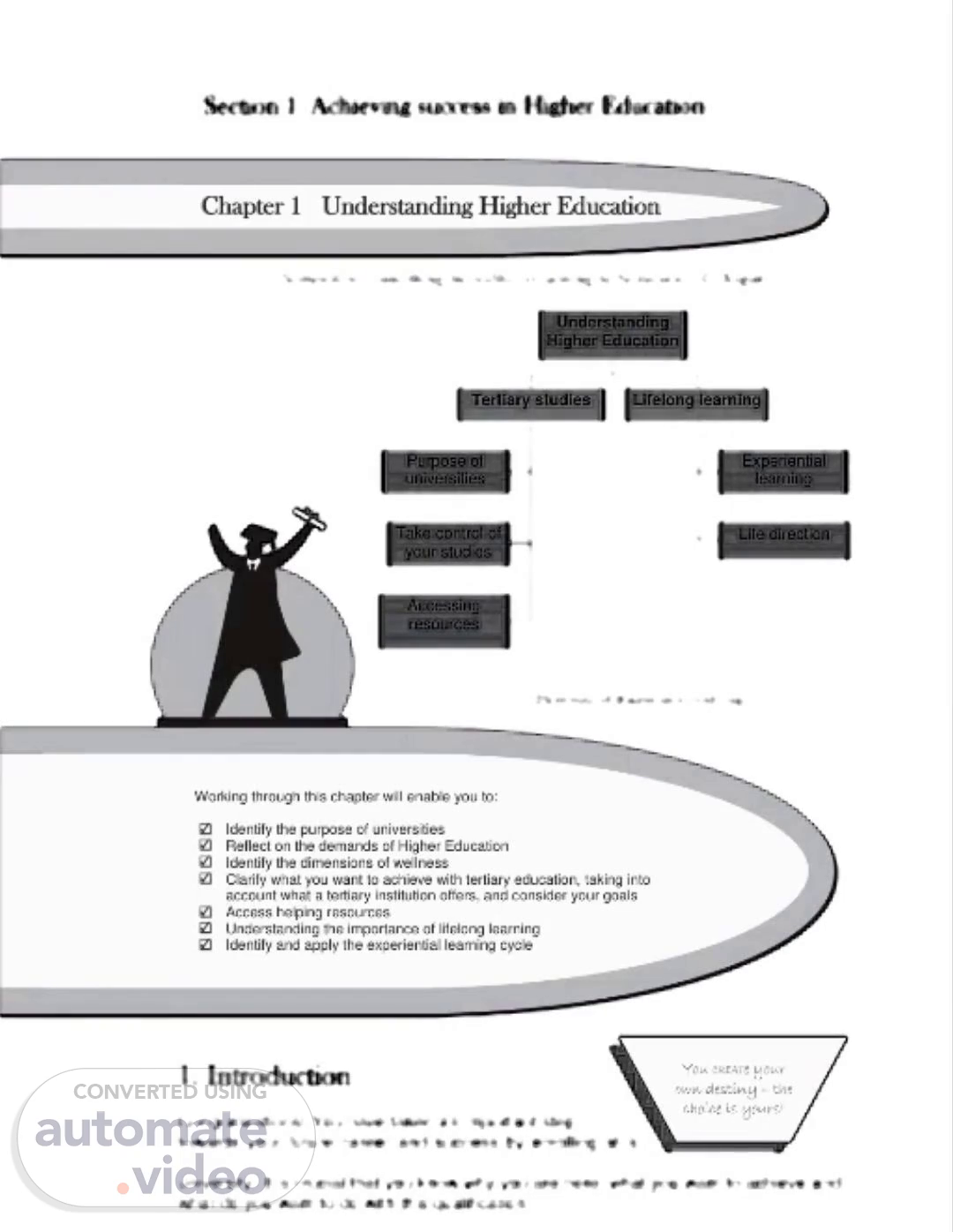
1 “Somewhere, something incredible is waiting to be known.” C Sagan 1. Congratulations! You have taken an important step towards your future career and success by enrolling at a You CREATe your own destiny – the choice is yours! university. It is crucial that you know why you are here, what you want to achieve and what do you want to do with this qualification. Section 1: Achieving success in Higher Education Chapter 1 Understanding Higher Education (Summary of chapter as a mind-map) Working through this chapter will enable you to: Identify the purpose of universities Reflect on the demands of Higher Education Identify the dimensions of wellness Clarify what you want to achieve with tertiary education, taking into account what a tertiary institution offers, and consider your goals Access helping resources Understanding the importance of lifelong learning Identify and apply the experiential learning cycle Understanding Higher Education Tertiary studies Lifelong learning Purpose of universities Experiential learning Take control of your studies Life direction Accessing resources Introduction.
Scene 2 (23s)
[Audio] The voiceover script for this slide is: "You are starting a new journey in your life. This journey is full of possibilities and uncertainties. As you begin this new phase, you need to reflect on your identity and how it relates to your new environment. Your identity is shaped by your experiences, beliefs, and values. Think about what makes you unique and how you can contribute to your new community. Consider how your identity will guide your choices and actions in the coming months. Your identity is not fixed, it can evolve and grow as you navigate this new phase of your life." Your identity is not fixed, it can evolve and grow as you navigate this new phase of your life..
Scene 3 (1m 3s)
[Audio] The essential reason for doing research is that scientific knowledge does not stand still, but expands all the time all over the world. Scientific knowledge is not the property of only one nation, but an ongoing, international enterprise on the part of the entire human and natural scientists in the world. Some tertiary institutions offer formal research opportunities, where lecturers and senior students participate in this ongoing research process by publishing their work regularly. These opportunities allow students to engage with the research process and contribute to the advancement of knowledge in their chosen field. For instance, the Human Sciences, Social Sciences, Natural Sciences, and Health Sciences are areas of research that are traditionally offered at universities. Informal research is also an essential part of the research process. Students need to develop research skills to complete research assignments and to navigate the services provided by the university. Success in research requires a holistic approach, considering both intellectual and personal growth. It involves developing the necessary skills to cope with the social environment of tertiary education, including adjusting to new academic requirements, campus life, as well as relationships with peers. To succeed, students need to understand the role of the lecturer versus that of the student, and how universities serve society. By recognizing these differences, students can develop the learning skills needed to excel in their studies..
Scene 4 (2m 39s)
[Audio] The student's ability to manage their academic career is crucial for achieving success in higher education. To do this, students must be proactive in seeking out resources that will help them succeed. These resources include lecturers, academic support services, and libraries. Students should also develop essential skills such as critical thinking, problem-solving, and time management. By mastering these skills, students can better cope with the demands of higher education and ultimately achieve success..
Scene 5 (3m 44s)
[Audio] The students who attended the seminar were able to identify their strengths and weaknesses in areas such as time management, communication skills, and emotional intelligence. They learned that effective time management is essential for balancing work and study responsibilities. The participants also gained insight into strategies for improving communication skills, such as active listening and assertive expression. Furthermore, they discovered ways to enhance emotional intelligence through self-reflection and mindfulness practices. These new knowledge and skills will enable them to better manage their workload and improve their relationships with peers and instructors..
Scene 6 (4m 37s)
[Audio] Critical thinking, innovation and creativity are essential qualities for success in higher education. These qualities enable us to grasp concepts, reason logically, and apply our understanding and knowledge effectively. They also promote occupational wellness by helping us find suitable occupations and gain satisfaction and fulfillment from our work. Furthermore, academic integrity is crucial for success in higher education. This means being honest and original in our work, and avoiding plagiarism and cheating. By taking control of our studies and using resources effectively, we can achieve academic success and prepare ourselves for life..
Scene 7 (5m 42s)
[Audio] The key to gathering useful information is to be proactive and take initiative. This involves seeking out resources and investigating their availability on your campus. Resources may vary between campuses, so it is crucial to explore those specific to your institution. By asking questions, keeping notes, and utilizing campus maps, you can effectively locate these resources and make informed decisions about how to utilize them. Considering the broader implications of your wellness on your education and lifelong learning can help you maximize your potential and achieve success in higher education..
Scene 8 (6m 47s)
[Audio] The character set used here is HTML code for a horizontal line. Please provide the example text rewritten in English with full sentences only, removing greetings, introductions, and thankings. Lifelong learning is a continuous process where you take charge of your own learning. It requires a positive attitude and being goal-oriented. As a lifelong learner, you look at every day as an opportunity to learn and grow. You reflect on your experiences, both successes and failures, to gain insights and develop your skills. By doing so, you enhance your knowledge, insight, and skills. Today's fast-paced environment demands that you be proactive and self-directed in your learning. With the right mindset, you can unlock your full potential and achieve success in higher education. Each person is unique, and your learning style will be influenced by various factors such as your background, aptitude, attitude, and goals. Therefore, it is essential to reflect on your experiences and adjust your approach accordingly. By embracing experiential learning, you can learn from your experiences, reflect on them, and apply the lessons to future situations. Successful tertiary education is about taking action and making the most of the information and resources available. Ultimately, you are your own teacher, and it is up to you to harness your knowledge and skills to achieve your goals..
Scene 9 (8m 13s)
[Audio] The experiential learning approach emphasizes the importance of taking responsibility for one's own learning. This involves making active decisions about one's learning at all times, being proactive, and taking ownership of one's learning process. The key to this approach is recognizing that the responsibility for learning lies with the individual, and encouraging individuals to become active learners who can reflect on their experiences and make changes accordingly..
Scene 10 (9m 18s)
[Audio] The key to success in higher education lies in taking control of one's own studies and life direction, which can be achieved through effective reflection. Reflecting on an experience allows us to delve deeper into what we saw, felt, and thought during the event. It enhances the richness of our experience and allows us to clarify exactly what it is that we are trying to deal with or reflect on. By examining the experience systematically and thinking it through, we can gain a better understanding of our reactions and emotions. For example, you may have felt anxious because you value being on time, or you may have felt afraid of being asked to leave the lecture room. By reflecting on these emotions, we can start to understand their underlying causes and how we can better handle them in the future. Generalization is the next step, where we form ideas and interpretations about the meaning, value, and effect of the experience. This is where change becomes possible, and we start looking towards the future. We move from the reality inside the activity to the reality of everyday life. Everything that happens to you is your teacher, as Polly B. Berends said. Reflection allows us to learn from our own experiences and apply them to our lives. Many students get lost in a new environment, but those who had a plan or a map were able to navigate successfully. This shows the relevance of reflection and how it can help us in various situations. To apply what we have learned, there is no point in reflecting if we do not use what we have discovered in our daily lives. Therefore, I urge you all to take the time to reflect on your experiences and use that knowledge to shape your success in higher education..
Scene 11 (11m 13s)
[Audio] The student's role in higher education is not just limited to attending classes and listening to lectures. Rather, it involves being an active participant in one's own learning process. The student must take initiative to seek out resources, engage with peers, and participate in discussions. This proactive approach enables students to develop critical thinking skills, problem-solving abilities, and effective communication skills. Furthermore, by taking ownership of their learning, students can identify areas where they need improvement and work towards addressing those gaps. Students who are proactive in their learning will have a greater chance of achieving academic success..
Scene 12 (12m 18s)
[Audio] The character set used here is HTML. The HTML code for the given text is as follows: Self-reflection and the development of self-knowledge are crucial components of a personal career plan. This includes examining your interests, values, personality, goals, current skills and knowledge, aptitude, and attitude to learning. By linking these factors to your career choice, you can determine if your chosen career path aligns with your values and meets the needs of the specific career. It is essential to be honest with yourself during this process, and if necessary, seek assistance from family members, friends, and counselors..
Scene 13 (13m 23s)
[Audio] The students are required to develop their academic, social, and emotional skills to become employable. The university offers various opportunities for students to gain practical experience and build their professional network. Students must also understand the differences between higher education and traditional schooling. They should be prepared to face new challenges and demands, but with the right attitude and support, they can succeed. Developing intellectual and critical thinking skills is crucial for tackling the demands of higher education. Students must take responsibility for their own learning and utilize all the resources available to them. With persistence and determination, students can achieve their goals and secure their future..