Scene 1 (0s)
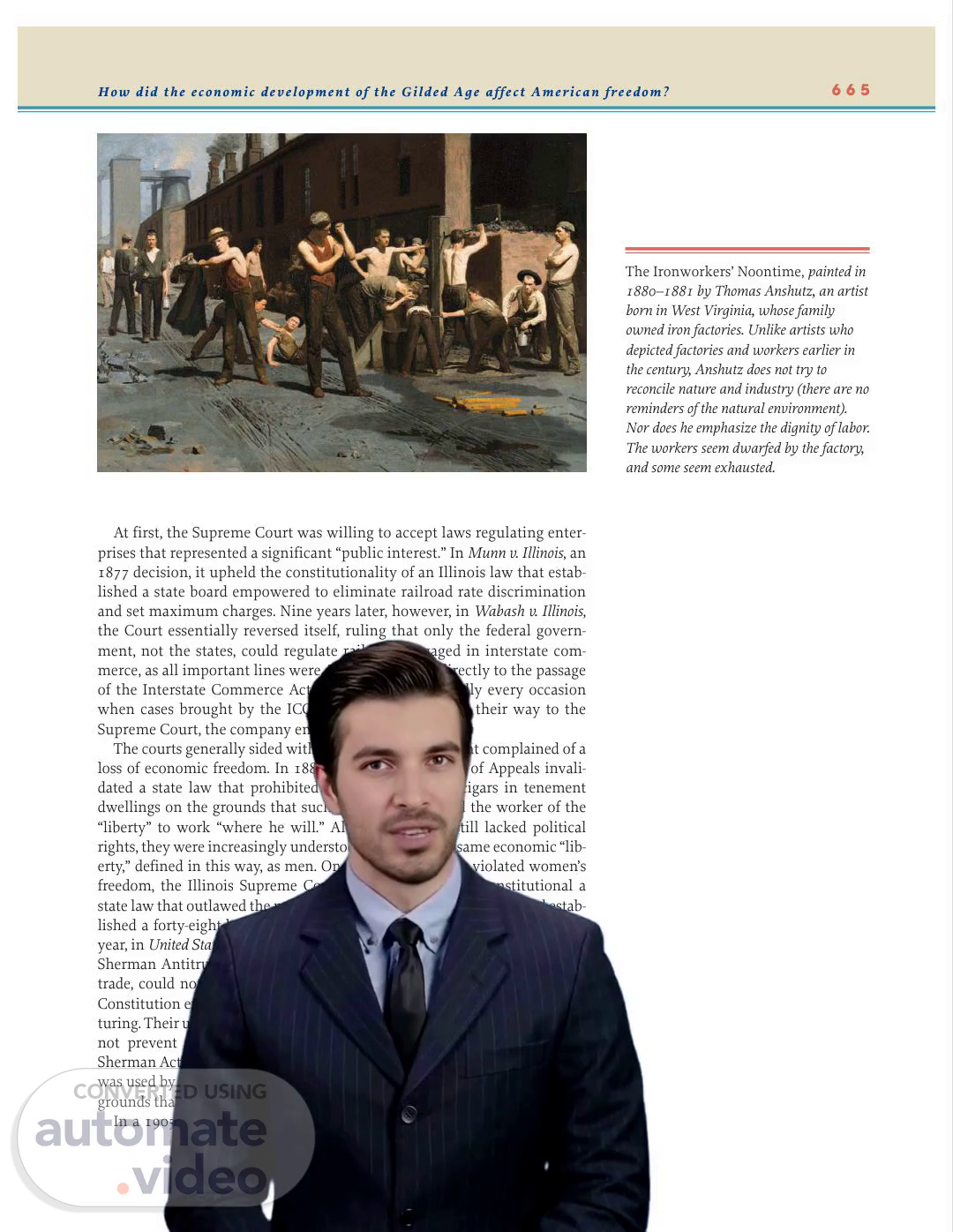
[Virtual Presenter] The United States experienced a period of rapid economic growth known as the Gilded Age in the late 19th century. This era brought about many advancements and opportunities, but it also had a darker side. During this time, unregulated industries and businesses gained immense power and wealth, often coming at the expense of American freedom. The concept of freedom for the American people was significantly impacted by these developments. A painting titled "The Ironworkers' Noontime" by Thomas Anshutz, created in 1880-1881, depicted the harsh realities faced by workers in the iron industry during the Gilded Age. Unlike other artists who attempted to romanticize factories and industry, Anshutz showed the harsh working conditions and the toll it took on the workers. His depiction reflected the lack of concern for the well-being of laborers during this time. The Supreme Court made several significant decisions regarding regulations during the Gilded Age. In the case of Munn v. Illinois, the Court upheld a state law regulating railroad rates in the interest of the public. However, just nine years later, in Wabash v. Illinois, the Court effectively reversed its decision, stating that only the federal government had the power to regulate interstate commerce. This shift in the Court's stance led to the passage of the Interstate Commerce Act of 1887, but the courts continued to favor businesses in subsequent cases brought by the Interstate Commerce Commission. In cases involving economic claims, the courts consistently sided with business enterprises, arguing that their economic freedom was being infringed upon. For example, in 1885, the New York Court of Appeals ruled that a state law prohibiting cigar manufacturing in tenement dwellings was invalid because it deprived workers of their "liberty" to work where they wanted. This ruling highlights the prioritization of economic freedom over the well-being of workers, even at the cost of their health and safety. The economic development of the Gilded Age ultimately impacted American freedom in various ways. While women did not yet possess political rights, they began to be viewed as having the same economic "liberty" as men. This narrow definition of freedom reinforced the dominance of businesses and their interests over the rights and well-being of the American people. In conclusion, the economic development of the Gilded Age had a profound effect on American freedom. The lack of regulations and the prioritization of economic interests over the well-being of workers resulted in a loss of freedom for many Americans. Further exploration of this topic will be presented in the following slides..
Scene 2 (2m 49s)
[Audio] The Gilded Age saw significant economic growth, but it also resulted in a lack of government regulation, leading to court cases like Lochner v. New York, which favored businesses over laborers. The Supreme Court's ruling in this case used the term "Lochnerism" to describe its decisions in favor of individual freedom and the right to contract between employers and employees. However, these interpretations of freedom were not always clear-cut, as seen in the case of Kansas's anti-union law, which allowed employers to make non-membership in a union a condition of employment. This divide between labor and management was a major issue during the Gilded Age, often referred to as the "overwhelming labor question." The Great Railroad Strike of 1877 highlighted the growing tensions between workers and employers, marking the beginning of a national debate on labor rights. Understanding the impact of the Gilded Age on labor and society is crucial to grasping the complexities of this era..
Scene 3 (3m 14s)
[Audio] The wealthy elite continued to accumulate more wealth and power, while the poor struggled to make ends meet. The lack of regulation allowed businesses to exploit workers, leading to long hours, low wages, and poor working conditions. Many workers felt trapped in their jobs with little hope of advancement. The labor movement emerged as a response to these injustices, demanding better working conditions, higher wages, and greater job security. The movement sought to challenge the dominant ideology of Social Darwinism, which held that individuals should compete against each other for survival. The labor movement instead advocated for collective action and social responsibility. They also challenged the concept of liberty of contract, arguing that it gave employers too much power over workers. The labor movement believed that economic rights, such as fair wages and safe working conditions, were essential for achieving true freedom and equality. They argued that the concentration of wealth among a few individuals threatened democracy and undermined the principles of liberty and justice. The labor movement's fight for economic rights became a central issue in American society during the Gilded Age..
Scene 4 (3m 43s)
[Audio] Our discussion now turns to the economic development of the Gilded Age, a period marked by rapid industrial growth and material progress. The lack of regulation during this time infringed upon American freedom. In today's lesson, we will examine how this was reflected in court cases and various social and political movements. Moving on to slide number four, we see an image from Frank Leslie's Illustrated Newspaper depicting the "Great Labor Parade" of September 1st, 1884. This parade, organized by labor unions, aimed to bring attention to the struggles and demands of the working class during the Gilded Age. One of the key themes of this movement was the comparison of Gilded Age employers to the Slave Power of the pre-Civil War era, highlighting the exploitation and lack of rights faced by workers during this time. The labor movement was not the only voice speaking out against the Gilded Age. Writers, such as Henry George, also joined the discourse on the impact of rapid industrialization on American society. In his book, "Progress and Poverty," George highlighted the growing gap between material progress and social inequality. His proposed solution was the implementation of a "single tax" on increases in real estate value to prevent speculation. Despite being seen as extreme by some, George's message gained widespread attention and sparked discussions on the effects of unregulated capitalism. "Progress and Poverty" became one of the most widely read economics books in American history, resonating with millions of people who were drawn to his analysis of economic relationships and call for social justice. At the heart of George's message was the idea of freedom, that true freedom could only be achieved by addressing the issue of industrial slavery, just as the Republican Party had fought against the slavery of black Americans. While his proposed solution may not have been widely accepted, the impact of his message cannot be denied. In our next slide, we will delve deeper into the impact of the Gilded Age on American society and the various movements that emerged in response. Stay tuned for the next part of our discussion..
Scene 5 (4m 37s)
[Audio] The Gilded Age saw the rise of industrialization and urbanization, leading to increased inequality and poverty among the working class. Industrialists and corporations dominated the economy, often disregarding regulations and exploiting workers. Many people believed that capitalism was the key to success, but critics argued that it created a system of haves and have-nots. The wealthy elite enjoyed luxurious lifestyles, while the poor struggled to make ends meet. This disparity was reflected in the high cost of living, particularly in cities like New York and Chicago. The cost of housing, food, and other necessities was extremely high, making it difficult for low-income families to afford basic needs. Many people felt that the government had failed to address these issues, leaving them to seek alternative solutions. Some reformers sought to improve working conditions and reduce income inequality through legislation and activism. However, many others believed that socialism would be a better solution, promoting collective ownership and social welfare. One notable example is the work of Laurence Gronlund, who wrote about the benefits of socialism in his book "The Cooperative Commonwealth". His ideas were influential in shaping the American socialist movement. Despite the challenges faced by socialists, they continued to advocate for change, eventually becoming a significant force in American public life..
Scene 6 (5m 12s)
[Audio] The economic development during the Gilded Age created a lack of regulation and limited American freedom. This was evident through court cases that favored businesses and repealed laws designed to improve working conditions for laborers. As a result, society was characterized by personal dependence and a lack of control over their own lives. In response to this, the labor movement began advocating for reforms such as an eight-hour workday, better working conditions, and more economic equality. Many reformers, including those within the church, started questioning the morality of unregulated capitalism and the pursuit of wealth. This led to the emergence of the Social Gospel movement. The rise of labor activism and the growth of the Knights of Labor marked a significant moment in the fight for workers' rights. On May 1, 1886, thousands of workers took part in demonstrations and protests. As the labor movement gained momentum, it challenged the dominant ideology of the time, which emphasized individual wealth and the "liberty of contract..
Scene 7 (5m 38s)
[Audio] The Haymarket bombing and subsequent trials shed light on the violent clashes between labor and capital during this period, which marked a significant shift in the relationship between labor and politics. This event increased awareness and mobilization among laborers, while also highlighting the vulnerability of labor movements to state repression and the dangers of being labeled as a threat to national security. The Haymarket bombing became a symbol for labor activists, representing the unjust suppression of their rights and freedoms. It also sparked widespread outrage and calls for improved protections for workers. The aftermath of the bombing led to a surge in support for labor causes, as people recognized the need for stronger regulations and better working conditions. Ultimately, this event contributed to the passage of important legislation, including the Sherman Anti-Trust Act and the Fair Labor Standards Act. The Haymarket bombing remains a crucial moment in American labor history, serving as a reminder of the ongoing struggle for workers' rights and the importance of safeguarding those rights..
Scene 8 (6m 5s)
[Audio] The Gilded Age saw an increase in the number of people living in urban areas, leading to overcrowding and poverty among the working class. Many Americans felt that they were being exploited by large corporations and the government. The lack of regulation allowed these corporations to operate with impunity, resulting in poor working conditions and low wages. The Supreme Court ruled in favor of business interests, striking down laws that would have improved working conditions for laborers. The power and influence of the wealthy elite dominated the political landscape, making it difficult for labor movements to gain traction. However, despite these challenges, labor movements emerged throughout the country, with many achieving some form of electoral success. In Kansas City, a coalition of black and Irish-American workers and middle-class voters elected Tom Hanna as mayor, who prioritized the interests of unions over employers. A notable example of a labor campaign was the 1886 strike in New York City, led by Henry George, who ran for mayor on a platform of a single tax on land. Although he did not win the mayoral election, his campaign drew widespread support, with nearly 70000 New Yorkers voting for him. This marked a turning point in the labor movement, demonstrating its growing influence and power in the American political landscape. The need for labor rights and protections became increasingly apparent, highlighting the importance of regulation and oversight. The rise of labor movements also showed the potential for change and progress in this era of rapid economic development. The labor movement's efforts to address issues like poverty, inequality, and poor working conditions helped to shape the course of American history. Ultimately, the Gilded Age laid the groundwork for future social and economic reforms, paving the way for the progressive era of the early 20th century..