Scene 1 (0s)
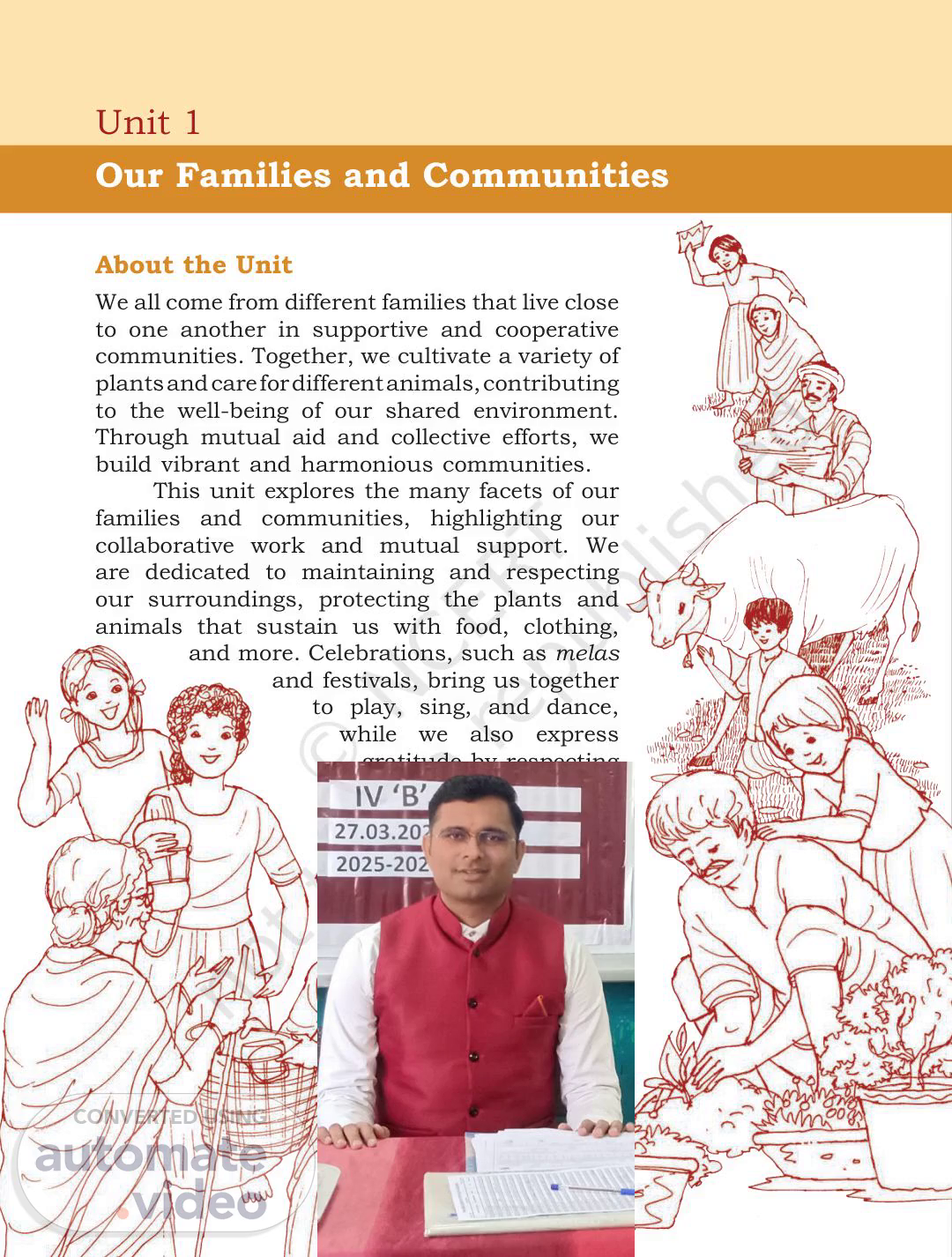
Unit 1 Our Families and Communities About the unit We all come from different families that live close to one another in supportive and cooperative communities. Together, we cultivate a variety of plants and care for different animals, contributing to the well-being of our shared environment. Through mutual aid and collective efforts, we build vibrant and harmonious communities. This unit explores the many facets of our families and communities, highlighting our collaborative work and mutual support. We are dedicated to maintaining and respecting our surroundings, protecting the plants and animals that sustain us with food, clothing, and more. Celebrations, such as melas and festivals, bring us together to play, sing, and dance, while we also express gratitude by respecting the natural elements including the sun, moon, air, water, and soil. Reprint 2026-27.
Scene 2 (1m 19s)
[Audio] The teacher wants to prepare the children for the upcoming chapter on 'Family and Friends'. The teacher will ask the children to bring photographs of their families prior to starting Chapter 1. This activity will allow the children to share and discuss their own family experiences with the class. The teacher will then use these photographs to create a visual display of the different types of families that exist in the community. This will help the children understand the concept of family and its various forms. By doing so, the teacher is encouraging the children to think critically about their own family structures and relationships. Additionally, the teacher may use the photographs to introduce the concept of intergenerational relationships, such as grandparents and siblings, and highlight the importance of mutual support within families. Overall, this activity will lay the foundation for the rest of the chapter by providing a personal connection to the material being presented..
Scene 3 (2m 22s)
[Audio] This is a perfect example of the strong bond within a family. Bela introduces her family dynamics, including her brothers, Banku Bhaiya and Bishu, and their shared love for playing chhupan-chhupai. She also invites the listeners to join in and learn about playing hide-and-seek, promoting interaction and engagement. It highlights how families can come together through shared experiences and activities..
Scene 4 (2m 48s)
[Audio] This part of the presentation showcases the love and care that is put into creating a warm and inviting home environment. The speaker explains that they enjoy spending time with their family playing games like peek-a-boo and antakshari, and sharing laughter. They also mention the contribution of their mother and grandmother, who make the home a happy place by preparing delicious treats such as pakodas and tea. The speaker emphasizes the importance of intergenerational relationships and community connections, as their nearby grandparents also participate in these activities. This highlights the ability of families to come together and create meaningful moments, even on rainy days. The speaker's emphasis on spending quality time with family members and cherishing each other's company illustrates a strong sense of family values and commitment. This is a valuable lesson that we can all learn from and strive to implement in our own homes..
Scene 5 (3m 50s)
[Audio] The family gathers around the small shelter in the garden on rainy days. They play board games such as Antakshari and Snakes and Ladders. The mother and grandmother, who are referred to as Dadiji, prepare hot snacks like pakodas and tea. Everyone enjoys the pakodas together. Dadiji sings songs about the rain, which Bela joins in on. She learns some of these songs from Dadiji and sings them with her family. Bela writes a poem called A Rain Song, describing the beauty of the rainy day. In this poem, she sees paper boats floating in puddles, birds perched on trees, peacocks dancing, and the overall beauty of the scene. Bela's family values spending time together and enjoying each other's company, especially on rainy days..
Scene 6 (4m 41s)
[Audio] Today's lesson is focused on families and communities, and the importance of supporting and caring for one another, as well as celebrating together. We will explore different aspects of families and communities, starting with Bela's family on slide six. Can you think about the members in Bela's family and what makes your own family unique? It's important to show love and support to our family members, despite our differences. Let's also consider how rain affects our families - do you stay inside and play games, or go on an adventure together? Rain can be a great bonding opportunity for families. Let's take a moment to sing a rain song with our classmates, as music is a great way to bring people together. On slide six, you will find a table for you to fill out with the names of your family members and how you address them. Let's also write down the special relationship we have with each family member - whether it's laughing together or cooking together. Remember, family is not just limited to our blood relatives, it can also include close friends and community members. Let's celebrate the diversity of families and communities in our world. I hope you have a better understanding of the importance of families and communities. Let's continue to support, care for, and celebrate with those around us. See you on our next slide..
Scene 7 (6m 6s)
[Audio] Today we will be discussing slide number 7 out of 18 in our presentation on families and communities. This slide is titled 'Family and Friends' and it emphasizes the significant role our loved ones play in our lives. We all have someone special in our family who teaches us valuable lessons and shares their wisdom with us. In this case, it is Banku and Bela's grandfather, known as Dadaji. He has passed down games from his childhood to his grandchildren, creating a beautiful bond between them. Even their dog, Shiru, holds a special place in their family and brings them joy. It's inspiring to see how Banku and Bela care for Shiru and share their love with him. Now, let's take a moment to reflect on our own families. Do you know what games your grandparents used to play as children? Learning about our family history and traditions can be fascinating. Our families may be unique, but one thing remains constant- our love for them. In addition to our parents, children, and grandparents, we also have our friends who are like an extended family, always there to have fun with us. So, let's remember the important lesson from this slide- the value of family and friends. Thank you for listening, and I'll see you in the next slide..
Scene 8 (7m 30s)
[Audio] Today in our class, we will be discussing families and communities. Specifically, we will be focusing on the diversity within them and the importance of mutual support, caring for the environment, and celebrating together. Let's continue with our lesson by looking at slide number 8 out of 18. This slide features a beautiful image of a family and some thought-provoking questions. Families are made up of people who care about each other and each family is unique in its own way. Now, let's think about Bela's family - would you classify it as a big or small family? Remember, families come in all shapes and sizes. If you observe your neighborhood, you will find various types of families. Some may have few members while others may have many. It's essential to accept and appreciate the diversity of families within our communities. Let's now consider the games and activities we play with our family members, especially our elders. Do you have any special traditions or games that you enjoy doing with your family? Share them with us. Moving on, let's talk about the animals that come to our homes or neighborhoods. Have you ever shared food with them? What was your experience like? Remember, it's crucial to treat animals with love and respect, just like any other family member. Let's make a promise to protect and care for the animals around us. As we continue to learn about the wonders of the world and the importance of families and communities, let's always be inclusive and compassionate towards one another..
Scene 9 (9m 3s)
[Audio] The speaker emphasizes that every individual has a family, whether it is biological or not. The speaker highlights the importance of showing love and support to family members, regardless of the task they may require. The speaker encourages students to observe their own family dynamics and identify the activities listed on the slide that occur within their family. The speaker concludes by emphasizing the significance of appreciating and caring for one's family, as well as recognizing the value of community and friendship..
Scene 10 (9m 37s)
[Audio] The family members in our community are very supportive and helpful. They provide us with food, shelter, and clothing. The children in our village go to school to learn various skills such as reading, writing, and mathematics. The teachers at the school teach them these subjects using different methods such as lectures, discussions, and hands-on activities. The students also participate in extracurricular activities like sports, music, and art. These activities help them develop their physical and mental abilities. The villagers also come together to maintain the cleanliness of their homes and public spaces. Everyone works together to keep their community clean and healthy. This sense of community and cooperation is essential for the well-being of individuals and society as a whole. By working together, people can achieve great things and build strong relationships..
Scene 11 (10m 30s)
[Audio] The company has been working on a new project for several years, but it has not yet reached its full potential. The project involves developing a new type of aircraft that can fly at high speeds and make long-distance flights more efficient. The company has made significant progress in this area, with several prototypes already built and tested. However, there are still some challenges to overcome before the project can be completed..
Scene 12 (10m 59s)
[Audio] I learned many things from my family members and my neighbors. My mother taught me how to cook food. My father taught me how to play cricket. My grandmother taught me how to take care of plants. My neighbor taught me how to ride a bicycle. I learned how to share and care for each other from my family members. I learned how to be kind and helpful from my parents. I learned how to respect others by listening to them and being patient. I learned how to work together as a team from my siblings. I learned how to appreciate nature by spending time outdoors with my family. I learned how many different types of animals there are from watching birds and insects with my family. I learned how to take care of myself by taking care of my own needs and being responsible. I learned how to communicate effectively by talking to my family members and expressing my feelings. I learned how to solve problems by working together with my family. I learned how to celebrate special occasions by participating in festivals and traditions with my family. I learned how to show love and affection by giving hugs and kisses to my family members. I learned how to be grateful by appreciating what I have and being thankful for my family. I learned how to forgive and forget by understanding that everyone makes mistakes and apologizing when needed. I learned how to be creative by making art and crafts with my family. I learned how to be brave by trying new things and facing challenges head-on. I learned how to be patient by waiting for things to happen and not getting frustrated. I learned how to be kind by doing good deeds and helping others. I learned how to be responsible by completing tasks and taking care of my belongings. I learned how to be respectful by treating others with kindness and consideration. I learned how to be selfless by putting others before myself and being willing to help those in need. I learned how to be humble by recognizing my strengths and weaknesses and being open to feedback. I learned how to be generous by sharing my resources and time with others. I learned how to be honest by telling the truth and being transparent. I learned how to be loyal by standing by my family and friends and being committed to our relationships. I learned how to be optimistic by looking on the bright side and expecting good things to happen. I learned how to be punctual by arriving on time and respecting other people's time. I learned how to be quiet by listening carefully and not interrupting others. I learned how to be thoughtful by considering others' feelings and needs. I learned how to be trustworthy by keeping promises and being reliable. I learned how to be enthusiastic by showing excitement and energy when engaging in activities. I learned how to be adventurous by trying new things and exploring new places. I learned how to be confident by believing in myself and my abilities. I learned how to be courageous by facing challenges head-on and standing up for what I believe in. I learned how to be curious by asking questions and seeking knowledge. I learned how to be determined by setting goals and working towards achieving them. I learned how to be diligent by staying focused and motivated. I learned how to be energetic by maintaining my physical and mental well-being. I learned how to be flexible by adapting to changing circumstances and being open to new ideas. I learned how to be friendly by being approachable and welcoming to others. I learned how to be hardworking by putting in effort and striving for excellence. I learned how to be imaginative by thinking creatively and coming up with.
Scene 13 (14m 38s)
[Audio] The two friends I enjoy playing with at home and in my neighborhood are Banku Bhaiya and Bishu. I have a close relationship with my dadaji, who teaches me games he used to play with friends when he was my age. He also plays games with me and my brother. Dadaji holds a special place in our household as a member of our family. He generously shares food with me and my brother, and I have a deep love and appreciation for him. In addition to my dadaji, I also love my mom, brother, and everyone in my family. I also have a strong fondness for my neighbors and community. My school holds a special place in my heart as well, and I have love for all my teachers, classmates, and everyone in my school..
Scene 14 (15m 25s)
[Audio] My mom is the oldest person in my family. She takes care of me and my dad. They both work hard to give me everything I need. My mom cooks delicious food for me and my dad teaches me new things every day. My brother is the youngest person in my family. He is very playful and always makes me laugh. My parents love each other very much and show it by hugging each other. They also take care of my brother and me. Everyone in my family loves each other and we celebrate our special occasions together. We have lots of fun together and that's what makes our family happy..
Scene 15 (16m 1s)
[Audio] The family members who are closest to us are called relatives. Relatives can be either biological or non-biological. Biological relatives are those who are born from our parents. Non-biological relatives are those who are not born from our parents but whom we still consider as family. Examples of non-biological relatives include aunts, uncles, cousins, and grandparents. Grandparents are often considered as extended family members because they are not always living with their children. Many families have grandparents who live separately from their children. However, grandparents are an essential part of our lives. They provide guidance, support, and love to their grandchildren. Grandparents often teach their grandchildren various skills such as cooking, gardening, and crafts. They also provide emotional support during difficult times. Grandparents can be male or female. Both males and females can serve as grandparents. The role of a grandfather is different from that of a grandmother. While grandmothers often take on a nurturing role, grandfathers may take on a more authoritative role. However, both grandmothers and grandfathers play a vital role in the life of their grandchildren. Grandchildren also have a significant impact on their grandparents. Grandchildren bring joy and happiness to their grandparents. Grandchildren can also teach their grandparents new things. Grandchildren can introduce their grandparents to new hobbies and interests. Grandchildren can also provide companionship to their grandparents. Companionship is essential for elderly grandparents. Grandchildren can visit their grandparents regularly and spend quality time with them. Regular visits can strengthen the bond between a child and their grandparents. Grandchildren can also show respect to their grandparents. Respect is essential for building strong relationships. Grandchildren should treat their grandparents with kindness and consideration. Kindness and consideration go a long way in maintaining a healthy relationship. Grandchildren can make their grandparents feel loved and appreciated. Love and appreciation are essential for grandparents. Grandchildren can also make their grandparents proud. Pride is essential for grandparents. Grandchildren can achieve great things and make their grandparents proud. Grandchildren can also make their grandparents happy. Happiness is essential for grandparents. Grandchildren can bring happiness into their grandparents' lives. Grandchildren can also make their grandparents feel useful. Feeling useful is essential for grandparents. Grandchildren can give their grandparents tasks to complete. Tasks can make grandparents feel useful. Grandchildren can also give their grandparents gifts. Gifts can make grandparents feel special. Grandchildren can also give their grandparents advice. Advice can make grandparents feel valued. Grandchildren can also give their grandparents attention. Attention is essential for grandparents. Grandchildren can spend quality time with their grandparents. Quality time is essential for grandparents. Grandchildren can also make their grandparents laugh. Laughter is essential for grandparents. Grandchildren can bring laughter into their grandparents' lives. Grandchildren can also make their grandparents feel connected. Feeling connected is essential for grandparents. Grandchildren can make their grandparents feel part of something bigger than themselves. Feeling part of something bigger is essential for grandparents. Grandchildren can also make their grandparents feel grateful. Gratitude is essential for grandparents. Grandchildren can make their grandparents feel thankful. Thankfulness is essential for grandparents. Grandchildren can also make their grandparents feel at peace. Peace is essential for grandparents. Grandchildren can bring peace into their grandparents' lives. Grandchildren can also make their grandparents feel content. Contentment is essential for grandparents. Grandchildren can make their grandparents feel satisfied. Satisfaction is essential for grandparents. Grandchildren can also make their grandparents feel fulfilled. Fulfillment is essential for grandparents. Grandchildren can bring fulfillment into their grandparents' lives. Grandchildren can also make their grandparents feel like they belong. Belonging is essential for grandparents. Grandchildren can make their grandparents feel like they are part.
Scene 16 (20m 31s)
[Audio] The speaker describes a scene where they are at the park with their dadaji on a holiday. They join their friends who are playing pitthoo, a game involving throwing stones into holes. Their team piles the stones quickly, but then their opponents try to hit them with a ball to make them lose. It was fun, and they started to feel tired. The game involves social interaction and physical activity. Their dadaji brought a ball to scatter the stones. The overall tone is one of enjoyment and camaraderie. Having fun and being active with family and friends is very important..
Scene 17 (21m 9s)
[Audio] The speaker describes a scene where family members spend quality time together. The father figure, referred to as Dadaji, buys ice cream for the children after they've been playing outside. As the day comes to a close, they go home together, indicating a sense of unity and togetherness. The speaker then shifts focus to a reflective activity, asking students to write down how family members show their love and care for one another. This prompts students to think critically about the ways in which family members demonstrate affection and support. The second part of the prompt encourages students to draw pictures of happy moments shared with their own families. This allows students to express their creativity and showcase the positive aspects of their family relationships. By engaging in this reflective activity, students can develop a deeper understanding of the importance of family bonds and the value of nurturing those relationships..
Scene 18 (22m 6s)
[Audio] I have learned a great deal from my grandparents. They taught me various traditional games such as banku and other activities. I gained knowledge about our cultural heritage and customs through them. My grandfather possesses exceptional wisdom and often shares stories about our ancestors. He instructs me on how to care for plants and animals. I assisted my grandmother in maintaining her garden. She guided me on planting seeds and watering them correctly. I am responsible for caring for my pet dog, Shiru, by providing food and engaging in playtime with him. I also help my neighbors by lending them my toys and assisting them with their daily tasks. I contribute to the well-being of the environment by collecting waste and ensuring our community remains clean. I participate in festive celebrations and holidays alongside my family and friends. I firmly believe that acquiring knowledge from elderly individuals is crucial because it enables us to comprehend our origins and core values..