Scene 1 (0s)
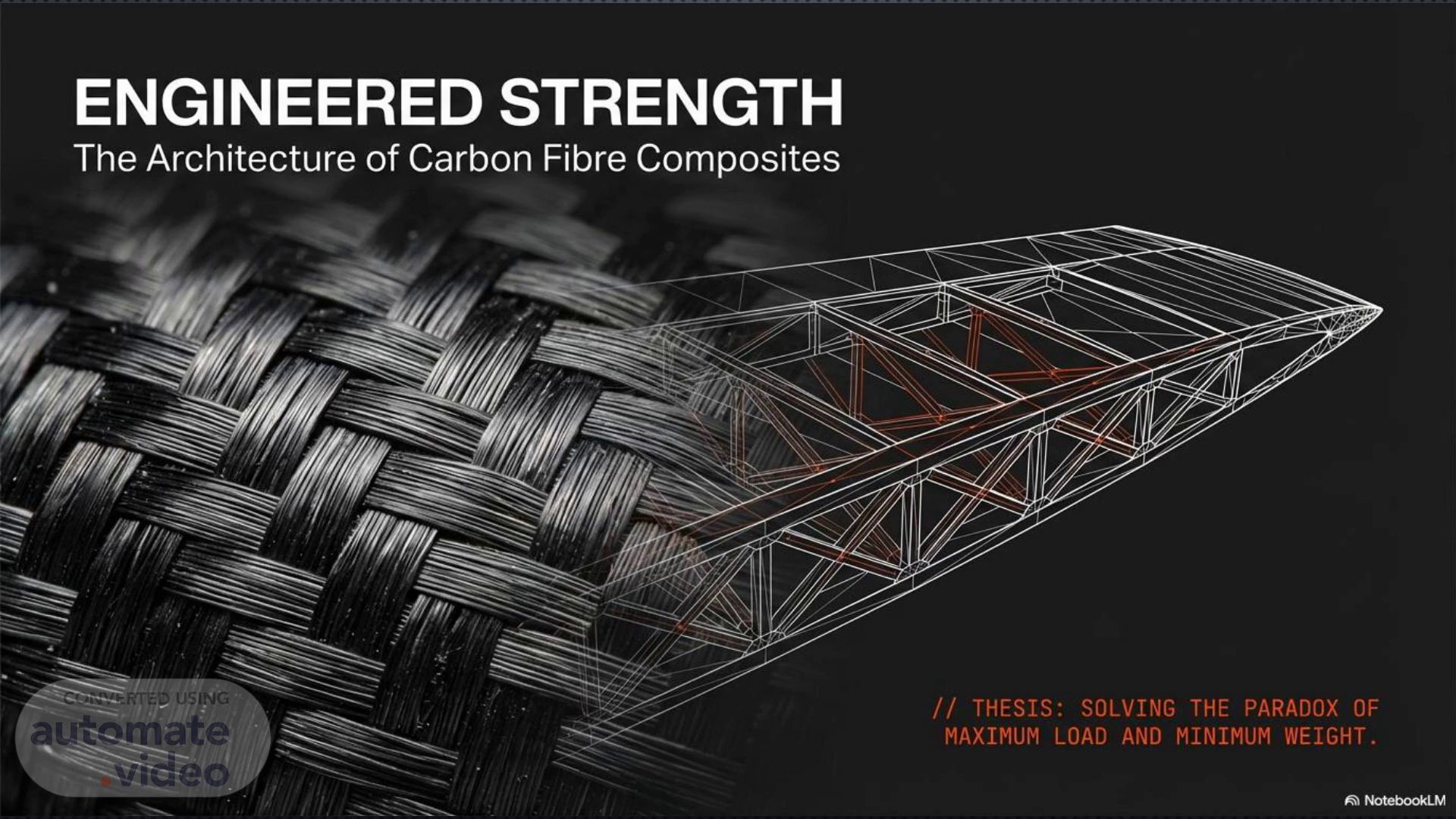
ENGINEERED STRENGTH The Architecture of Carbon Fibre Composites // THESIS: SOLVING THE PARADOX OF MAXIMUM LOAD AND MINIMUM WEIGHT. NotebookLM.
Scene 2 (9s)
THE ENGINEERING PARADOX LOAD CAPACITY O STRUCTURAL MASS Carbon fibre composites are not chosen because they are 'advanced.' They are chosen because they solve a specific problem: > How do you carry high loads white keeping weight extremely low? In aerospace, motorsport, and wind energy, this equation is not optional—it is the defining requirement. NotebookL.
Scene 3 (24s)
THE FAILURE OF CONVENTIONAL MATERIALS METALS [+] Strong & Tough [-] Heavy [-] Prone to fatigue & corrosion POLYMERS Lightweight & Cheap Low Strength Low Stiffness CERAMICS Stiff & Heat Resistant Brittle / Catastrophic Failure CONCLUSION: NO SINGLE NATURAL MATERIAL FILLS THE CENTER OF THE TRIANGLE. WE MUST BUILD A HYBRID..
Scene 4 (36s)
BUILDING THE PERFECT MATERIAL High Strength-to- Weight Ratio METALS Carbon Fibre Reinforced Polymer (CFRP) exists to combine the best properties of its constituents white filtering out the weight of metal and the weakness of plastic. (Composite) POLYMERS Excellent Fatigue Resistance High Stiffness-to- Weight Ratio NotebookLM.
Scene 5 (49s)
THE COMPOSITE SYSTEM EQUATION REINFORCEMENT (Fibre) // The Muscle: Load Carrying MATRIX (Resin) // The Tendon: Transfer & Protection + = PERFORMANCE INTERFACE // The Bond: Transfer Efficiency Insight: We do not find this material; we build it. NotebookLM.
Scene 6 (1m 2s)
THE FIBRE: ATOMIC-LEVEL STRENGTH COVALENT BOND DIRECTION Carbon fibres consist of aligned graphitic planes. Load is carried through strong covalent bonds along the fibre axis. "Strength comes from bond directionality , not // PROPERTIES: - High Tensile Strength - High Elastic Modulus - Low Density - Near-Zero Thermal Expansion bulk material. " NotebookLM.
Scene 7 (1m 17s)
Engineered Architecture THE MATRIX: THE UNSUNG HERO 0000 00000000 oooooooooooo THE MATRIX CARRY THE MAIN LOAD. JOB DESCRIPTION: Bind the fibres together Transfer stress via shear Prevent fibre buckling (Compression) Protect against moisture & abrasion NotebookLM.
Scene 8 (1m 28s)
HOW IT WORKS: LOAD TRANSFER SHEAR TRANSFER 1. 2. 3. Load applied to composite. EXTERNAL LOAD Matrix transfers toad to fibres via shear. Fibres carry the majority of the load . FAILURE MODES: Fibre Breakage Matrix SHEAR TRANSFER Cracking Interface Debonding NotebookLM.
Scene 9 (1m 40s)
THE PHILOSOPHY OF ANISOTROPY ISOTROPIC (Metal) Uniform strength in att directions. Design Implication: Engineers must design the ANISOTROPIC (Composite) Strength exists ONLY where fibres are placed. fibre orientation, not just the part geometry. NotebookLM.
Scene 10 (1m 52s)
MANUFACTURING STEP 1: FOUNDATION HEAT (N3000c) EXTREME HEAT o PAN Precursor Stabilization Oxygen Absorption Spinning Result : Carbonization Removal of non-carbon atoms Alignment of Graphitic Layers A fibre defined by purity and atomic alignment. NotebookLM.
Scene 11 (2m 3s)
MANUFACTURING STEP 2: FIBRE FORM UNIDIRECTIONAL TAPE Fibres run one way Maximum strength along axis Zero crimp WOVEN FABRIC Interlaced fibres Multidirectional strength Easier handling / draping NotebookLM.
Scene 12 (2m 12s)
MANUFACTURING STEP 3: IMPREGNATION • METHODS: Prepreg (Pre-impregnated) RTM (Resin Transfer Molding) Vacuum Infusion RESIN SYSTEM INTRODUCTION CRITICAL VARIABLES: Fibre Volume Fraction Void Content (Air = Failure) bubbles Resin Viscosity The 'Secret Sat-JCe' : This step decides final strength more than fibre quality. NotebookLM.
Scene 13 (2m 25s)
MANUFACTURING STEP 4: LAY-UP & INTELLIGENCE STRUCTURAL LOGIC: • Fibres oriented along calculated load paths. • Stacking sequence creates symmetry. 900 Result: I Customized' material properties. NotebookLM.
Scene 14 (2m 35s)
MANUFACTURING STEP 5: CURING HEAT (Cross-linking) PRESSURE (Consolidation) VACUUM (Void Removal) Resin cross-links and hardens permanently. are locked in Fibres position . processing Autoclave maximizes Fibre- the Matrix bond NotebookLM.
Scene 15 (2m 44s)
THE PERFORMANCE REALITY MATERIAL COMPARISON (JetBrains Mono) Steel Aluminum CFRP (Carbon Composite) XO.X GPa/(g/cm3) 20.X GPa/(g/cm3) 45.X GPa/(g/cm3) 45.X GPa/(g/cm3) Lighter than Aluminum. Stronger than Steel per unit weight. SPECIFIC STRENGTH LEADER XX.X GPa/(g/cm3) 111 Specific Strength (Orange/Grey) Specific Stiffness (White Outline) NotebookLM.
Scene 16 (3m 1s)
APPLICATIONS: WHERE WEIGHT IS THE ENEMY AEROSPACE // Fuel Efficiency & Payload MOTORSPORT // Acceleration & Safety ENERGY // Fatigue Life Efficiency SPORTS Human Extension NotebookLM.
Scene 17 (3m 10s)
THE BRUTAL TRUTH: COST OF PERFORMANC-= FINANCIAL Expensive raw materials. Labor-intensive processing. OPERATIONAL Extremely difficult to repair or inspect. BRITTLE FAILURE MECHANICAL Impact sensitive. Failure is sudden (Brittle)—no bending warning tike metal. ENVIRONMENTAL Recycling is a nightmare. Thermoset plastics do not melt..
Scene 18 (3m 24s)
[Virtual Presenter] REFERENCES: https://youtu.be/1JpfOjKrw58?si=6dqW5XQo-1_rA-CC https://youtu.be/1JpfOjKrw58?si=6dqW5XQo-1_rA-CC.
Scene 19 (3m 48s)
DESIGNED, NOT INHERITED Carbon fibre composites are powerful because their strength is designed, not inherited. Manufacturing defines the material behavior. It is the ultimate expression of engineering intent. // WEIGHT SAVINGS DOMINATE SYSTEM-LEVEL PERFORMANCE. NotebookLM.