Scene 1 (0s)
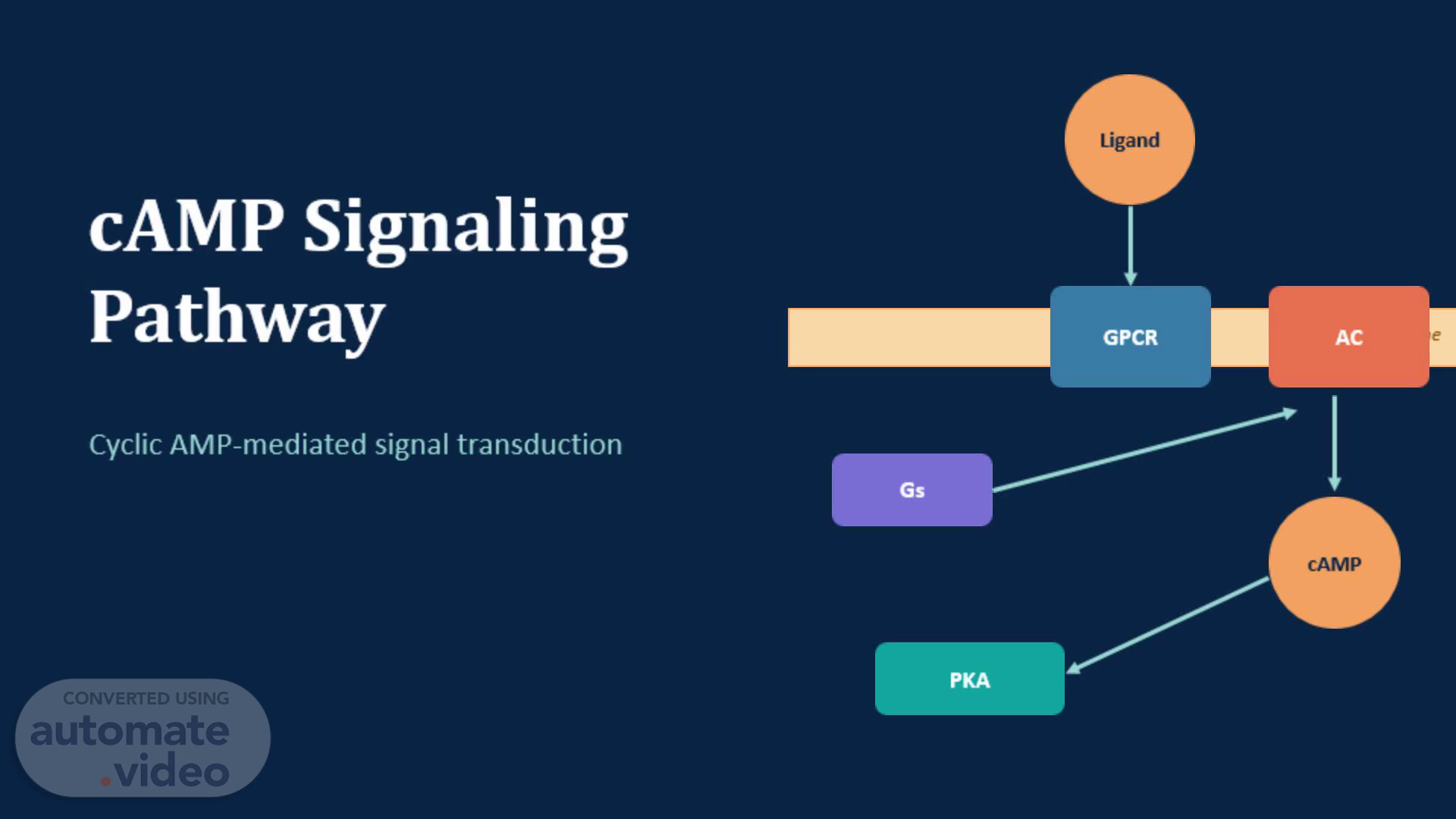
[Audio] Ligand cAMP Signaling Pathway GPCR AC Plasma membrane Cyclic AMP-mediated signal transduction Gs cAMP PKA Welcome. This talk covers the cAMP pathway, the classic second-messenger system: from hormone binding at a GPCR to PKA-driven cellular responses and gene expression..
Scene 2 (27s)
[Audio] Introduction cAMP = cyclic adenosine 3′,5′-monophosphate, made from ATP Second messenger: relays hormone signals from membrane to cytosol Amplifies and transduces extracellular signals Extracellular Hormone GPCR AC Plasma membrane Cytosol cAMP Major functions Metabolism Gene expression Cellular response Ion channel control Growth & differentiation cAMP was the first second messenger discovered (Sutherland). It converts a hormone signal at the membrane into an intracellular response, amplifying it along the way..
Scene 3 (1m 10s)
[Audio] Components of the cAMP Pathway MEMBRANE Ligand Hormone, first messenger GPCR 7-TM receptor G-protein Gαβγ; Gαs activates AC Adenylyl cyclase Makes cAMP from ATP substrate CYTOSOL ATP Substrate cAMP Second messenger PKA R₂C₂ effector kinase PDE cAMP → 5′-AMP PDE terminates the signal by degrading cAMP Eight components: ligand, GPCR, Gs, adenylyl cyclase, ATP as substrate, cAMP as messenger, PKA as the main effector, and PDE for termination..
Scene 4 (1m 58s)
[Audio] Activation and cAMP Formation Ligand Ligand binds GPCR; receptor changes shape GPCR Adenylyl cyclase Plasma membrane Gαs swaps GDP for GTP, separates from βγ Gαs: GDP → GTP Gαs·GTP activates adenylyl cyclase: ATP → cAMP + PPi cAMP ATP Ligand binding causes a GPCR conformational change that acts as a GEF for Gαs, which swaps GDP for GTP. Gαs-GTP then stimulates adenylyl cyclase to convert ATP to cAMP and pyrophosphate..
Scene 5 (2m 48s)
[Audio] PKA Activation and Cellular Response Inactive PKA (R₂C₂) R₂·(cAMP)₄ R R + 4 cAMP C C ATP → ADP 2 C (active) Target protein Protein–P cAMP binds R subunits → C subunits released → Ser/Thr phosphorylation Glycogen breakdown ↑ Lipolysis ↑ Ion channel & enzyme regulation Four cAMP molecules bind the regulatory subunits of the R2C2 tetramer, releasing two active catalytic subunits that phosphorylate Ser/Thr residues, for example activating phosphorylase kinase and inhibiting glycogen synthase..
Scene 6 (3m 34s)
[Audio] cAMP–CREB Pathway Cytoplasm Nucleus cAMP PKA CREB CREB–P (Ser133) Active C CRE (TGACGTCA) mRNA Gene products Active PKA catalytic subunits enter the nucleus and phosphorylate CREB at Ser133. CREB-P recruits CBP/p300 and binds cAMP response elements (CRE) to switch on target genes such as PEPCK and c-fos..
Scene 7 (4m 7s)
[Audio] Termination and Biological Examples Termination Biological examples GTP → GDP (Gαs GTPase) Adrenaline Glycogen breakdown (liver, muscle) Adenylyl cyclase inactivated Glucagon Glucose metabolism ↑ (liver) PDE: cAMP → 5′-AMP ACTH Steroidogenesis (adrenal cortex) Phosphatases remove phosphate Termination: intrinsic GTPase of Gαs, AC inactivation, PDE hydrolysis of cAMP to 5′-AMP, and phosphatases (PP1/PP2A) reversing PKA phosphorylation. Examples: adrenaline (glycogenolysis), glucagon (glucose mobilization), ACTH (adrenal steroid synthesis)..
Scene 8 (5m 9s)
[Audio] Complete Pathway and Conclusion Ligand GPCR Gs protein Adenylyl cyclase ATP Cellular response Target proteins / CREB PKA cAMP PDE 5′-AMP Signal termination Amplifies weak hormone signals Rapid and reversible Controls metabolism and gene expression Drug target: PDE inhibitors, β-agonists Summary: signal flows ligand → GPCR → Gs → AC → cAMP → PKA → targets/CREB → response, and PDE converts cAMP to 5′-AMP to end it. Key takeaways: amplification, speed and reversibility, dual control of metabolism and transcription, and clinical relevance..