Scene 1 (0s)
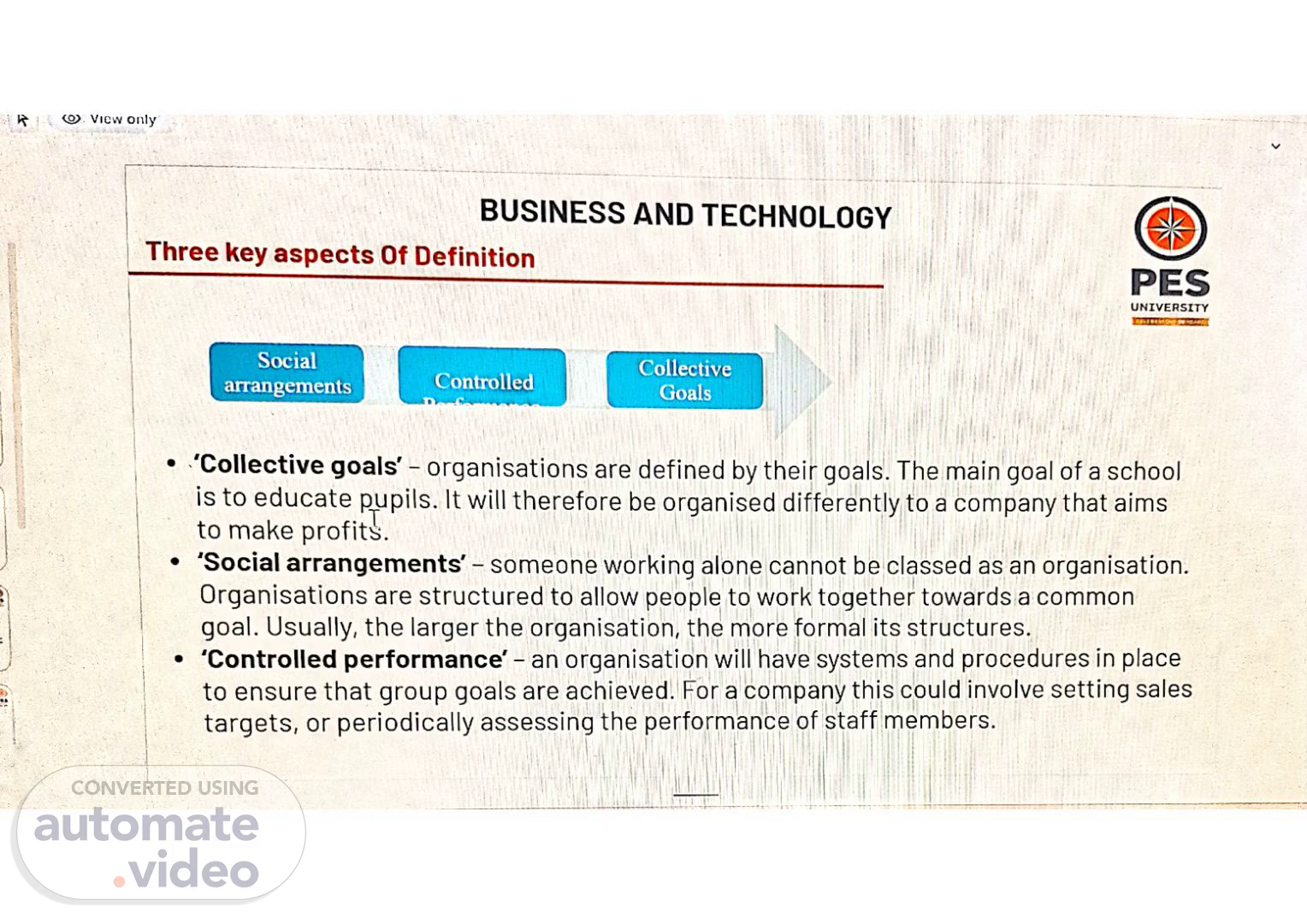
BUSINESS AND TECHNOLOGY Three key aspects Of Definition Social arrangements Controlled PES UNIVERSITY Collective Goals • 'Collective goals' - organisations are defined by their goalÅ. The main goal ofa school is to educate pupils. It will therefore be organised differently to a company that aims to make profits. • 'Social arrangements' - someone working alone cannot be classed as an organisation. Organisations are structured to allow people to work together towards a common goal. Usually, the larger the organisation, the more formal its structures. • 'Controlled performance' - an organisation will have systems and procedures in place to ensure that group goals are achieved. For a company this could involve setting sales targets, or periodically assessing the performance of staff members..
Scene 2 (27s)
Astra N . Your Copy o' 1. l.pptx - Google SEI. X PPIs - Google Drive presentation/d/l IWa9Sspjfz0RSoF8EZYW12MOhiOqONDM/edit View only BUSINESS AND TECHNOLOGY Purpose of Business Organizations Organisations enable people to: etmm PES UNIVERSITY • Share skills and knowledge - this can enable people to perform tasks that they would be unable to achieve on their own. Knowledge can also be shared between all the people within the organisation. • Specialise — individual workers can concentrate on a limited type of activity. This allows them tolbuild up a greater level of skill and knowledge than they would have if • they attempted to be good at everything. Pool resources - whether money or time ENG 16-09-2025.
Scene 3 (54s)
pas - m/presentation/d/l IWa9SspjfzORSoF8EZYW12 MOhiOqONDM/edit .p5 =id.p5 @ View only BUSINESS AND TECHNOLOGY Types of Organizations Commercial Not-For-Profit Public versus Private Sector Organisations Non-Governmental Organizations Cooperatives 1 PES UNIVERSITY ORGANISATIONS TYPES • profit seeking v NFP • Private v public sector • Co-operative • NGOs ENG Q Search O Q)) 79% 22:21 16-29-2025.
Scene 4 (1m 9s)
I/presentation/d/l = id.p6#slide id.p6 @ View only BUSINESS AND TECHNOLOGY Common forms o PES UNIVERSITY Commercial - Commercial (or profit-seeking) organisations see their main objective as maximising the wealth of their owners Three common forms : • Sole Traders • Partnerships I • Limited liability companies Q Search ENG 2221 79%.
Scene 5 (1m 23s)
presentation/d/l IWa9SspjfzORSoF8EZYW12 ide @ View only BUSINESS AND TECHNOLOGY Common Forms Of Commercial Business PES UNIVERSITY 1. 2. Sole traders - the business is owned and run by one person. In this type of business structure, the owner is not legally separate from the business itself. If a sole trader's business is sued by a customer, the customer is actually, suing the owner themselves. Partnerships - the organisation is owned and run by two or more individuals. Traditionally, bartnerships (like sole traders) do not have a separate legal identity from their owners. However, in recent years many countries have created alternative partnership structures (such as Limited Liability Partnerships (LLPs) in the UK) which mean that the business exists as a separate legal entity and the owners' liability is limited to the amount they have invested into the partnership. Q Search ENG 2221.
Scene 6 (1m 56s)
Vtew only BUSINESS AND TECHNOLOGY Common Forms Of Commercial Business 3. Limited liability companies - a company has a separate legal identity to its owners (who are known as shareholders). The owner's liability is limited to the amount they have invested into the company. In the UK, there are two types of limited company: Private limited companies (with 'Ltd' after their name) - these tend to be smaller often owned by a few shareholders. Shares cannot be offered to the general public. Public limited companies (with 'plc' after their name) - these can be much larger businesses. Shares can be offered to the general public, meaning that there can be millions of different shareholders. This makes it easier for the company to raise finance, enabling further growth. PES UNIVERSITY 2221 ENG 43) — au Q Search OO.
Scene 7 (2m 26s)
Goog!e rive @ View only BUSINESS AND TECHNOLOGY Not for profit organisations Not-for-profit organisations (NFPs or NPOs) do not see profitability as their main objective. Instead, they seek to satisfy the particular needs of their members or the sectors of society that they have been set up to benefit. Good to Know: Eisential Reading How To Set Up A Non-Profit Orqanisation In The UK - White Fuse PES UNIVERSITY Q Sear ch o ENG Q)) 22:21 79% 16-09-2025.
Scene 8 (2m 46s)
PPIs- Google Duve presentation/d/ 1 IWa9Sspjfz0RSoF8EZYW12MOhiOqONDM/edit ?slide =id.p id. p10 View only BUSINESS AND TECHNOLOGY Public versus Private Sector Organisations Public sector organisations The public sector is the part of the economy that is concerned with providing basic government services and is controlled by government organisations. Private sector The private sector consists of organisations that are run by private individuals and groups rather than the government. ENG Q Search o PES UNIVERSITY 2221 79% 16-09-2026.
Scene 9 (3m 5s)
@ View only BUSINESS AND TECHNOLOGY Non-governmental organisations (NGOs) and Co-operatives PES UNIVERSITY Non-governmental organisations (NGOs) : A non-governmental organisation is one which does not have profit as its primary goal and is not directly linked to the national government. NGOs often promote political, social or environmental change within the countries they operate. Co-operatives : uroperatives are organisations that are owned and democratically controlled by their members - the people who buy their goods or services. Each member usually gets a single vote on key decisions - unlike companies where shareholders get one vote for each share that they own. They are organised solely to meet the needs of the member-owners, who usually share any profits. Q Search ENG 2221.
Scene 10 (3m 33s)
@ View only ide-id.p2 BUSINESS AND TECHNOLOGY Stakeholders in Business Organisations What are stakeholders? PES UNIVERSITY A stakeholder is an individual or group who has an interest in what the organisation does, or who affects, or cån be affected by, the organization's actions. STAKEHOLDERS 40 Q Search.
Scene 11 (3m 48s)
@ View only Types Of Stakeholders BUSINESS AND TECHNOLOGY PES UNIVERSITY Internal stakeholders : These are any stakeholders that are within the organisation itself. Their objectives are likely to have a strong influence on how it is run. Intemal stakeholders include: Stakeholder Employees Managers/directors Example If workers are to be given more responsibility, they will expect increased pay. If growth is going to occur, the managers will want increased profits, leading to increased bonuses. Stakeholders ENG Q Search Needlexpectation Pay, working conditions and job security Status, pay, bonus, job security o.
Scene 12 (4m 9s)
agoogle.com/presentation/d/l PgPHbV4DOrPTr2MRVoOdyW2DbHcoY_du/edit id.p4 @ View only BUSINESS AND TECHNOLOGY Types Of Stakeholders External stakeholders: These stakeholders tend to not have a direct link to the organisation but can influence or be influenced by its activities. PES UNIVERSITY Stakeholder Cornmunity at large Environmental press ure groups Government Trade unions O Soar rh Nee+xpectation The general public can be a stakeholder. especially if their lives are affected by an organisation's decisions. The organisation does not harm the external environment. Company activities are central to the success of the economy (providing jobs and paying taxes). Legislation (e.g. health and safety) must be met by the company. Taking an active part in the decision-making process. Example E.g. local residents' attitude towards out-of-town shopping centres. If an airport wants to build a new runway. the pressure groups may stage a •sit in'. Actions by companies could break the law'. or damage the environment, and governments therefore control what organisations can do. If a department is to be closed the union will want to be consulted. and there should be a scheme in place to help employees find alternative employment. External Stakeholders ENG 16-09-2026.
Scene 13 (4m 50s)
e X C Unitl -GoogleDrive X Copyot1.2.pptx-Goc x , Copyot 1.1.pptx-G0' X Astra N s.google.com/prcsentation/d/l @ View only • your 24/1 Protile I MyCourses BUSINESS AND TECHNOLOGY Types Of Stakeholders Connected stakeholders : Connected stakeholders either invest in or have the firm. Stakeholder Shareholders Customers Suppliers Finance providers Needlexpectation Steady flow of income, possible capital growth and the continuation of the business. Satisfaction of customers' needs will be achieved through providing value- for- money products and services. Paid promptly. Ability to repay the finance including interest, security of investment. Example If capital is required for growth, the shareholders will expect a rise in the dividend stream. Any attempt to. for example, increase the quality and the price, may lead to customer dissatisfaction. If a decision is made to delay payment to suppliers to ease cash flow, existing suppliers may cease supplying goods. The firm's ability to generate cash. Ask Gemini PES UNIVERSITY ENG.
Scene 14 (5m 26s)
X C, Vnitl- Google Drive X Copy of 1.2.pptx - (_io: X : Copy Ot 1.1.pptx • GO Astra A1 • your 24/ i J, Profile MyCourses pogle.com/presentation/d/l Pg PHbVa id.p6 @ View only BUSINESS AND TECHNOLOGY Types Of Stakeholders Gem.ru PES UNIVERSITY Primary and secondary : This is a different method of categorizing stakeholders, which is based on whether or not they have a contractual relationship with the organisation. Primary stakeholders are those that have a contractual relationship, for instance employees, directors, shareholders - in fact any stakeholder who falls into the 'connected' or 'internal' categories which are examined above. Secondary stakeholders are parties that have an interest in the organisation, but have no contractual link, such as the public. Any stakeholders in the 'external' category would fall into this group. Q Search o ENG.
Scene 15 (6m 0s)
Copy Copy Ot l.?.pptx X C; Unit I-Google Duve X gle.com/presentation/d/l PgPHbV4DOrPTr2MRVoOdyW2 ide = id.p7#slide id.p7 @ View only BUSINESS AND TECHNOLOGY Stakeholder Conflict PES UNIVERSITY An organisation can have many different stakeholders, all with different needs. Inevitably, these needs of some stakeholders will come into conflict with the needs of others. In the event of conflict, an organisation will need to decide which stakeholder's needs are more important. This will commonly be the most dominant stakeholder (in other words, the one with the most power). If an organisation is having difficulty deciding who the dominant stakeholder is, they can use Mendelow's power-interest matrix ENG 2222.
Scene 16 (6m 29s)
e. 1 - Google Drive X e Copy of 1.2.pptx - Gcz X Copy of 1.1.pptx - GOL X Astra N @ View only - Your 24/7 X O Profile I MyCourses Ask Gemini PES UNIVERSITY o x BUSINESS AND TECHNOLOGY Stakeholder Conflict Mendelow's power-interest matrix By plotting each stakeholder according to the power they have over the organisation and the interest they in a particular decision, the dominant stakeholder(s), i.e. the key players can be identified. The needs of the key players must be considered during the formulation and evaluation of new strategies. Level of interest Level of power Low High Low Minimal effort Keep satisfied High Keep informed Key players ENG Q) 16-09-2026.
Scene 17 (6m 54s)
@ View Only 1 IDMGmh/edit?slide BUSINESS AND TECHNOLOGY • A) Political And Legal Factors External Analysts — Political systems and Government policy PES UNIVERSITY A political system is: a set of institutions, political organisations and interest groups (such as lobby groups); and the relationship between them; and the rules and norms that govern their funq\ions (such as constitutions and election law). Governments can affect organisations in two major ways. • The first is government policy. The other way that governments can affect organisationsis by direct legislation. There are three levels of political systems that organisations have to take account of: • Global - such as the World Trade Organisation (W TO), European Union (EU) legislation. National - national government policy(see below). • Local - local government departments, councils. Sources of legal authority include the following: Q Search ENG 16-09-2025.
Scene 18 (7m 26s)
@ View only BUSINESS AND TECHNOLOGY External Analysis - A) Political And Legal Factors Sources of legal authority include the following: PES UNIVERSITY • • Supra-nationq! : UN resolutions. International Court of Justice. European Parliament. European Courts. National : National Governments through Acts of Parliament. Senior Courts (such as the Supreme Court in the UK and USA). Other major courts through the principles of case law and the setting of precedents. Regional : Regional/Federal Government (e.g. Welsh Assembly in the UK, State Government in the USA). Local councils through the use of bye-laws. o O ENG Q Search 2223 16-09-2026.
Scene 19 (7m 52s)
X : Unit 1 •Google X Copy Ot 1.1.pptx - Go- X Copy Ot 13.pptx GO, X Astra A1 slide- id.p6 @ View only - Your 24/7 Vrofde I MyCourses BUSINESS AND TECHNOLOGY External Analysis - A) Political And Legal Factors The principles of Data protection Ask Gemini PES UNIVERSITY Data protection is concerned with protecting individuals against the misuse of this information. Everyone responsible for using personal data has to follow strict rules called 'data protection principles. The General Data Protection Regulation (GDPR) is an EU law introduced in 201b Data security : Data security is concerned with keeping data safe from various hazards that could destroy or compromise it. These include: • Physical risks — impact on the physical environment in which the system exists (e.g. fire or flood). • Human risks - access is gained to the system by an unauthorised user, either physically or remotely (e.g. hacking, virus infection or fraud). ENG Q Search @D000 4) 2223 1609 2026.
Scene 20 (8m 28s)
, Copy of 1.1.pptx - GO, X , Astra A1 X t Unit I-Google Olive X Copy o' 1 J.pptx - Go, X @ View only vow A. Profile I Ask Gemini BUSINESS AND TECHNOLOGY External Analysis - B) Social and Demographic factors Demographics Factors : Refers to the composition of the population in any given whether a country or an area within a country. There are a number of important demographic issues that businesses will need to monitor. These include: PES UNIVERSITY • Population siz&: Many businesses monitor forecasts for population size as a growing • • • population often results in a growing market for their products and services. Population composition : This often relates to the age of the population, which is usually affected by the relative sizes of the birth and death rates. In Ireland, around 33% of the population is aged 25 and under, making it an attractive country for businesses needing a large, young workforce. Wealth : Economic growth in a country often results in higher disposable incomes for its population. This in turn leads to increased demand for goods and services. • Education: An educated workforce is a key driver of economic growth. Health Q Search 000 2223 IN.
Scene 21 (9m 12s)
Copy of 1.3,pptx • GOU X Copy Of 1. l.pptx • GO, X Astra N X Unit 1 -Google Dove X google.com/presentation/d/l rdXGsB5bbgMh3WdNzgAHh-fPH BhDMGmh/edit ?slide- id.p8Yslide -id.p8 @ View only - Your 24/1 profile I M/€_ourses BUSINESS AND TECHNOLOGY External Analysis - B) Social and Demographic factors Ask Gemini PES UNIVERSITY Social trends : This examines how society changes over time. There are a number of'key=— ways in which this change occurs, including: • Social structure : Social structure is the term that is given to all of the interconnected relationships of the various social groups and institutions in which people create and become part oiö Values : Social values are the accepted behaviours and norms that help to bind a social • group together. • Attitudes : Attitudes represent a person or group's like or dislike for something. They are positive or negative views of a person, place, thing or event. • Tastes. Taste refers to an individual's personal preferences or patterns of choice. On a • social level, tastes may be linked to the social group that an individual belongs to. Government policy : For many firms the impact of social and demographic change is primarily through government responses to trends. ENG Q Search 2223 78%.
Scene 22 (9m 59s)
C Umt 1 Google X Copy ot 1.3.pptx - Got X Copy ot 1. l.pptx - X @ View only Astra A1 - Your 24/7 O Prowe I MyCourses BUSINESS AND TECHNOLOGY External Analysis — C) Environmental factors Ask Gemini PES UNIVERSITY Looks at how an organisation affects or is affected by the world around it its phy9cal environment. Sustainability : Means that organisations should use resources in such a way that they do not compromise the needs of future generations. Q Scarch Business effects upon the environment Environmental effects upon the business • • Pollution, such as production of rubbish or harmful emissions. Wastage of resources, such as food, water or other raw materials. Destruction of natural habitats. Loss of plant and animal species. • Changing climate may affect a number of businesses — especially those involved in food production. Lack of resources will increase the cost of raw materials — potentially reducing business profits. Loss of sales — if a business has a poor environmental record, customers may no longer wish to trade with it. Legislation — polluting companies may trigger legislation by governments. The additional compliance costs and fines may reduce profits. ENG 2223.
Scene 23 (10m 37s)
Copy of 1.1.pptx-Go: X Unit 1 - Google Drive X Copy of 1.3.pptx - Goc X Astra A1 g le.com/presentati on/d/l r4XGsB5bbgMh3WdNzgAHh-fPHBhDMGmh/edit?slide id.pl O#slide id.pl O @ View only - Your X O Prone I MyCourses BUSINESS AND TECHNOLOGY External Analysis - D) Technological factors Ask Gemini PES UNIVERSITY Technological change has affected organisational structure in a number of key Ways. These have resulted in downsizing and delayering in firms. Downsizing : Downsizing is a term used for reducing the number of employees in an organisation witlOut necessarily reducing the work or the output. Delayering : Delayering is the process of removing layers of management. This is usually to change the organisation from one with a rigid hierarchical framework with numerous layers of supervisory grades into a 'flatter' organisation with minimal layers of management. Such organisations tend to emphasise team working, with people taking on different roles in different teams. ENG.
Scene 24 (11m 13s)
C, Unit 1 - Google Diive X Copy ot 1.3.pptx - Goc X Copy of 1.1.pptx • Go: X Astra - Your 24" X O Profile I MyCourses @ Mew only BUSINESS AND TECHNOLOGY External Analysis — D) Technological factors Outsourcing Ask Gemini PES UNIVERSITY Advantages and disadvantages of outsourcing to the organisation • Outsourcing means contracting out aspects of the work of thecrganisation, previously done in-house, to specialist providers. • In some cases suppliers are given access to the firm's records so they can review production schedules and stock records to ensure that supplies are delivered before they run out. Advantages The supplier may have specialist skills and knowledge that the organisation may lack. such as programming. Outsourcing may operate on a fixed fee contract. This removes any uncertainty about how much the company will pay for its IT in the year. Outsourcing may improve business flexibility, allowing the business to vary the level of work the supplier performs, depending on demand. The supplier may be more efficient at running the IT function for the organisation, leading to cost savings. Disadvantages It may be difficult to bring IT back in-house at a later date. as outsourcing often causes the loss of staff with specialist skills from the organisation. Outsourcing may lead to the organisation being locked into an unfavourable contract with a poor quality supplier. Outsourcing IT will allow third- party suppliers to gain access to the organisation's information. This may be confidential, leading to a risk of data security breaches. By relying on a third-party for its IT, the organisation will have no way to create its own, unique systems. This means that it cannot obtain competitive advantage from its systems. ENG Q)) 978% 16-cg-2026.
Scene 25 (12m 11s)
Copy o! 1.3 pptx - C. Umt 1 - Google Dnve X @ View only BUSINESS AND TECHNOLOGY External Analysis - D) Technological factors Advantages and disadvantages of outsourcing to the organisation PES UNIVERSITY Outsourcing • Outsourcing means contracting ouvaspects of the work of previously done in-house, to specialist providers. • In some cases suppliers are given access to the firm's records so they can review production schedules and stock records to ensure that supplies are delivered before they run out. Q Search Advantages The supplier may have specialist skills and knowledge that the organisation may lack. such as programming. Outsourcing may operate on a fixed fee contract. This removes any uncertainty about how much the company will pay for its IT in the year. Outsourcing may improve business flexibility, allowing the business to vary the level of work the supplier performs, depending on demand. The supplier may be more efficient at running the IT function for the organisation, leading to cost savings. Disadvantages It may be difficult to bring IT back in-house at a later date, as outsourcing often causes the loss of staff with specialist skills from the organisation. Outsourcing may lead to the organisation being locked into an unfavourable contract with a poor quality supplier. Outsourcing IT will allow third- party suppliers to gain access to the organisation's information. This may be confidential, leading to a riSk of data security breaches. By relying on a third-party for its IT, the organisation will have no way to create its own, unique systems. This means that it cannot obtain competitive advantage from its systems. ENG O 2223 16-09-2026.
Scene 26 (13m 4s)
BUSINESS AND TECHNOLOGY External analysis — E) Economic factors Economic Factors PES UNIVERSITY Economic factors are external influences that affect the operations and performance of businesses. They form part of PEST analysis and help organisations identify business opportunities and potential threats. Economics studies how scarce resources are allocated to satisfy unlimited human wants. Two aspects of economics: Microeconomics is the study of the economic behaviour of individual consumers, firms, and industries. Macroeconomics considers aggregate behaviour, and the study of the sum of individual economic decisions Q Search - in other words, the workings of the economy as a whole. o ENG 40) 16-09-2026.
Scene 27 (13m 29s)
e Astra N Copy 01 1.1.ppt. • Gon x Copy ot 1.4.pptx - Got X Umt 1 - Google Drive X cs.google.com/presentation/d/l kXg B RZqMJ id.p3#slide id.p3 @ View Only • Your 24/7 g: BUSINESS AND TECHNOLOGY External analysis - E) Economic factors : Microeconomic factors Microeconomics PES UNIVERSITY • Microeconomics focuses on how the individual parts of an economy make decisions about how to allocate scarce resources. Microeconomics attempts to examine how supply and demand decisions made by these individuals affect the selling prices of goods and within an industry or market. • Microeconomics attempts to examine how supply and demand decisions made by these individuals affect the selling prices of goods and services within an industry or market. ENG.
Scene 28 (13m 59s)
Copy Ot 1. l.pptx - GU._ X X Unit 1 •Google Dnve X Copy Ot 1.4.pptx • GOU X @ View only Astra A1 . Your I MyCourses BUSINESS AND TECHNOLOGY External analysis - E) Economic factors : Microeconomic factors Demand 1) Individual demand PES UNIVERSITY • Demand tends to be higher at a low price and lower at a high price for most goods and services. • When the demand for a good or service changes in response to a change in its price, the change is referre$o as: • Expansion in demand as demand rises when the price falls • Contraction in demand as demand falls when the price rises. 2) Market demand : Market demand shows the total amount of effective demand from all the consumers in a market. 3) Elasticity of demand : Refers to the relationship between two variables and measures the responsiveness of one (dependent) variable to a change in another (independent) variable ENG o 22.23 Q Search.
Scene 29 (14m 33s)
Unit 1 - Google Dove X Copy of 1.4.pptx • Go, X Copy 01 1. .ppty• Gc X le.com/presentation/d/l 2id.p5#slide p5 @ View only BUSINESS AND TECHNOLOGY External analysis - E) Economic factors : Microeconomic factors 4) Conditions of Demand PES UNIVERSITY • Income : Changes in income often affect demand. There are also inferior goods. In these cases, a rise in income leads to a lower demand for the product as consumers, now being richer, substitute better quality and preferred goods and services for the original ('inferior) good or service. • Tastes : Tastes, in particular fashions, change frequently and it may make the demand for certain goods volatile. • The prices of other goods : Goods may be unrelated, or they may be complements or substitutes for each other. If goods are in joint demand (i.e. complements such as cars and tyres) a change in the price of one will affect the other also. Where goods are substitutes, a rise in the price of one will cause an increase in demand for the other • Population: An increase in population creates a larger market for most goods ENG 2223 16-09 2026.
Scene 30 (15m 18s)
Unit 1 • GoogleDtive x e Copy Of 1.4.pptx • X Copy Of I. l.pptx- X Astra A1 @ View only - Your X O Profile I MyCourses Ask Gemini arm PES UNIVERSITY •J BUSINESS AND TECHNOLOGY External analysis - E) Economic factors : Microeconomic factors Supply : A supply curve shows how many units producers would be willing to offer for sale, at different prices, over a given period of time. Conditions of supply • An upward shiftSf supply : This means that the cost of supply has increased. At existing prices less will now be supplied This results from: Higher production costs. The costs of production may increase because the factors of production become expensive. Thus conditions such as higher wage costs per unit, higher input prices and increased interest rates will lead to reductions in supply. ii. Q Search Indirect taxes. The imposition of an indirect tax, such as VAT, makes supply at existing prices less profitable. o ENG 2223.
Scene 31 (15m 53s)
Copy ot 1.1.pptx - Gor Unitl - Google Drive X Copy of 1 .•tpptx - Goc. X @ View only Astra A1 • Your 241/ Profile I MyCourses BUSINESS AND TECHNOLOGY External analysis - E) Economic factors : Microeconomic factors • A downward shift of supply Ask Gemini PES UNIVERSITY ii. iii. iv. Q Search Technological innovations, for example, the advance of microchip technology lowered the cost of computers and led to large increases in supply More efficient use of existing factors of production, for example, introduction of a shift system of working might mean fuller use of productive capacity, leading to lower unit costs. Lower input prices such as, cheaper raw material imports and lower priced components could bring down production costs A reduction or abolition of an indirect tax or the application or increase in subsidies. • Equilibrium : If the demand of consumers and the supply plans of sellers correspond, then the market is deemed to be in equilibrium. o ENG 2224 16-C9-2026.
Scene 32 (16m 29s)
Copy Of 1.1.pptx - Gc Copy ot 1.4.pptx • Goc X Unit 1 - Google Drive X n/presentation/d/l p8 @ View only Astra A1 - Your ProfNe MyCourses BUSINESS AND TECHNOLOGY External analysis - E) Economic factors : Microeconomic factors Cost Behaviour Cost Behaviour Ask Gernim PES UNIVERSITY • Short Run : In the short run, businesses incur both fixed costs (such as rent) and variable costs (such as raw materials). Production can increase only to a limited extent. • Long Run : In the long run, all costs become variable, allowing businesses to expand production capacity and benefit from economies of scale. O ENG o 2224 Q Search.
Scene 33 (16m 55s)
Copy of 1.4.pptx- Got X Copy of 1.1.pptx-Goc Urut 1 • Google Drive X p9 @ View only Astra A' • Your 24" O I MyCourses Ask Gemini PES UNIVERSITY BUSINESS AND TECHNOLOGY External analysis - E) Economic factors : Microeconomic factors Types of market Micro-economic models make certain assumptions about how the market operates. There are three types of market: 1) Perfect and Imperfect markets A perfect market exists when the following criteria are met: • Large numbers of pustomers and suppliers none of whom have the power to dominate the market. • The products or seYvices sold by all suppliers are identical (homogenous). There is perfect information all customers and suppliers have complete information on the prices that goods and services are being sold at elsewhere in the market. • No barriers to entry to, or exit from, the market - that is, competitors can easily enter and exit the market. This is seen as being the 'ideal' market position. If any of the factors above do not hold true, the market is described as imperfect. ENG Q Search 2224 16-09-2026.
Scene 34 (17m 35s)
X Unlt1-Google X I-Ei Copy ot 1.4 pptx • Go, X Copy o! 1.1.pptx - Go, @ View only A1 - Your 24/1 BUSINESS AND TECHNOLOGY External analysis - E) Economic factors : Microeconomic factors Types of market 2)Monopoly Monopolies occur when one company controls all or nearly all of the market for a particular product or service and no major competitors. The key features inåude: • Only one major supplier in the market • No close substitutes are available for this supplier's products • The supplier is therefore free to set prices due to the lack of competition. Q Search Ask Gemini PES UNIVERSITY ENG 16-e9-202S.
Scene 35 (18m 1s)
• Copy o' • Go: X J X Unit 1 -Google Dnve X Copy 01 1 A.pptx - GO' X p12 @ View only • your Profile I MyCourses Ask Gemini PES UNIVERSITY BUSINESS AND TECHNOLOGY External analysis - E) Economic factors : Microeconomic factors Types of market 3) Monopolistic competition This type of market occurs when a business has many different competitors, but each offers a somewhat differentiated product. Monopolistic compel$ion typically has the following features: • • • • • Each business makes independent decisions about the products it offers and the price it charges • There are no major barriers to entering or leaving the market products are differentiated between each business, meaning that they can charge more or less than their competitors Due to the large amount of competition in the market, there is typically significant advertising expenditure by all the businesses in the market. Q Search ENG IN x 2224 16-09-2026.
Scene 36 (18m 32s)
e.com/presentation/d/l kXgBRZq = id.p 13 slide id. p13 @ View only BUSINESS AND TECHNOLOGY External analysis — E) Economic factors : Microeconomic factors Types of market 4) Oligopolies PES UNIVERSITY Oligopolies are another form of imperfect market where the market is controlled by a small number of organisations. While there is no precise number typically the market must be dominated by between two and six different firms for it to be classed as an oligopoly. • If only two firms dominate the market, this is referred to as a duopoly. The dominant position of the businesses in an oligopoly will tend to: Make it difficult for new firms to enter the market Give them significant influence over the prices of the goods and services that they sell. 22:24 ENG.
Scene 37 (19m 3s)
Copyof 1 bpptx Gor X Copy 01 1. l.pptx• X unit I-Google Drive x ygle.com/presentation/d/l _M7501 @ View only Astra N • Your 24!' Profile I MyCourses BUSINESS AND TECHNOLOGY External analysis - E) Economic factors : Macroeconomic factors Microeconomics Macroeconomics focuses on the workings of the economy as a whole, including: • The overall ('aggregate') demand for goods and services • The output of goods and services ('national output' or 'national product') • The supply of factors of production • Total incomes earned by providers of factors of production • Money spent in purchasing the national product ('national expenditure') • Government policy Q Search Ask Gemini PES UNIVERSITY ENG.
Scene 38 (19m 27s)
Unit 1 - Google Drue X It:' Copy ot I.S.pptx - x Copy ot 1.1.pptx- Go X Jle.com/presentation/d/l _M7501 FzltOpGj4E2iEu2PnCCobcAx58/edit slide—id.p3 @ View only Astra N • your 24/1 I MyCourses Ask Gemim PES UNIVERSITY x BUSINESS AND TECHNOLOGY External analysis - E) Economic factors : Macroeconomic factors The level of business activity in the Economy The overall level of activity in an economy can be predicted by reference to several key factors: 1) Aggregate demand • This is the total demand for a country's output. • It is given by the foglnula: AD=C+I+G+(X-M) • This means: Aggregate demand (AD)= Consumer spending (C)+ Investment by firms (l) + Government spending (G) + Demand from exports (X)- Imports (M). Higher demand can result in firms increasing output (e.g. by hiring more staff) to meet the demand, leading to growth in the economy. Q Search ENG IN 16 2026.
Scene 39 (20m 2s)
e, Copy of 1.1.ppt' Copyof I.S.pptx • Goc X Unitl -GoogleDnve X Ilecom/presentation/d/1_M7501 FzltOpGjd E? iEu2 pnCCobcAx58/edit?slide id.p.:l "slide = id pa @ View only BUSINESS AND TECHNOLOGY External analysis - E) Economic factors : Macroeconomic factors The level of business activity in the Economy 2)Consumer Confidence PES UNIVERSITY • This is the degree of optimism that consumers or businesses feel about the state of the economy and their own personal financial state. Higher consumer confidence means that they are willing to spend more on goods and services, normally leading to growth in aggregate demand. Higher business co?fidence will result in increased levels of investment in new factories and machinery (for example), also increasing aggregate demand. 3) Capital • Greater availability of finance will allow businesses to raise the funds that they need to expand. This will therefore tend to increase aggregate demand. • Lower interest rates will make capital cheaper, also tending to boost investment by businesses. ENG CA-2'22ö.
Scene 40 (20m 41s)
O View Only BUSINESS AND TECHNOLOGY External analysis — E) Economic factors : Macroeconomic factors The level of business activity in the Economy 4) Government policy PES UNIVERSITY Governments can increase or decrease the level of aggregate demand in the economy by adjusting their fiscal policies (governmental spending and taxation). For instance, increased tax rates may harm consumer confidence, leading to a fall in aggregate demand. 5) Exchange rate movcments A strengthening currency will make a country's exports more expensive, but imports will become cheaper. This would tend to reduce the aggregate demand in the economy. 6) Use of resources New technology and more efficient working practices can improve business productivity and lower costs, thereby increasing business output. Higher levels of education can also improve the efficiency and effectiveness of the workforce. 2225 16-09-2025.
Scene 41 (21m 12s)
O View only BUSINESS AND TECHNOLOGY External analysis — E) Economic factors : Macroeconomic factors Economic policy options Governments have two main ways of affecting the economy: • Fiscal policy refers to the government's taxation and spending plans. PES UNIVERSITY • Monetary policy refers to the management of the money supply (the total amount of money including currency in circulation and deposited in banks and building societies) in the economy. o.
Scene 42 (21m 29s)
Unit 1 - Google Drive X Copy o' I.S.pptx Goc Copy ot 1.1.pptx • GO X .com/presentation/d/1_M7501 F @ View only e • 24/1 Prorec I BUSINESS AND TECHNOLOGY External analysis — E) Economic factors : Macroeconomic factors Economic policy options Fiscal policy options The two key elements that governments must plan for each year are: Ask Gemma PES UNIVERSITY • • • Income - this is primarily the money the government raises from direct and indirect taxes on individuals and businesses. Expenditure - the total amount the government will need to spend to provide services for the population. In the medium- to long-term, most governments would prefer to run a balanced budget. This occurs when government income and expenditure are exactly matched. Budget deficit : This occurs when government spending is higher than government income. Running a deficit is known as an 'expansionary' strategy. Budget surplus : This occurs when government spending is lower than government income. his is referred to as a 'contractionary' policy. ENG 16-0+2026.
Scene 43 (22m 8s)
Astra i' i Copy Of 1.1.ppty • Go, Copy o' 1.5.pptx - Go, X Umt 1 Google X Jle.com/presentation/d/l_M7501 F it id.p8 @ View only • Your 24'/ x Pro"ip i BUSINESS AND TECHNOLOGY External analysis - E) Economic factors : Macroeconomic factors Economic policy options Monetary policy Gem J n. PES UNIVERSITY An expansionary policy increases the money supply in the economy, helping to increase investment and employment. A contractionary policy decreases the total money supply, helping to reduce demand and easing inflation The government increase or reduce the money supply by: 1) Interest rates :Raising interest rates will increase the cost of borrowing money for individuals and businesses. This will typically reduce the level of investment by businesses and expenditure by individuals, helping to reduce aggregate demand in the economy. In addition, high rates encourage individuals to save money, further reducing expenditure. 2) Reserve requirements : Increasing the reserve requirement will reduce the amount of money that banks have available to lend, limiting the money supply. The reduction in the amount of money available to loan will also tend to push interest rates up. 3) Open market operations : By buying and selling its own bonds, the government is able to exert some control over the money supply. Q Search ooo ENG 16-09-2026.
Scene 44 (22m 57s)
t.e• Copy ot - X unit 1 - Google Drive X m/presentation/d/l UxSMX7142 kR/ed it?slide- id.p3 ide: id .p3 @ View only BUSINESS AND TECHNOLOGY External analysis - F) Competitive Factors 1) Competitive advantage Part of a firm's external analysis will involve assessing the degree and sources of competition within the industry. The key issue here is whether the firm has a sustainable competitive advantage. This will be analysed in three steps: i. The main competitive forces in an industry ii. The different ways a firm can achieve a competitive advantage iii. How different activities and departments within the firm contribute to its competitiveness. Q Search O O ENG PES UNIVERSITY 7+6 22:25.
Scene 45 (23m 24s)
BUSINESS AND TECHNOLOGY External analysis — F) Competitive Factors PES UNIVERSITY Competitors Of similar site • Slow in • filed costs • S to maintain tack o' differentiation 2. 2) A) Porter's Five Forces Model Michael Porteödeveloped the Five Forces Model to analyse the level of competition within an industry. These five forces determine the overall profitability of an industry and help organisations understand how attractive a market is. Barriers to entry Which battiers exist? What extent do they limit entry? • we trying in ot keep others out? power greatest *here • Concentration 01 • Alternative sources Of e •ist • Cost Of purchase is high proportion total cost • Threat Of backwards integration Low switching costs Buyers P' 0 fits Buyers have ation • Economies o' Other cost advantag es • Capital requirements • to 6sttibution • patents. • Reactions o' existing NEW ENTR?.NTS BUYERS powtR RIVALRY AMONGST COMPETITORS suppuERS suBSiruTtS To what extent Is a danger ? Can be by diffe•entiation low cost! greatest few • substitutes Switcting costs at. • possibility o' integrating Customer significant • product dife tertiated 16c9-20Z.
Scene 46 (23m 52s)
BUSINESS AND TECHNOLOGY External analysis - F) Competitive Factors 2) B) Porter's Generic Strategies Strategies for dömpetitive Advantage PES UNIVERSITY Porter suggested that organisations should adopt one of three competitive strategies to achieve long-term success. • Cost Leadership : Becoming the lowest-cost producer in the industry. Achieved through economies of scale, efficient production and cost control. Enables firms to charge lower prices while maintaining profitability. Differentiation :Offering unique products or services that customers perceive as superior. Differentiation may be based on quality, technology, design, customer service and branding. Customers are willing to pay premium prices. • Focus Strategy :Concentrating on a specific market segment or customer group. The organisation may compete through either cost leadership or differentiation within that niche market. ENG 4)) 16.og-2ff26.
Scene 47 (24m 23s)
BUSINESS AND TECHNOLOGY External analysis - F) Competitive Factors 3) Porter's value chain Porter developed his value chain to determine whether and how a firm's activities conéibute towards its competitive advantage. The value chain The approach involves breaking the firm down into five 'primary' and four 'support' activities, and then looking at each to see if they give a cost advantage or quality advantage. PES UNIVERSITY.
Scene 48 (24m 39s)
BUSINESS AND TECHNOLOGY External analysis — F) Competitive Factors 3) Porter's value chain Primary activities PES UNIVERSITY Activity Inbound logistics Operations Outbound logistics Marketing and sales Service Description Receiving, storing and handling raw material inputs. Transformation Of the raw materials into finished goods and services. Storing, distributing and delivering finished goods to customers. Market research + 4Ps. All activities that occur after the point of sale. such as installation. training, repair. Example A just-in-time stock system could give a cost advantage. Using skilled craftspeople could give a quality advantage. Outsourcing deliveries could give a cost advantage. Sponsorship Of a sports celebrity could enhance the image Of the product. Marks & Spencer's friendly approach to returns gives it a perceived quality advantage. Support (also known as secondary) activities Activity Firm infrastructure Technology development Human resources development Procurement Description How the firm is organised. How the firm uses technology. How people contribute to competitive advantage. Purchasing. but not just limited to materials. Example Centralised buying could result in cost savings due to bulk discounts. The latest computer-controlled machinery gives greater flexibility to tailor products to individual customer specifications. Employing expert buyers could enable a supermarket to purchase better wines than competitors. Buying a building out of town could give a cost advantage over High Street competitors..
Scene 49 (25m 19s)
X 1 - Google Drive X Copy ot 1.6-pptx • Got X :sgoogle.com/presentation/d/l @ View only Copy of 1.1.pptx - GO' Ast Your 24/7 Profile I MyCourses BUSINESS AND TECHNOLOGY External analysis - F) Competitive Factors 4) Corporate Appraisal (SWOT) Ask Gemini PES UNIVERSITY Resource Based (Internal) • SWOT analysis examines the Strengths, Weaknesses, Opportunities and Threats of an organisation. • SWOT analysis is used to view the internal and external situation that an organisation finds itself in. Q Search s The things we are doing well The things we are doing that tho competition are not Major successes o Events or changes in the external environment that can be exploited Things likely to go well in the future w The things we are doing badly (need to correct or improve) The things we are not doing but should be Major failures Events or changes in the external environment we need to protect ourselves from or defend ourselves against Things likely to go badly in the Position Based (Extemal) ENG 40).
Scene 50 (25m 53s)
BUSINESS AND TECHNOLOGY Organisational structure Organisational structure is concerned with the way in which work is divided up PES UNIVERSITY and allocated. It outlines the roles and responsibilities of individuals and groups within the organisation. There are several possible ways in which an organisation can be structured: 1. Entrepreneurial stR1cture : This structure is built around the owner manager and is typical of small businesses in the early stages of their development. It is also often found where the entrepreneur has specialist knowledge of the product or service that the organisation offers. 2. Functional/departmental : Structure Functional organisations group together employees that undertake similar tasks into departments. This type of structure is often found in organisations that have outgrown the entrepreneurial structure. It is most appropriate for small organisations which have relatively few products or locations and which exist in a relatively stable environment. Q Search o O ENG 16.