Scene 1 (0s)
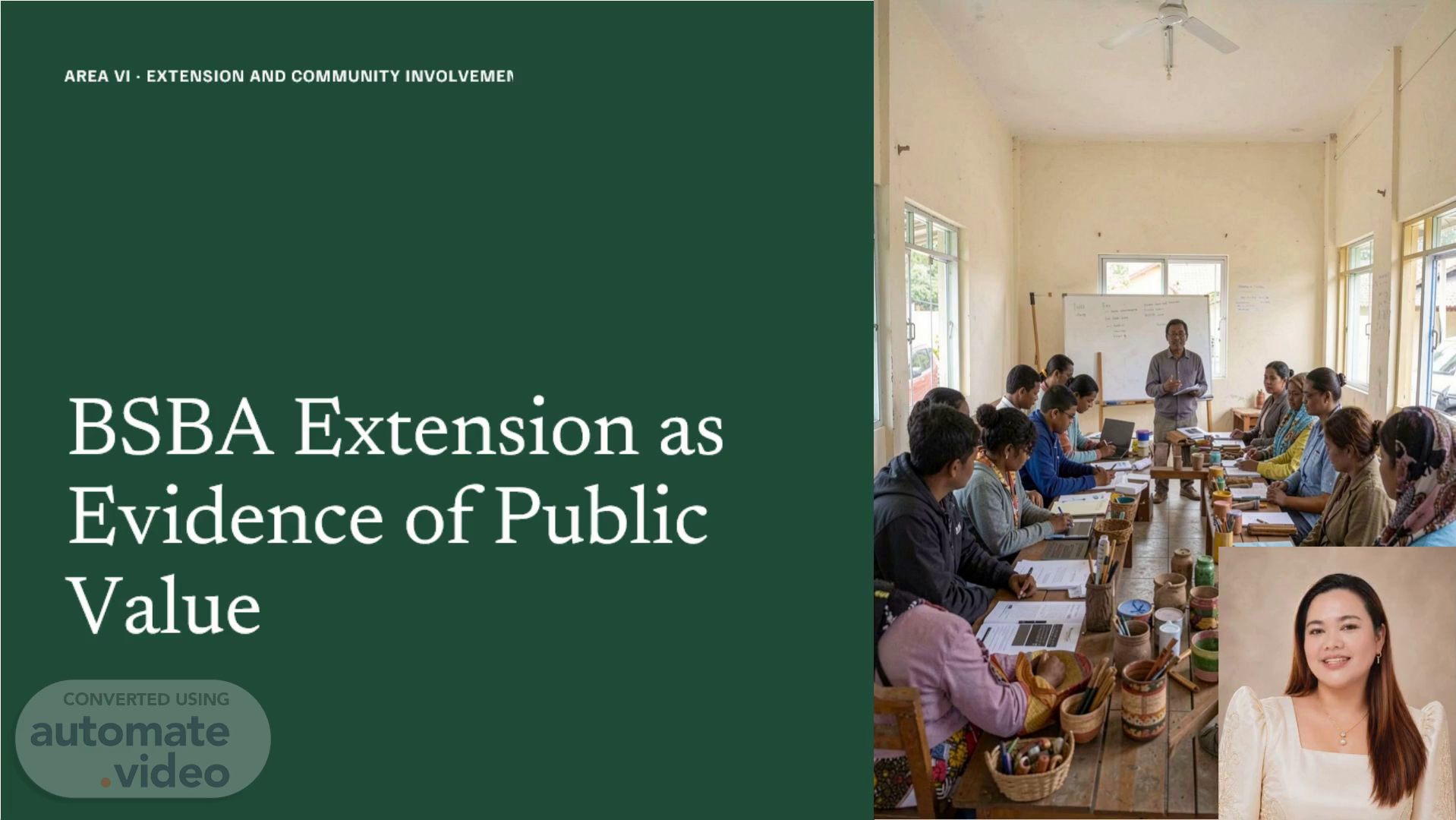
AREA VI · EXTENSION AND COMMUNITY INVOLVEMENT. BSBA Extension as Evidence of Public Value.
Scene 2 (2m 6s)
[Audio] The Jose Rizal Memorial State University - Dipolog Campus is a public institution that offers various programs including the Bachelor of Science in Business Administration. The program's institutional basis is rooted in the university's mission, which guides the delivery of effective and efficient services in instruction, research, production, and extension. The authority behind the program is evident through the approval of the institution's mission and the implementation of the BSBA major in Marketing Management, Human Resource Management, and Financial Management. This documentation of authority ensures that the program remains aligned with the university's objectives..
Scene 3 (2m 47s)
[Audio] The governance structure of our university's extension office is based on a hierarchical system with multiple levels of oversight and accountability. Each proposal must go through a series of defined steps before being implemented. These steps include faculty preparation, peer review, local CoORDEx review, recommendation, and final approval from the top-level administrators. This structured approach ensures that all proposals are thoroughly vetted and meet the necessary standards before moving forward. The Extension Office plays a crucial role in connecting different stakeholders and facilitating communication among them. Effective delivery of extension services requires collaboration among various groups, including faculty, staff, and students. By working together, we can ensure that our extension services are delivered efficiently and effectively..
Scene 4 (3m 44s)
[Audio] The three stages of needs assessment are: 1. Identifying the felt need 2. Coordinating with stakeholders 3. Reviewing and refining the program response These stages help to ensure that the program response is tailored to meet the specific needs of the community, taking into account the unique characteristics of each community. The stages also help to build trust among stakeholders by involving them in the process from the outset. This helps to increase the likelihood of successful implementation of the program. The first stage, identifying the felt need, involves gathering information about the current state of the community, including demographic data, economic conditions, and social trends. This information can be obtained through various means such as surveys, focus groups, and interviews. The goal is to identify the specific needs of the community that require attention. The second stage, coordinating with stakeholders, involves working with key individuals who have a vested interest in the outcome of the program. These stakeholders may include local government officials, business leaders, and community members. By engaging with these stakeholders, the program can gain valuable insights into the needs of the community and make adjustments accordingly. The third stage, reviewing and refining the program response, involves evaluating the effectiveness of the program and making any necessary adjustments. This stage requires careful consideration of the data collected during the previous stages and the input of stakeholders. The goal is to create a program response that is responsive to the needs of the community and effective in achieving its objectives. By completing all three stages of needs assessment, organizations can develop a comprehensive understanding of their community's needs and create a program response that meets those needs. This approach ensures that the program is tailored to the specific needs of the community, increasing the likelihood of successful implementation..
Scene 5 (5m 45s)
[Audio] The BSBA program has developed six projects that focus on sustainability, marketing, and entrepreneurship. These projects are designed to enhance the capacity of individuals and organizations in the community. The projects cover a range of topics including micro business sustainability, marketing strategies for start-ups, and growth directions for businesses. By applying the BSBA expertise to community needs, these projects can help address pressing issues in the community..
Scene 6 (6m 16s)
[Audio] The partnerships we have formed are essential for the success of our program. We partner with local communities and agencies to ensure effective delivery of our work. The barangay governments, Dipolog City stakeholders, the Sangguniang Kabataan Federation, and MSME beneficiaries are among our key partners. They provide valuable insights and expertise to our project. Furthermore, we collaborate with technical partners such as Project LEAD, which supports MSME development through its collaboration with the Department of Science and Technology. To maintain transparency and accountability, we have established Memoranda of Agreement (MOAs) with our partners. These agreements outline each partner's role and responsibility. This collaborative approach allows us to deliver high-quality services to our target groups..
Scene 7 (7m 10s)
[Audio] The university's business school has implemented various strategies to achieve its goals. The implementation process involves planning, documenting, and linking the strategies to specific disciplines such as marketing, human resources, and finance. The BSBA program brings together students with diverse backgrounds and expertise. The program's curriculum is designed to foster collaboration among students from different disciplines. The implementation process relies on a team effort, where each discipline contributes its unique knowledge and skills. This collaborative approach ensures that the program's delivery remains aligned with shared records and data..
Scene 8 (7m 52s)
[Audio] The organization's programs have shown a tangible impact on its target groups. The Akay-Diwang program has reached 50 Sangguniang Kabataan Federation members through its service. The Project LEAD program has also had a significant impact on 50 small, micro, and medium enterprises in Zamboanga del Norte. Monitoring instruments have been used to track the adoption and income of these projects over time, providing valuable insights into their effectiveness. The use of monitoring instruments allows for the assessment of progress at three- and six-month intervals, enabling adjustments to be made as necessary. This approach ensures that the organization's programs have a lasting impact on the lives of its target groups..
Scene 9 (8m 38s)
[Audio] The BSBA program has been working closely with the community to gather feedback on how to improve their learning experience. The beneficiaries have expressed their need for more interactive and relevant training methods, such as hands-on simulations and localized case studies. The program has taken this feedback seriously and refined its approach based on the insights gathered. This process of continuous improvement ensures that the program remains responsive to the community's evolving needs. By listening to the beneficiaries and translating their feedback into actionable changes, the BSBA program demonstrates its commitment to providing high-quality education and support. The next phase of the program will build upon these refinements, incorporating new elements such as digital marketing tools and resilience modules to further enhance the learning experience..
Scene 10 (9m 31s)
[Audio] The College of Business Administration has a plan to ensure that its extension services continue uninterrupted despite any challenges it may face. To achieve this goal, the college has allocated a significant amount of money from its budget to support various projects. This allocation includes funds for honoraria, travel, training, and other materials required for the successful implementation of these projects. With these resources, the college can provide high-quality extension services to the community. The allocated budget covers essential expenses such as honoraria, travel, training, and materials necessary for the successful implementation of these projects. The college's ability to deliver high-quality extension services is greatly enhanced by the availability of these resources. The budget lines allocated Php 316,973.00 will be used to cover essential expenses such as honoraria, travel, training, and materials necessary for the successful implementation of these projects. The college's stakeholders will also benefit from the maintenance of their relationships with the college. Maintaining these relationships ensures continuity of service delivery. The college's resources will be utilized to sustain delivery through equipment and trained personnel. The college's stakeholders will appreciate the efforts made to maintain their relationships and ensure continuity of service delivery. The college's resources will be used to sustain delivery through equipment and trained personnel, enabling the college to effectively deliver high-quality extension services to the community..