Scene 1 (0s)
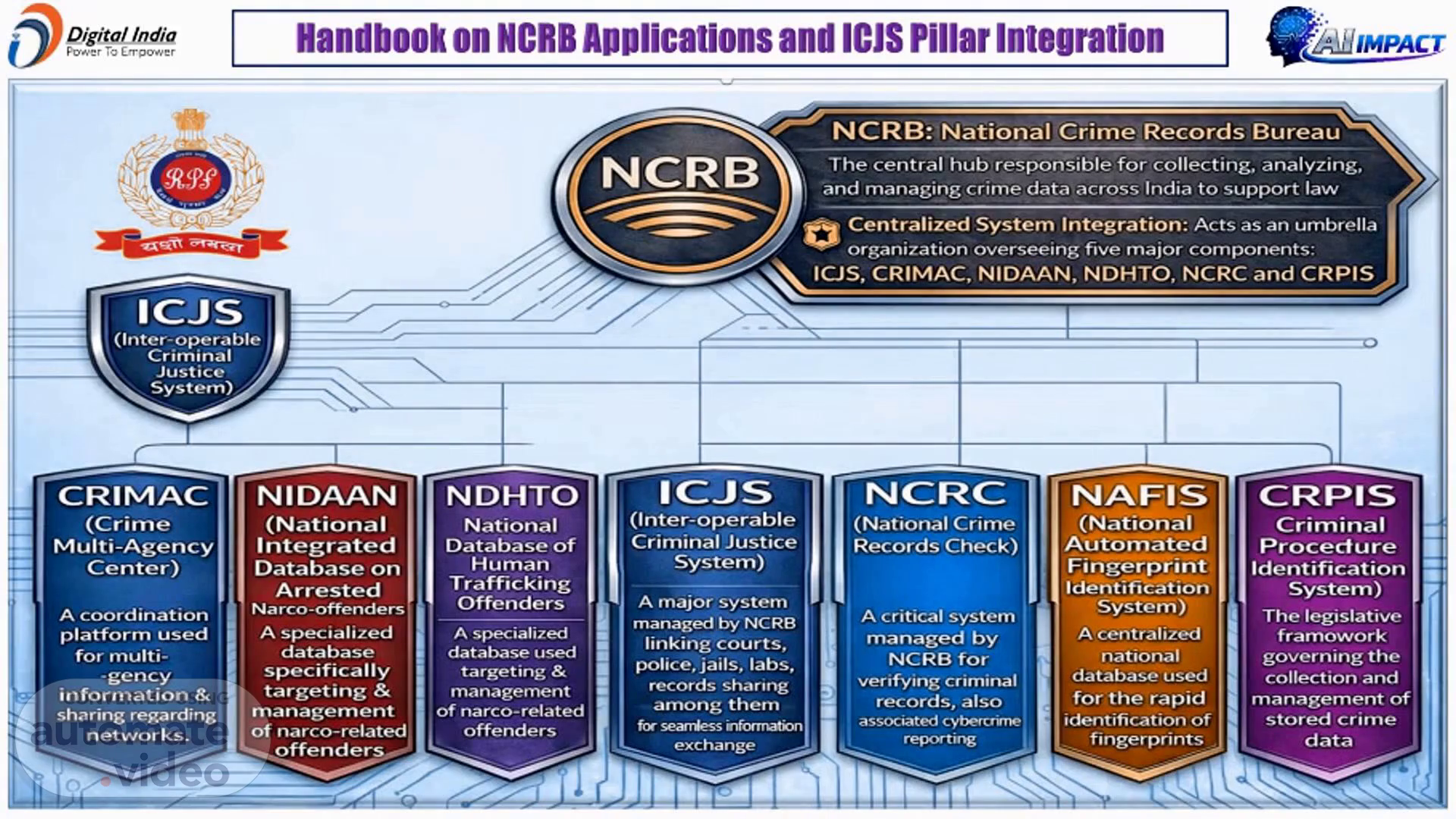
NCRB: National Crime Records Bureau The central hub responsible for collecting, analyzing, and managing crime data across India to support law Centralized System Integration: Acts as an umbrella organization overseeing five major components: IOS, CRIMAC, NIDAAN, NDHTO, NCRC and CRPIS ICJS (Inter-operable Criminal Justice System) CRIMAC (Crime Multi-Agency Center) A coordination platform used for multi- -gency information & sharing regarding networks. NIDAAN (National Integrated Database on Arrested Narco-offenders A specialized database specifically targeting & management of narco-related NDHTO National Database of Human Trafficking Offenders A specialized database used targeting & management of narco-related offenders NCRB ICJS (Inter-operable Criminal Justice System) A major system managed by NCRB linking courts, police, jails, labs, records sharing among them for seardess information exchange NCRC (National Crime RecordS'Ch•eCk) AcritiCäI System managed by NCRB for verif9in•g criminal records; also associated CVbercrirne reporting NAFIS (NatiOnaI AutOmated Fingerprint IdentificatiOrh system) A centralized national database used for the rapid identification of fingerprints CRPIS Criminal Procecture Identification System) The legislative framowork governing the collection and management of stored crime data.
Scene 2 (1m 20s)
[Audio] The National Security Council (NSC) has been established by the Government of India to provide a comprehensive framework for national security, which includes cyber security, terrorism, and other threats. The NSC has also been tasked with developing strategies for disaster management and response. The council's primary objective is to ensure that the country's national security is protected from various threats, including cyber attacks, terrorism, and natural disasters. The NSC has been given the authority to develop policies and guidelines for national security, which are then implemented by the government. The National Cyber Security Policy (NCSP) was launched in 2013 as part of the National Security Council's efforts to enhance national security. The policy aims to protect the country's critical infrastructure from cyber threats, such as hacking and malware. The NCSP has several key objectives, including protecting the nation's critical infrastructure, preventing cyber attacks, and promoting cybersecurity awareness among citizens. The National Disaster Management Authority (NDMA) was established in 2005 to coordinate disaster management efforts across the country. The NDMA works closely with state governments and local authorities to prepare for and respond to natural disasters. The authority has developed a range of strategies and plans to mitigate the impact of disasters, including early warning systems and evacuation procedures. The National Security Council has also taken steps to promote national security through technology. The council has developed a range of initiatives aimed at enhancing national security, including the use of artificial intelligence and big data analytics. These initiatives aim to improve the country's ability to detect and prevent cyber threats, as well as to enhance its overall resilience to disasters..
Scene 3 (3m 21s)
[Audio] The Integrated Law Enforcement Tech Stack is comprised of various components that aim to improve the efficiency and effectiveness of law enforcement operations. A digital index for background verifications and criminal history checks has been developed, along with a criminal procedure identification system. There is also a legislative framework guiding the identification of criminals, focusing on interoperability between different systems. The tech stack incorporates five key pillars, including Cri-MAC and the Crime Multi-Agency Centre, which collectively offer a holistic approach to criminal justice. These components enable real-time information sharing and tracking of suspects, thereby supporting the objective of enhancing the efficiency of law enforcement operations..
Scene 4 (4m 26s)
[Audio] The Railway Protection Force (RPF) is a paramilitary force that was established in 1985 by the Government of India to protect its railways from threats such as terrorism, banditry, and other forms of criminal activity. The RPF is responsible for maintaining law and order on Indian Railways, which includes the prevention of crimes against passengers, the protection of railway property, and the enforcement of laws related to rail transport. The RPF has been instrumental in preventing terrorist attacks on Indian Railways, including the 1997 Mumbai bombings and the 2008 Ahmedabad train bombing. The RPF also plays a crucial role in maintaining the security of high-profile trains like the Shatabdi Express and the Rajdhani Express. The RPF has undergone significant changes over the years, with new recruits being added to the force every year. The RPF has also expanded its operations beyond the railways, providing security services to government agencies and private companies. The RPF has received numerous awards and recognition for its contributions to national security and public safety. The RPF has also been recognized for its efforts in combating human trafficking and other forms of organized crime. The RPF has a strong presence in major cities across India, with a network of checkpoints and surveillance systems in place to monitor and respond to potential threats. The RPF works closely with local law enforcement agencies to ensure effective coordination and communication between the two forces. The RPF has implemented various initiatives to improve passenger safety, including the use of advanced technology such as CCTV cameras and biometric identification systems. The RPF has also introduced measures to prevent overcrowding and congestion on trains, reducing the risk of accidents and incidents. The RPF has received praise from passengers and critics alike for its professionalism and dedication to duty. The RPF has also been commended for its efforts in promoting social justice and equality among all sections of society. The RPF has a long history dating back to the British colonial era, when it was known as the Railway Police Force. Over time, the force has evolved to meet changing needs and circumstances, adapting to new technologies and strategies to stay ahead of emerging threats. The RPF has a diverse range of personnel, including officers, constables, and auxiliary personnel. The RPF has also established partnerships with international organizations and governments to share intelligence and best practices in counter-terrorism and security operations. The RPF has a robust system of training and development programs to equip its personnel with the necessary skills and knowledge to perform their duties effectively. The RPF has also invested heavily in modernizing its equipment and infrastructure to support its operations. The RPF has a strong commitment to community outreach and engagement, working closely with local communities to build trust and cooperation. The RPF has also established programs to promote education and awareness about safety and security issues affecting the general public. The RPF has a comprehensive plan to address the growing threat of cybercrime and online harassment, taking proactive steps to prevent and mitigate these risks. The RPF has also developed strategies to combat human trafficking and other forms of organized crime. The RPF has a well-organized command structure, with clear lines of authority and communication. The RPF has also established a robust system of accountability and oversight to ensure transparency and effectiveness in its operations. The RPF has a strong focus on innovation and adaptability, continuously updating its strategies and tactics to stay ahead of emerging threats and challenges. The RPF has also invested heavily in research and development to identify new solutions and technologies to support its operations. The RPF has a broad mandate to address a wide range of security-related issues,.
Scene 5 (8m 53s)
[Audio] The Indian government has taken steps to improve the quality of its judicial system by introducing new laws and policies aimed at reducing corruption and increasing transparency. However, despite these efforts, corruption remains a significant problem in India's judicial system. Corruption in the judiciary involves bribery, nepotism, and favoritism, which undermine the integrity of the institution. The lack of transparency and accountability in the judiciary makes it difficult to identify and address corruption. Furthermore, the use of technology in the judiciary has created new opportunities for corruption, such as online bribes and digital manipulation of evidence. To combat corruption, the Indian government needs to strengthen its institutions and promote transparency and accountability throughout the entire judicial system..
Scene 6 (9m 49s)
[Audio] The question was asked by a student who had been studying for several years, but still could not understand the concept of "pratibaddhata" which means "duty" or "responsibility". The teacher gave him some examples to help him understand. For example, if someone is responsible for taking care of their child, they have a duty to provide food, shelter, clothing, education, and healthcare. This responsibility can be passed on to others, such as family members or caregivers, but it remains a duty nonetheless. Another example is that of a person who has taken a loan from a bank. They have a duty to repay the loan with interest. If they fail to do so, they will face consequences. In this context, the teacher explained that the concept of "pratibaddhata" is essential in everyday life. It helps individuals to take responsibility for their actions and make decisions based on their duties. The teacher also mentioned that there are different types of responsibilities, such as personal, social, and professional. Personal responsibilities include things like keeping one's home clean, paying bills, and taking care of oneself. Social responsibilities include things like contributing to the community, helping others, and being part of a team. Professional responsibilities include things like working at a job, earning a salary, and meeting deadlines. He emphasized that understanding these different types of responsibilities is crucial for making informed decisions about one's life. The teacher concluded by saying that the concept of "pratibaddhata" is not just limited to formal situations, but it applies to all aspects of life. It is essential to recognize and fulfill our duties, whether we are students, employees, parents, or citizens." The teacher then turned to the student and said: "Now, I want you to think about what kind of responsibilities you have in your daily life. What are some of the duties you need to fulfill every day? Can you give me an example?" The student thought for a moment and replied: "I have a duty to go to school every day, to study hard, and to complete my assignments on time. My parents also have a duty to provide me with food, shelter, clothing, education, and healthcare. And I have a duty to contribute to my community by volunteering at a local charity." The teacher smiled and nodded in approval. "That's correct! You have identified some of the key responsibilities that come with being a student. Keep thinking about how you can apply the concept of 'pratibaddhata' in your daily life." The teacher then turned to another student and asked: "Can anyone else tell me about a time when they felt a sense of duty or responsibility towards something or someone?" One of the students raised her hand and said: "I remember when I volunteered at a nursing home last summer. I felt a great sense of duty to care for the elderly residents and make them happy. It was a wonderful experience, and I learned a lot about the importance of taking care of others." The teacher smiled and nodded in approval. "That's a great example! We should all strive to feel a sense of duty and responsibility towards others. Thank you for sharing your story." The teacher then turned to the class and said: "As we continue to explore the concept of 'pratibaddhata', let us consider the following questions: What are some common mistakes people make when trying to fulfill their duties? How can we avoid making those mistakes? What are some strategies for overcoming obstacles when fulfilling our duties?" The teacher then turned to the student who had initially asked the.
Scene 7 (13m 31s)
[Audio] The National Crime Records Bureau (NCRB) plays a significant role in maintaining the integrity of the Indian crime statistics. The NCRB is responsible for collecting and analyzing data from various sources, including police stations, courts, and other government agencies. The bureau has developed a comprehensive framework for crime reporting, which includes the collection of data on crimes such as murder, rape, robbery, and kidnapping. The NCRB also provides training and support to law enforcement agencies, helping them to improve their investigative skills and enhance their ability to prevent and investigate crimes. Furthermore, the NCRB works closely with other organizations, such as the Central Bureau of Investigation (CBI), to share intelligence and coordinate efforts to combat organized crime. The NCRB's efforts have led to improved crime statistics, which have contributed to a safer and more secure society. The organization's commitment to transparency and accountability ensures that the data collected is accurate and reliable. The NCRB's work has had a positive impact on the country's overall crime rate, leading to increased public confidence in law enforcement. The NCRB's initiatives have helped to reduce the incidence of violent crimes, such as murder and rape, and have promoted a culture of safety and security. The NCRB's role in maintaining the integrity of the Indian crime statistics is essential to ensuring a safe and secure society..
Scene 8 (15m 12s)
[Audio] The National Crime Records Bureau (NCRB) has been working tirelessly to develop a comprehensive criminal justice system. The NCRB has developed a robust database that stores and compares fingerprints collected from crime scenes with those of known criminals. This allows us to quickly identify and track down potential suspects. Our system also integrates with law enforcement agencies across the country, creating a centralized network for sharing and accessing fingerprint data. This not only improves the efficiency of investigations, but also helps in preventing and solving crimes. The NCRB's efforts are focused on enhancing the security of citizens and ensuring public safety..
Scene 9 (15m 58s)
[Audio] The National Crime Records Bureau (NCRB) has been working with law enforcement agencies to develop a centralized system integration for crime management. The integration enables the sharing of data and information across different agencies, enhancing their collaboration and operational efficiency. This system facilitates the identification and tracking of criminals, thereby preventing them from evading the law. The phrase "Nishaan Chhupa Na Paayega, Kanoon Pakad Hi Laayega" translates to "the law will inevitably catch those who try to hide and evade it". This integration is essential for achieving the NCRB's goal of utilizing technology to enhance the performance of law enforcement agencies. The system is designed to provide real-time updates and alerts to facilitate swift decision-making. The integration also enables the sharing of intelligence and best practices among agencies, promoting cooperation and collaboration. Furthermore, the system provides a platform for law enforcement agencies to share their experiences and lessons learned, enabling them to learn from each other and improve their operations. By leveraging this integrated system, law enforcement agencies can better coordinate their efforts and respond more effectively to emerging threats..
Scene 10 (17m 22s)
[Audio] The National Crime Records Bureau (NCRB) has introduced a new initiative called "Nayi Takneek", which translates to "New Technique". The main objective of Nayi Takneek is to utilize the latest technology to enhance the collection, analysis, and management of crime data. The primary focus is on providing a more accurate and comprehensive view of crime trends in India. One of the key components of Nayi Takneek is the centralization of law enforcement agencies' databases and information sources. This allows for the easy sharing of data between different agencies, thereby improving coordination and facilitating case-solving. Another crucial aspect of Nayi Takneek is its impact on the criminal justice system. The goal is to ensure fair and swift justice for all by streamlining processes and reducing delays through technological advancements. Advanced facial recognition software and other tools are utilized to aid in identifying and tracking criminals. A digital index for background verifications is also included in Nayi Takneek. This database is used by various organizations and individuals for security purposes and is continuously updated with the latest information to ensure accuracy and reliability. The ultimate vision of NCRB is to harness technology to empower and improve the efficiency of law enforcement. Nayi Takneek represents a significant step towards achieving this vision..
Scene 11 (18m 58s)
[Audio] NCRB manages several key components related to crime and law enforcement. One of these components is the centralized system integration for law enforcement agencies. This system enables law enforcement agencies to share information seamlessly and communicate effectively with each other. The result is a more efficient and effective law enforcement process. Another critical component is the criminal justice system. This system ensures that criminal cases are processed fairly and in a timely manner, promoting transparency and accountability. Furthermore, NCRB maintains databases for identifying and tracking criminals, which aids in solving crimes and preventing future incidents. Additionally, the organization has developed a digital index for background verifications, which is vital in today's digital age. This index facilitates background checks for various purposes. Overall, NCRB's efforts focus on using technology to enhance law enforcement capabilities and ensure public safety and security..
Scene 12 (20m 2s)
[Audio] The National Crime Records Bureau (NCRB) manages several key components, including the Criminal and Citizen Centric Services (CCS) project. The CCS project provides a centralized system integration for law enforcement agencies across India. This enables them to access relevant information related to crime and criminals in one place, facilitating efficient and effective crime control. The NCRB also manages a criminal justice system, which plays a vital role in the functioning of the Indian legal system. This system helps identify and track criminals, facilitates the investigation process, and ensures justice is served to victims. A well-functioning criminal justice system is essential for creating a safer and more secure society. In addition to the criminal justice system, the NCRB maintains various databases to aid in the identification and tracking of criminals. These include fingerprint, DNA, and facial recognition technologies. Such databases help solve crimes and bring criminals to justice. Furthermore, the NCRB has developed a digital index for background verifications, which aids in preventing crimes and ensuring public safety. By utilizing technology, the NCRB aims to empower and improve the efficiency of law enforcement agencies. With the right tools and systems in place, the NCRB believes it can significantly impact crime control and contribute to making Indian society a better place..
Scene 13 (21m 43s)
[Audio] The Criminal Pan-India Services (CrPIS) is a centralized system integration that manages and shares crime data with law enforcement agencies across India. The system brings together various databases and information from different sources, streamlining the process of data collection and analysis. This results in a more comprehensive and accurate picture of crime trends and patterns in the country. The criminal justice system is a key component of CrPIS, playing a crucial role in ensuring justice for victims and holding perpetrators accountable. The system tracks and monitors criminal cases from the time of filing to the completion of trials, expediting the legal process while maintaining transparency and accountability. Databases for identifying and tracking criminals are another essential aspect of CrPIS. These databases contain critical information such as fingerprints, DNA, and facial recognition data, aiding law enforcement in identifying and catching suspects. Technology facilitates this process, making it more efficient and accurate, ultimately contributing to reduced crime rates. The Digital Index for background verifications is an innovative tool developed by NCRB. This index enables quick and reliable background checks of individuals, suitable for employment purposes or other relevant reasons. NCRB aims to utilize technology to empower and improve the efficiency of law enforcement agencies. The phrase "Har chehra pe nazar, CrPIS hai suraksha ka asar!" translates to "With every face, CrPIS provides security's impact!" emphasizing the importance of effective technology in enhancing law enforcement capabilities..
Scene 14 (23m 36s)
[Audio] NCRB has implemented a centralized system integration for law enforcement agencies to provide a clearer picture of the crime landscape in the country. The system allows for seamless communication and collaboration between different agencies, enabling them to share information and coordinate their efforts more effectively. The NCRB also maintains a robust criminal justice system database that helps identify and track criminals. The database contains information on past criminal activities as well as real-time updates on ongoing cases and suspects. This enables law enforcement to take swift action against criminals and bring them to justice. In addition to the above systems, NCRB has developed a digital index for background verifications. This tool facilitates efficient and thorough background checks on individuals, allowing law enforcement to identify potential threats and mitigate risks. Through the implementation of these technologies, NCRB aims to create a safer and more secure environment for its citizens. By leveraging technology, NCRB believes it can enhance the efficiency of law enforcement and ultimately achieve its goal of empowering and improving the safety of the nation..
Scene 15 (24m 54s)
[Audio] The Measurement Collection Unit is designed to provide a secure environment for gathering information from individuals who have been accused of crimes. This unit incorporates advanced security features such as access control, iris scanning, and authorized user authentication. The setup includes a police officer or prison officer to oversee the process, ensuring that all procedures are followed correctly. The accused person sits in this area to provide their measurements, while the camera captures images on a wall-mounted screen for further analysis. The workstation allows for documentation and storage of relevant documents, and the UPS provides continuous power supply to maintain the integrity of the system. This modernized approach enhances the safety and security of the country, providing a reliable and efficient means of identification and verification..
Scene 16 (25m 51s)
Ek Click, Poora Hisaab! 13.
Scene 17 (25m 57s)
[Audio] The Integrated Criminal Justice System (ICJS) is a central platform that enables law enforcement agencies to collaborate and share information. The ICJS aims to strengthen the criminal justice system in India by providing a digital network that connects various stakeholders and streamlines the flow of information. This digital network saves time and improves the overall efficiency of the system. The ICJS contains databases that help identify and track criminals. These databases enable law enforcement agencies to quickly and accurately identify suspects and criminals, thereby making communities safer. The ICJS also includes a digital index for background verifications. This thorough screening process prevents criminals from slipping through the cracks. The ICJS is a tool used by law enforcement agencies to enhance their operations. It provides a framework for collaboration and communication among stakeholders. The ICJS has several benefits, including improved efficiency, reduced costs, and enhanced public safety. The ICJS is a valuable resource for law enforcement agencies, enabling them to make informed decisions and respond effectively to crimes. The ICJS is designed to support the efforts of law enforcement agencies in preventing and investigating crimes. It facilitates the exchange of information between agencies and stakeholders, promoting cooperation and coordination. The ICJS is a critical component of the criminal justice system, playing a vital role in maintaining public order and safety. The ICJS is a key initiative of the National Crime Records Bureau, aimed at strengthening the criminal justice system in India. The ICJS is a cutting-edge technology that supports the goals of law enforcement agencies in India. It provides a platform for law enforcement agencies to share information and coordinate their efforts. The ICJS is a valuable asset for law enforcement agencies, enabling them to respond effectively to crimes and maintain public safety. The ICJS is a comprehensive system that integrates various aspects of the criminal justice system. It provides a framework for collaboration, communication, and information sharing among stakeholders. The ICJS is a critical component of the criminal justice system, supporting the efforts of law enforcement agencies in preventing and investigating crimes. The ICJS is a valuable resource for law enforcement agencies, enabling them to make informed decisions and respond effectively to crimes. The ICJS is a key initiative of the National Crime Records Bureau, aimed at strengthening the criminal justice system in India. The ICJS is a cutting-edge technology that supports the goals of law enforcement agencies in India. It provides a platform for law enforcement agencies to share information and coordinate their efforts. The ICJS is a valuable asset for law enforcement agencies, enabling them to respond effectively to crimes and maintain public safety. The ICJS is a comprehensive system that integrates various aspects of the criminal justice system. It provides a framework for collaboration, communication, and information sharing among stakeholders. The ICJS is a critical component of the criminal justice system, supporting the efforts of law enforcement agencies in preventing and investigating crimes. The ICJS is a valuable resource for law enforcement agencies, enabling them to make informed decisions and respond effectively to crimes. The ICJS is a key initiative of the National Crime Records Bureau, aimed at strengthening the criminal justice system in India. The ICJS is a cutting-edge technology that supports the goals of law enforcement agencies in India. It provides a platform for law enforcement agencies to share information and coordinate their efforts. The ICJS is a valuable asset for law enforcement agencies, enabling them to respond effectively to crimes and maintain public safety. The ICJS is a comprehensive system that integrates various aspects of the criminal justice system. It provides a framework for.
Scene 18 (30m 38s)
[Audio] The National Crime Records Bureau (NCRB) has developed a digital index for background verifications which uses advanced technology to collect, analyze, and manage crime data. The digital index provides a comprehensive overview of an individual's criminal history, including information about their past crimes, convictions, and arrests. It also includes details such as fingerprints, DNA records, and facial recognition data, allowing law enforcement agencies to identify and track criminals with greater accuracy. The digital index is integrated with existing systems, enabling a seamless flow of data between police, court, and jail records. This facilitates a holistic view of an individual's criminal history, making it easier for law enforcement agencies to make informed decisions. The system is designed to be user-friendly and accessible, ensuring that all users can easily access and utilize the information contained within. The digital index is a critical component of the NCRB's efforts to use technology to empower and improve the efficiency of law enforcement. It plays a vital role in supporting the country's law enforcement agencies in their efforts to maintain public safety and order. The digital index is constantly being updated and improved, incorporating new technologies and features to ensure its continued relevance and effectiveness. As a result, the digital index has become an essential tool for law enforcement agencies across the country..
Scene 19 (32m 19s)
[Audio] The Integrated Criminal Justice System (ICJS) is a critical component managed by the National Crime Records Bureau (NCRB). The ICJS aims to ensure a record of integrated and accelerated justice. This system has been established to improve the efficiency of law enforcement agencies. The ICJS enables seamless communication and sharing of information among different law enforcement agencies through its centralized system integration. This facilitates coordination of efforts and expedites the process of criminal justice. The ICJS also includes a criminal justice system that collects and analyzes crime data across India. This enables the identification of patterns and trends in criminal activity, allowing law enforcement agencies to proactively prevent and combat crime. A key database managed by NCRB under the ICJS is used to identify and track criminals. This database contains information such as fingerprints, DNA, and facial recognition data, aiding in the identification and apprehension of suspects. The ICJS also features a digital index for conducting background verifications. This tool ensures the safety and security of society by providing thorough screenings of individuals before employment or access to sensitive areas. The ICJS demonstrates the company's commitment to using technology to enhance law enforcement efficiency. The organization remains dedicated to striving for a safer and more just society..
Scene 20 (34m 0s)
[Audio] The company NCRB provides services related to crime data collection, analysis, and management. The organization plays a significant role in ensuring the accuracy and completeness of crime data across India. NCRB utilizes its centralized system integration for law enforcement agencies to streamline processes and improve overall efficiency. The criminal justice system is constantly evolving to provide fair and swift justice for all. NCRB's databases help identify and track criminals, while also providing a digital index for background verifications. These databases aid in maintaining safety and security in various sectors. NCRB believes in using technology to empower and enhance the capabilities of law enforcement agencies. The organization's accomplishments highlight its commitment to fair and swift justice..
Scene 21 (34m 58s)
[Audio] The National Crime Records Bureau (NCRB) has been working tirelessly to strengthen its systems and infrastructure to better serve the nation. The bureau's primary goal is to provide accurate and reliable information to aid law enforcement agencies in their efforts to combat crime. To achieve this, NCRB has developed a comprehensive system called CRIMAC. CRIMAC stands for Centralized Repository for Information Management and Analysis of Crimes. This system allows for the sharing of information across different agencies and regions, facilitating a more coordinated approach to addressing crime. By integrating various databases and creating a digital index for background verifications, CRIMAC enables law enforcement agencies to identify and track criminals more effectively. Furthermore, the use of technology in CRIMAC facilitates the provision of accurate and reliable information to support investigations and decision-making processes. As the country moves towards a more digital age, it is essential that NCRB continues to utilize technology to enhance the capabilities of law enforcement agencies. With CRIMAC, NCRB aims to provide a robust and efficient system that supports the nation's vision of a safer and more secure India..
Scene 23 (36m 27s)
[Audio] The National Crime Records Bureau (NCRB) has developed a comprehensive system to ensure the safety of the innocent and educate criminals. The system integrates data from various sources, including law enforcement agencies, to track and identify individuals who pose a threat to society. The criminal justice system holds these individuals accountable for their actions and imposes penalties accordingly. Databases play a key role in identifying and tracking repeat offenders. A digital index facilitates background verifications, preventing potential criminals from entering the system. The NCRB's vision is to harness technology to enhance law enforcement efficiency and create a safer society..
Scene 24 (37m 16s)
[Audio] The National Crime Records Bureau (NCRB) is responsible for collecting, analyzing, and managing crime data across India. The NCRB has implemented a centralized system integration for law enforcement agencies, providing them with a comprehensive platform to effectively tackle crime and maintain law and order. This system, known as NDHTO, is the backbone of our operations, constantly working to keep our nation safe. With its advanced features and capabilities, NDHTO is always prepared to combat any threat and ensure swift action against criminals. The NCRB uses this system to monitor and analyze crime trends, identify patterns, and develop strategies to prevent crimes from occurring. By utilizing the power of technology, the NCRB can provide timely and accurate information to law enforcement agencies, enabling them to make informed decisions and take effective actions. The NCRB also collaborates with other government agencies and international organizations to share intelligence and best practices, further enhancing the effectiveness of the NDHTO system..
Scene 25 (38m 30s)
[Audio] The National Database on Human Trafficking and Offenders (NDHTO) aims to protect the safety of India's daughters and youth from human trafficking. The National Crime Records Bureau (NCRB) plays a significant role in collecting and analyzing crime data to inform law enforcement agencies and guide their actions. The centralized system integration has significantly improved the efficiency of the criminal justice system. However, NCRB is also focused on taking proactive steps to prevent crime and protect citizens. To achieve this, the NDHTO was established to safeguard the safety of girls and young people, who are often vulnerable to exploitation and abuse. The database helps identify and track criminals involved in human trafficking, aiding in their apprehension and prosecution. Additionally, the digital index for background verifications is essential in ensuring community safety by screening potential employees and volunteers with a history of criminal activity. Technology is used to make the country a safer place for all. The safety of India's daughters and youth is of utmost importance, and the team will continue to work towards achieving this goal through dedicated efforts. The NDHTO is a vital tool in this endeavor..
Scene 26 (39m 59s)
[Audio] The National Crime Records Bureau (NCRB) has been working tirelessly to manage crime data and empower law enforcement agencies across the country. The NCRB has created a national digital database against human trafficking, known as NDHTO - Manav Taskari ke khilaf ek rashtriya digital dhaal. This database helps law enforcement agencies identify and track human traffickers, rescue victims, and bring them to safety. The NCRB uses technology and data management to strengthen its fight against human trafficking and create a safer society for all. The NCRB is utilizing its resources and expertise to achieve its vision of empowering law enforcement agencies and improving the efficiency of the criminal justice system. The NCRB's efforts are focused on creating a safer India through effective management of crime data..
Scene 27 (40m 57s)
[Audio] NIDAAN is a critical tool in the fight against drug-related crimes. The National Integrated Database on Arrested Narco-Offenders, it provides a comprehensive digital index of arrested narco-offenders. This database integrates data from various law enforcement agencies, allowing users to track and identify repeat offenders. Additionally, it facilitates background verifications for individuals in sensitive positions. NIDAAN has been instrumental in improving law enforcement operations. Its integration with other databases enables more effective investigations and prosecutions. Furthermore, it helps in preventing recidivism among arrested individuals..
Scene 28 (41m 41s)
[Audio] NIDAAN is a centralized database that collects and stores information on arrested drug offenders from across the country. This includes their personal details, criminal history, and drug-related offenses. The system allows law enforcement agencies to easily access and share information on these criminals, making it easier to track and apprehend them. Additionally, NIDAAN enables authorities to map out drug trafficking networks and identify their key players. Furthermore, NIDAAN provides evidence-based data for effective prosecution and sentencing of offenders, which enhances accountability and reduces the chances of repeat offenses. NIDAAN also impacts background verification processes, allowing employers to hire individuals with a clean record, thereby promoting a safer and more secure work environment. NIDAAN plays a vital role in the criminal justice system, facilitating efficient law enforcement operations..
Scene 29 (42m 41s)
[Audio] NIDAAN is a national integrated database on arrested narco-offenders. It serves as a crucial tool in the fight against drug trafficking and abuse. The database provides a comprehensive overview of arrested individuals involved in the illicit trade. Law enforcement agencies across the country have access to this database, enabling them to share and analyze information effectively. The database helps in identifying patterns and trends among arrested individuals. It also aids in the swift and efficient apprehension of repeat offenders. Moreover, NIDAAN provides accurate and reliable data on drug-related arrests and convictions. This information can be used by the judiciary to make informed decisions and ensure that justice is served. NIDAAN also serves as a valuable resource for conducting background verifications. Employers can use the database to access an individual's criminal record, ensuring a safer and more secure workplace. The database plays a significant role in various sectors, including law enforcement and security. In summary, NIDAAN is a vital component in the fight against drug-related crimes. Its impact extends beyond law enforcement, contributing to a safer and more just society. NIDAAN will continue to play a crucial role in the country's efforts to combat drug trafficking and abuse..
Scene 30 (44m 10s)
[Audio] NCRB's application process involves several steps that are designed to ensure the integrity and accuracy of data collected during the process. The first step is to submit an application form which includes providing detailed information about the agency's requirements and needs. This information is then used to develop a customized solution tailored to meet those specific needs. The second step is to undergo a thorough evaluation process, which includes assessing the agency's current infrastructure and identifying areas where technology can be integrated to improve operational efficiency. This evaluation is conducted by a team of experts who assess the agency's readiness to adopt new technologies and identify potential challenges. The third step is to implement the chosen solution, which typically involves installing software and hardware upgrades to support the new system. Once the implementation is complete, the agency must undergo training to ensure they have the necessary skills and knowledge to effectively utilize the new system..
Scene 31 (45m 19s)
31 28.
Scene 32 (45m 25s)
[Audio] The National Crime Records Bureau (NCRB) has been working diligently to enhance the efficiency of law enforcement agencies through its cutting-edge technologies and innovative approaches. As part of this effort, the organization has developed a comprehensive framework for integrating police, courts, and jails into a single, unified system. This integrated system enables seamless communication and information sharing between these entities, facilitating more effective crime prevention and investigation. Furthermore, NCRB has established robust databases for tracking and identifying criminals, ensuring that law enforcement agencies have access to critical information at their fingertips. Additionally, the organization has implemented a digital index for background verifications, providing a secure and efficient means of conducting thorough checks on individuals. These initiatives demonstrate NCRB's commitment to leveraging technology to support the safety and security of citizens..