Scene 1 (0s)
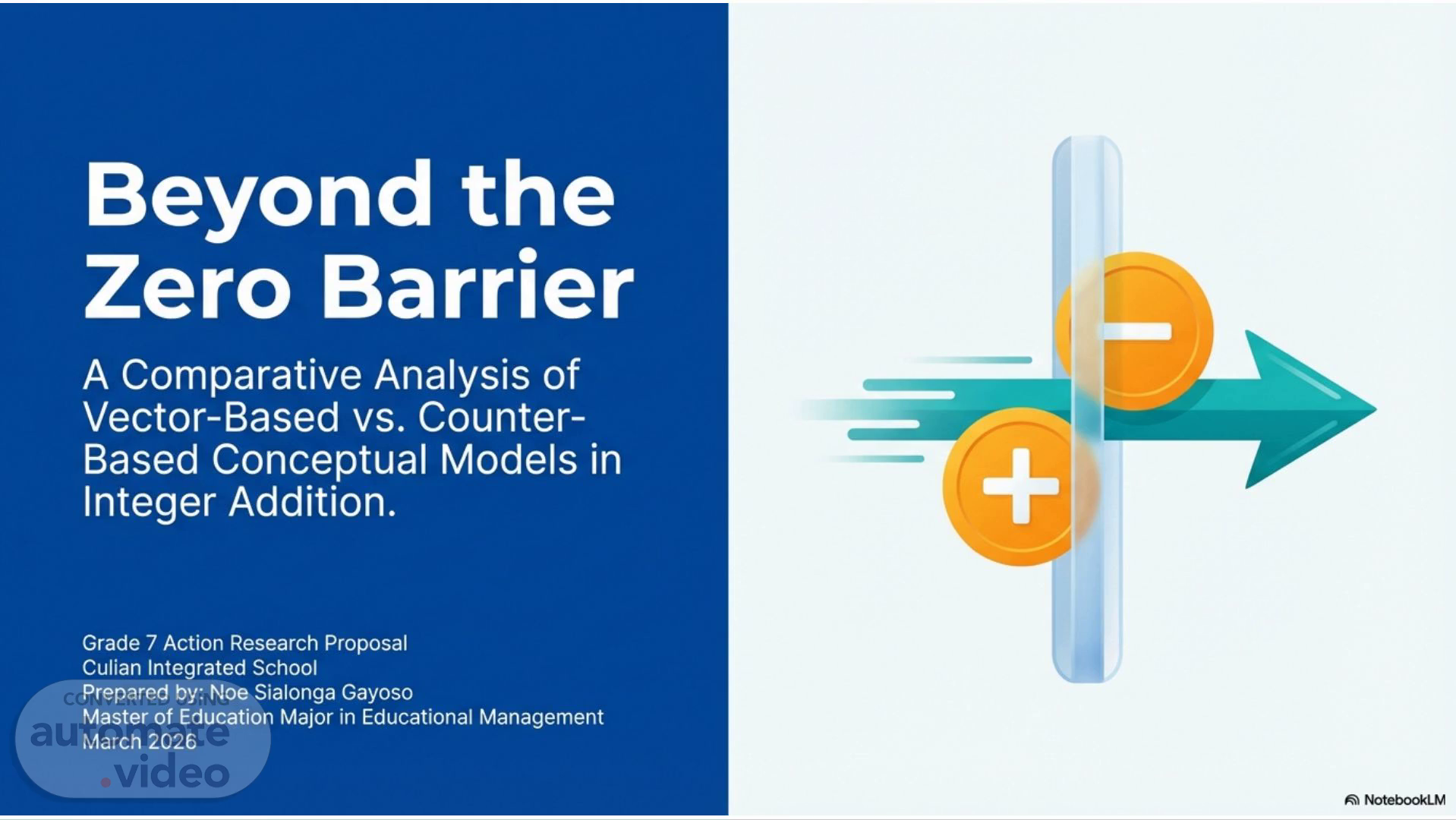
Beyond the Zero Barrier A Comparative Analysis of Vector-Based vs. Counter- Based Conceptual Models in Integer Addition. Grade 7 Action Research Proposal Culian Integrated School Prepared by: Noe Sialonga Gayoso Master of Education Major in Educational Management March 2026 NotebookLM.
Scene 2 (12s)
The Spiral Curriculum Creates a High-Stakes Transition at Grade 7 The DepEd K-12 Goal Numeracy as a lifelong foundational skill, taught through a spiral approach to gradually address conceptual difficulties. Elementary Math Foundational Skills Junior High School Math Grade 7 Transition Point The Reality Grade 7 learners face severe adjustment challenges moving from purely positive numbers to operations involving positive and negative integers. t'40tebookLM.
Scene 3 (26s)
Hitting the Zero Barrier in Integer Addition The Observation Nearly half the Grade 7 class fails proficiency in integer addition despite repeated instruction. +1 +1 +2 +2 +3 +3 +4 +5 +5 The Diagnosis The failure is conceptual, not procedural. Students attempt to memorize abstract rules (e.g., unlike signs subtract) without concrete models. They understand numbers, but hit a cognitive wall when crossing zero into negative territory. t'40teb00kLM.
Scene 4 (43s)
Core Objectives of the Action Research Performance Difference Is there a significant difference in student performance when taught using the vector-based model versus the counter- based model? Conceptual Understanding How do these models affect students' ability to mentally navigate negative numbers and cross the Zero Barrier? Action Research Objectives Measured Improvement What is the exact level of pre-test to post-test improvement for both groups?.
Scene 5 (57s)
Shifting from Rule Memorization to Conceptual Manipulation The Traditional Trap Rote memorization of sign rules. Results in high confusion, low retention, and an inability to visualize math. +5 +3 ' øøøøøn The Proposed Innovation Conceptual understanding through visualization and manipulation. Equips students with foundational tools to mentally see addition before calculating it. NotebookLM.
Scene 6 (1m 13s)
Two Distinct Pathways to Conceptual Understanding The Vector-Based Model (Movement & Direction) -5 -4 -3 -2 -1 0 1 23 4 5 Uses arrows, floor number lines, and board illustrations. Positive = right movement; Negative = left movement. Focuses on magnitude, direction, and starting points. The Counter-Based Model (Objects & Annihilation) Uses bottle caps, chips, or paper circles. positive and negative colors. Focuses on Zero Pairs, where opposite counters physically cancel each other out. NotebookLM.
Scene 7 (1m 33s)
Structural Comparison of the Proposed Interventions Primary Representation Physical Manipulation Mechanism for Zero Cognitive Focus Vector-Based Model Directional movement and magnitude Walking on floor lines, drawing scaled arrows Crossing a fixed coordinate on a continuous line Spatial reasoning and distance Counter-Based Model Discrete, colored physical objects Pairing, sorting, and O physicaly removing tokens Complete cancellation/neutralization of zero pairs Grouping, matching, and arithmetic equivalence NotebookLM.
Scene 8 (1m 48s)
The Concrete-RepresentationaI-Abstract (CRA) Strategy o Step 2: Representational (Visual) Students transition to drawing diagrams, sketching arrows, or mapping +/- circles on paper. Step 1: Concrete (Hands-On) Students begin by physically manipulating real materials (floor lines, vector arrows, physical colored counters). -4 3 Step 3: Abstract (Symbolic) Students confidently solve numerical equations without needing physical or drawn aids. NotebookLM.
Scene 9 (2m 5s)
Purposive Sampling for Comparative Analysis Grade 7 Population - Culian Integrated School eeoeeoeeoeee eeoeeoeeoeee Participant Selection: 30 Students Group A 15 Students Assigned to the Vector-Based Conceptual Model. Selected via purposive sampling based on comparable academic levels to ensure a fair baseline. Group B 15 Students Assigned to the Counter-Based Conceptual Model. Controlled Conditions Both groups receive identical lesson objectives, identical timeframes, and take the same pre-test to verify comparable prior knowledge. Noteb00kLM.
Scene 10 (2m 23s)
A Mixed-Methods Assessment Toolkit Quantitative Benchmarks Teacher-made Pre-Test and Post-Test. Data analyzed using descriptive statistics (mean and percentage scores). Gain scores mapped directly to DepEd mastery level descriptors. Qualitative Thematic Analysis Formative Tools: Short quizzes, worksheets, and exit slips to catch immediate misconceptions. Observation Checklists: Documenting real-time classroom engagement and participation. Teacher Reflection Journals: Recording instructional insights and student responses to crossing the zero barrier. Notet»okLM.
Scene 11 (2m 43s)
The Three-Phase Action Research Workflow REPORT Phase 1: Development Prepare teacher-made pre/post-tests. Design observation checklists. Create formative tools (worksheets/exit slips). Set up reflection journals. Phase 2: Experimental Administer baseline pre-test. Run Group A (Vector) interventions. Run Group B (Counter) interventions. Conduct continuous formative assessment. Administer post-test. Phase 3: Output Tabulate score comparisons. Analyze learning gains. Extract qualitative themes. Finalize actionable instructional recommendations. NotebookLM.
Scene 12 (3m 2s)
A Nine-Week Execution and Data Gathering Timeline Week 1 Week 2 Week 3 Week 4 Week 5 Week 6 Week 7 Week 8 Week 9 Preparation Problem identification, proposal writing, and instrument validation. The Experimental Window Week 3: Baseline Pre-Test. Weeks 4-5: Implementation of Vector and Counter interventions; guided practice; formative observations. Week 6: Administration of Post-Test. Analysis & Output •+ Data tabulation, thematic analysis, writing of findings, and submission of the final action research output. Integrated directly into regular classroom instruction to ensure authentic learning conditions. NotebookLM.